 UPBoardBook
UP Board Class 8 English (2. The Tsunami) solution PDF
UP Board Class 8 English 2. The Tsunami is a Hindi Medium Solution which is prescribed by Uttar Pradesh Board for their students. These Solutions is completely prepared considering the latest syllabus and it covers every single topis, so that every student get organised and conceptual learning of the concepts. Class 8 Students of UP Board who have selected hindi medium as their study medium they can use these Hindi medium textSolutions to prepare themselves for exam and learn the concept with ease.
UP Board Class 8 English 2. The Tsunami Hindi Medium Solutions - PDF
Click Here to
UP Board Solutions for Class 8 English Honeydew
Chapter 2: The Tsunami
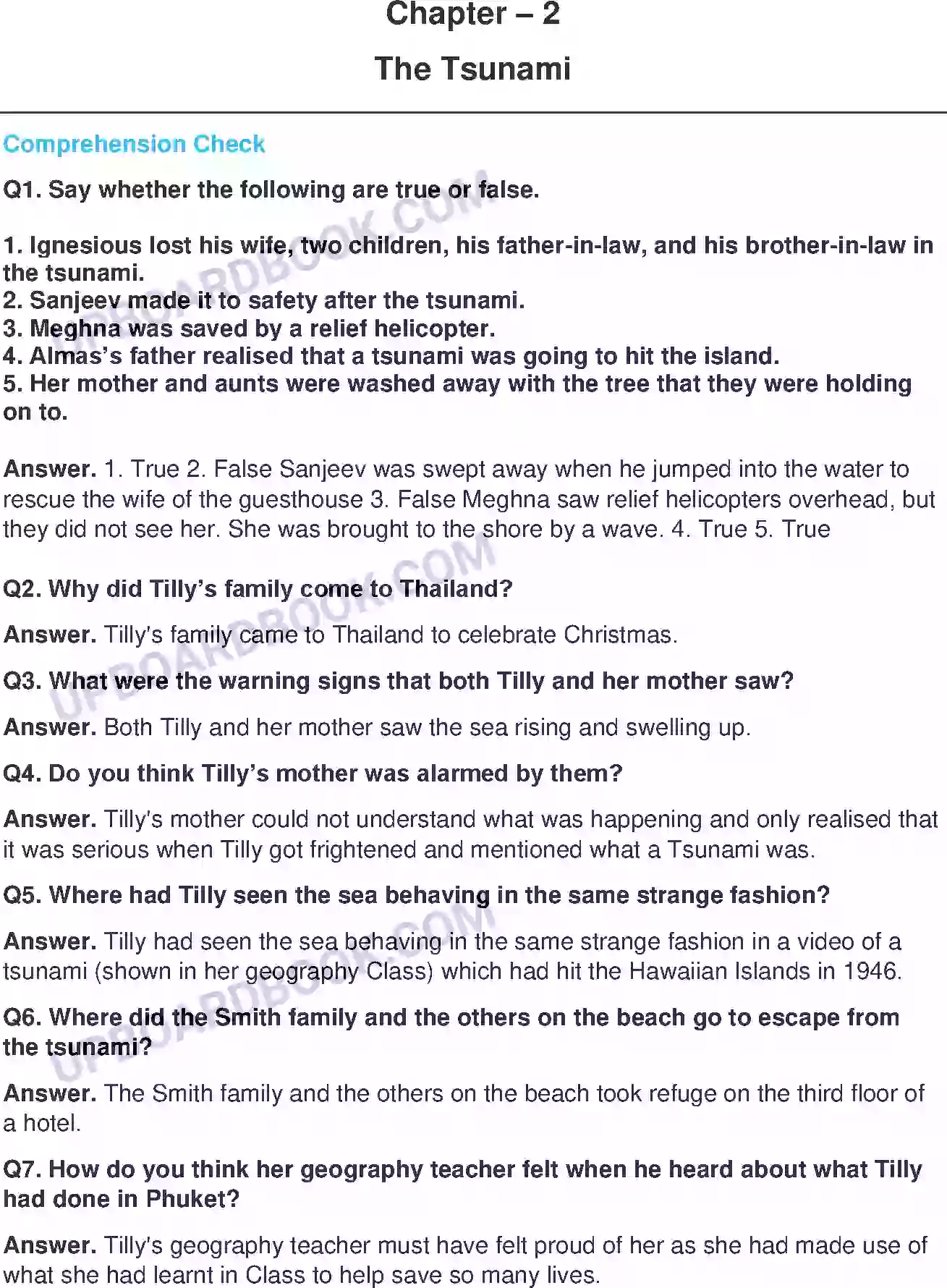
Comprehension Check
Q1. Say whether the following are true or false.
1. Ignesious lost his wife, two children, his father-in-law, and his brother-in-law in the tsunami.
2. Sanjeev made it to safety after the tsunami.
3. Meghna was saved by a relief helicopter.
4. Almas’s father realised that a tsunami was going to hit the island.
5. Her mother and aunts were washed away with the tree that they were holding on to.
Answer:
1. True. Ignesious tragically lost these family members to the tsunami waves.
2. False. Sanjeev did not make it to safety. He bravely jumped into the water to rescue the guesthouse cook's wife, and both were swept away by the powerful waves.
3. False. Meghna was not saved by a helicopter. Although she saw helicopters, they did not spot her. She survived by floating on a wooden door for two days and was finally brought to shore by a wave.
4. True. Almas's father noticed the seawater receding and understood it was a sign of an approaching tsunami.
5. True. Almas's mother and aunts were holding onto a coconut tree when a giant wave washed them all away.
Q2. Why did Tilly’s family come to Thailand?
Answer: Tilly's family had come to Thailand for a holiday to celebrate Christmas.
Q3. What were the warning signs that both Tilly and her mother saw?
Answer: Both Tilly and her mother saw the sea water at the beach suddenly begin to foam, bubble, and form whirlpools. The water level was rising and swelling in an unusual and alarming manner.
Q4. Do you think Tilly’s mother was alarmed by them?
Answer: Initially, Tilly's mother was not very alarmed; she was just curious about the strange sea behaviour. She became truly alarmed only when she saw the fear on Tilly's face and heard her screaming about a tsunami.
Q5. Where had Tilly seen the sea behaving in the same strange fashion?
Answer: Tilly had seen the sea behaving in this exact strange way in a geography lesson video at her school. The video showed the tsunami that hit the Hawaiian Islands in 1946.
Q6. Where did the Smith family and the others on the beach go to escape from the tsunami?
Answer: Following Tilly's warning, the Smith family and other tourists quickly ran from the beach and took shelter on the third floor of their hotel, which was a safe height from the destructive waves.
Q7. How do you think her geography teacher felt when he heard about what Tilly had done in Phuket?
Answer: Tilly's geography teacher must have felt extremely proud and gratified. He would have been happy to see that a student not only paid attention in class but also applied that knowledge in a real-life situation to save over a hundred lives.
Q8. In the tsunami 150,000 people died. How many animals died?
Answer: Remarkably, very few animals died in the tsunami compared to the massive human casualties.
Q9. How many people and animals died in Yala National Park?
Answer: At Yala National Park, sixty visitors lost their lives, but only two water buffaloes died.
Q10. What do people say about the elephants of Yala National Park?
Answer: People reported that the elephants at Yala National Park ran away from the beach towards higher ground about an hour before the tsunami struck, as if they sensed the danger.
Q11. What did the dogs in Galle do?
Answer: In Galle, the dogs refused to go for their usual morning run on the beach. Their unusual behaviour suggested they could sense the impending disaster.
Working With The Text
Q1. Discuss the following questions in class. Then write your own answers.
1. When he felt the earthquake, do you think Ignesious immediately worried about a tsunami? Give reasons for your answer.
Which sentence in the text tells you that the Ignesious family did not have any time to discuss and plan their course of action after the tsunami struck?
Answer:
1. No, Ignesious did not immediately think of a tsunami. His first reaction was to save his television set from falling, which shows he thought it was just a regular earthquake. If he had suspected a giant wave was coming, he would have immediately rushed his family to safety instead of worrying about household items.
2. The sentence that shows they had no time to plan is: "In the chaos and confusion, two of his children caught hold of the hands of their mother’s father and mother’s brother, and rushed in the opposite direction."
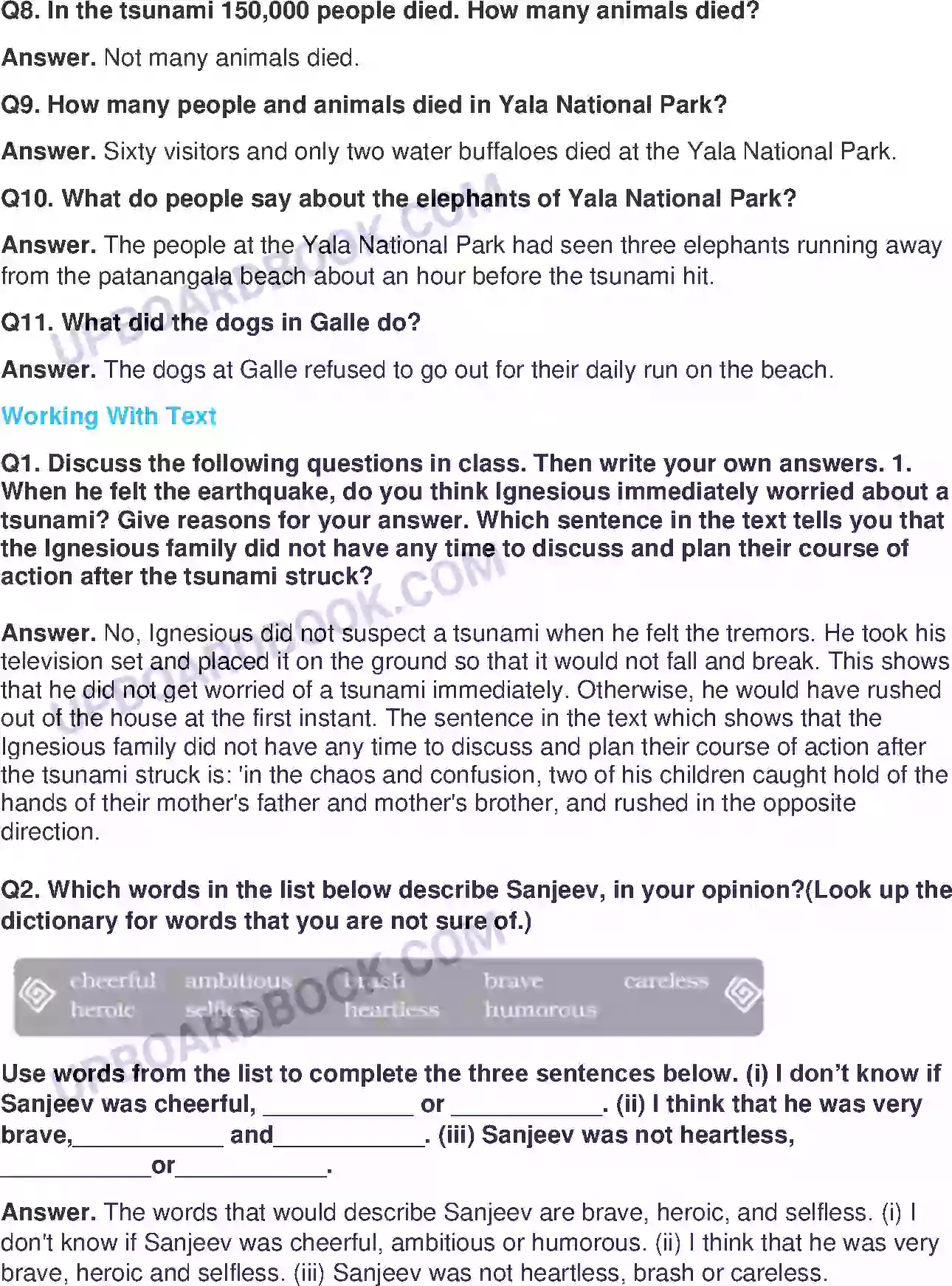
Q2. Which words in the list below describe Sanjeev, in your opinion?(Look up the dictionary for words that you are not sure of.)
Use words from the list to complete the three sentences below.
(i) I don’t know if Sanjeev was cheerful, ________ or ________ .
(ii) I think that he was very brave, ________ and ________ .
(iii) Sanjeev was not heartless, ________ or ________ .
Answer: Words that best describe Sanjeev are brave, heroic, and selfless.
(i) I don’t know if Sanjeev was cheerful, ambitious or humorous.
(ii) I think that he was very brave, heroic and selfless.
(iii) Sanjeev was not heartless, brash or careless.
Q3. How are Meghna and Almas’s stories similar?
Answer: The stories of Meghna and Almas are tragically similar in several ways. Both were young girls who lost almost their entire families to the tsunami. They both survived by holding onto floating objects—Meghna on a wooden door and Almas on a log of wood—for a long time in the sea. Finally, both girls were deeply traumatised by the experience. Meghna was found walking in a daze, while Almas became too withdrawn to talk about the incident.
Q4. What are the different ways in which Tilly’s parents could have reacted to her behaviour? What would you have done if you were in their place?
Answer: Tilly's parents could have dismissed her fears as a child's overreaction and tried to calm her down without leaving the beach. This would have been a fatal mistake. If I were in their place, seeing my child so genuinely terrified and hearing her give a specific reason ("tsunami"), I would have trusted her instinct and immediately rushed everyone away from the shore without waiting for confirmation.
Q5. If Tilly’s award was to be shared, who do you think she should share it with— her parents or her geography teacher?
Answer: If Tilly's award was to be shared, she should share it with her geography teacher. While her parents wisely listened to her, it was the teacher who provided the crucial knowledge about tsunamis in the first place. The teacher's effective lesson is what empowered Tilly to recognise the danger and take action.
Q6. What are the two different ideas about why so few animals were killed in the tsunami? Which idea do you find more believable?
Answer: The two ideas are:
1. Animals possess a "sixth sense" that warns them of natural disasters.
2. Animals have more acute hearing and can feel the earth's vibrations (like tremors) much earlier than humans.
The second idea seems more believable and scientific. It is known that many animals can detect infrasound (low-frequency sounds) and subtle ground movements that humans cannot, allowing them to flee to safety earlier.
Working With Language
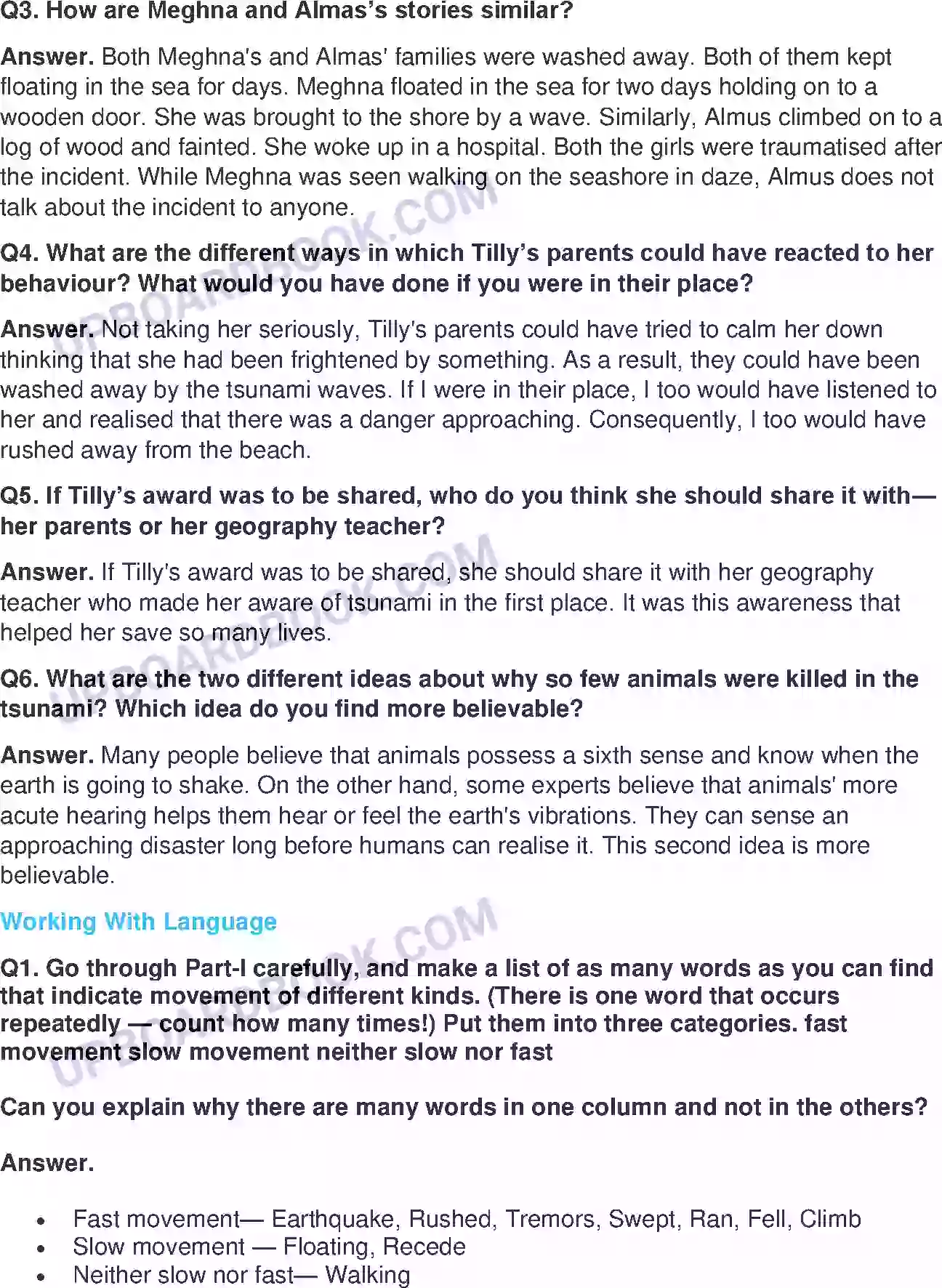
Q1. Go through Part-I carefully, and make a list of as many words as you can find that indicate movement of different kinds. (There is one word that occurs repeatedly — count how many times!) Put them into three categories.
fast movement
slow movement
neither slow nor fast
Can you explain why there are many words in one column and not in the others?
Answer:
Fast movement: earthquake, rushed, tremors, swept, ran, fell, climbed. (The word 'swept' occurs repeatedly).
Slow movement: floating, recede.
Neither slow nor fast: walking.
There are many more words in the 'fast movement' column because the story describes a sudden, violent disaster—the tsunami. The events happened very quickly: people running, waves sweeping things away, and earthquakes shaking. There was little time for slow actions during the main event.
Q2. Fill in the blanks in the sentences below (the verbs given in brackets will give you a clue).
(i) The earth trembled, but not many people felt the ________ . (tremble)
(ii) When the zoo was flooded, there was a lot of ________ and many animals escaped into the countryside. (confuse)
(iii) We heard with ________ that the lion had been recaptured. (relieve)
(iv) The Zookeeper was stuck in a tree and his ________ was filmed by the TV crew. (rescue)
(v) There was much ________ in the village when the snake charmer came visiting. (excite)
Answer:
(i) The earth trembled, but not many people felt the trembling.
(ii) When the zoo was flooded, there was a lot of confusion and many animals escaped into the countryside.
(iii) We heard with relief that the lion had been recaptured.
(iv) The zookeeper was stuck in a tree and his rescue was filmed by the TV crew.
(v) There was much excitement in the village when the snake charmer came visiting.
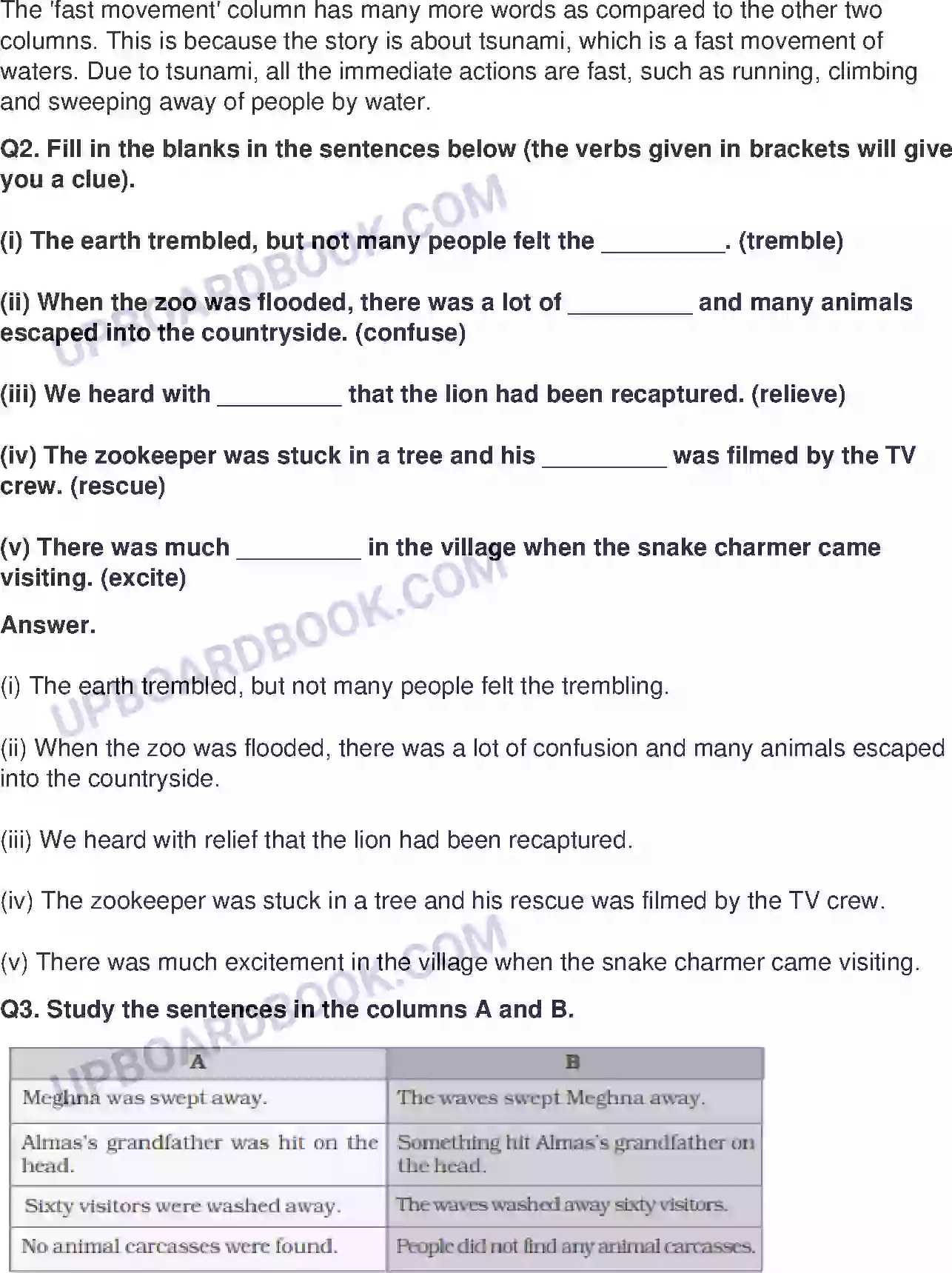
Q3. Study the sentences in the columns A and B.
A
Meghna was swept away.
Almas’s grandfather was hit on the head.
Sixty visitors were washed away.
No animal carcasses were found.
B
The waves swept Meghna away.
Something hit Almas’s grandfather on the head.
The waves washed away sixty visitors.
People did not find any animal carcasses.
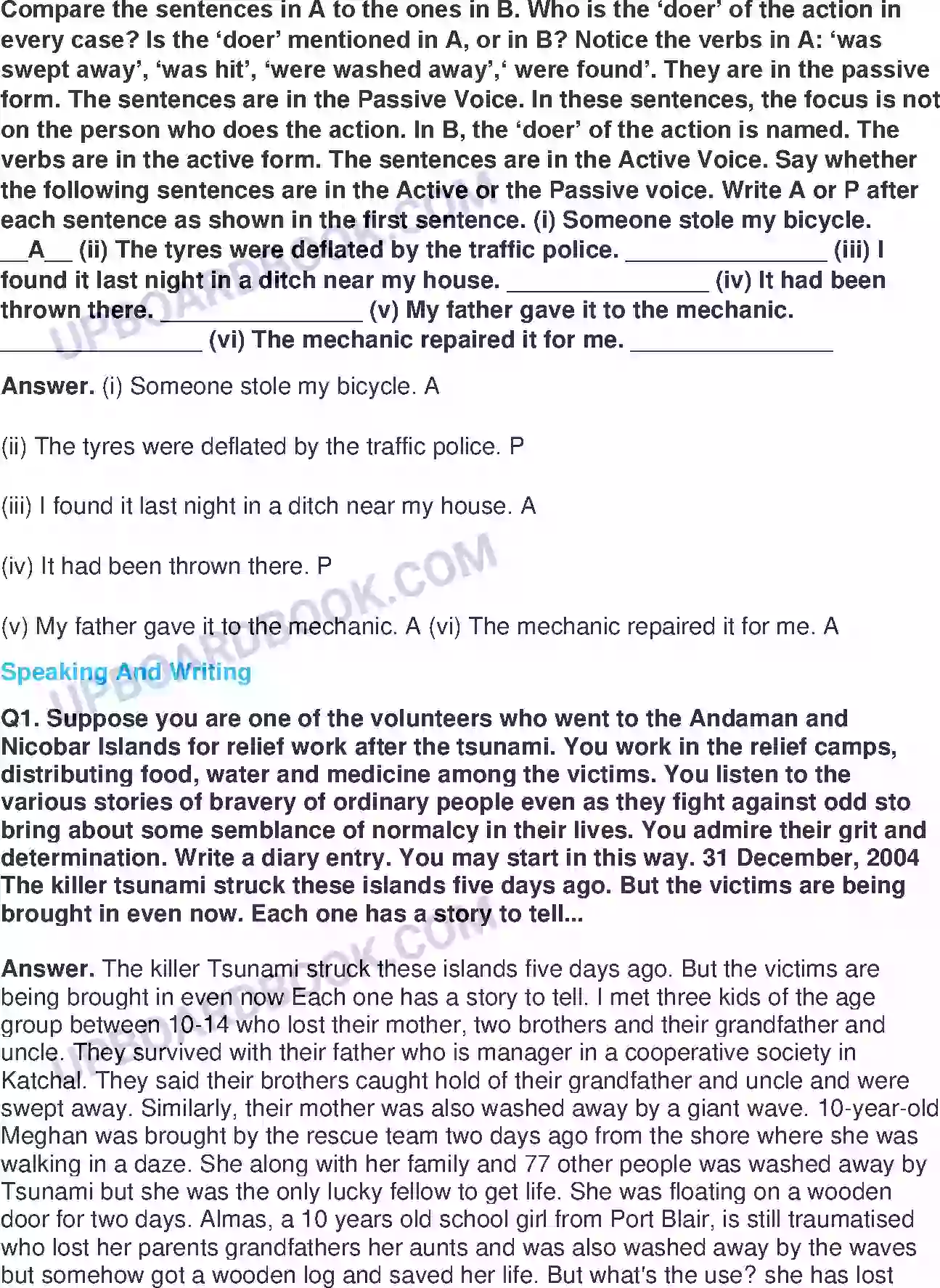
Compare the sentences in A to the ones in B. Who is the ‘doer’ of the action in every case? Is the ‘doer’ mentioned in A, or in B?
Notice the verbs in A: ‘was swept away’, ‘was hit’, ‘were washed away’,‘ were found’. They are in the passive form. The sentences are in the Passive Voice. In these sentences, the focus is not on the person who does the action.
In B, the ‘doer’ of the action is named. The verbs are in the active form. The sentences are in the Active Voice.
Say whether the following sentences are in the Active or the Passive voice. Write A or P after each sentence as shown in the first sentence.
(i) Someone stole my bicycle. __A__
(ii) The tyres were deflated by the traffic police. ____
(iii) I found it last night in a ditch near my house. ____
(iv) It had been thrown there. ____
(v) My father gave it to the mechanic. ____
(vi) The mechanic repaired it for me. ____
Answer:
In Column A, the 'doer' of the action is not mentioned. In Column B, the 'doer' is mentioned (e.g., The waves, Something, People).
(i) Someone stole my bicycle. A
(ii) The tyres were deflated by the traffic police. P
(iii) I found it last night in a ditch near my house. A
(iv) It had been thrown there. P
(v) My father gave it to the mechanic. A
(vi) The mechanic repaired it for me. A
Speaking And Writing
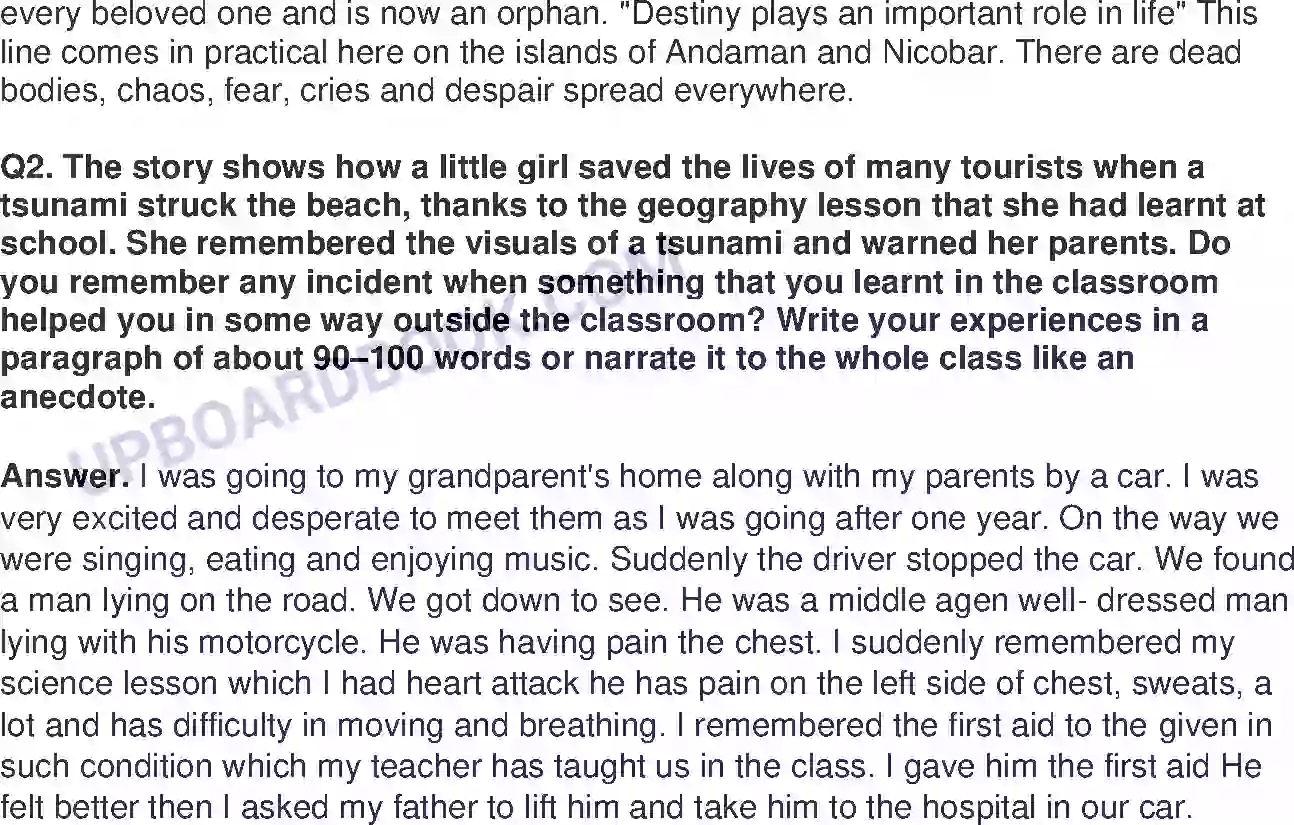
Q1. Suppose you are one of the volunteers who went to the Andaman and Nicobar Islands for relief work after the tsunami. You work in the relief camps, distributing food, water and medicine among the victims. You listen to the various stories of bravery of ordinary people even as they fight against odds to bring about some semblance of normalcy in their lives. You admire their grit and determination. Write a diary entry.
You may start in this way.
31 December, 2004
The killer tsunami struck these islands five days ago. But the victims are being brought in even now. Each one has a story to tell...
Answer:
31 December, 2004
The killer tsunami struck these islands five days ago. But the victims are being brought in even now. Each one has a story to tell, each more heartbreaking than the last. Today, I met three young siblings who clung to each other. They lost their mother, brothers, grandfather, and uncle. Their father, who survived, is numb with grief. They spoke of the chaos—how their brothers grabbed their grandfather's hand and were swept away in an instant.
Then there was Meghna, a ten-year-old found walking alone on the shore in a daze. She floated for two days on a wooden door, the sole survivor from her family and village. Almas, another girl of the same age, hasn't spoken a word since she was found. She clung to a log of wood and survived, but now she's an orphan, lost in a silent world of her own.
Amidst the overwhelming smell of death, chaos, and despair, I also see incredible resilience. People are sharing the little they have, helping strangers search for loved ones, and trying to piece their world back together. Their courage in the face of such immense loss is both humbling and inspiring. It reminds me why we are here—to help, to heal, and to hope with them.
Q2. The story shows how a little girl saved the lives of many tourists when a tsunami struck the beach, thanks to the geography lesson that she had learnt at school. She remembered the visuals of a tsunami and warned her parents. Do you remember any incident when something that you learnt in the classroom helped you in some way outside the classroom? Write your experiences in a paragraph of about 90-100 words or narrate it to the whole class like an anecdote.
Answer: Last summer, I was at a park when an elderly man suddenly collapsed. People gathered but were confused about what to do. I remembered my UP Board science class lesson on first aid. The man was clutching his chest and sweating—signs of a possible heart attack. I recalled that the immediate step is to ensure the person can breathe easily and to keep them calm. I quickly loosened his collar, asked someone to call an ambulance, and talked to him gently until help arrived. The paramedics later said those initial actions were crucial. That day, I was profoundly grateful for my classroom learning, which helped me stay calm and be of real use.
Get UP Board Class 8 English 2. The Tsunami Solution in Hindi Medium
UP Board Class 8 English 2. The Tsunami Solution is available at our platform https://upboardbook.com in hindi medium for free of cost. Content provided on our website is free of cost and in PDF format which is easily available for download. Getting the UP Board Solutions for Class 8 will help student to achieve good learning experience so that they can study effectively. UP board holds examination of more than 3 million students every year and majority of the question of exams are from their UP Board Solutions. That’s why it is important to study using the textSolution issued by UP Board.
Importance of UP Board Class 8 English 2. The Tsunami Text Solutions
It is essential to know the importance of UP Board Class 8 English 2. The Tsunami textSolution issued by UP Board because students completely rely on these Solutions for their study and syllabus offered by UP Board is so balanced that each student should be aware about the importance of it. Below is the list of Importance of UP Board Class 8 English 2. The Tsunami :
- These TextSolutions are very clear and accurate which helps student to understand concept with ease.
- It is also to mention that these text Solutions are prepared by the content experts of subject, thus these Solutions helps student in clearing their doubts and understand the core concept easily.
- It is considered to be the best study material for competitive exam preparation.
Features of UP Board Class 8 textSolutions
There are various features of UP Board Class 8 TextSolutions, some of them are mentioned below so that you student can understand the value and usability of the contend and understand why Uttarpradesh board has prescribed these Solutions.
- Best feature of these textSolutions is free availability of content in PDF format
- Second feature that content generated and written is clear and easy to read.
- There are various illustration and images are shown in the Solution so that student can easily understand the concept and should be more appealing to the student.
- Each chapter is explained thoroughly
