 UPBoardBook
UP Board Class 10 English (2. Long Walk To Freedom) solution PDF
UP Board Class 10 English 2. Long Walk To Freedom is a Hindi Medium Solution which is prescribed by Uttar Pradesh Board for their students. These Solutions is completely prepared considering the latest syllabus and it covers every single topis, so that every student get organised and conceptual learning of the concepts. Class 10 Students of UP Board who have selected hindi medium as their study medium they can use these Hindi medium textSolutions to prepare themselves for exam and learn the concept with ease.
UP Board Class 10 English 2. Long Walk To Freedom Hindi Medium Solutions - PDF
Click Here to

UP Board Solutions for Class 10 English First Flight
Chapter 2 - Long Walk to Freedom
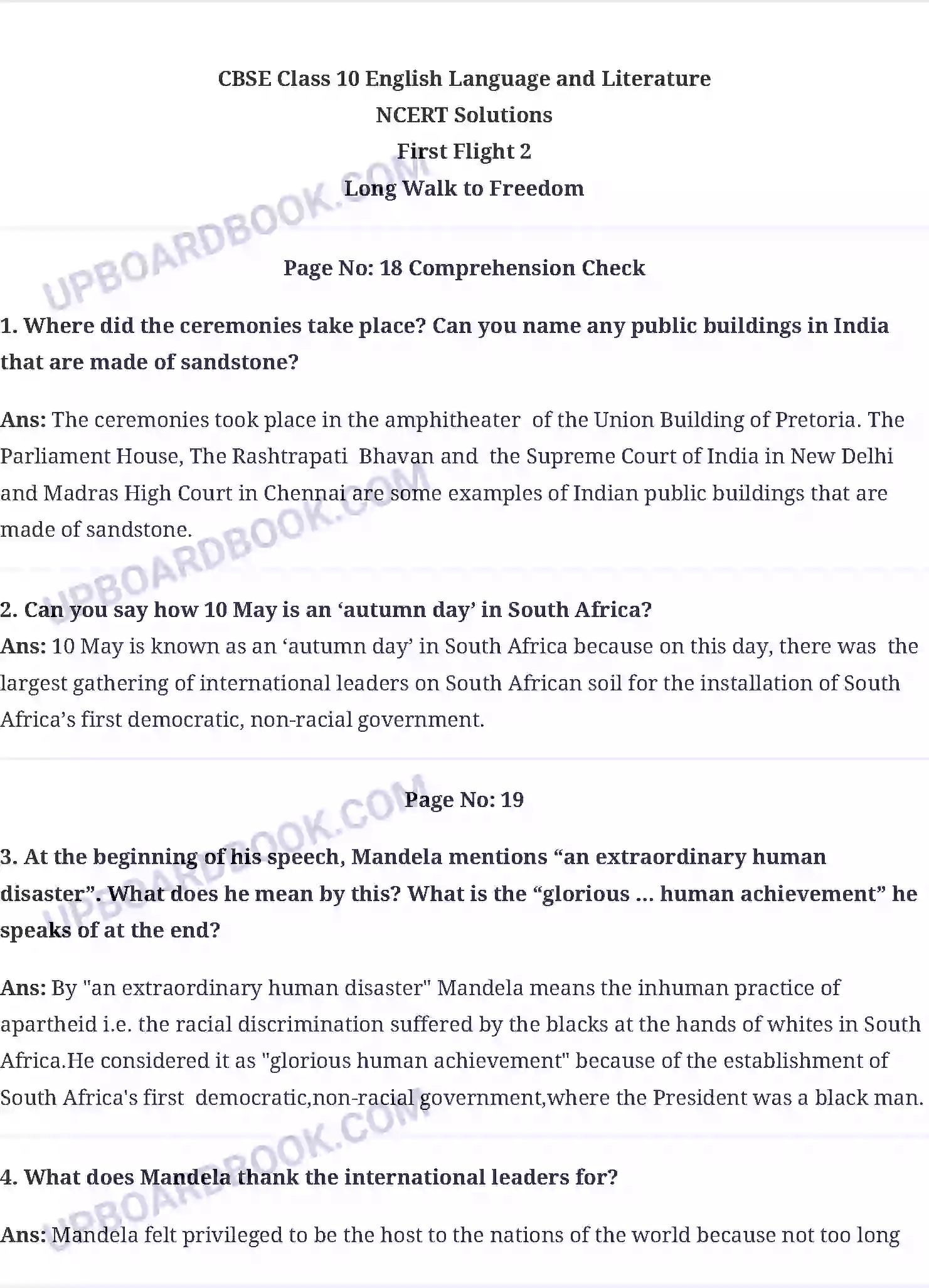
1. Where did the ceremonies take place? Can you name any public buildings in India that are made of sandstone?
Ans: The inauguration ceremony for South Africa's first democratic government was held at the beautiful sandstone amphitheatre of the Union Buildings in Pretoria. In India, many historic government buildings are made of sandstone. Notable examples include the Parliament House (Sansad Bhavan), the Rashtrapati Bhavan, and the Supreme Court of India in New Delhi, as well as the Madras High Court in Chennai.
2. Can you say how 10 May is an ‘autumn day’ in South Africa?
Ans: South Africa is in the Southern Hemisphere, where the seasons are opposite to those in the Northern Hemisphere. While May is a summer month in India, it is an autumn month in South Africa. Therefore, 10 May was a clear, sunny 'autumn day'. This day was also extraordinary because it witnessed the largest ever gathering of world leaders on South African soil for a historic event—the birth of a democratic nation.
3. At the beginning of his speech, Mandela mentions “an extraordinary human disaster”. What does he mean by this? What is the “glorious ... human achievement” he speaks of at the end?
Ans: The "extraordinary human disaster" refers to the brutal system of apartheid that was enforced for decades in South Africa. This policy of racial segregation and discrimination caused immense suffering, denied basic human rights to the black majority, and was a dark period in human history.
The "glorious human achievement" is the triumphant end of that apartheid regime and the peaceful establishment of South Africa's first democratic, non-racial government. It was a victory for justice, equality, and human dignity, achieved through sacrifice and struggle.
4. What does Mandela thank the international leaders for?
Ans: Nelson Mandela thanks the international leaders for attending his presidential inauguration. Their presence was significant because it represented global recognition and support for South Africa's new democracy. For years, the apartheid government was isolated by the world; now, these leaders were honouring the South African people's victory over oppression. Mandela saw their attendance not just as a courtesy to him, but as a celebration of a common victory for justice, peace, and human dignity for all.
5. What ideals does he set out for the future of South Africa?
Ans: In his speech, Mandela sets out lofty ideals for the future of South Africa. He dreams of a nation free from the deep wounds of poverty and deprivation. He envisions a society where no one suffers due to gender or racial discrimination. His ultimate ideal is to build a peaceful, prosperous, and equal South Africa where every citizen, regardless of their background, can live with dignity and opportunity.
Oral Comprehension Check
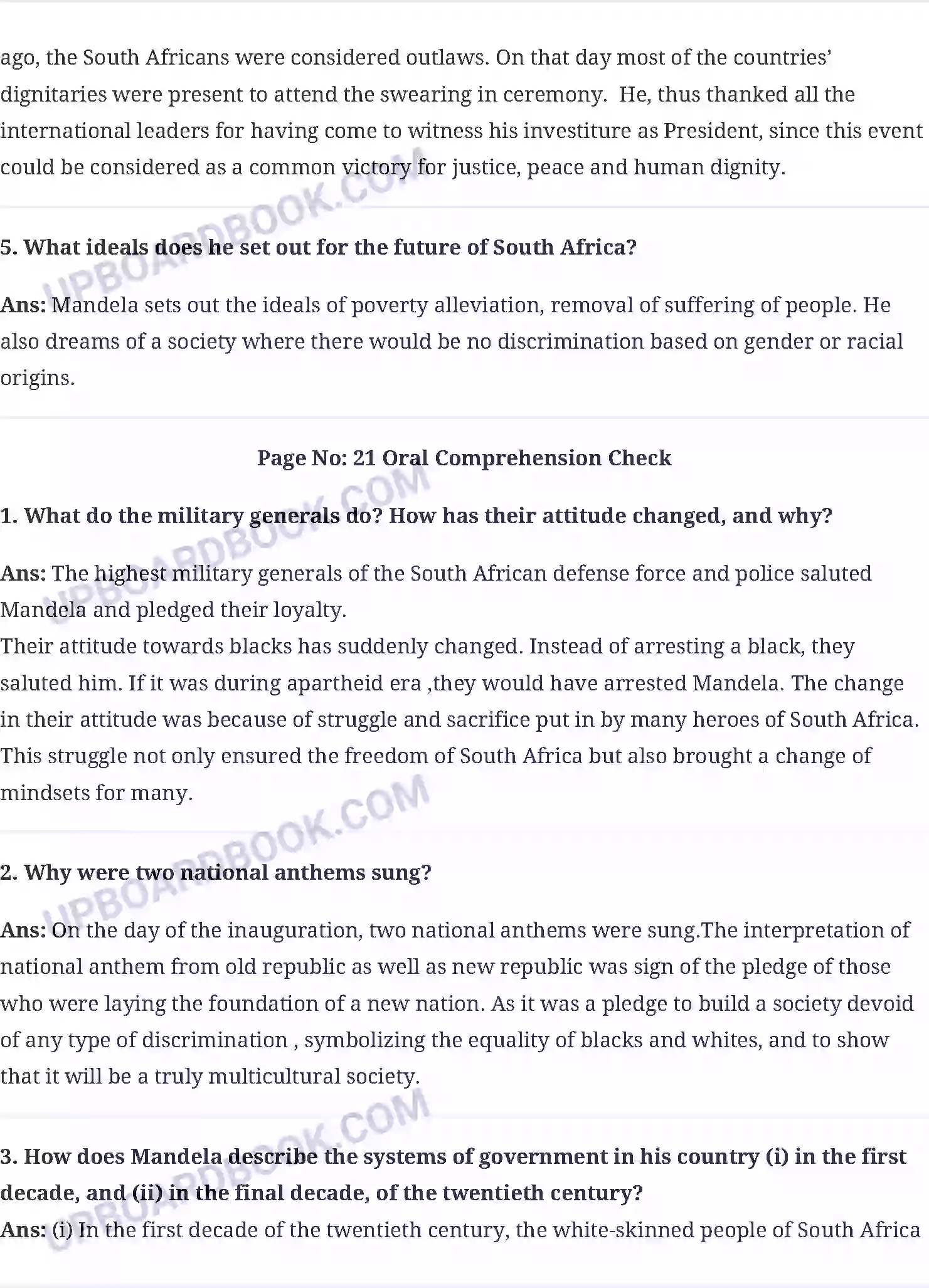
1. What do the military generals do? How has their attitude changed, and why?
Ans: At the inauguration, the top military generals of the South African defense force and police, who were once white symbols of the oppressive regime, saluted Nelson Mandela and pledged their loyalty to him and the new democracy. Their attitude underwent a complete transformation—from being enforcers of apartheid who would have arrested Mandela to becoming protectors of a black president. This change was not sudden but was the result of the long, painful struggle waged by countless South African patriots, which finally changed not just laws but also people's hearts and minds.
2. Why were two national anthems sung?
Ans: Two national anthems were sung as a powerful symbol of the new South Africa. The white minority's anthem, "Nkosi Sikelel’ iAfrika" (God Bless Africa), and the black majority's anthem, "Die Stem" (The Call of South Africa), were both performed. This act signified the unity of a nation that was healing from its divided past. It was a pledge to build a single, unified nation where both black and white cultures were respected and celebrated equally, marking the birth of a truly multicultural society.
3. How does Mandela describe the systems of government in his country (i) in the first decade, and (ii) in the final decade, of the twentieth century?
Ans:
(i) In the first decade: At the start of the 20th century, shortly after the Anglo-Boer War, the white-skinned people (the British and the Boers) reconciled their differences. Together, they established a system of racial domination (apartheid) over the black majority. This created one of the most cruel and inhuman societies in world history.
(ii) In the final decade: By the end of the 20th century, that oppressive system had been utterly destroyed. It was replaced by a democratic and non-racial government that recognized the rights and freedoms of all citizens, irrespective of their skin colour.
4. What does courage mean to Mandela?
Ans: For Mandela, courage is not the absence of fear, but the triumph over it. A truly brave person is not someone who never feels afraid, but one who feels fear and yet finds the strength to conquer it, to act rightly in spite of it. He believed that real heroes are those who overcome their fears for a greater cause.
5. Which does he think is natural, to love or to hate?
Ans: Mandela firmly believes that love comes more naturally to the human heart than hate. He argues that people are born with the capacity for love, and if they can learn to hate, they can also be taught to love, as love is a more fundamental and positive human emotion.
Oral Comprehension Check
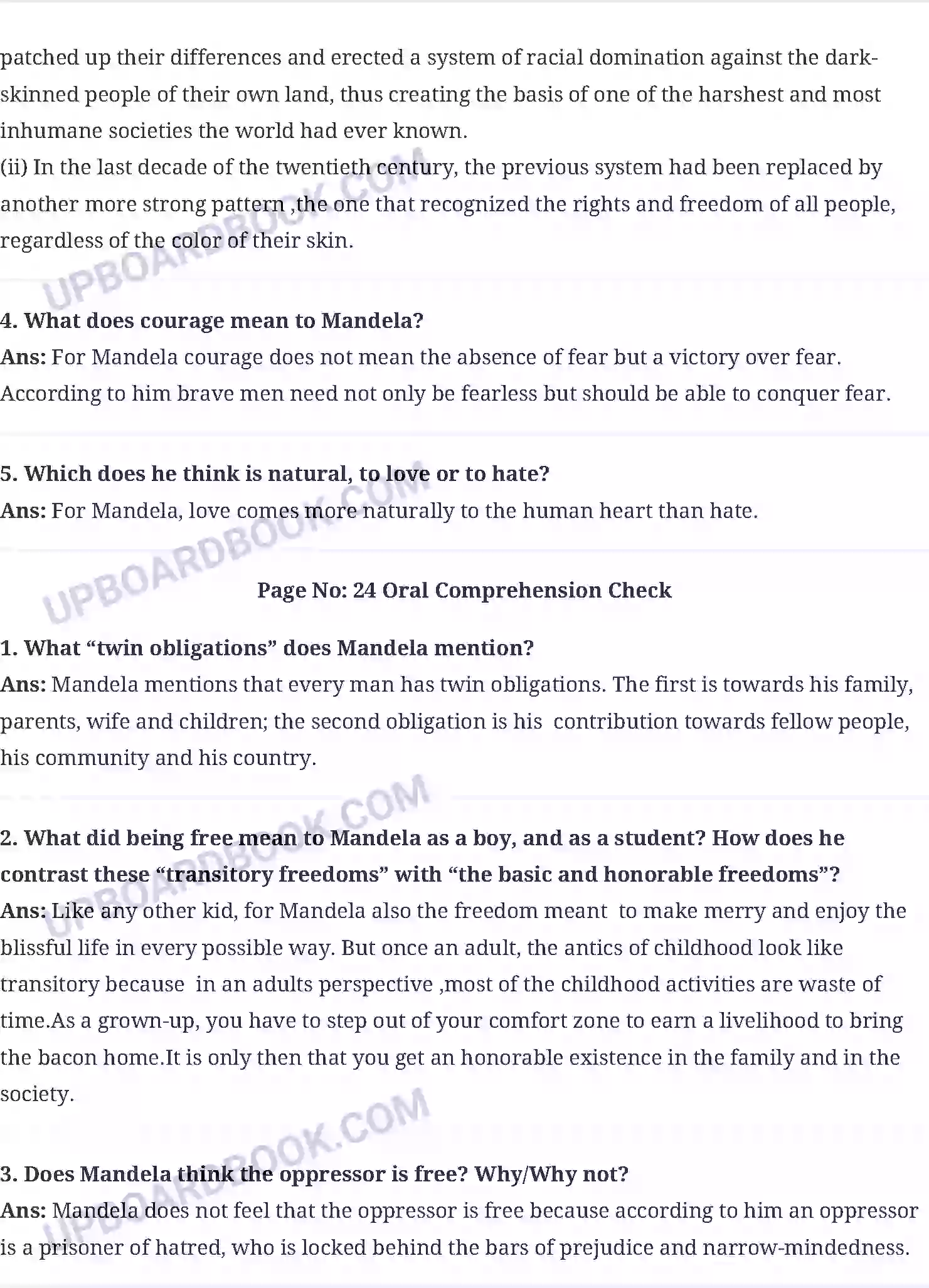
1. What “twin obligations” does Mandela mention?
Ans: Mandela says that every person has "twin obligations" or two main duties in life. The first obligation is to one's family—to parents, spouse, and children. The second, equally important obligation is to one's community and country—to contribute to the welfare of fellow citizens and the nation's progress.
2. What did being free mean to Mandela as a boy, and as a student? How does he contrast these “transitory freedoms” with “the basic and honorable freedoms”?
Ans: As a boy in his village, freedom meant being able to run in the fields, swim in the streams, and do as he pleased—it was an illusion of freedom. As a student, he wanted the freedom to stay out at night, read what he wished, and go where he chose. He calls these "transitory freedoms"—temporary and superficial.
He contrasts them with the "basic and honorable freedoms", which are more substantial. These include the freedom to fulfill one's potential, to earn a living and support one's family (earning my keep), and to live a life of dignity, respect, and equality in society. The struggle was for these fundamental freedoms.
3. Does Mandela think the oppressor is free? Why/Why not?
Ans: No, Mandela does not believe the oppressor is free. He argues that an oppressor is a prisoner of hatred, trapped behind the bars of prejudice and narrow-mindedness. Just as oppression robs the oppressed of their dignity, it also robs the oppressor of their own humanity. True freedom, according to Mandela, is indivisible; both the oppressed and the oppressor need to be liberated from the system of injustice.
Thinking about the Text
1. Why did such a large number of international leaders attend the inauguration? What did it signify the triumph of?
Ans: The large gathering of international leaders was a powerful gesture of global solidarity with the new South Africa. For decades, the world had condemned apartheid. Their presence at the inauguration was a celebration of its end. It signified the triumph of good over evil, justice over injustice, and democracy over tyranny. It was the world's way of welcoming South Africa back into the community of free nations.
2. What does Mandela mean when he says he is “simply the sum of all those African patriots” who had gone before him?
Ans: With this humble statement, Mandela acknowledges that he is not a solitary hero. He is the product of the collective struggle and sacrifice of thousands of African patriots who fought and suffered for freedom before him. Leaders like Oliver Tambo, Walter Sisulu, and countless others paved the way. He sees himself as carrying forward their legacy, a representative of their dreams and efforts, which is why he received the overwhelming support of his people.
3.Would you agree that the “depths of oppression” create “heights of character? How does Mandela illustrate this? Can you add your own examples to this argument?
Ans: Yes, the statement is profoundly true. Extreme oppression often forges extraordinary courage, resilience, and leadership. Mandela illustrates this by pointing to the great heroes of South Africa's freedom struggle—like the Satyagrahis and leaders of the African National Congress—whose remarkable character was shaped in the fire of apartheid.
Example from India: The brutal oppression of British colonial rule produced giants of character like Mahatma Gandhi, Bhagat Singh, Sardar Patel, and Subhash Chandra Bose. Their unwavering spirit, sacrifice, and integrity were directly shaped by the challenge they faced. This contrasts with times of lesser struggle, which may not produce leaders of the same mettle.
4. How did Mandela’s understanding of freedom change with age and experience?
Ans: Mandela's understanding of freedom evolved deeply:
- As a boy: He felt free, thinking freedom was about obeying tribal customs and enjoying childhood pleasures.
- As a student and young man: He desired personal freedoms like choosing his career and partner.
- As an adult: He realized his personal freedom was an illusion. He saw that all black people were unfree. His hunger then shifted from personal liberty to the collective freedom of his people from apartheid, leading him to join the struggle.
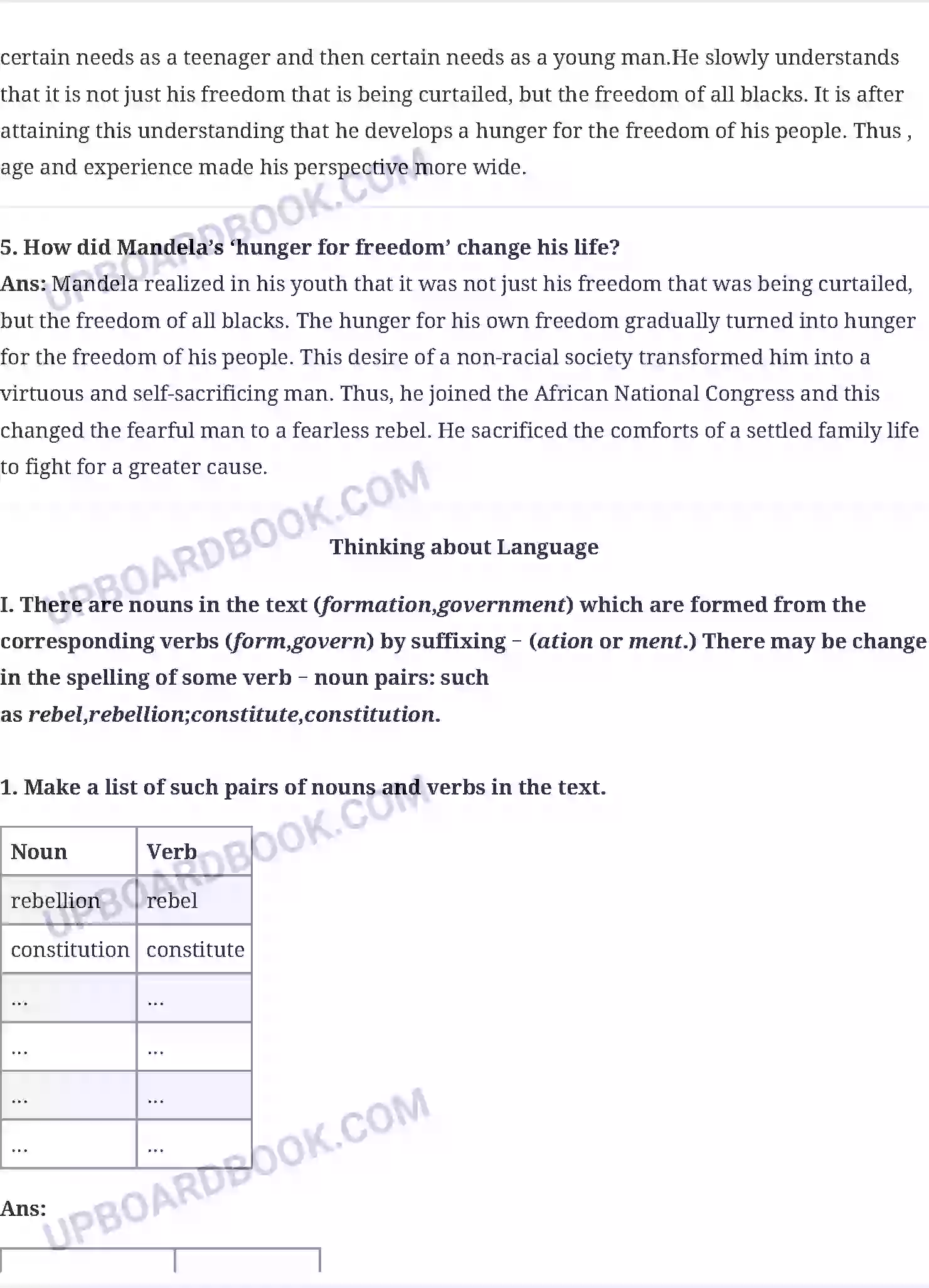
5. How did Mandela’s ‘hunger for freedom’ change his life?
Ans: Mandela's 'hunger for freedom' completely transformed his life's path. It turned him from a fearful young man dreaming of a simple life into a fearless revolutionary. He sacrificed the comforts of a stable career and family life. He joined the African National Congress (ANC), which led to decades of activism, a long imprisonment (27 years), and immense personal hardship. This hunger gave him a higher purpose, making him selfless and dedicated to the cause of liberating his nation.
Thinking about Language
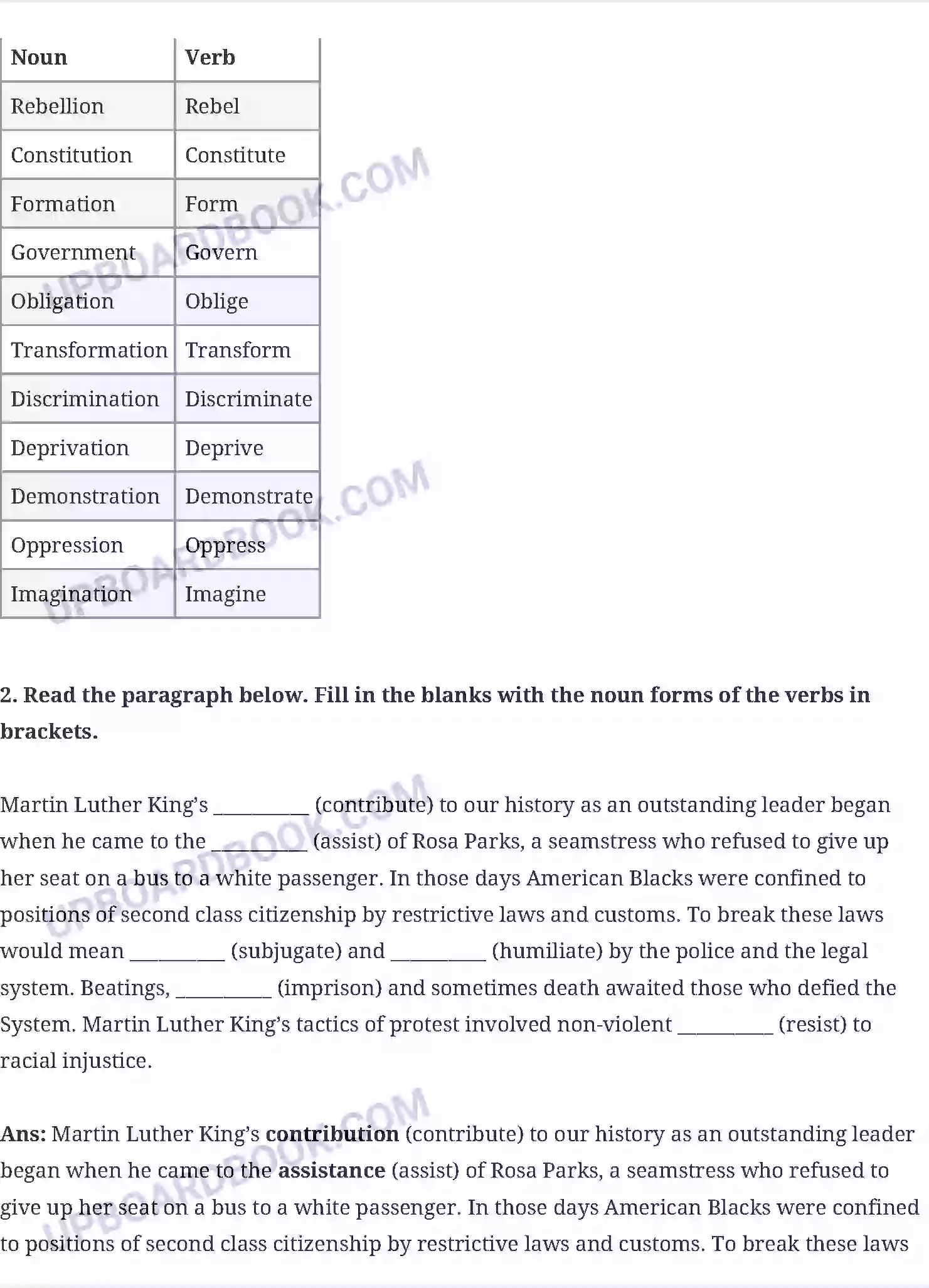
I. 1. Make a list of such pairs of nouns and verbs in the text.
| Noun | Verb |
|---|---|
| Rebellion | Rebel |
| Constitution | Constitute |
| Formation | Form |
| Government | Govern |
| Obligation | Oblige |
| Transformation | Transform |
| Discrimination | Discriminate |
| Deprivation | Deprive |
| Demonstration | Demonstrate |
| Oppression | Oppress |
| Imagination | Imagine |
2. Read the paragraph below. Fill in the blanks with the noun forms of the verbs in brackets.
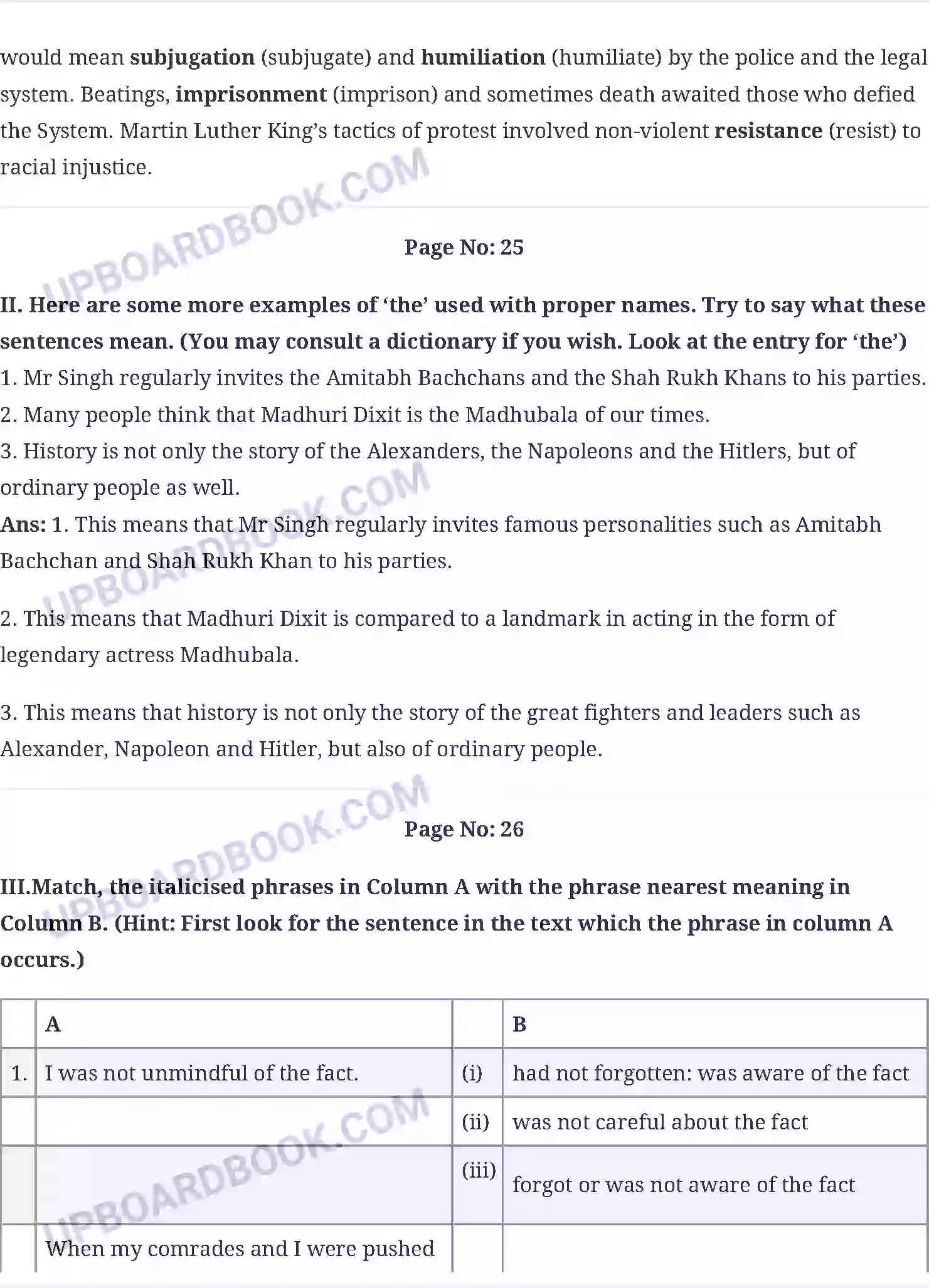
Ans: Martin Luther King’s contribution (contribute) to our history as an outstanding leader began when he came to the assistance (assist) of Rosa Parks, a seamstress who refused to give up her seat on a bus to a white passenger. In those days American Blacks were confined to positions of second class citizenship by restrictive laws and customs. To break these laws would mean subjugation (subjugate) and humiliation (humiliate) by the police and the legal system. Beatings, imprisonment (imprison) and sometimes death awaited those who defied the System. Martin Luther King’s tactics of protest involved non-violent resistance (resist) to racial injustice.
II. Here are some more examples of ‘the’ used with proper names. Try to say what these sentences mean.
Ans:
1. This means Mr. Singh invites famous celebrities of the stature of Amitabh Bachchan and Shah Rukh Khan to his parties.
2. This means Madhuri Dixit is considered the epitome of beauty and talent, comparable to the legendary actress Madhubala, in today's times.
3. This means history records the stories not only of famous conquerors and dictators like Alexander, Napoleon and Hitler but also of common people.
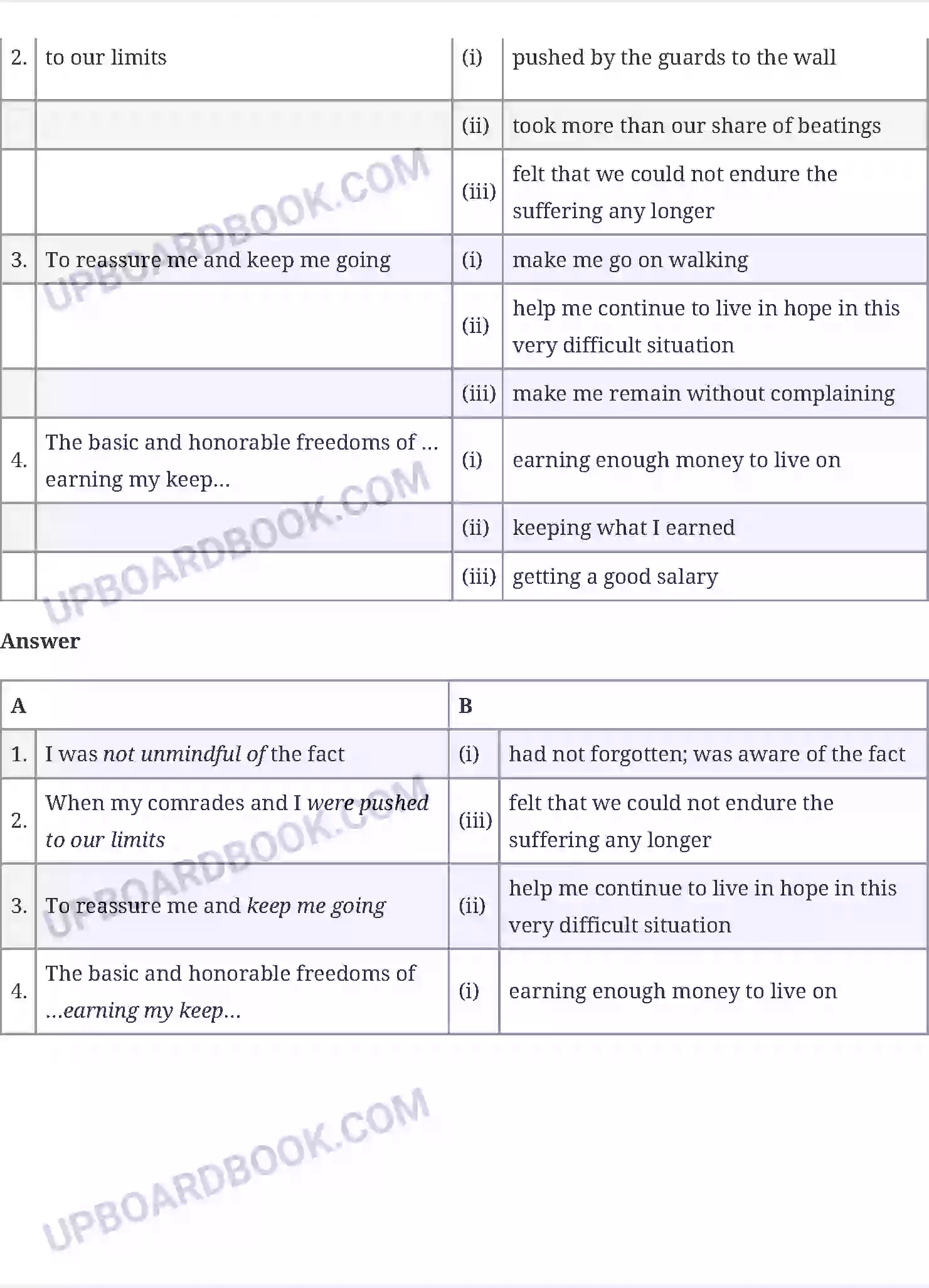
III. Match, the italicised phrases in Column A with the phrase nearest meaning in Column B.
| A | B |
|---|---|
| 1. I was not unmindful of the fact. | (i) had not forgotten; was aware of the fact |
| 2. When my comrades and I were pushed to our limits | (iii) felt that we could not endure the suffering any longer |
| 3. To reassure me and keep me going | (ii) help me continue to live in hope in this very difficult situation |
| 4. The basic and honorable freedoms of...earning my keep... | (i) earning enough money to live on |
Get UP Board Class 10 English 2. Long Walk To Freedom Solution in Hindi Medium
UP Board Class 10 English 2. Long Walk To Freedom Solution is available at our platform https://upboardbook.com in hindi medium for free of cost. Content provided on our website is free of cost and in PDF format which is easily available for download. Getting the UP Board Solutions for Class 10 will help student to achieve good learning experience so that they can study effectively. UP board holds examination of more than 3 million students every year and majority of the question of exams are from their UP Board Solutions. That’s why it is important to study using the textSolution issued by UP Board.
Importance of UP Board Class 10 English 2. Long Walk To Freedom Text Solutions
It is essential to know the importance of UP Board Class 10 English 2. Long Walk To Freedom textSolution issued by UP Board because students completely rely on these Solutions for their study and syllabus offered by UP Board is so balanced that each student should be aware about the importance of it. Below is the list of Importance of UP Board Class 10 English 2. Long Walk To Freedom :
- These TextSolutions are very clear and accurate which helps student to understand concept with ease.
- It is also to mention that these text Solutions are prepared by the content experts of subject, thus these Solutions helps student in clearing their doubts and understand the core concept easily.
- It is considered to be the best study material for competitive exam preparation.
Features of UP Board Class 10 textSolutions
There are various features of UP Board Class 10 TextSolutions, some of them are mentioned below so that you student can understand the value and usability of the contend and understand why Uttarpradesh board has prescribed these Solutions.
- Best feature of these textSolutions is free availability of content in PDF format
- Second feature that content generated and written is clear and easy to read.
- There are various illustration and images are shown in the Solution so that student can easily understand the concept and should be more appealing to the student.
- Each chapter is explained thoroughly
