 UPBoardBook
UP Board Class 12 English (1. The Last Lesson) solution PDF
UP Board Class 12 English 1. The Last Lesson is a Hindi Medium Solution which is prescribed by Uttar Pradesh Board for their students. These Solutions is completely prepared considering the latest syllabus and it covers every single topis, so that every student get organised and conceptual learning of the concepts. Class 12 Students of UP Board who have selected hindi medium as their study medium they can use these Hindi medium textSolutions to prepare themselves for exam and learn the concept with ease.
UP Board Class 12 English 1. The Last Lesson Hindi Medium Solutions - PDF
Click Here to

UP Board Solutions for Class 12 English Flamingo
Chapter 1: The Last Lesson
Exercise Answers & Summary
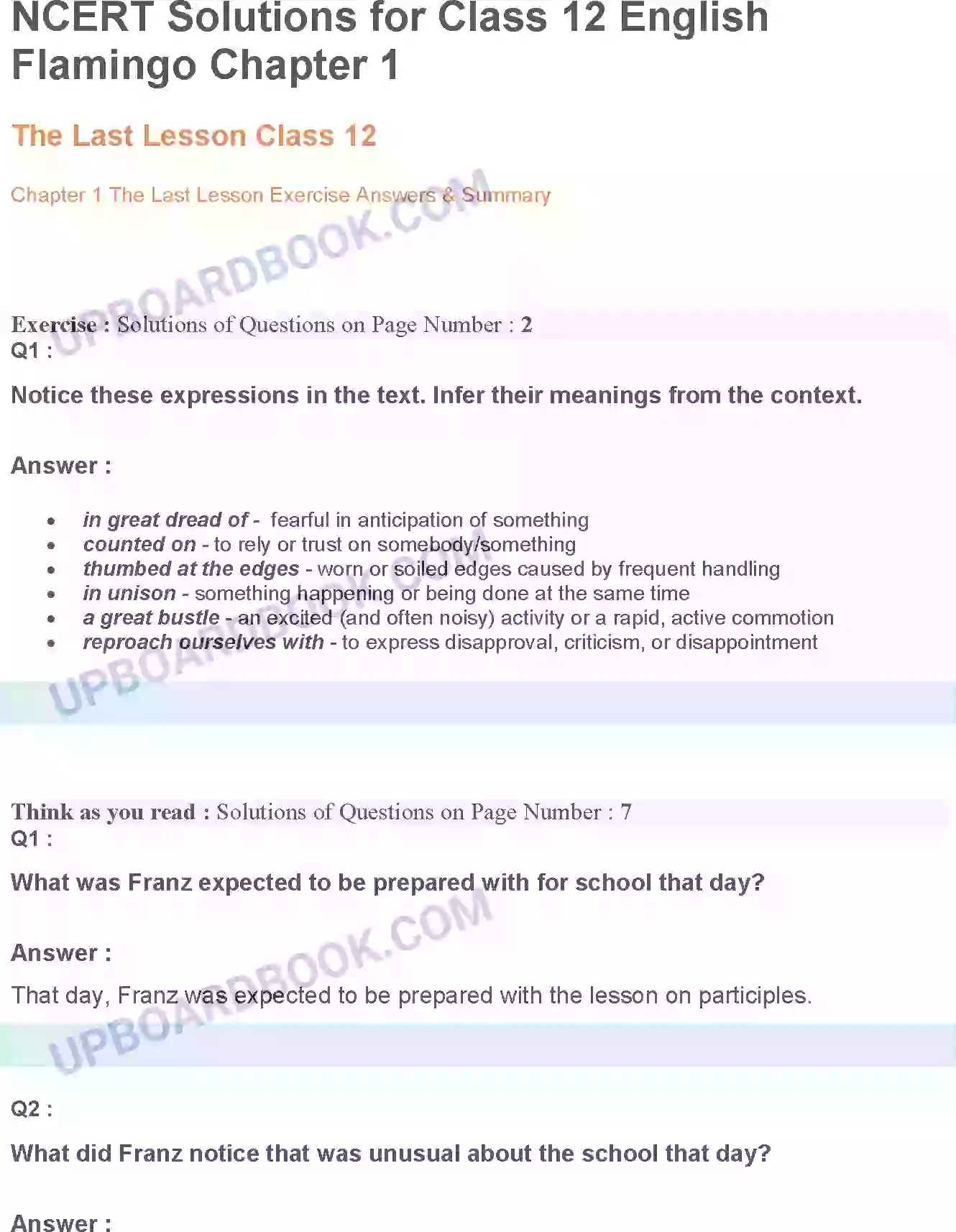
Notice these expressions in the text. Infer their meanings from the context.
Answer:
- in great dread of - fearful in anticipation of something
- counted on - to rely or trust on somebody/something
- thumbed at the edges - worn or soiled edges caused by frequent handling
- in unison - something happening or being done at the same time
- a great bustle - an excited (and often noisy) activity
- reproach ourselves with - to express disapproval, criticism, or disappointment
Think as you read:
Q1: What was Franz expected to be prepared with for school that day?
Answer: That day, Franz was expected to be prepared with the lesson on participles.
Q2: What did Franz notice that was unusual about the school that day?
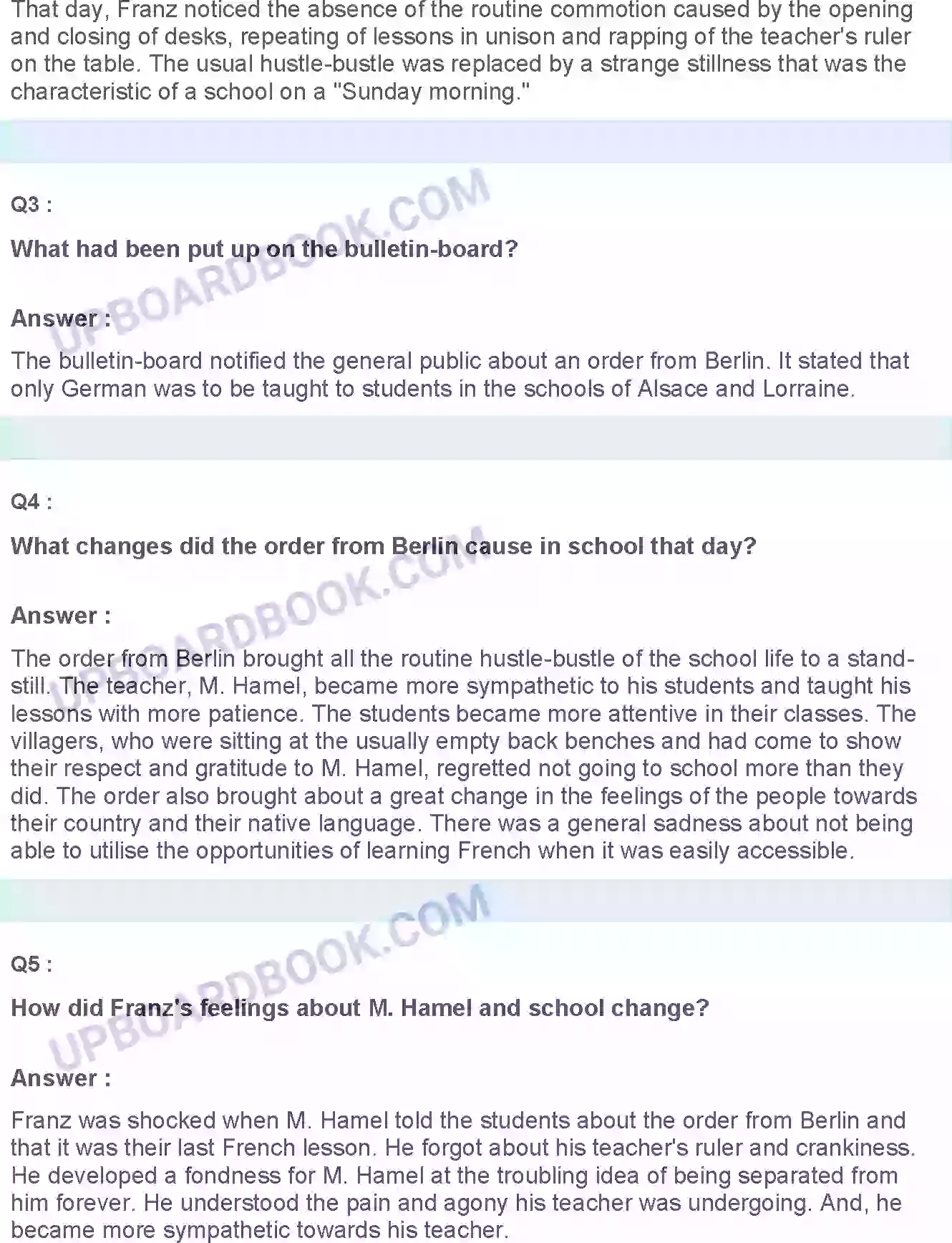
Answer: Franz noticed the absence of the routine commotion. The usual sounds of opening and closing desks, lessons repeated in unison, and the teacher's ruler rapping on the table were missing. The school was as quiet as a Sunday morning.
Q3: What had been put up on the bulletin-board?
Answer: The bulletin-board had an order from Berlin. It stated that from then on, only German would be taught in the schools of Alsace and Lorraine.
Q4: What changes did the order from Berlin cause in school that day?
Answer: The order caused profound changes:
- The usual school noise was replaced by a solemn silence.
- M. Hamel, the teacher, was patient and kind, not cranky.
- The students and old villagers in the class were exceptionally attentive.
- There was a deep sense of regret for taking the French language for granted.
- Everyone suddenly realized the value of their native language and culture.
Q5: How did Franz's feelings about M. Hamel and school change?
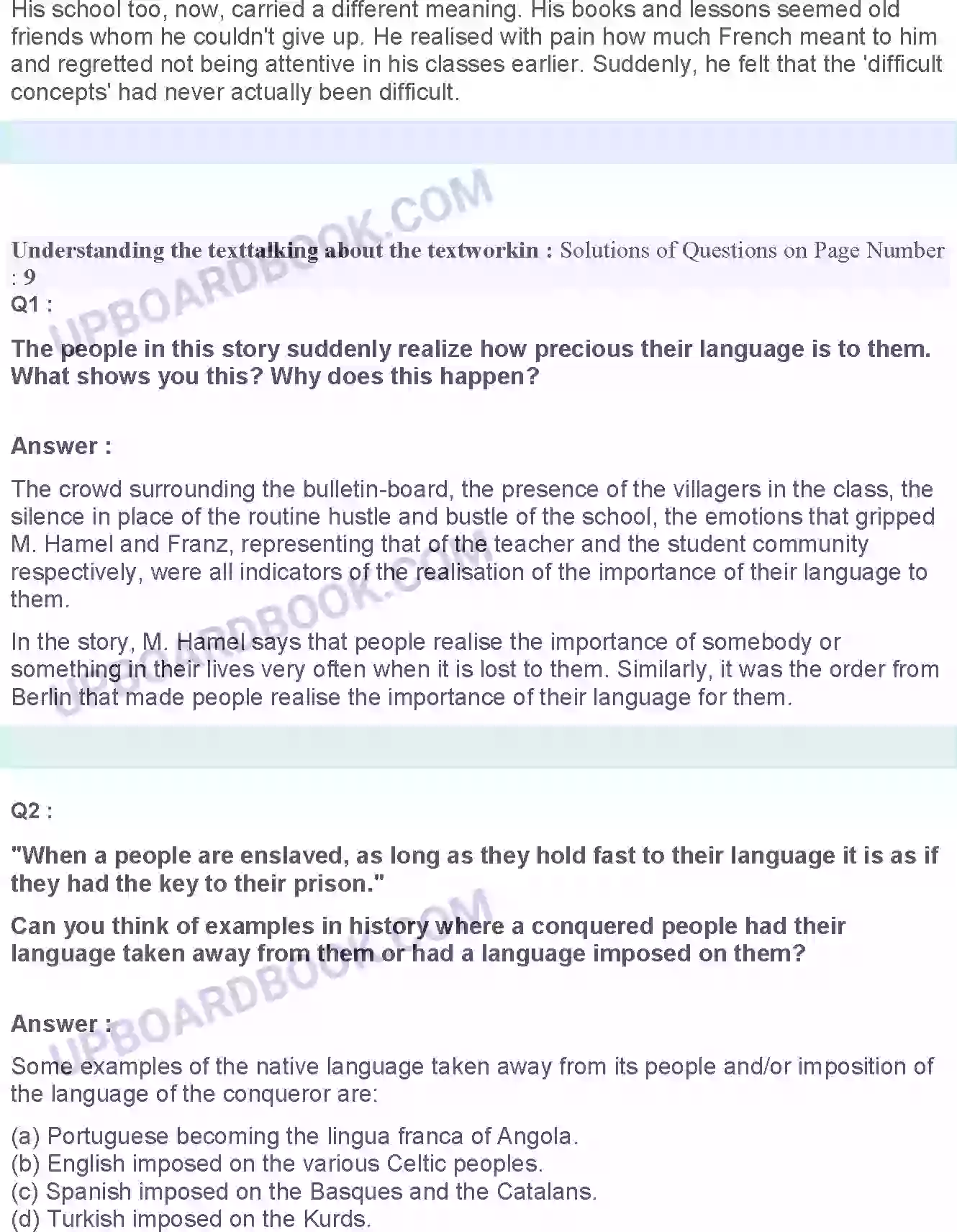
Answer: Franz's feelings underwent a complete transformation. He forgot all about M. Hamel's ruler and strictness. He suddenly saw his teacher as a patriot suffering great pain. His books, which felt like a nuisance before, now seemed like old friends. He regretted not learning his lessons properly and realized the importance of his language and school.
Understanding the Text
Q1: The people in this story suddenly realize how precious their language is to them. What shows you this? Why does this happen?
Answer: The realization is shown through:
- The crowd around the bulletin-board.
- The villagers attending the last lesson in silence.
- The emotional outburst of M. Hamel.
- Franz's regret and newfound attention.
Q2: “When a people are enslaved, as long as they hold fast to their language it is as if they had the key to their prison." Can you think of examples in history where a conquered people had their language taken away from them or had a language imposed on them?
Answer: Yes, history has many such examples:
- Imposition of English on the Celtic peoples of Ireland and Scotland.
- Imposition of Spanish on the native people of South America.
- Suppression of the Kurdish language in Turkey.
- Russian promoted over local languages in parts of the former Soviet Union.
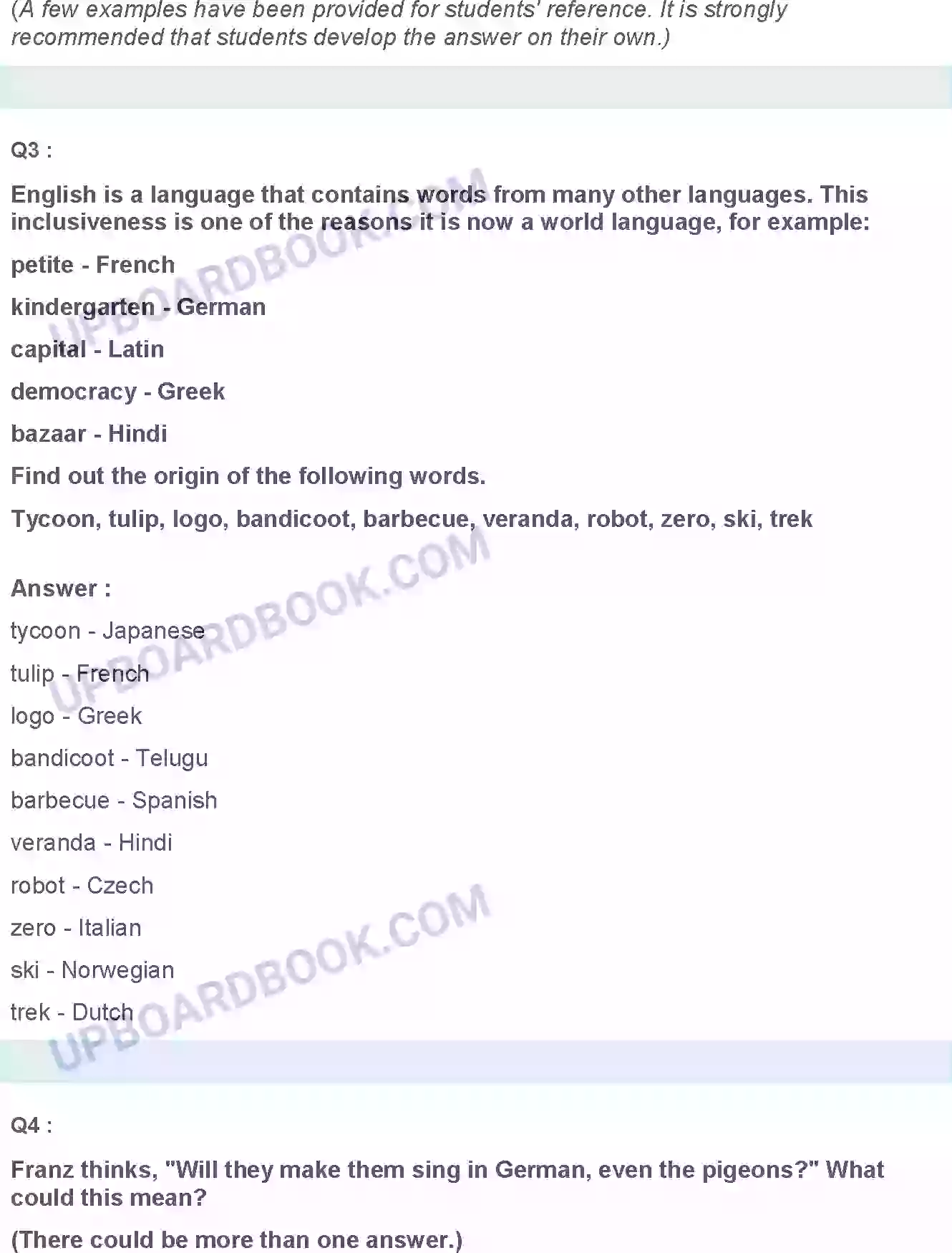
Q3: English is a language that contains words from many other languages. This inclusiveness is one of the reasons it is now a world language. Find out the origin of the following words.
Answer:
- Tycoon - Japanese
- Tulip - Turkish (via French)
- Logo - Greek
- Bandicoot - Telugu
- Barbecue - Spanish
- Veranda - Hindi/Portuguese
- Robot - Czech
- Zero - Arabic (via Italian)
- Ski - Norwegian
- Trek - Dutch/Afrikaans
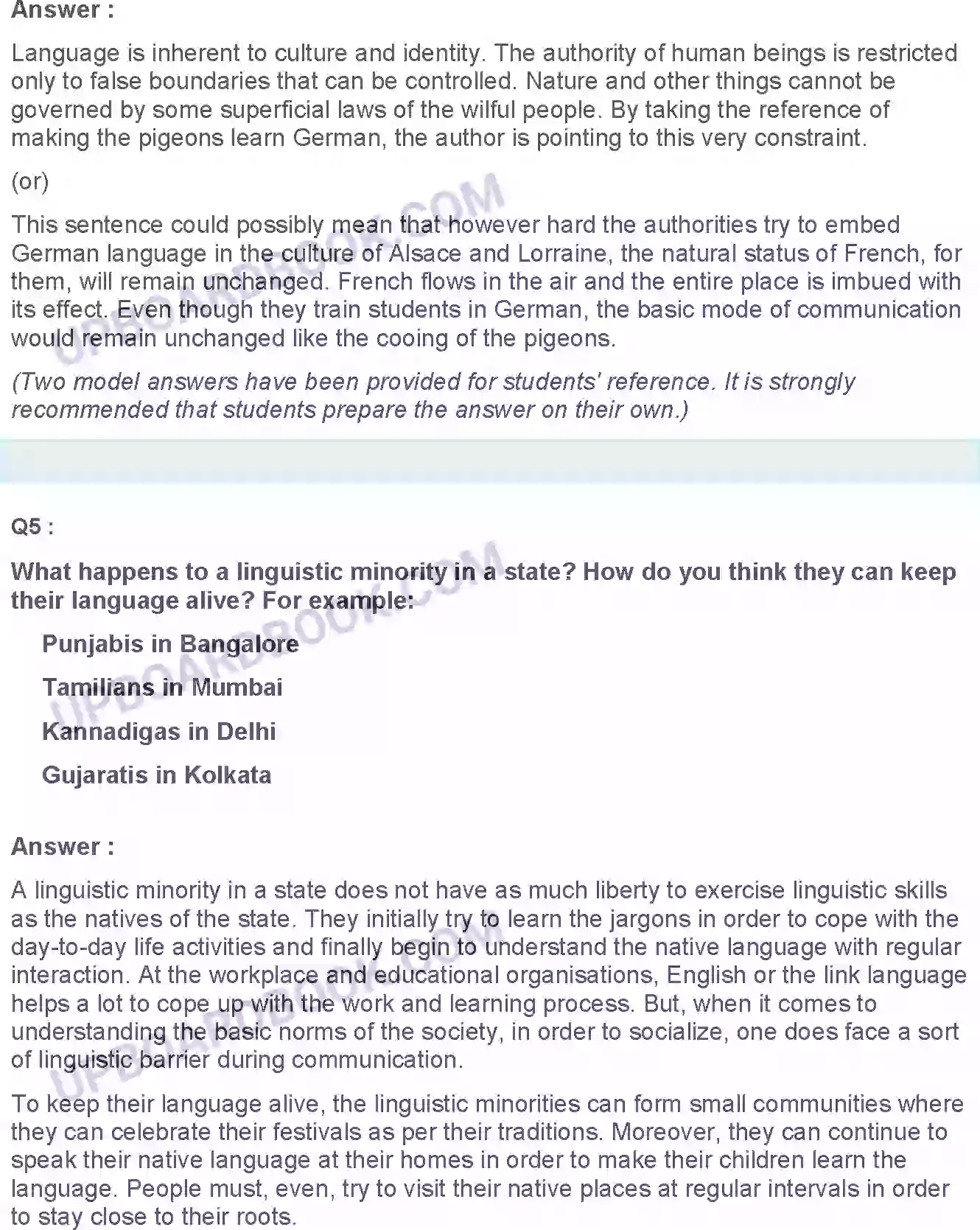
Q4: Franz thinks, "Will they make them sing in German, even the pigeons?" What could this mean?
Answer: This thought highlights the absurdity and ultimate futility of the German imposition. It means:
- Nature and instinct cannot be controlled by political orders. The pigeons will always coo in their own way, just as the love for one's mother tongue is natural and cannot be erased.
- It expresses Franz's anger and disbelief that the conquerors are trying to uproot every aspect of their identity, but some things (like the language of nature) will always remain free.
Q5: What happens to a linguistic minority in a state? How do you think they can keep their language alive?
Answer: A linguistic minority often faces challenges in using their language in public spaces, offices, and schools. They might initially struggle but usually adapt by learning the dominant language for daily life.
To keep their language alive, they can:
- Use their native language at home and in community gatherings.
- Celebrate festivals and cultural events traditionally.
- Run community classes to teach the language to younger generations.
- Consume and create media (books, songs, plays) in their own language.
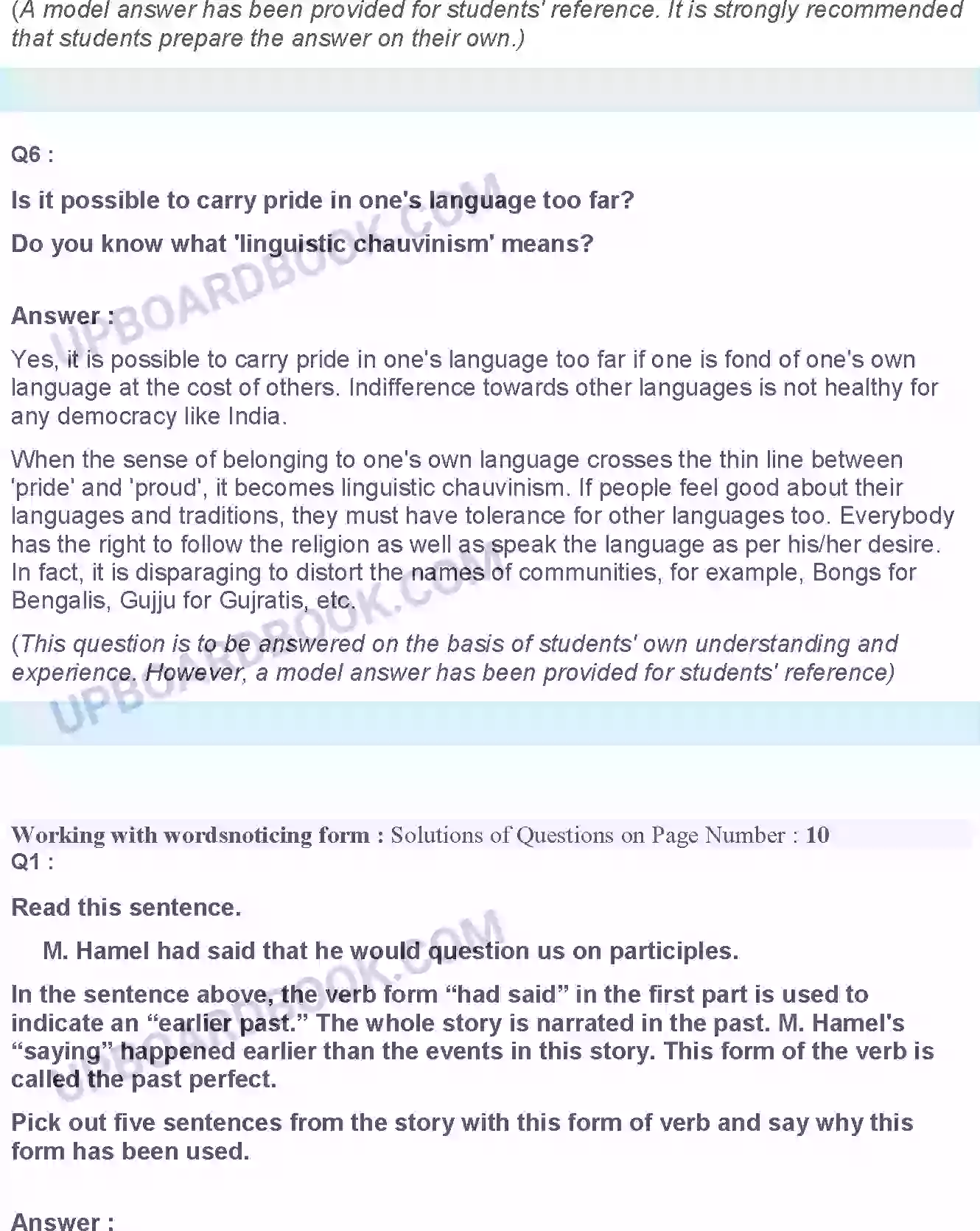
Q6: Is it possible to carry pride in one's language too far? Do you know what ‘linguistic chauvinism’ means?
Answer: Yes, pride in one's language can turn negative when it leads to looking down upon other languages and their speakers. This extreme, aggressive pride is called linguistic chauvinism. It can create disunity, conflict, and disrespect in a diverse society like India. Healthy pride is about loving and preserving your language while respecting others' right to do the same.
Working with Words & Grammar
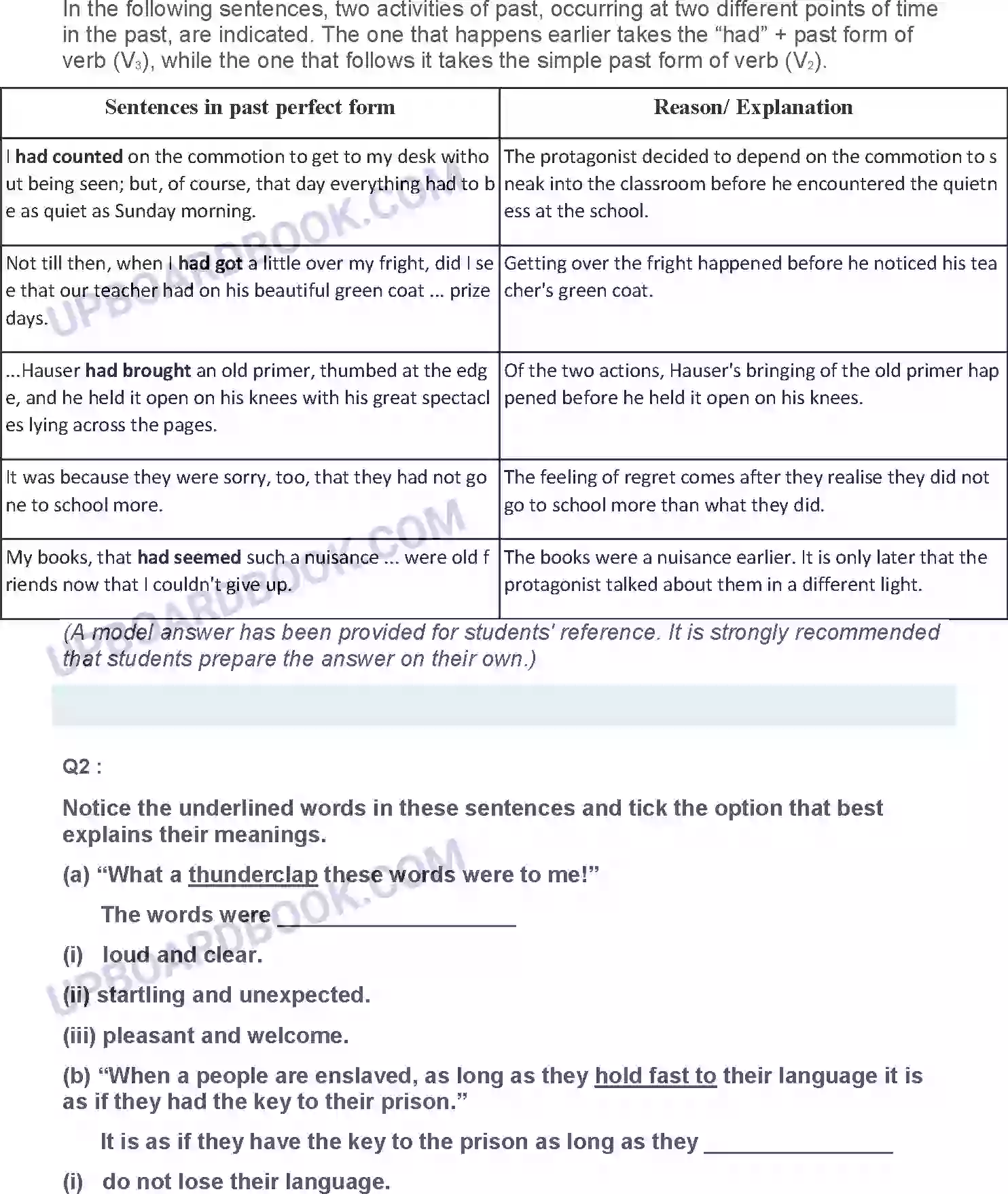
Q1: Pick out five sentences from the story that use the Past Perfect tense and say why this form has been used.
Answer: The Past Perfect tense (had + V3) is used to show an action that was completed before another action in the past.
Examples from the story:
- I had counted on the commotion to get to my desk... - (His planning happened before he reached school).
- ...our teacher had on his beautiful green coat... - (M. Hamel wore the coat before Franz noticed it).
- Hauser had brought an old primer... - (Bringing the book happened before he held it open).
- ...they were sorry... that they had not gone to school more. - (The regret is about not going to school in the past, before that day).
- My books, that had seemed such a nuisance... - (His feeling about the books existed before his change of heart that day).
Q2: Choose the correct meaning for the underlined words.
Answer:
- "What a thunderclap these words were to me!" means the words were (ii) startling and unexpected.
- "...hold fast to their language it is as if they had the key to their prison" means as long as they (ii) are attached to their language.
- "You will get to your school in plenty of time" means you will get there (iii) early enough.
- "I never saw him look so tall" means M. Hamel (b) seemed very confident and dignified.
Things to Do & Writing
Q1 & Q3: Research-based and Survey Activities.
Note: These are activity-based questions. Students are advised to conduct research on linguistic human rights and constitutional guarantees for linguistic minorities in India (Article 29, 30, 350A). They should also interview classmates to fill the language survey form.
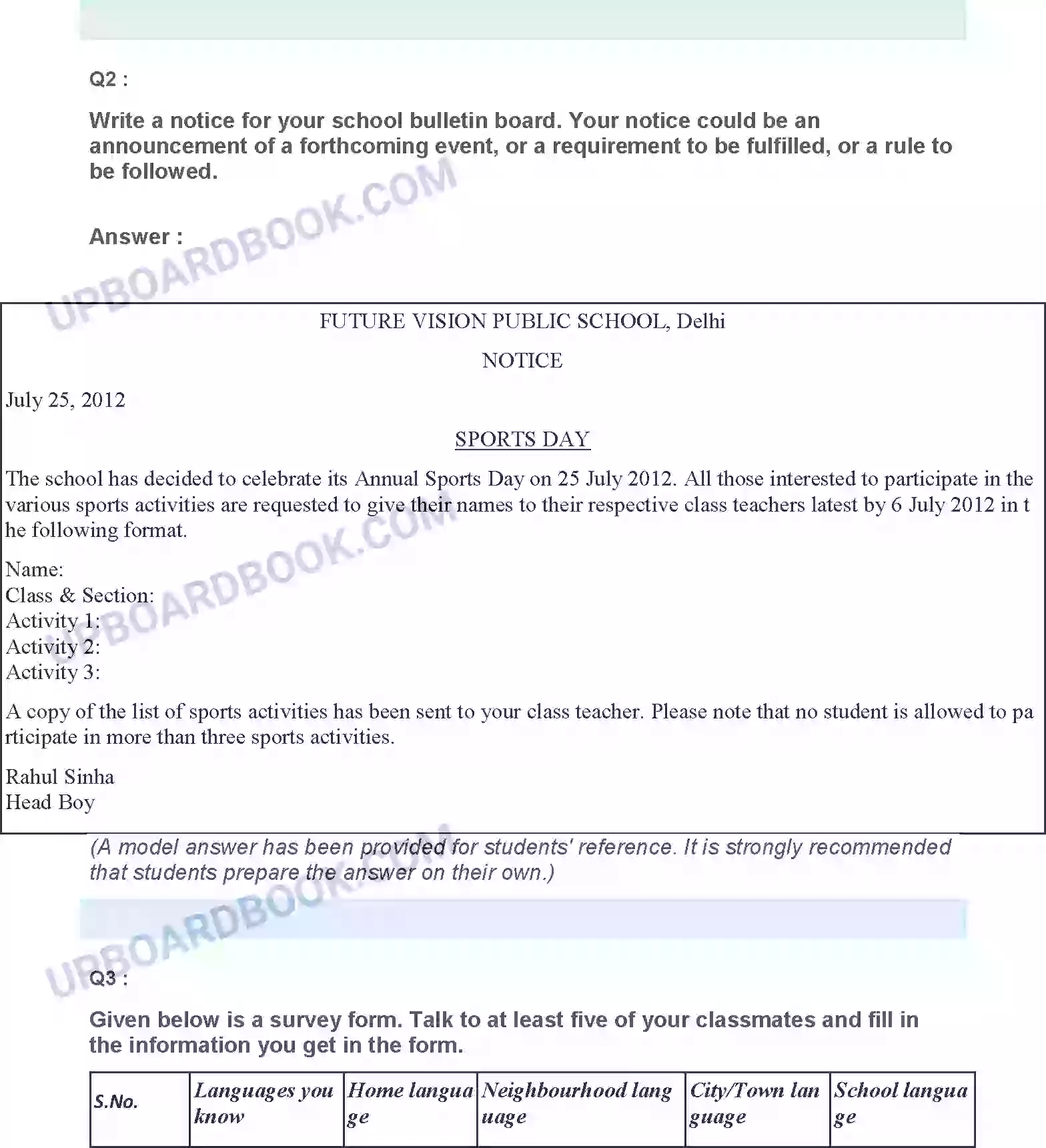
Q2: Write a notice for your school bulletin board.
Sample Answer:
GLOBAL INDIAN PUBLIC SCHOOL, Lucknow
NOTICE
Inter-School Debate Competition
Date: 15th October 2023
All students of Classes XI and XII are hereby informed that our school is organizing an Inter-School Debate Competition on the topic "The Digital Age: A Boon or a Bane for Young Learners?" on the 25th of October.
Those interested in participating must give their names to their respective English teachers by 10th October. Preliminary rounds will be held on the 18th of October.
For further details, contact the undersigned.
Rohan Sharma
Head Boy
Q4: Write a paragraph arguing for or against studying three languages at school.
Sample Points (For): Studying three languages in school is highly beneficial in our globalized world. It enhances cognitive abilities, improves memory, and fosters cultural understanding. Knowing a foreign language opens up international career and higher education opportunities. Learning one's mother tongue preserves cultural heritage, while Hindi and English ensure national integration and global connectivity. Thus, the initial effort leads to long-term personal and professional advantages.
Q5: Have you ever changed your opinion about someone or something? Narrate your experience.
Guidance: This is a personal response question. Think of an instance – perhaps you disliked a subject like Mathematics until a teacher explained it beautifully, or you misjudged a quiet classmate who later became a trusted friend. Describe what you initially thought, the specific incident or realization that changed your mind, and what you learned from this experience about avoiding quick judgments.
Get UP Board Class 12 English 1. The Last Lesson Solution in Hindi Medium
UP Board Class 12 English 1. The Last Lesson Solution is available at our platform https://upboardbook.com in hindi medium for free of cost. Content provided on our website is free of cost and in PDF format which is easily available for download. Getting the UP Board Solutions for Class 12 will help student to achieve good learning experience so that they can study effectively. UP board holds examination of more than 3 million students every year and majority of the question of exams are from their UP Board Solutions. That’s why it is important to study using the textSolution issued by UP Board.
Importance of UP Board Class 12 English 1. The Last Lesson Text Solutions
It is essential to know the importance of UP Board Class 12 English 1. The Last Lesson textSolution issued by UP Board because students completely rely on these Solutions for their study and syllabus offered by UP Board is so balanced that each student should be aware about the importance of it. Below is the list of Importance of UP Board Class 12 English 1. The Last Lesson :
- These TextSolutions are very clear and accurate which helps student to understand concept with ease.
- It is also to mention that these text Solutions are prepared by the content experts of subject, thus these Solutions helps student in clearing their doubts and understand the core concept easily.
- It is considered to be the best study material for competitive exam preparation.
Features of UP Board Class 12 textSolutions
There are various features of UP Board Class 12 TextSolutions, some of them are mentioned below so that you student can understand the value and usability of the contend and understand why Uttarpradesh board has prescribed these Solutions.
- Best feature of these textSolutions is free availability of content in PDF format
- Second feature that content generated and written is clear and easy to read.
- There are various illustration and images are shown in the Solution so that student can easily understand the concept and should be more appealing to the student.
- Each chapter is explained thoroughly
