 UPBoardBook
UP Board Class 12 English (4. The Rattrap) solution PDF
UP Board Class 12 English 4. The Rattrap is a Hindi Medium Solution which is prescribed by Uttar Pradesh Board for their students. These Solutions is completely prepared considering the latest syllabus and it covers every single topis, so that every student get organised and conceptual learning of the concepts. Class 12 Students of UP Board who have selected hindi medium as their study medium they can use these Hindi medium textSolutions to prepare themselves for exam and learn the concept with ease.
UP Board Class 12 English 4. The Rattrap Hindi Medium Solutions - PDF
Click Here to

UP Board Solutions for Class 12 English Flamingo
Chapter 4: The Rattrap
A comprehensive guide to exercise answers and chapter summary.
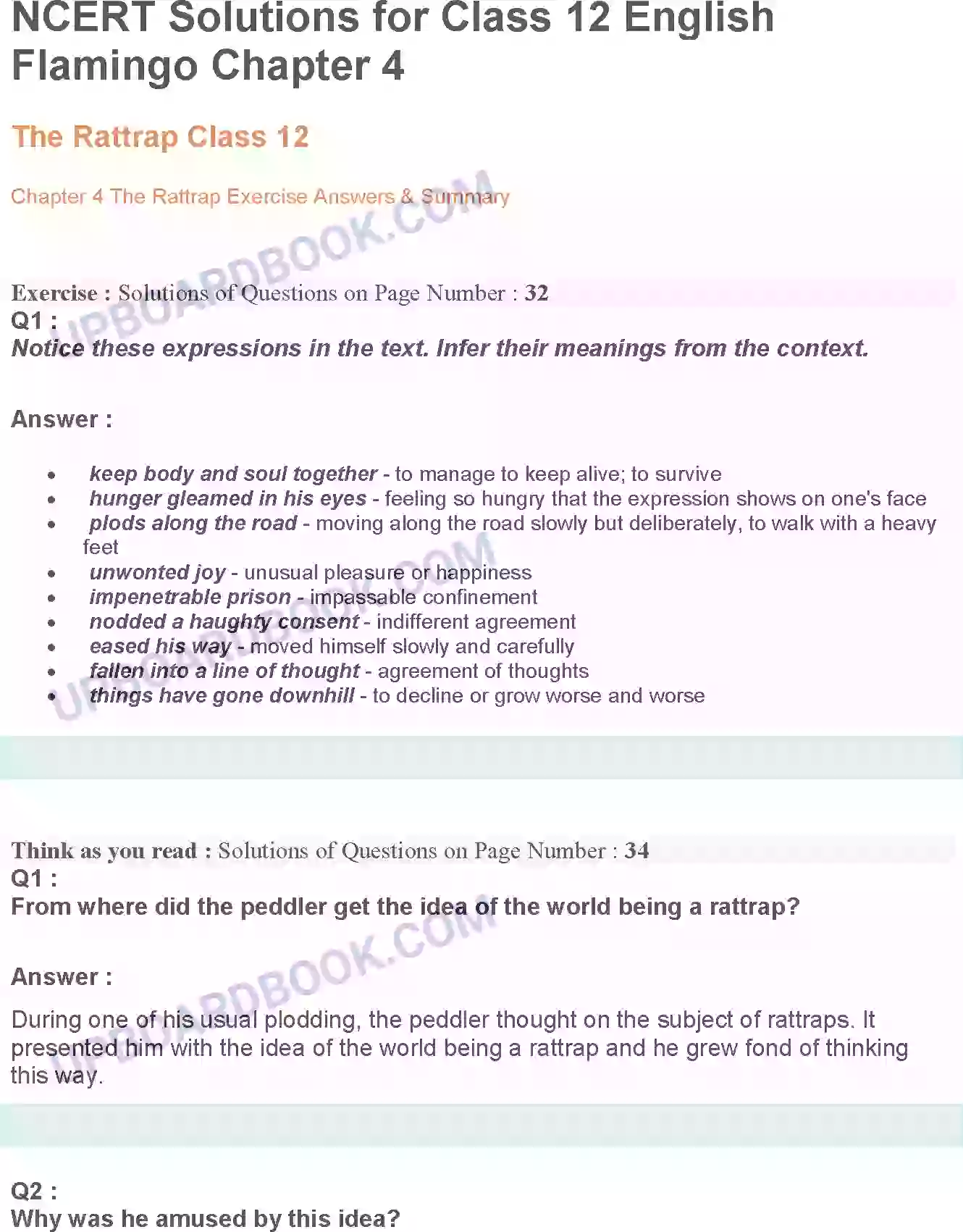
Exercise: Solutions of Questions on Page Number - 32
Q1: Notice these expressions in the text. Infer their meanings from the context.
Answer:
- keep body and soul together - to manage to keep alive; to survive.
- hunger gleamed in his eyes - a facial expression that shows one is extremely hungry.
- plods along the road - to walk slowly with heavy steps, usually because you are tired.
- unwonted joy - unusual or rare happiness.
- impenetrable prison - a confinement that cannot be passed through or escaped.
- nodded a haughty consent - gave an arrogant or indifferent agreement.
- eased his way - moved slowly and carefully.
- fallen into a line of thought - started thinking in a particular way; agreement of thoughts.
- things have gone downhill - a situation has deteriorated or become worse.
Think as you read: Solutions of Questions on Page Number - 34
Q1: From where did the peddler get the idea of the world being a rattrap?
Answer: During his lonely wanderings, the peddler was struck by the idea of rattraps. He began to see the world itself as a giant rattrap, a thought he became quite fond of.
Q2: Why was he amused by this idea?
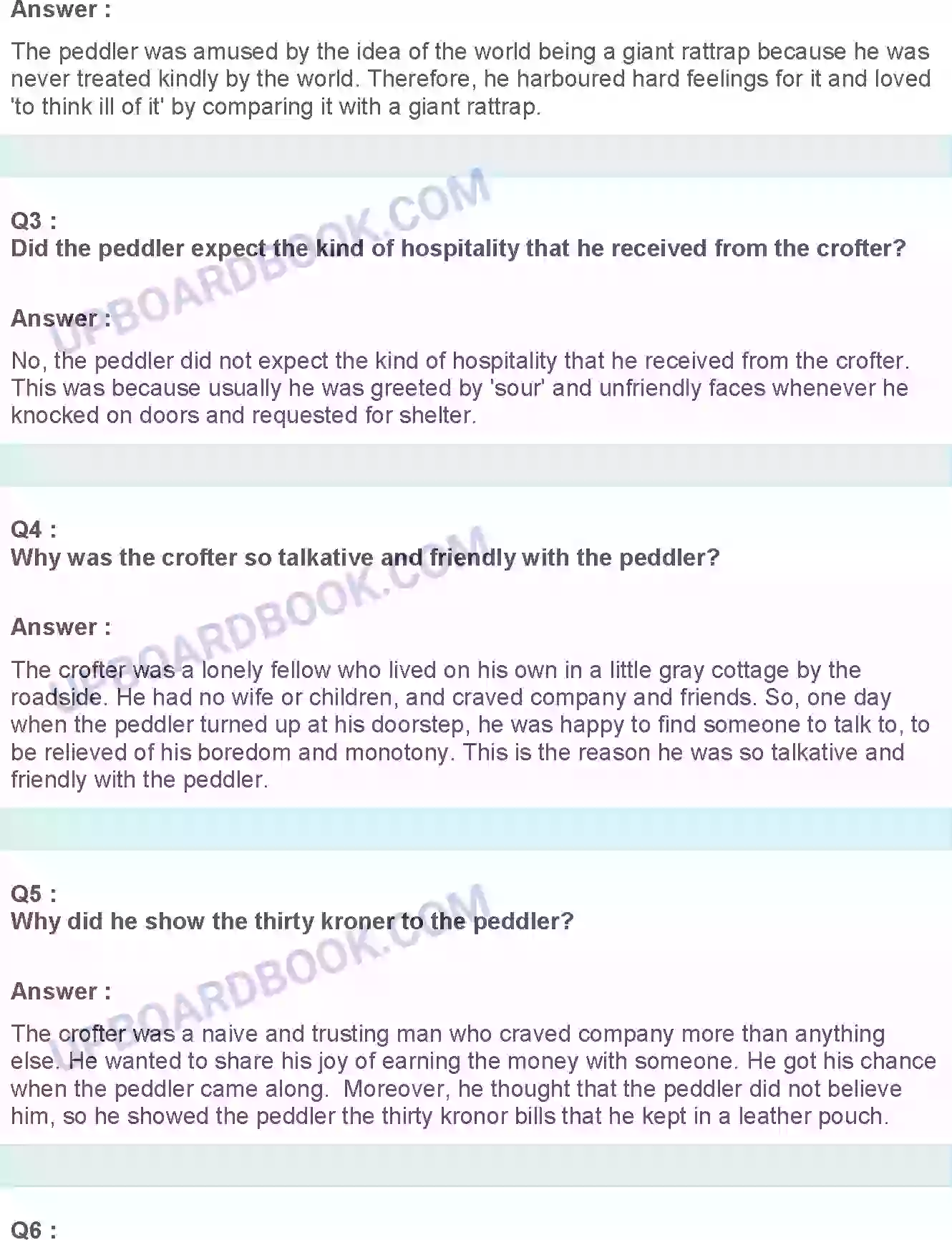
Answer: The peddler was amused because the world had never been kind to him. Thinking of it as a cruel rattrap gave him a way to harbor negative feelings towards it and justify his own ill fate.
Q3: Did the peddler expect the kind of hospitality that he received from the crofter?
Answer: No, he did not. He was accustomed to facing sour and unwelcoming faces whenever he asked for shelter. The crofter's warm welcome was a complete surprise.
Q4: Why was the crofter so talkative and friendly with the peddler?
Answer: The crofter lived alone in his cottage, with no wife or children. He suffered from loneliness and craved human company. The peddler's arrival provided him with a much-needed opportunity to talk and relieve his boredom.
Q5: Why did he show the thirty kronor to the peddler?
Answer: The crofter was a trusting and simple man. He was proud of his earnings and wanted to share his joy. He also felt the peddler didn't believe him, so he showed him the money kept in a leather pouch as proof.
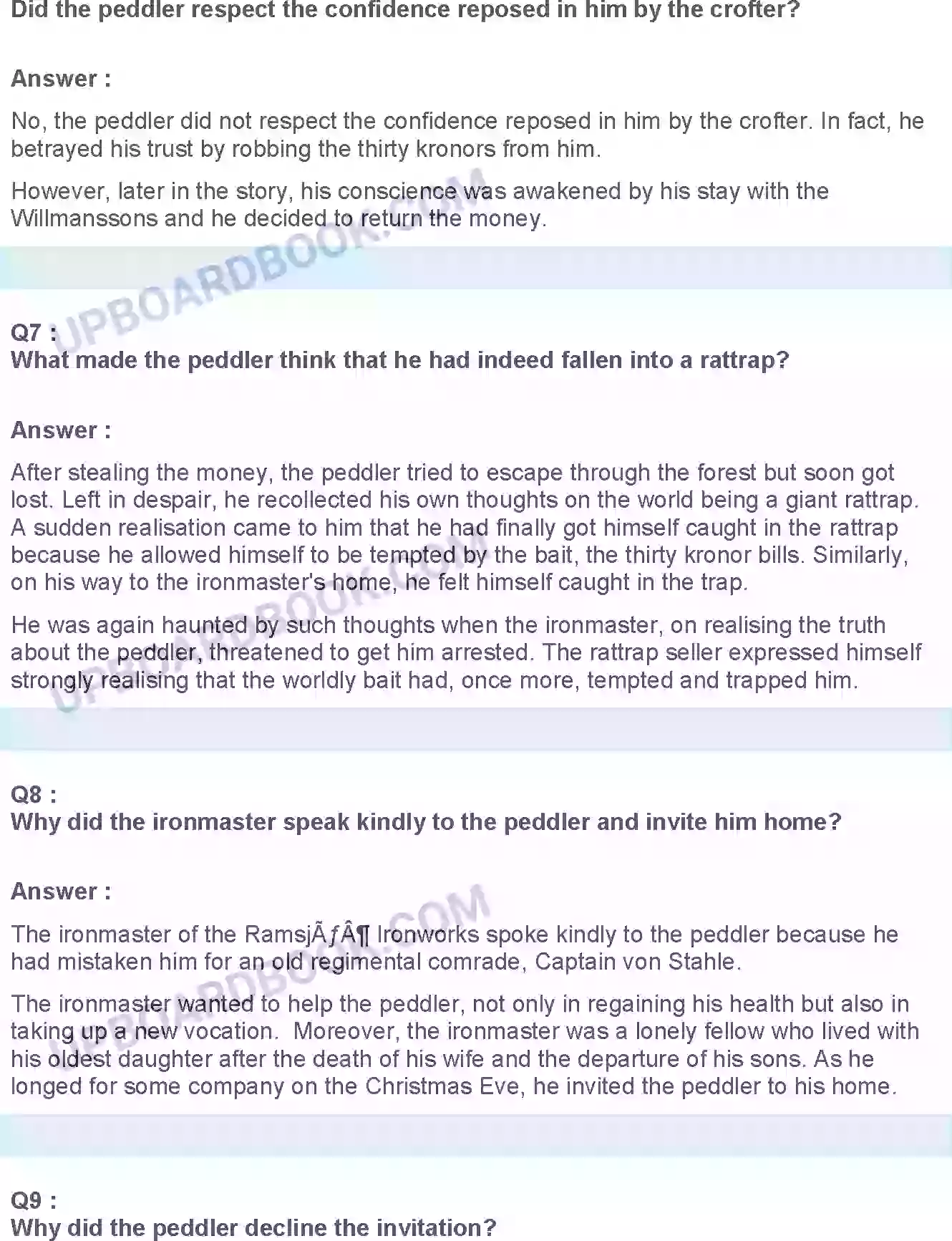
Q6: Did the peddler respect the confidence reposed in him by the crofter?
Answer: Initially, no. He betrayed the crofter's trust by stealing the thirty kronor. However, later in the story, his conscience was awakened by the kindness of Edla Willmansson, and he decided to return the money.
Q7: What made the peddler think that he had indeed fallen into a rattrap?
Answer: After stealing the money and getting lost in the forest, he remembered his own metaphor. He realized he had been tempted by the "bait" (the money) and was now trapped. This feeling returned when the ironmaster threatened him with the police—he felt caught in the world's trap once again.
Q8: Why did the ironmaster speak kindly to the peddler and invite him home?
Answer: The ironmaster mistook the peddler for an old regimental comrade, Captain von Stahle. Feeling nostalgic and lonely on Christmas Eve (as he lived only with his eldest daughter), he wanted to help his old "friend" and offer him a fresh start.
Q9: Why did the peddler decline the invitation?
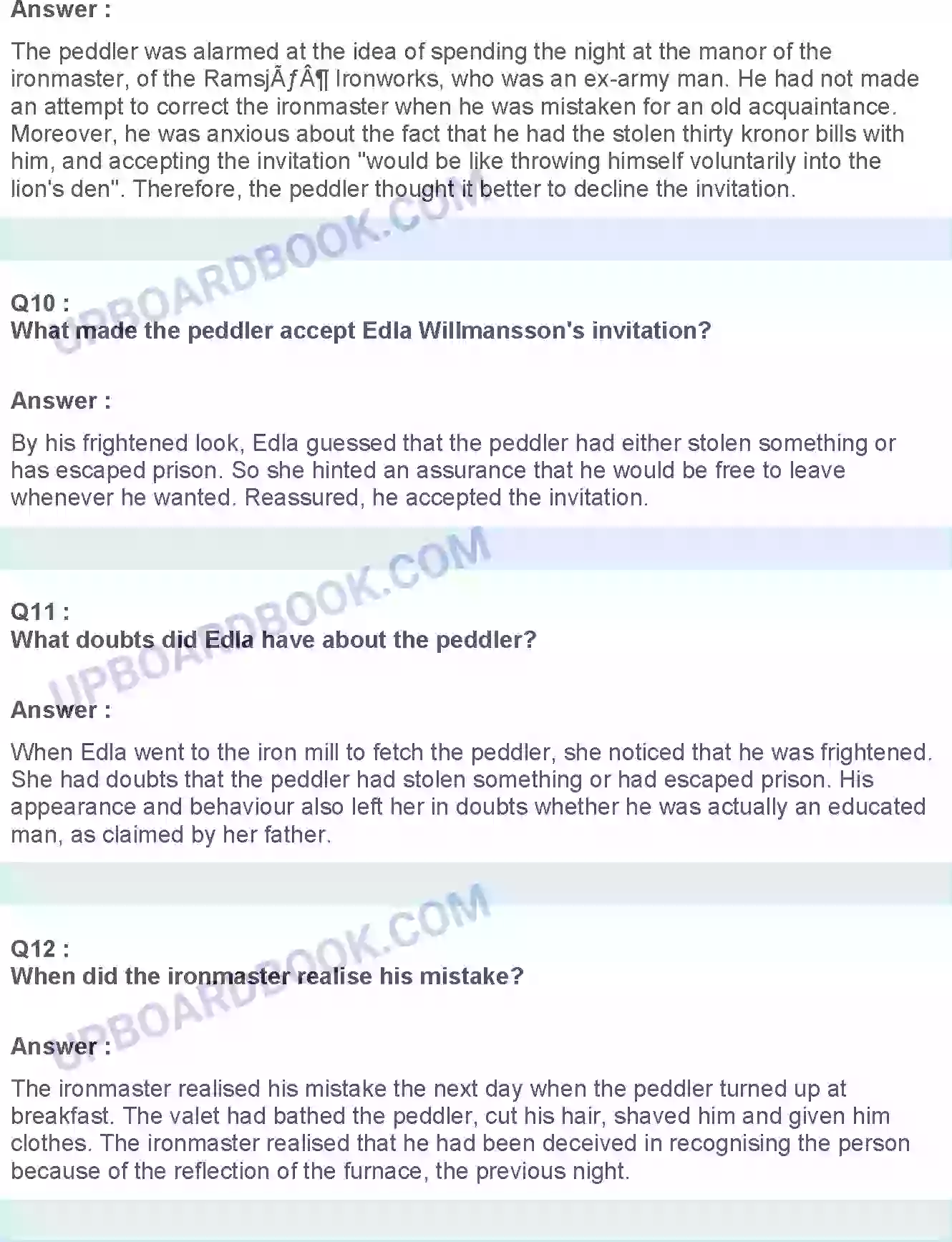
Answer: The peddler was frightened. He had the stolen money on him, and going to the ironmaster's manor felt like walking into a "lion's den." He also felt guilty for not correcting the ironmaster's mistaken identity.
Q10: What made the peddler accept Edla Willmansson's invitation?
Answer: Edla noticed his fear and kindly assured him that he would be free to leave whenever he wished. This reassurance made him feel safe enough to accept.
Q11: What doubts did Edla have about the peddler?
Answer: Edla suspected he was a thief or an escaped prisoner based on his frightened look. She also doubted her father's claim that he was an educated army captain, given his rough appearance and behaviour.
Q12: When did the ironmaster realise his mistake?
Answer: He realized his mistake the next morning at breakfast. In the proper light, with the peddler cleaned and shaved, he saw he was not his old comrade. The dim light and shadows from the furnace had deceived him the night before.
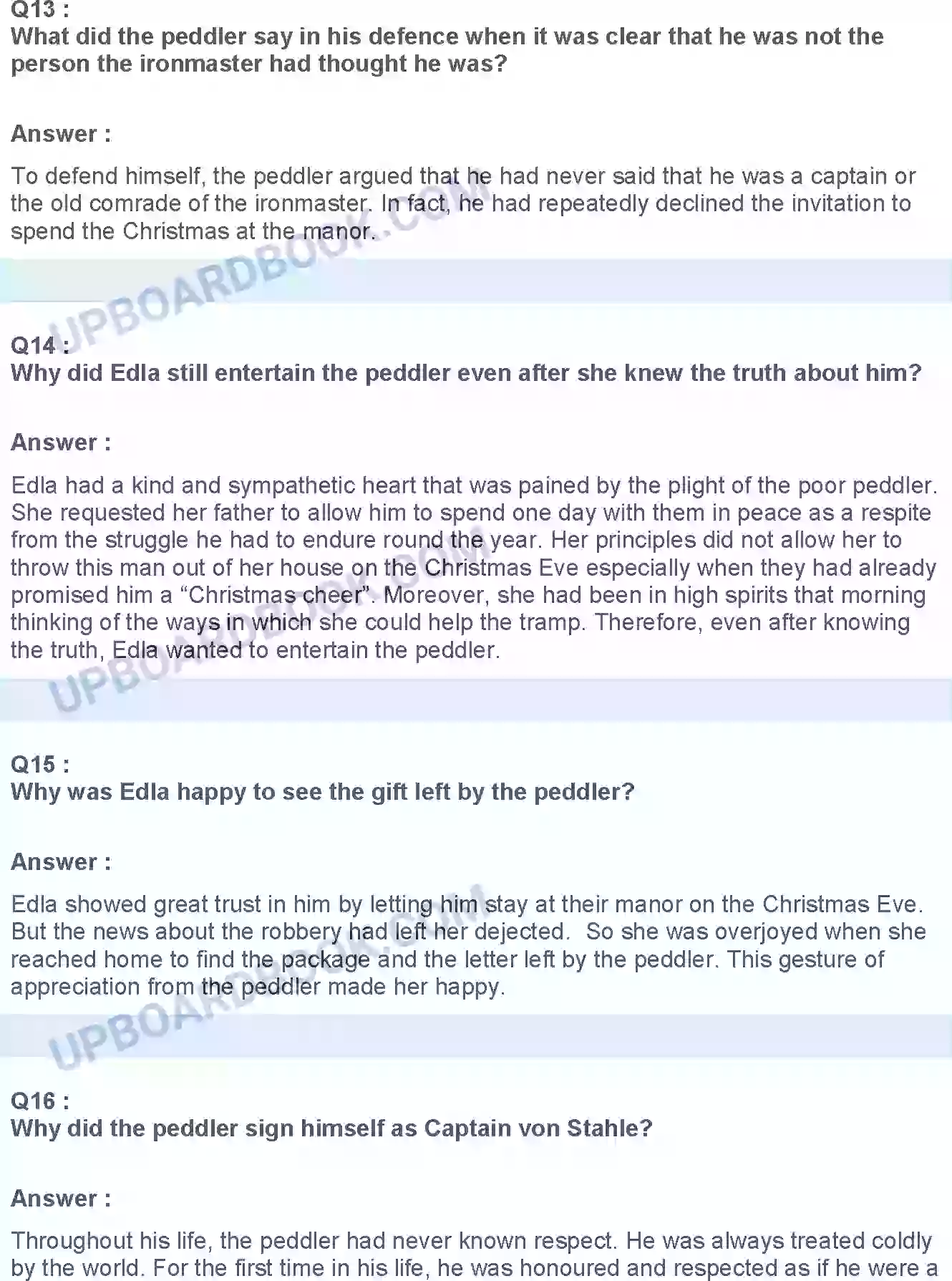
Q13: What did the peddler say in his defence when it was clear that he was not the person the ironmaster had thought he was?
Answer: The peddler defended himself by saying he never claimed to be the captain or the ironmaster's friend. He reminded them that he had repeatedly refused the invitation to the manor.
Q14: Why did Edla still entertain the peddler even after she knew the truth about him?
Answer: Edla was compassionate. She felt sorry for the peddler's year-round struggles and believed everyone deserved peace on Christmas. She didn't want to break their promise of "Christmas cheer" and was determined to show him kindness.
Q15: Why was Edla happy to see the gift left by the peddler?
Answer: After hearing about the robbery, Edla was dejected, feeling her trust was broken. Finding the peddler's gift and letter filled her with joy because it proved her kindness had touched him and transformed his heart.
Q16: Why did the peddler sign himself as Captain von Stahle?
Answer: For the first time in his life, he was treated with dignity and respect, as if he were a captain. He signed the letter with that name to honor Edla's goodness, which made him feel worthy of such a title.
Understanding the Text
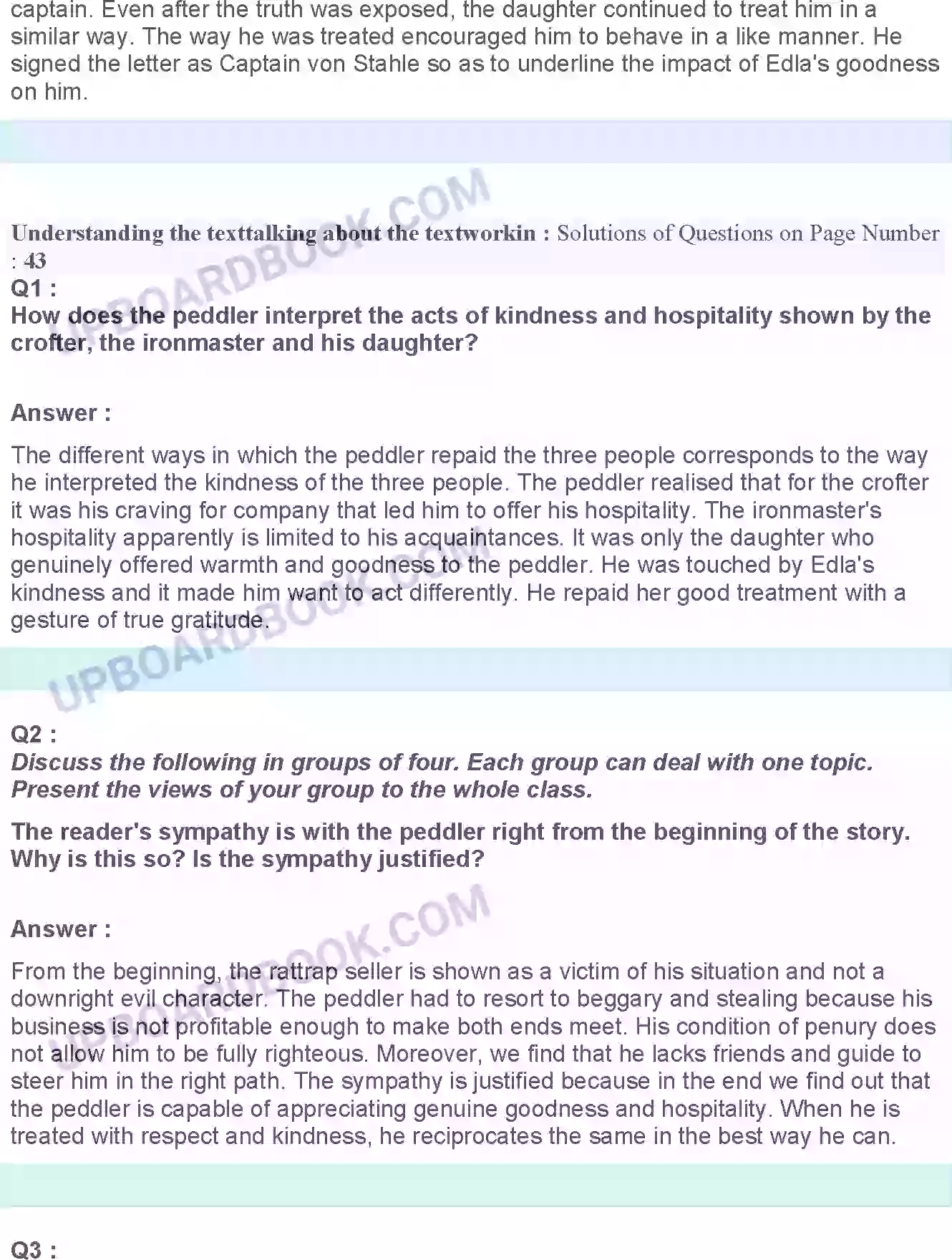
Q1: How does the peddler interpret the acts of kindness and hospitality shown by the crofter, the ironmaster and his daughter?
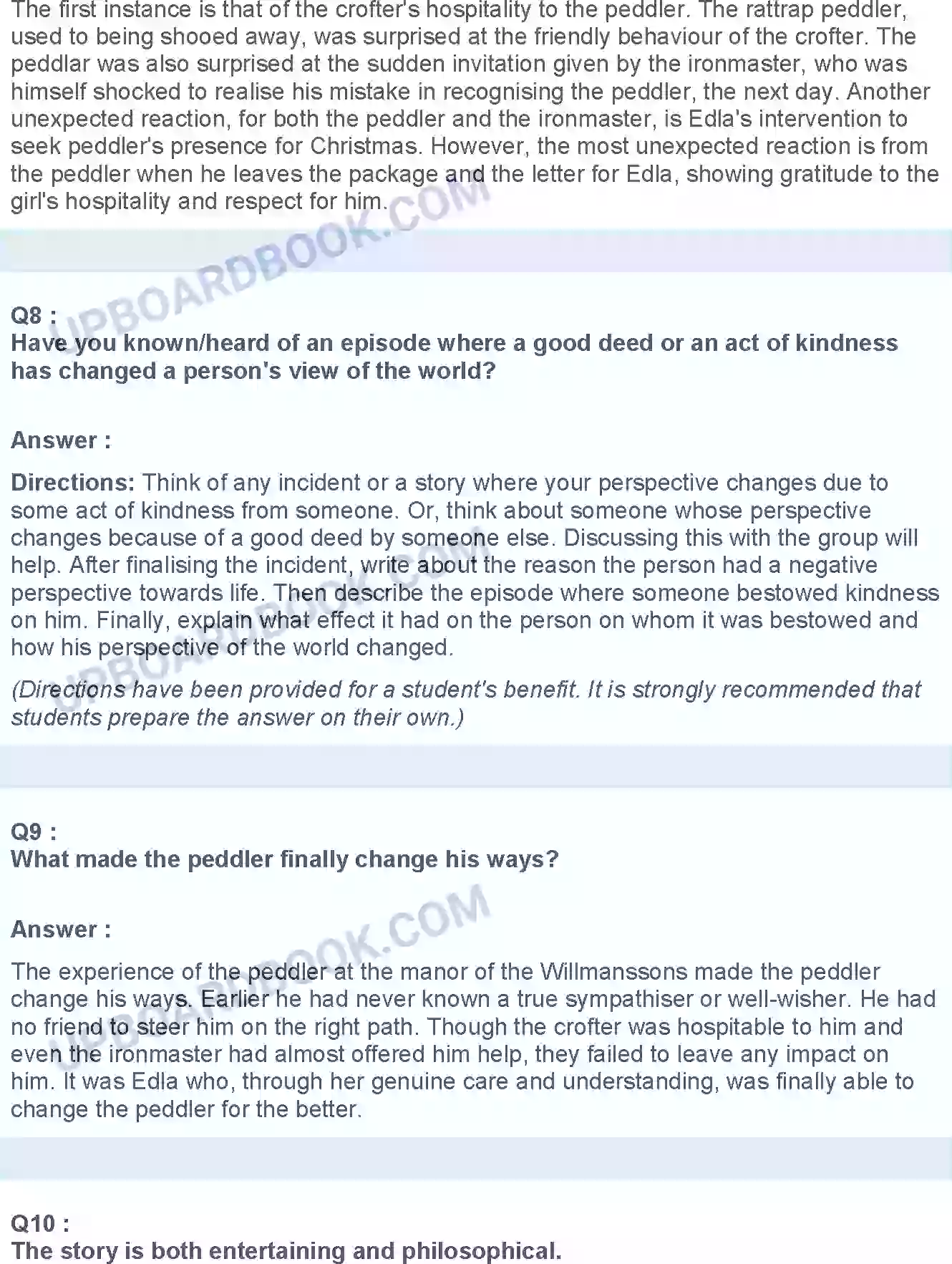
Answer: The peddler repays each person based on how he interprets their kindness. He sees the crofter's hospitality as stemming from loneliness, and the ironmaster's as reserved for old friends. Only Edla's kindness is genuine and selfless. Touched by her, he responds with true gratitude by returning the stolen money.
Q2: The reader's sympathy is with the peddler right from the beginning. Why is this so? Is the sympathy justified?
Answer: The peddler is portrayed as a victim of circumstance—his poverty forces him into petty theft. He lacks friends or guidance. The sympathy is justified because the story reveals his capacity for change. When shown genuine kindness (by Edla), he redeems himself, proving he is not inherently evil.
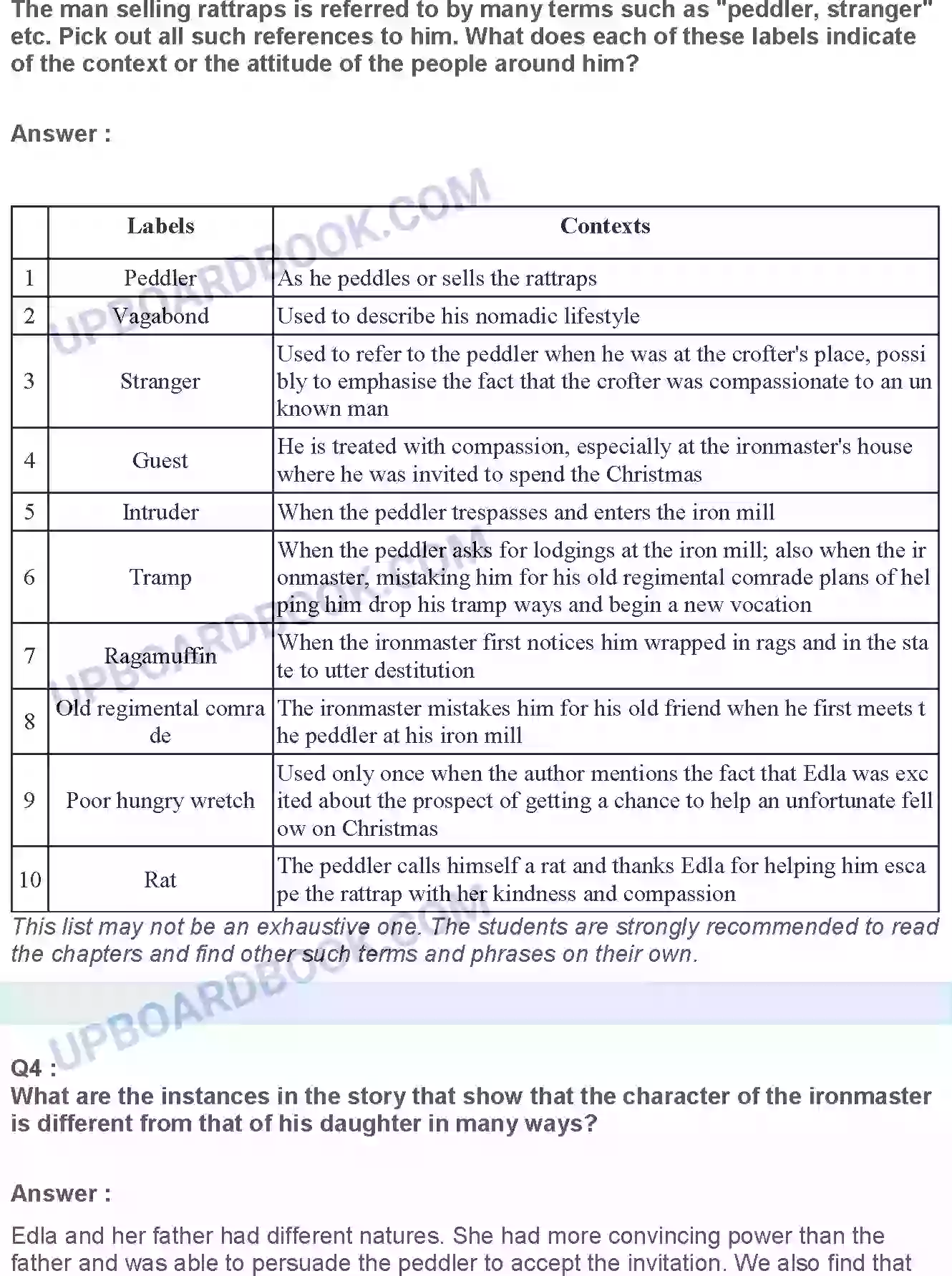
Q3: The man is referred to by many terms like "peddler", "stranger", etc. What does each label indicate?
Answer:
| Label | Indicates |
|---|---|
| Peddler | His profession of selling rattraps. |
| Vagabond / Tramp | His nomadic, homeless lifestyle. |
| Stranger | His unknown identity to the crofter. |
| Guest | The hospitality offered at the ironmaster's house. |
| Intruder | His uninvited entry into the iron mill. |
| Ragamuffin | His ragged, destitute appearance. |
| Old Comrade | The ironmaster's mistaken identity. |
| Poor hungry wretch | Edla's view of him as an unfortunate soul needing help. |
| Rat | How he sees himself—trapped in the world's rattrap. |
Q4: What instances show the ironmaster's character is different from his daughter's?
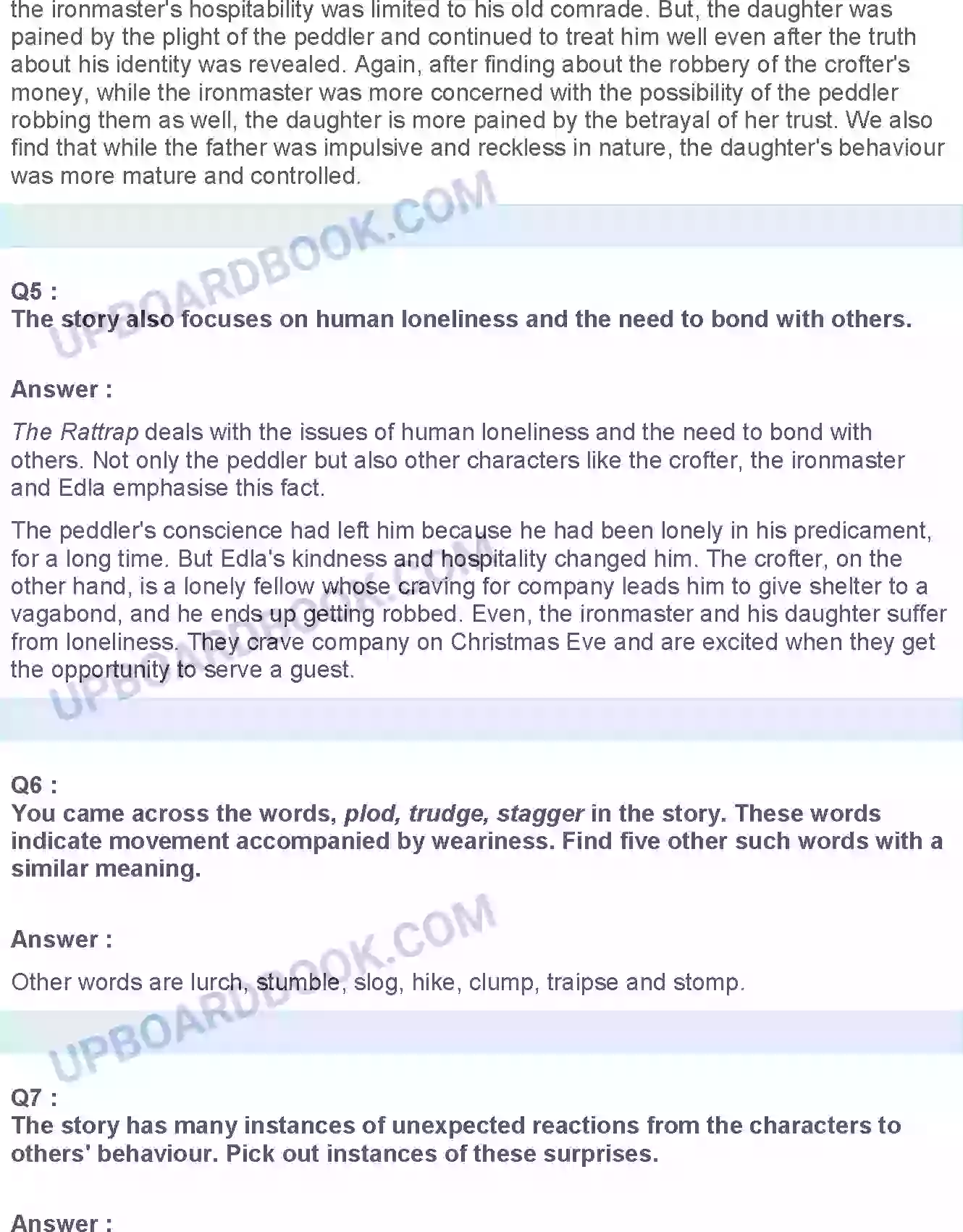
Answer: The ironmaster is impulsive (quickly invites then rejects the peddler) and his hospitality is conditional (only for friends). Edla is compassionate, persuasive, and principled. She treats the peddler with kindness regardless of his identity and is more hurt by the betrayal of trust than the risk of theft.
Q5: The story focuses on human loneliness and the need to bond with others. Discuss.
Answer: Loneliness drives the actions of key characters. The crofter is lonely, so he hosts a stranger. The ironmaster and Edla crave company on Christmas. The peddler, isolated for so long, loses his moral compass. Edla's bonding and kindness break his isolation, ultimately reforming him.
Q6: Find five words similar to 'plod', 'trudge', 'stagger' (movement with weariness).
Answer: Lurch, stumble, slog, traipse, clump.
Q7: Pick out instances of unexpected reactions from characters.
Answer:
- The crofter's warm welcome to a vagabond.
- The ironmaster inviting a dirty stranger home.
- Edla insisting the peddler stay even after the truth is revealed.
- The peddler's unexpected gift of returned money and a thankful letter.
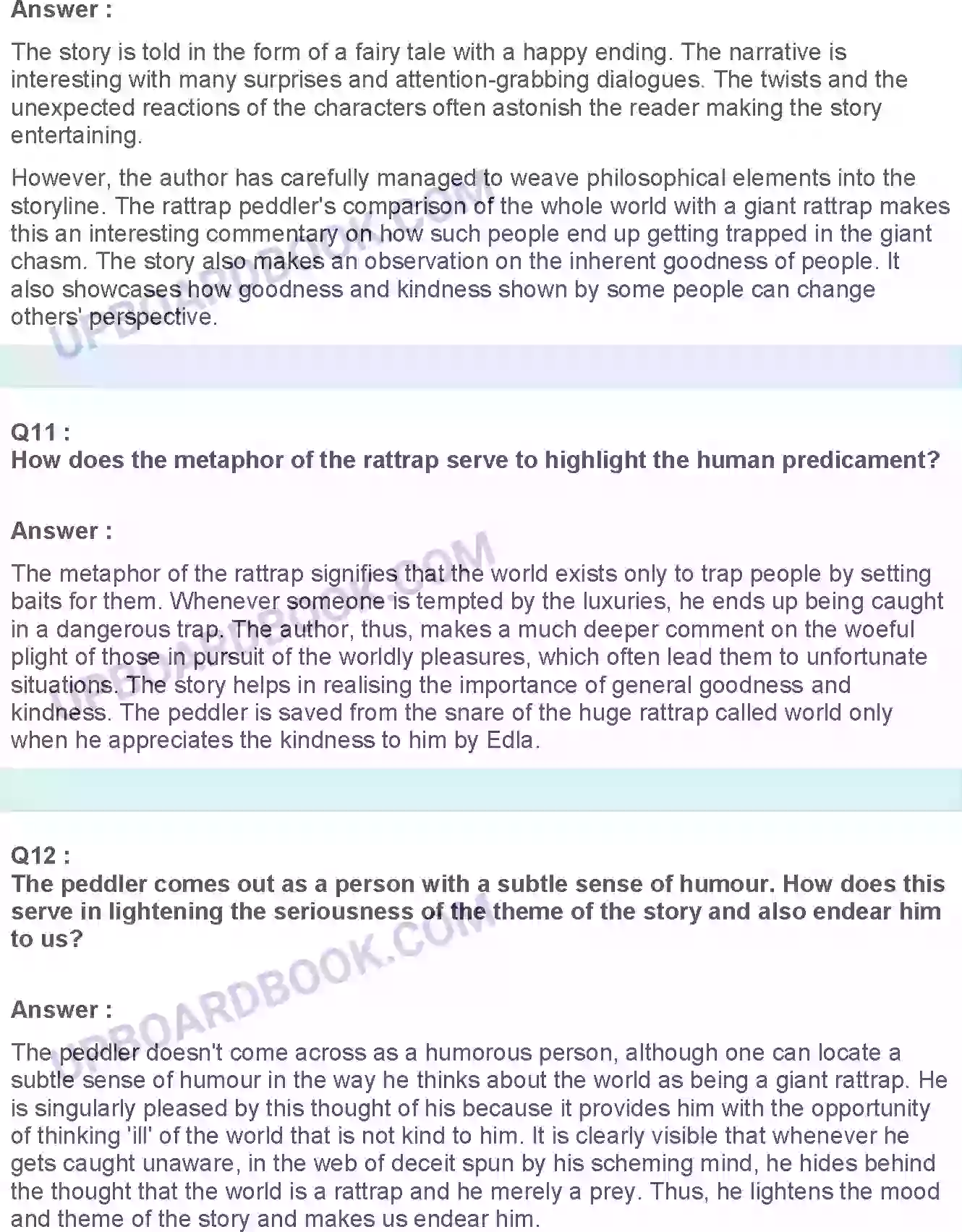
Q9: What made the peddler finally change his ways?
Answer: Edla Willmansson's genuine care and respect. Unlike others, her kindness was unconditional. This novel experience of being treated with dignity awakened his conscience and motivated him to become a better person.
Q11: How does the metaphor of the rattrap highlight the human predicament?
Answer: The metaphor suggests the world sets baits (like money, luxury) to trap people. The human predicament is the constant temptation by these baits, leading to entrapment in cycles of misery. The peddler escapes only when he chooses kindness and redemption over material bait.
Thinking about Language
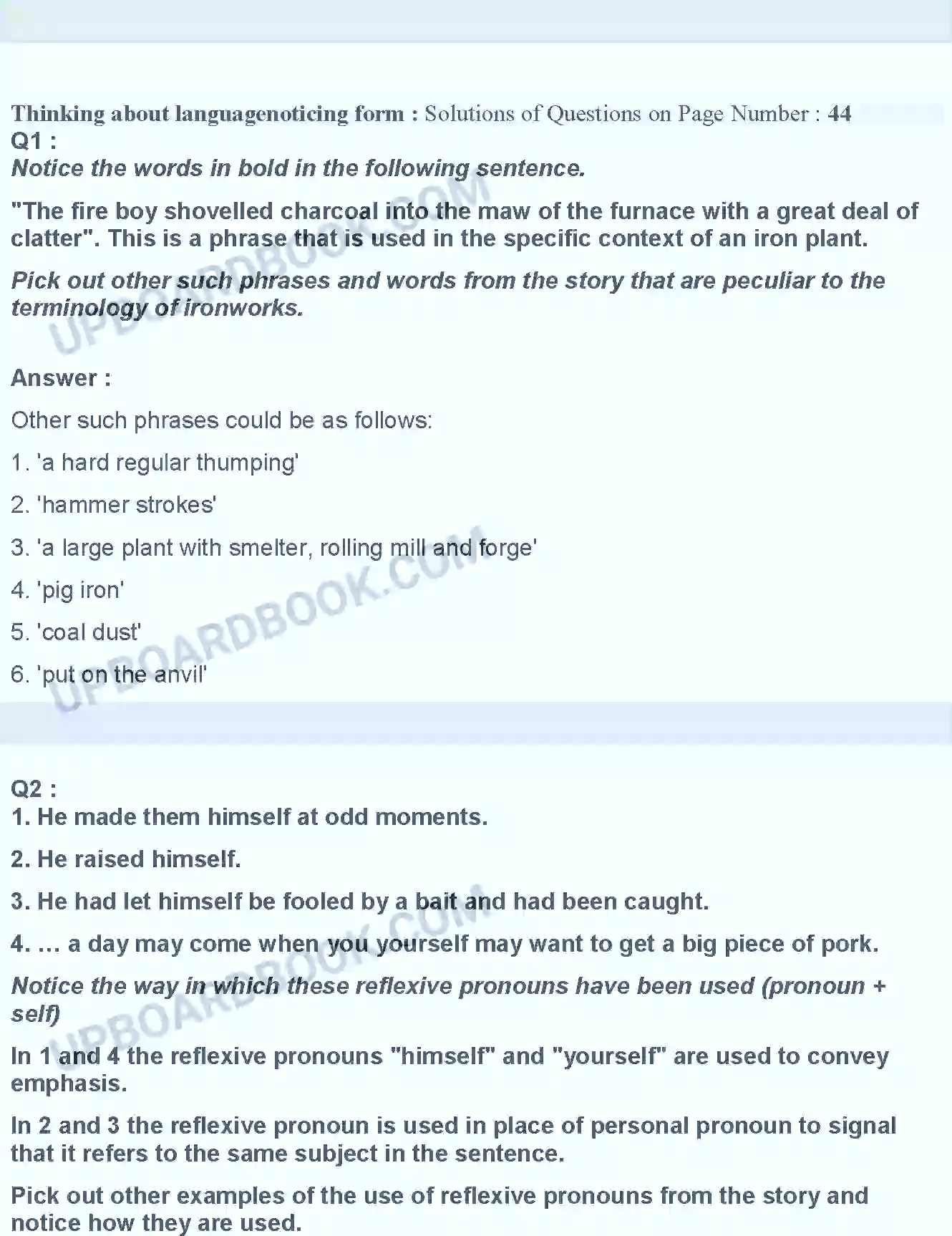
Q1: Pick out phrases peculiar to the terminology of ironworks.
Answer: 'A hard regular thumping', 'hammer strokes', 'smelter', 'rolling mill', 'forge', 'pig iron', 'coal dust', 'put on the anvil', 'maw of the furnace'.
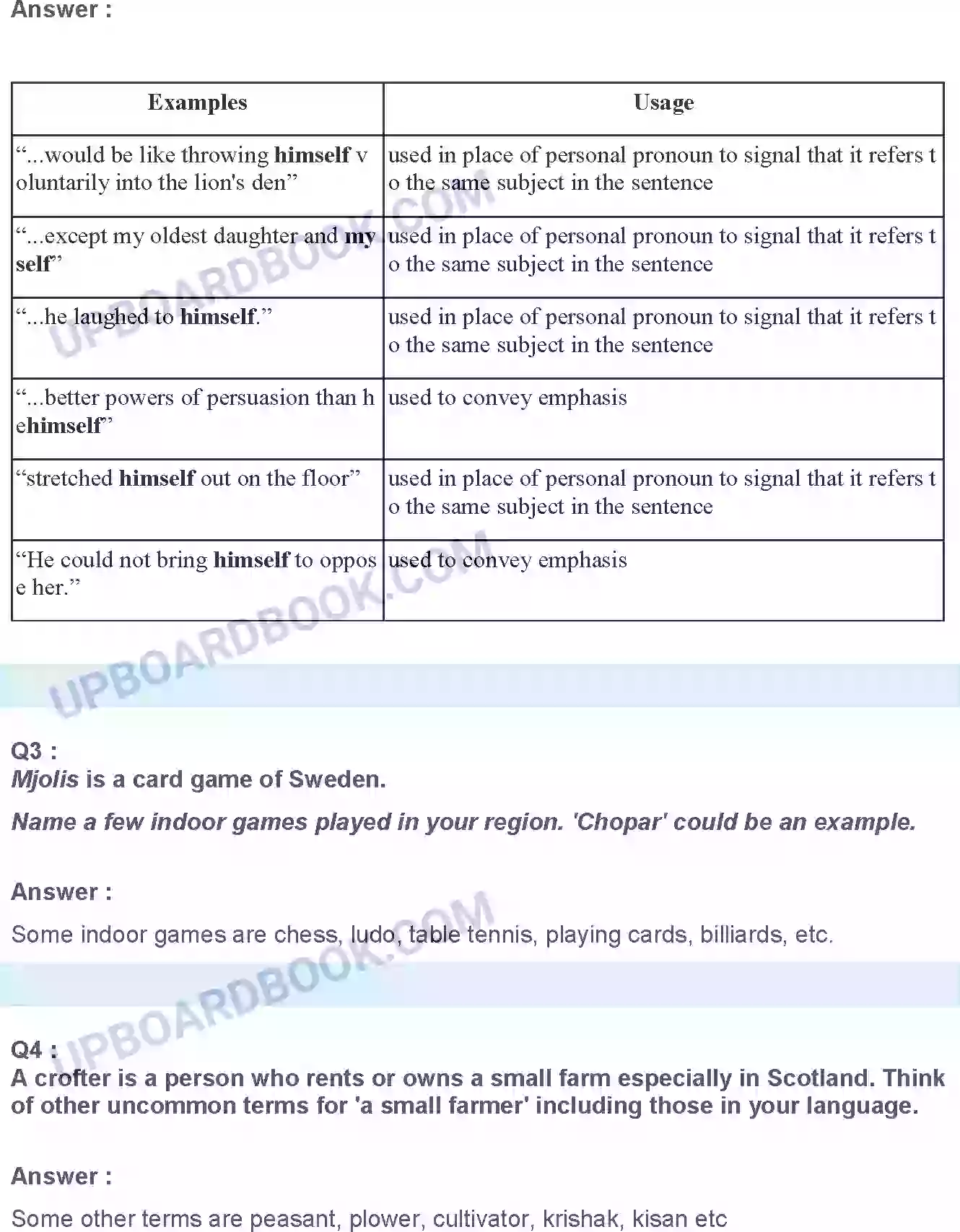
Q3: Name a few indoor games played in your region.
Answer: Chess, Ludo, Carrom, Playing Cards, Table Tennis, Billiards.
Q4: Think of other uncommon terms for 'a small farmer'.
Answer: Peasant, cultivator, tiller, ploughman, kisan (Hindi), krishak (Bengali).
--- End of UP Board Solutions for Chapter 4 - The Rattrap ---
Get UP Board Class 12 English 4. The Rattrap Solution in Hindi Medium
UP Board Class 12 English 4. The Rattrap Solution is available at our platform https://upboardbook.com in hindi medium for free of cost. Content provided on our website is free of cost and in PDF format which is easily available for download. Getting the UP Board Solutions for Class 12 will help student to achieve good learning experience so that they can study effectively. UP board holds examination of more than 3 million students every year and majority of the question of exams are from their UP Board Solutions. That’s why it is important to study using the textSolution issued by UP Board.
Importance of UP Board Class 12 English 4. The Rattrap Text Solutions
It is essential to know the importance of UP Board Class 12 English 4. The Rattrap textSolution issued by UP Board because students completely rely on these Solutions for their study and syllabus offered by UP Board is so balanced that each student should be aware about the importance of it. Below is the list of Importance of UP Board Class 12 English 4. The Rattrap :
- These TextSolutions are very clear and accurate which helps student to understand concept with ease.
- It is also to mention that these text Solutions are prepared by the content experts of subject, thus these Solutions helps student in clearing their doubts and understand the core concept easily.
- It is considered to be the best study material for competitive exam preparation.
Features of UP Board Class 12 textSolutions
There are various features of UP Board Class 12 TextSolutions, some of them are mentioned below so that you student can understand the value and usability of the contend and understand why Uttarpradesh board has prescribed these Solutions.
- Best feature of these textSolutions is free availability of content in PDF format
- Second feature that content generated and written is clear and easy to read.
- There are various illustration and images are shown in the Solution so that student can easily understand the concept and should be more appealing to the student.
- Each chapter is explained thoroughly
