 UPBoardBook
UP Board class 10 English (4. From the Diary of Anne Frank) solution PDF
UP Board class 10 English 4. From the Diary of Anne Frank is a Hindi Medium Solution which is prescribed by Uttar Pradesh Board for their students. These Solutions is completely prepared considering the latest syllabus and it covers every single topis, so that every student get organised and conceptual learning of the concepts. class 10 Students of UP Board who have selected hindi medium as their study medium they can use these Hindi medium textSolutions to prepare themselves for exam and learn the concept with ease.
UP Board class 10 English 4. From the Diary of Anne Frank Hindi Medium Solutions - PDF
Click Here to





UP Board Class 10 English Language and Literature Solutions
First Flight - Chapter 4: From the Diary of Anne Frank
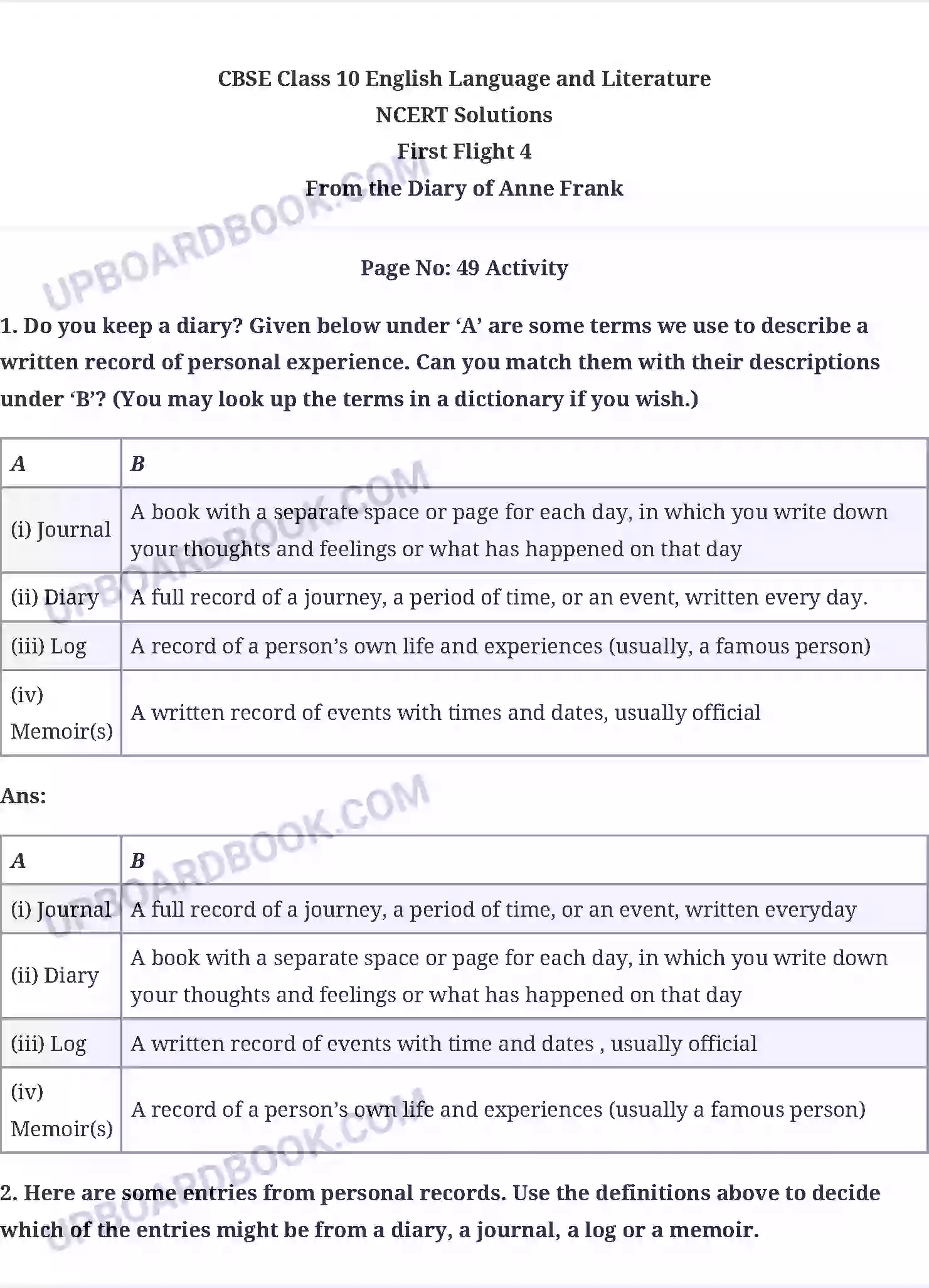
1. Do you Keep a diary? Given below under ‘A’ are some terms we use to describe a written record of personal experience. Can you match them with their descriptions under ‘B’? (You may look up the terms in a dictionary if you wish.)
Ans: The correct matching is as follows:
| A | B |
|---|---|
| (i) Journal | A full record of a journey, a period of time, or an event, written every day. |
| (ii) Diary | A book with a separate space or page for each day, in which you write down your thoughts and feelings or what has happened on that day. |
| (iii) Log | A written record of events with times and dates, usually official. |
| (iv) Memoir(s) | A record of a person’s own life and experiences (usually, a famous person). |
2. Here are some entries from personal records. Use the definitions above to decide which of the entries might be from a diary, a journal, a log or a memoir.
(i) I woke up very late today and promptly got a scolding from Mum! I can’t help it - how can I miss the FIFA World Cup matches?
Ans: Diary - This is a personal, daily entry about feelings and a specific day's event.
(ii) 10:30 a.m. Went to the office of the Director 01:00 p.m. Had lunch with Chairman 05:45 p.m. Received Rahul at the airport 09:30 p.m. Dinner at home
Ans: Log - This is a factual, time-based record of events, similar to an official schedule.
(iii) The ride to Ooty was uneventful. We rested for a while, every 50 km or so, and used the time to capture the magnificent landscape with my handy cam. From Ooty we went on to Bangalore. What a contrast! The noise and pollution of this once - beautiful city really broke my heart.
Ans: Journal - This is a descriptive account of a journey and the experiences during a period of time.
(iv) This is how Raj Kapoor found me - all wet and ragged outside R. K. Studios. He was then looking for just someone like this for a small role in Mera Naam Joker, and he cast me on the spot. The rest, as they say, is history?
Ans: Memoir - This is a recollection of a personal life experience, likely by someone notable, sharing a story from their past.
Page No: 51 Comprehension Check
1. What makes writing in a diary a strange experience for Anne Frank?
Ans: Writing in a diary felt strange to Anne for two main reasons. First, she had never written anything of this kind before. Second, she initially believed that no one would ever be interested in reading the inner thoughts and daily reflections of a thirteen-year-old girl.
2. Why does Anne want to Keep a diary?
Ans: Anne wanted to keep a diary because she felt she had no true friends in whom she could confide. She needed an outlet to express her deepest thoughts, feelings, and the burdens she carried. She saw the diary not just as a book, but as a faithful friend she named 'Kitty'.
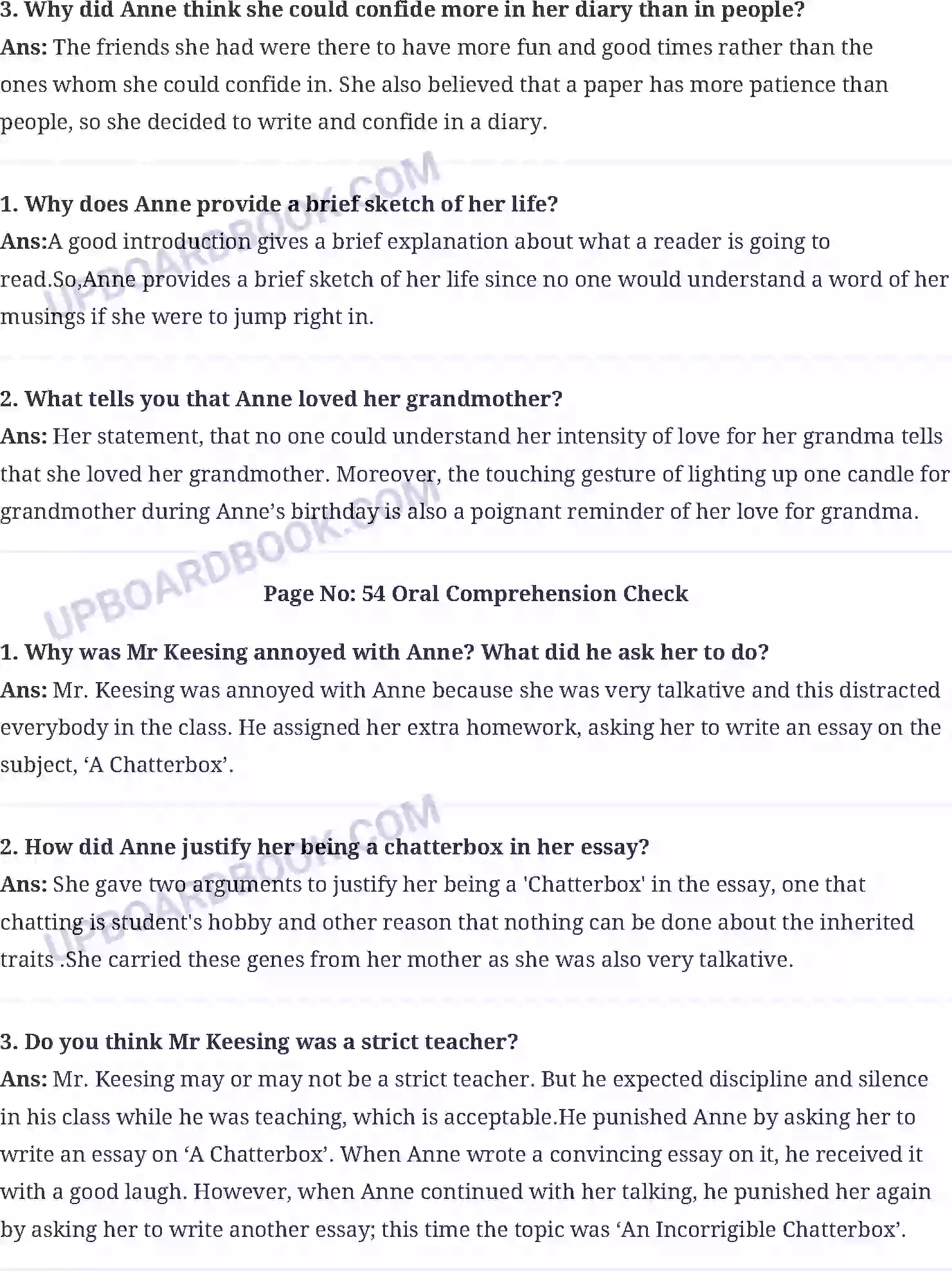
3. Why did Anne think she could confide more in her diary than in people?
Ans: Anne believed that paper had more patience than people. Her friends at school were more for fun and light-hearted times, not for sharing deep secrets or listening to long stories. She felt that her diary would listen without judgment or interruption, making it a more reliable confidant.
1. Why does Anne provide a brief sketch of her life?
Ans: Anne provides a brief introduction to her life to give context to her future diary entries. She thought that if she started writing about her current thoughts and life directly, a future reader would find it confusing. The sketch helps the reader understand her background, family, and situation before diving into her personal musings.
2. What tells you that Anne loved her grandmother?
Ans: Anne's deep love for her grandmother is evident in her actions and words. She mentions that no one could understand how much she thought about and loved her grandma. Even after her grandmother's death, Anne lit a special candle for her during her own birthday celebration, a touching tribute that shows her enduring affection and remembrance.
Page No: 54 Oral Comprehension Check
1. Why was Mr Keesing annoyed with Anne? What did he ask her to do?
Ans: Mr. Keesing was annoyed with Anne because she talked excessively in class, which distracted other students. As a punishment, he assigned her extra homework: to write an essay on the topic 'A Chatterbox'.
2. How did Anne justify her being a chatterbox in her essay?
Ans: In her essay, Anne justified her talkative nature with clever arguments. First, she stated that talking is a student's trait. Second, she humorously argued that she inherited this trait from her mother, who was also very talkative, implying that it was a natural, inborn quality that she could not easily change.
3. Do you think Mr Keesing was a strict teacher?
Ans: Mr. Keesing was a teacher who valued discipline and quiet in his classroom, which is a common expectation. While he punished Anne's constant talking by giving her essays to write, he was not overly harsh or cruel. He appreciated her witty and well-argued essays, laughed at them, and eventually accepted her nature. This shows he had a sense of humor and fairness, making him more firm than strictly stern.
4. What made Mr Keesing allow Anne to talk in class?
Ans: Mr. Keesing allowed Anne to talk in class after she repeatedly turned his punishments into creative successes. Each time he gave her a punitive essay topic ('A Chatterbox', 'An Incorrigible Chatterbox', and a poem on 'Quack, Quack, Quack'), she responded with such clever, humorous, and convincing writing that he was impressed. He finally realized that her talkativeness was a part of her intelligent and bubbly personality, and he decided to accept it, even enjoying her contributions.
Thinking about the Text
1. Was Anne right when she said that the world would not be interested in the musings of a thirteen-year-old girl?
Ans: No, Anne was not right. While many might overlook a teenager's diary, Anne's profound observations, honesty, and poignant writing about life, fear, hope, and human nature during one of history's darkest times proved to be of immense global interest. Her diary, "The Diary of a Young Girl", has become one of the world's most read and important books, showing that the world is deeply interested in the authentic voice of a young girl.
2. There are some examples of diary or journal entries in the ‘Before You Read’ section. Compare these with what Anne writes in her diary. What language was the diary originally written in? In what way is Anne’s dairy different?
Ans: Anne's diary was originally written in Dutch. Her diary is different from typical entries because she personalizes it deeply. She addresses her diary as 'Kitty', treating it as her closest friend. She writes in an informal, conversational tone, sharing not just events but her deepest fears, dreams, and critiques. This transforms her diary from a mere record into an intimate, one-sided dialogue with a trusted companion.
3. Why does Anne need to give a brief sketch about her family? Does she treat ‘Kitty’ as an insider or an outsider?
Ans: Anne gives a brief family sketch to provide essential background. Since she plans to pour out her heart to Kitty, she wants this "friend" to fully understand her world—her caring father, her mother, her sister Margot, and her dear grandmother. She treats Kitty as a complete insider, her most trusted confidante, as she starts entries with "Dearest Kitty" and ends with "Yours, Anne".
4. How does Anne feel about her father, her grandmother, Mrs Kuperus and Mr Keesing? What do these tell you about her?
Ans:
Father: She adored him, calling him "the most adorable father."
Grandmother: She loved and remembered her fondly even after her death.
Mrs. Kuperus: She shared a deep emotional bond with her; their farewell was tearful.
Mr. Keesing: Initially annoyed with her, he later appreciated her wit and intelligence.
These relationships show Anne was a loving, perceptive, and intelligent girl who could form deep connections and win people over with her charm and cleverness.
5. What does Anne write in her first essay?
Ans: In her first essay titled 'A Chatterbox', Anne presents a humorous yet logical defense of her talkative nature. She argues that talking is a student's trait and that she will try to control it. Most cleverly, she writes that she can't be blamed entirely because she inherited this trait from her talkative mother, and one can't change their genes. Mr. Keesing found her arguments amusing.
6. Anne says teachers are most unpredictable. Is Mr. Keesing unpredictable? How?
Ans: Yes, Mr. Keesing proves to be unpredictable. Instead of giving a standard punishment for talking, he assigns creative essay topics as a joke. His reaction to Anne's essays is also unpredictable—instead of getting angrier, he laughs and appreciates her work. Finally, his decision to stop punishing her and even allow her to talk in class is the most unexpected turn, showing he had a flexible and good-humored side.
7. What do these statements tell you about Anne Frank as a person?
(i) We don’t seem to be able to get any closer, and that’s the problem. Maybe it’s my fault that we don’t confide in each other.
Ans: This shows Anne's self-awareness and loneliness. She feels a lack of deep connection with people around her and is introspective enough to consider her own role in it.
(ii) I don’t want to jot down the facts in this diary the way most people would, but I want the diary to be my friend.
Ans: This reveals her creative and emotional depth. She seeks more than a record; she desires a true, personal connection, showing her need for companionship and self-expression.
(iii) Margot went to Holland in December, and I followed in February, when I was plunked down on the table as a birthday present for Margot.
Ans: This displays her witty and humorous outlook. She describes a significant life event with playful language, indicating she can find lightness even in serious situations.
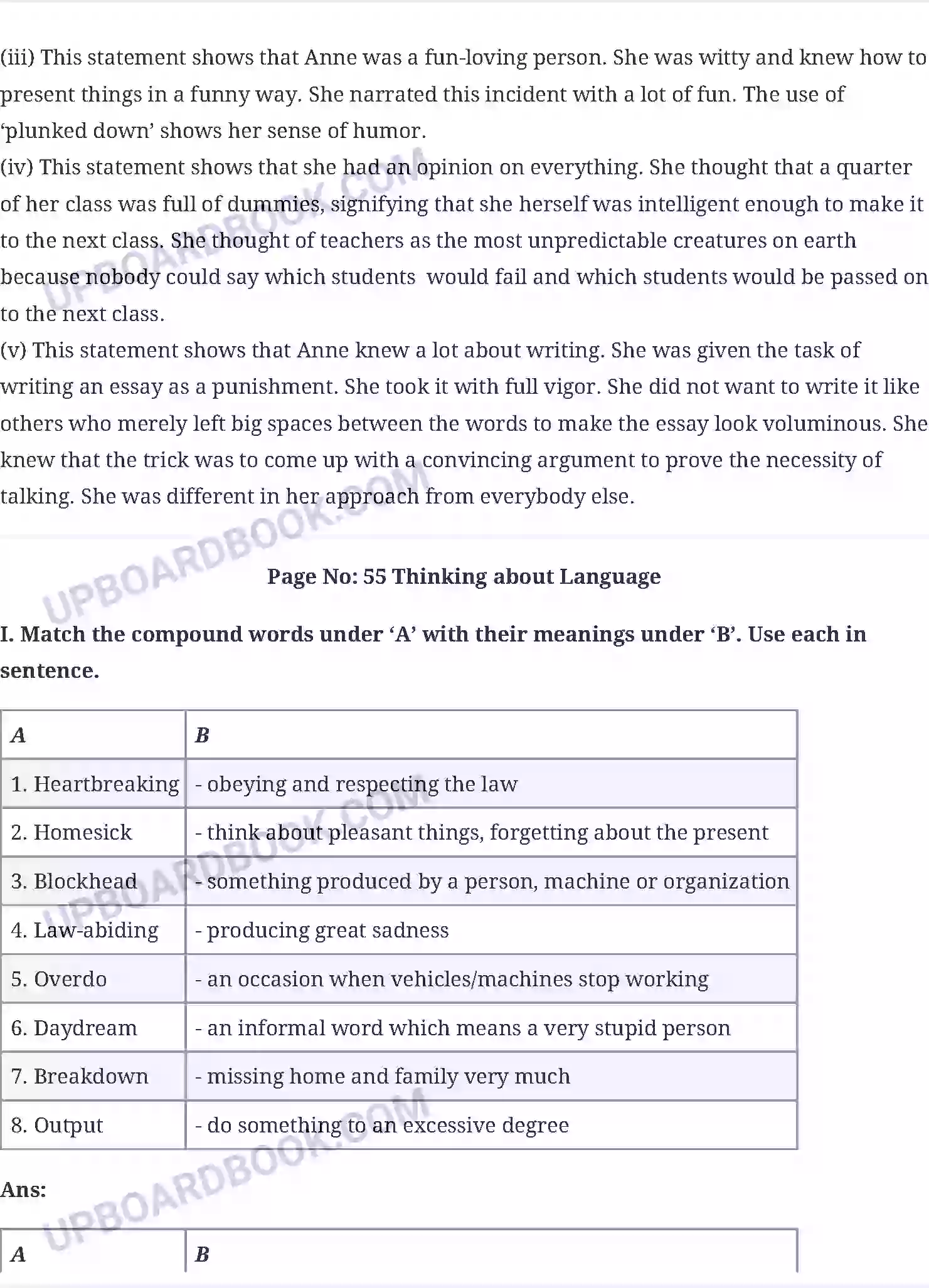
(iv) If you ask me, there are so many dummies that about a quarter of the class should be kept back, but teachers are the most unpredictable creatures on earth.
Ans: This shows she is observant, opinionated, and confident in her own intelligence. She isn't afraid to critique her classmates and the system.
(v) Anyone could ramble on and leave big spaces between the words, but the trick was to come up with convincing arguments to prove the necessity of taking.
Ans: This highlights her intelligence and understanding of effective writing. She knows that quality of argument matters more than simply filling pages, showing her maturity as a writer.
Page No: 55 Thinking about Language
I. Match the compound words under ‘A’ with their meanings under ‘B’. Use each in a sentence.
Ans:
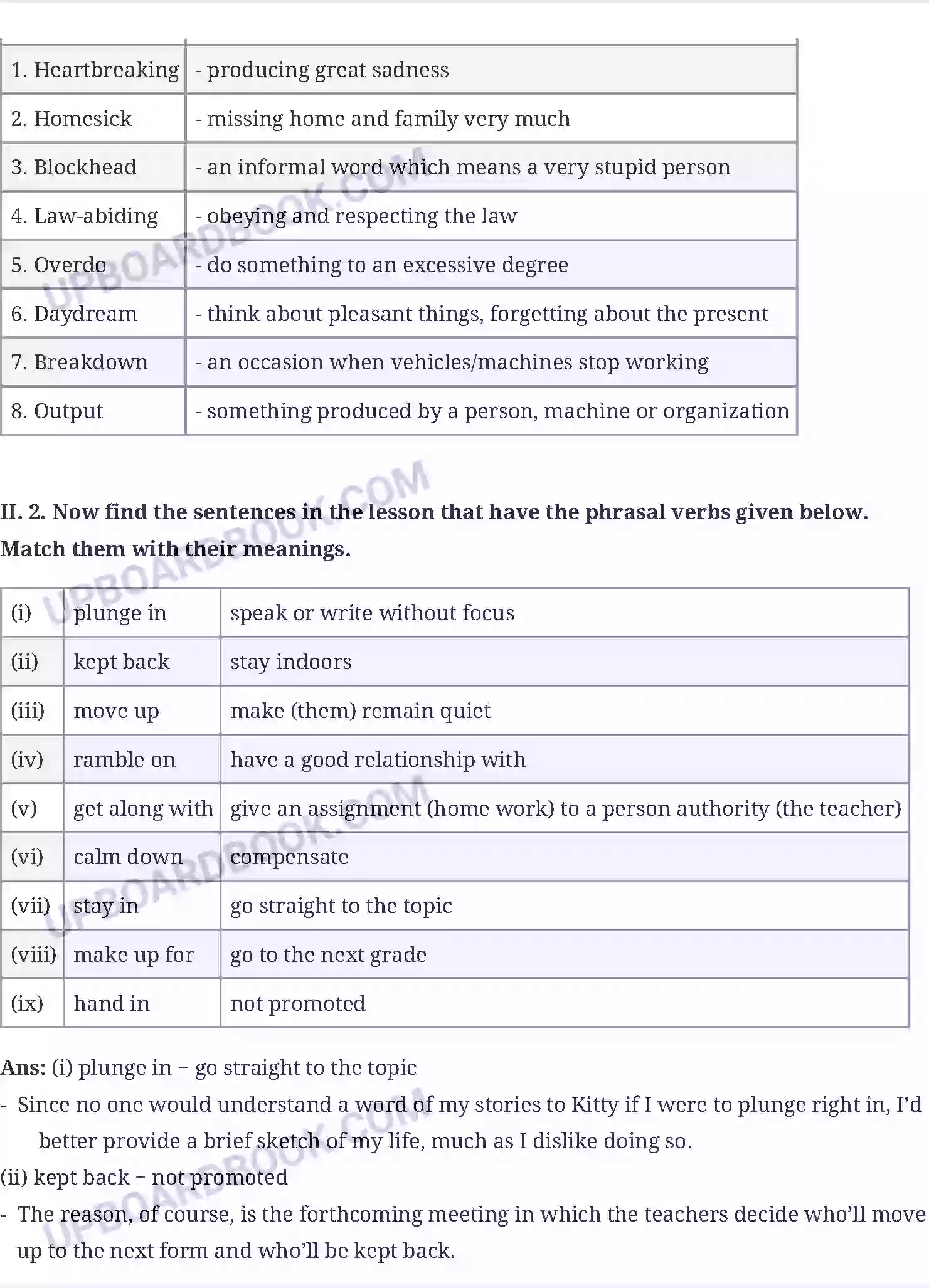
| A | B |
|---|---|
| 1. Heartbreaking | - producing great sadness |
| 2. Homesick | - missing home and family very much |
| 3. Blockhead | - an informal word which means a very stupid person |
| 4. Law-abiding | - obeying and respecting the law |
| 5. Overdo | - do something to an excessive degree |
| 6. Daydream | - think about pleasant things, forgetting about the present |
| 7. Breakdown | - an occasion when vehicles/machines stop working |
| 8. Output | - something produced by a person, machine or organization |
Example Sentences:
1. The movie's ending was absolutely heartbreaking.
2. During his first week at camp, he felt terribly homesick.
3. Don't be such a blockhead; read the instructions carefully!
4. My neighbor is a law-abiding citizen who follows all rules.
5. If you overdo the exercise, you might injure yourself.
6. She would often daydream about becoming a famous singer.
7. We were late due to a breakdown of the school bus.
8. The factory's daily output has increased this month.
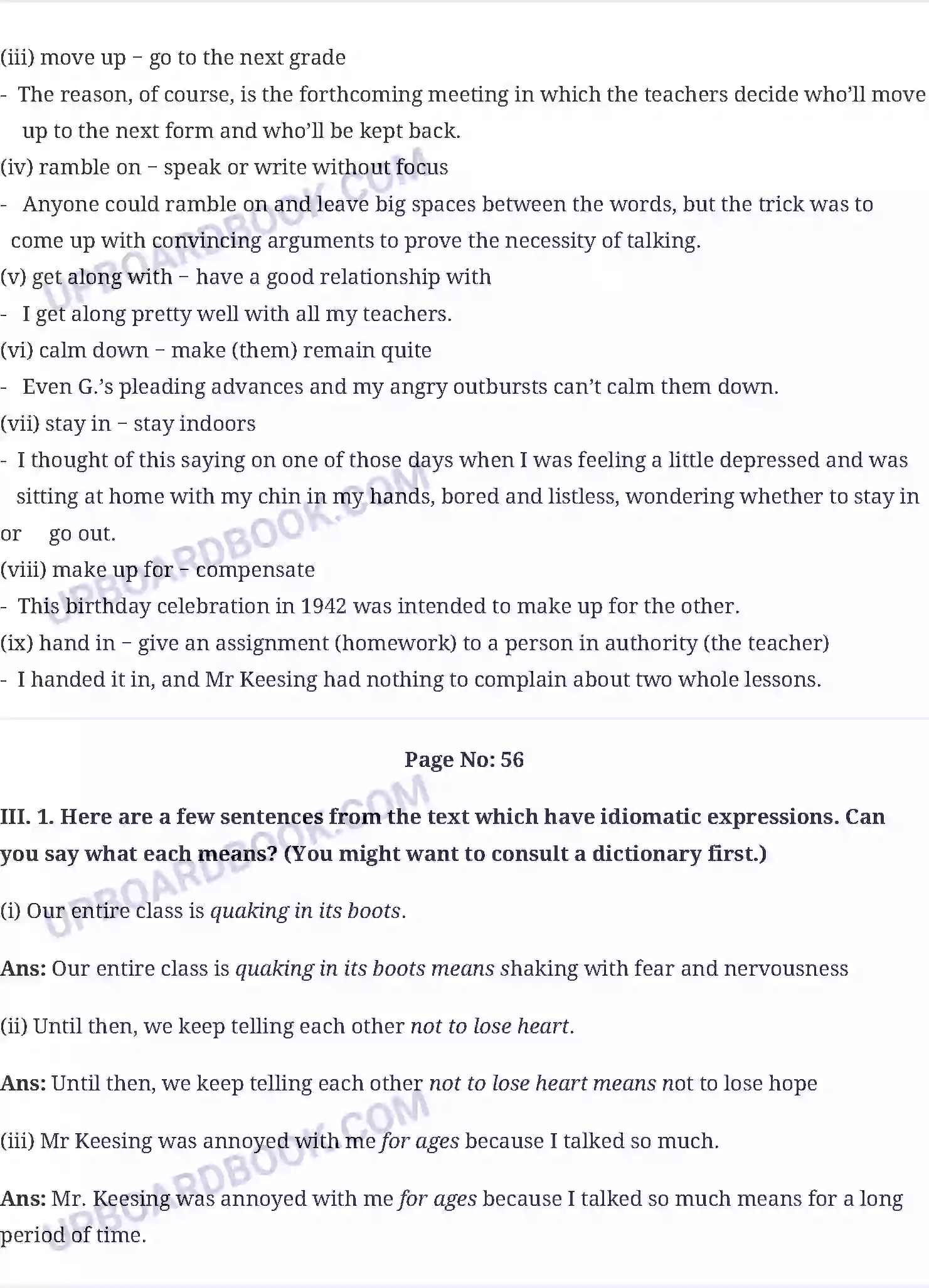
II. Now find the sentences in the lesson that have the phrasal verbs given below. Match them with their meanings.
Ans:
| Phrasal Verb | Meaning | Sentence from the lesson |
|---|---|---|
| (i) plunge in | go straight to the topic | "...if I were to plunge right in, I’d better provide a brief sketch..." |
| (ii) kept back | not promoted | "...who’ll move up to the next form and who’ll be kept back." |
| (iii) move up | go to the next grade | "...who’ll move up to the next form..." |
| (iv) ramble on | speak or write without focus | "Anyone could ramble on and leave big spaces..." |
| (v) get along with | have a good relationship with | "I get along pretty well with all my teachers." |
| (vi) calm down | make (them) remain quiet | "...can’t calm them down." |
| (vii) stay in | stay indoors | "...wondering whether to stay in or go out." |
| (viii) make up for | compensate | "...intended to make up for the other." |
| (ix) hand in | give an assignment to a person in authority | "...handed it in, and Mr Keesing had nothing to complain about..." |
Page No: 56
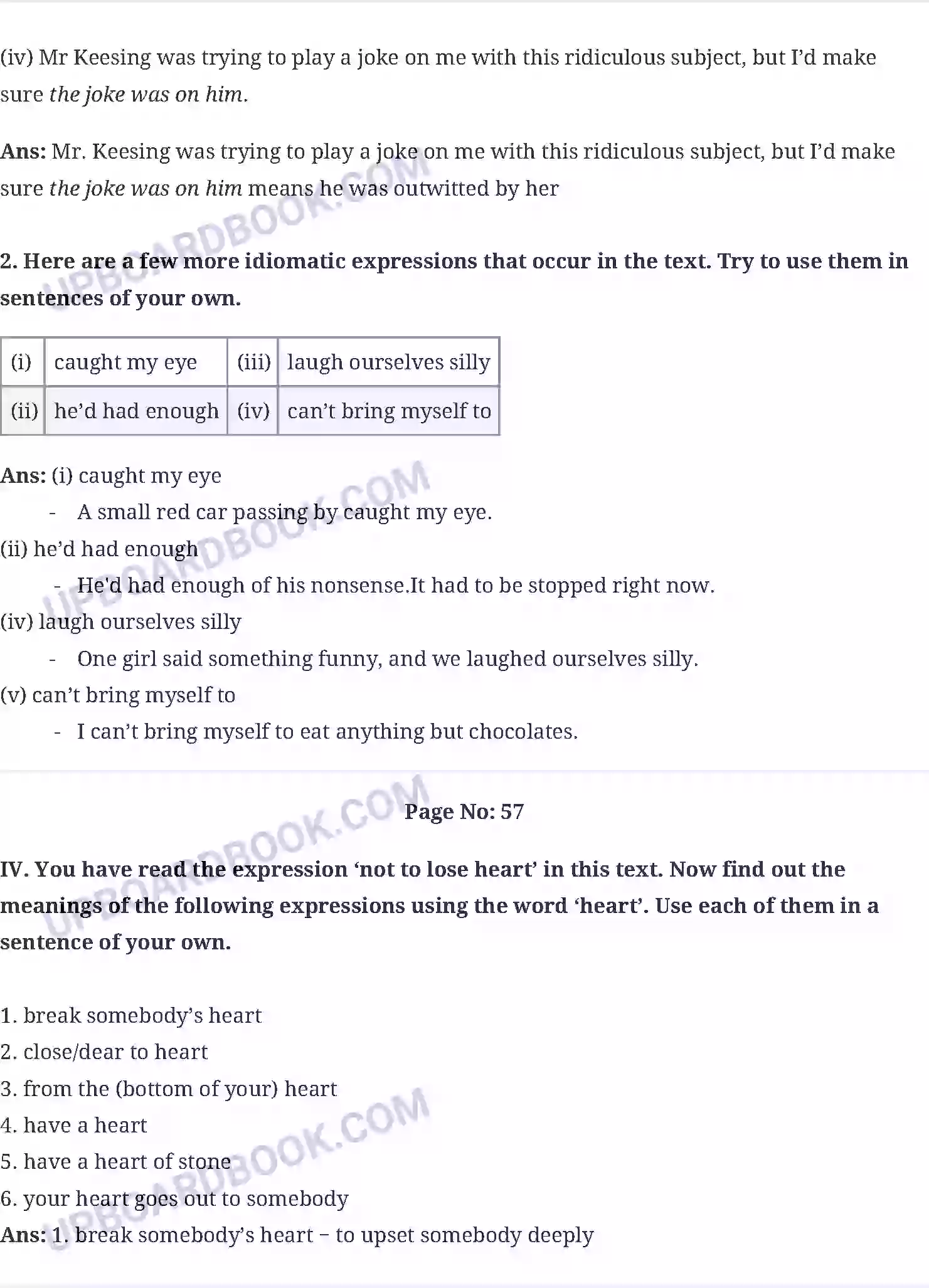
III. 1. Here are a few sentences from the text which have idiomatic expressions. Can you say what each means? (You might want to consult a dictionary first.)
(i) Our entire class is quaking in its boots.
Ans: It means the whole class was trembling with fear or anxiety.
(ii) Until then, we keep telling each other not to lose heart.
Ans: It means to not become discouraged or lose hope.
(iii) Mr Keesing was annoyed with me for ages because I talked so much.
Ans: It means he was annoyed for a very long period of time.
(iv) Mr Keesing was trying to play a joke on me with this ridiculous subject, but I’d make sure the joke was on him.
Ans: It means Anne planned to turn the joke back on him, so that he would become the target of the humor instead of her.
2. Here are a few more idiomatic expressions that occur in the text. Try to use them in sentences of your own.
Ans:
(i) caught my eye: A beautiful painting in the gallery immediately caught my eye.
(ii) he’d had enough: After the third interruption, the teacher said he’d had enough and asked the student to leave.
(iii) laugh ourselves silly: The comedian's jokes were so funny that we laughed ourselves silly.
(iv) can’t bring myself to: I know the food is stale, but I can’t bring myself to waste it.
Page No: 57
IV. You have read the expression ‘not to lose heart’ in this text. Now find out the meanings of the following expressions using the word ‘heart’. Use each of them in a sentence of your own.
Ans:
1. break somebody’s heart: To cause someone deep emotional pain.
Sentence: His thoughtless words broke her heart.
2. close/dear to heart: Very important or loved by someone.
Sentence: The welfare of stray animals is a cause close to her heart.
3. from the (bottom of your) heart: With sincere feeling.
Sentence: I thank you from the bottom of my heart for your kindness.
4. have a heart: To be merciful or sympathetic.
Sentence: Have a heart and forgive his small mistake.
5. have a heart of stone: To be unfeeling or cruel.
Sentence: The villain in the story had a heart of stone.
6. your heart goes out to somebody: To feel great sympathy for someone.
Sentence: My heart goes out to the families affected by the flood.
Page No: 58
V. 1. Make a list of the contracted forms in the text. Rewrite them as full forms of two words.
Ans:
I’ve = I have
Doesn’t = does not
Won’t = will not
I’m = I am
Don’t = do not
Can’t = cannot
It’s = it is
That’s = that is
I’d = I would / I had
Didn’t = did not
Who’ll = who will
You’re = you are
We’ll = we will
There’s = there is
He’d = he had / he would
Who’s = who is
Haven’t = have not
2. We have seen that some contracted forms can stand for two different full forms: I’d = I had or I would. Find in the text the contracted forms that stand for two different full forms, and say what these are.
Ans:
(i) I’d - This can stand for "I had" or "I would".
(ii) He’d - This can stand for "He had" or "He would".
Get UP Board class 10 English 4. From the Diary of Anne Frank Solution in Hindi Medium
UP Board class 10 English 4. From the Diary of Anne Frank Solution is available at our platform https://upboardbook.com in hindi medium for free of cost. Content provided on our website is free of cost and in PDF format which is easily available for download. Getting the UP Board Solutions for class 10 will help student to achieve good learning experience so that they can study effectively. UP board holds examination of more than 3 million students every year and majority of the question of exams are from their UP Board Solutions. That’s why it is important to study using the textSolution issued by UP Board.
Importance of UP Board class 10 English 4. From the Diary of Anne Frank Text Solutions
It is essential to know the importance of UP Board class 10 English 4. From the Diary of Anne Frank textSolution issued by UP Board because students completely rely on these Solutions for their study and syllabus offered by UP Board is so balanced that each student should be aware about the importance of it. Below is the list of Importance of UP Board class 10 English 4. From the Diary of Anne Frank :
- These TextSolutions are very clear and accurate which helps student to understand concept with ease.
- It is also to mention that these text Solutions are prepared by the content experts of subject, thus these Solutions helps student in clearing their doubts and understand the core concept easily.
- It is considered to be the best study material for competitive exam preparation.
Features of UP Board class 10 textSolutions
There are various features of UP Board class 10 TextSolutions, some of them are mentioned below so that you student can understand the value and usability of the contend and understand why Uttarpradesh board has prescribed these Solutions.
- Best feature of these textSolutions is free availability of content in PDF format
- Second feature that content generated and written is clear and easy to read.
- There are various illustration and images are shown in the Solution so that student can easily understand the concept and should be more appealing to the student.
- Each chapter is explained thoroughly
