 UPBoardBook
UP Board class 10 English (7. Glimpses of India) solution PDF
UP Board class 10 English 7. Glimpses of India is a Hindi Medium Solution which is prescribed by Uttar Pradesh Board for their students. These Solutions is completely prepared considering the latest syllabus and it covers every single topis, so that every student get organised and conceptual learning of the concepts. class 10 Students of UP Board who have selected hindi medium as their study medium they can use these Hindi medium textSolutions to prepare themselves for exam and learn the concept with ease.
UP Board class 10 English 7. Glimpses of India Hindi Medium Solutions - PDF
Click Here to
UP Board Solutions for Class 10 English First Flight
Chapter 7: Glimpses of India
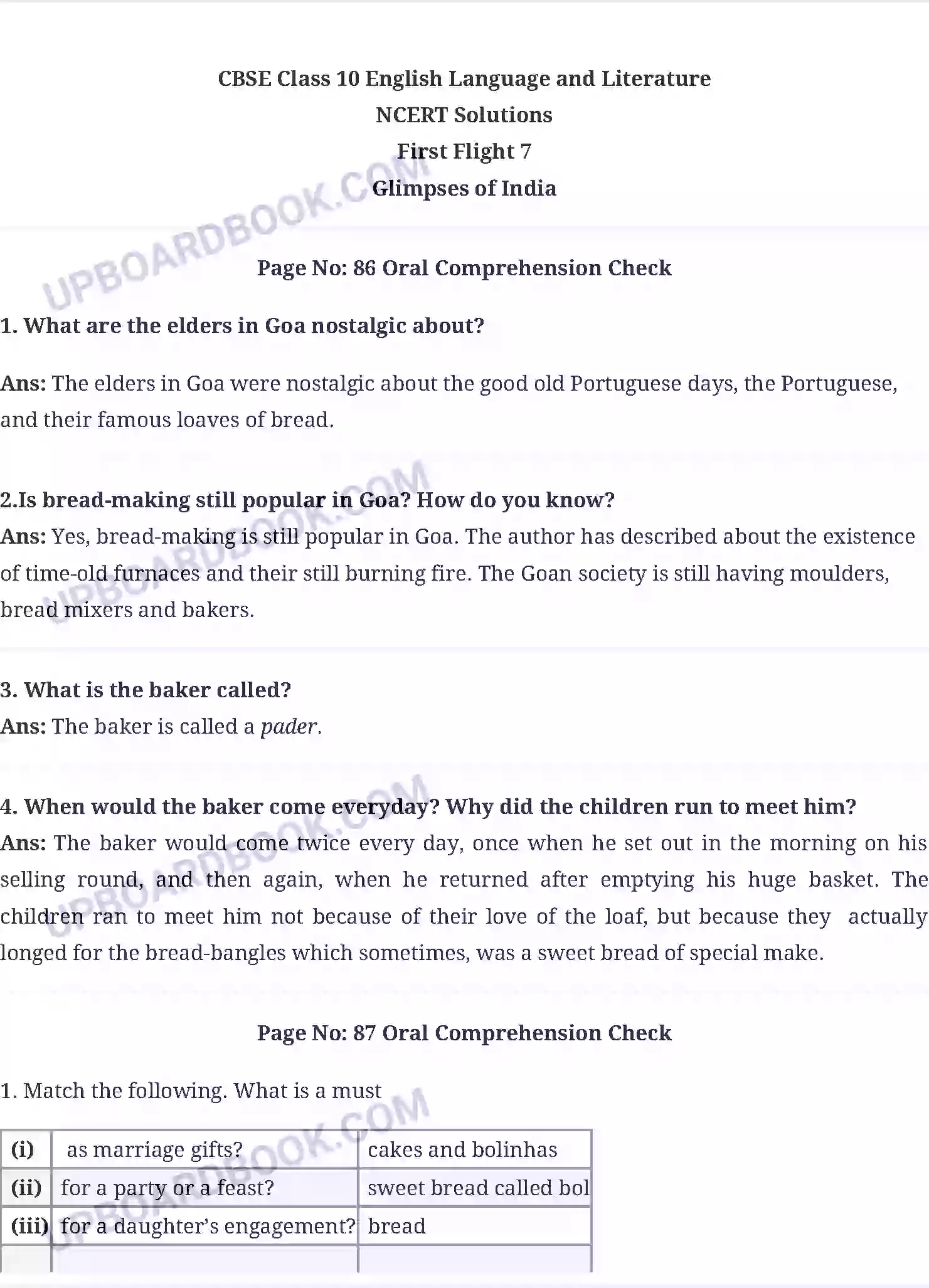
Page No: 86 Oral Comprehension Check
1. What are the elders in Goa nostalgic about?
Ans: The elders in Goa often feel nostalgic about the times when the Portuguese ruled Goa. They fondly remember the old days, the Portuguese people, and especially the delicious and famous loaves of bread that were baked during that era.
2.Is bread-making still popular in Goa? How do you know?
Ans: Yes, bread-making is definitely still a popular and thriving tradition in Goa. The author provides evidence by mentioning that the old furnaces used for baking are still present and their fires are kept burning. Furthermore, the community still has traditional bread moulders, mixers, and professional bakers, indicating that the practice is very much alive.
3. What is the baker called?
Ans: In Goa, the baker is traditionally called a pader.
4. When would the baker come everyday? Why did the children run to meet him?
Ans: The baker would visit twice each day. His first round was in the morning when he started his selling journey, and he would return later after selling all the bread from his large basket. The children would run eagerly to meet him, not just for the regular loaves, but specifically for the sweet, ring-shaped bread-bangles that he sometimes carried, which were a special treat for them.
Page No: 87 Oral Comprehension Check
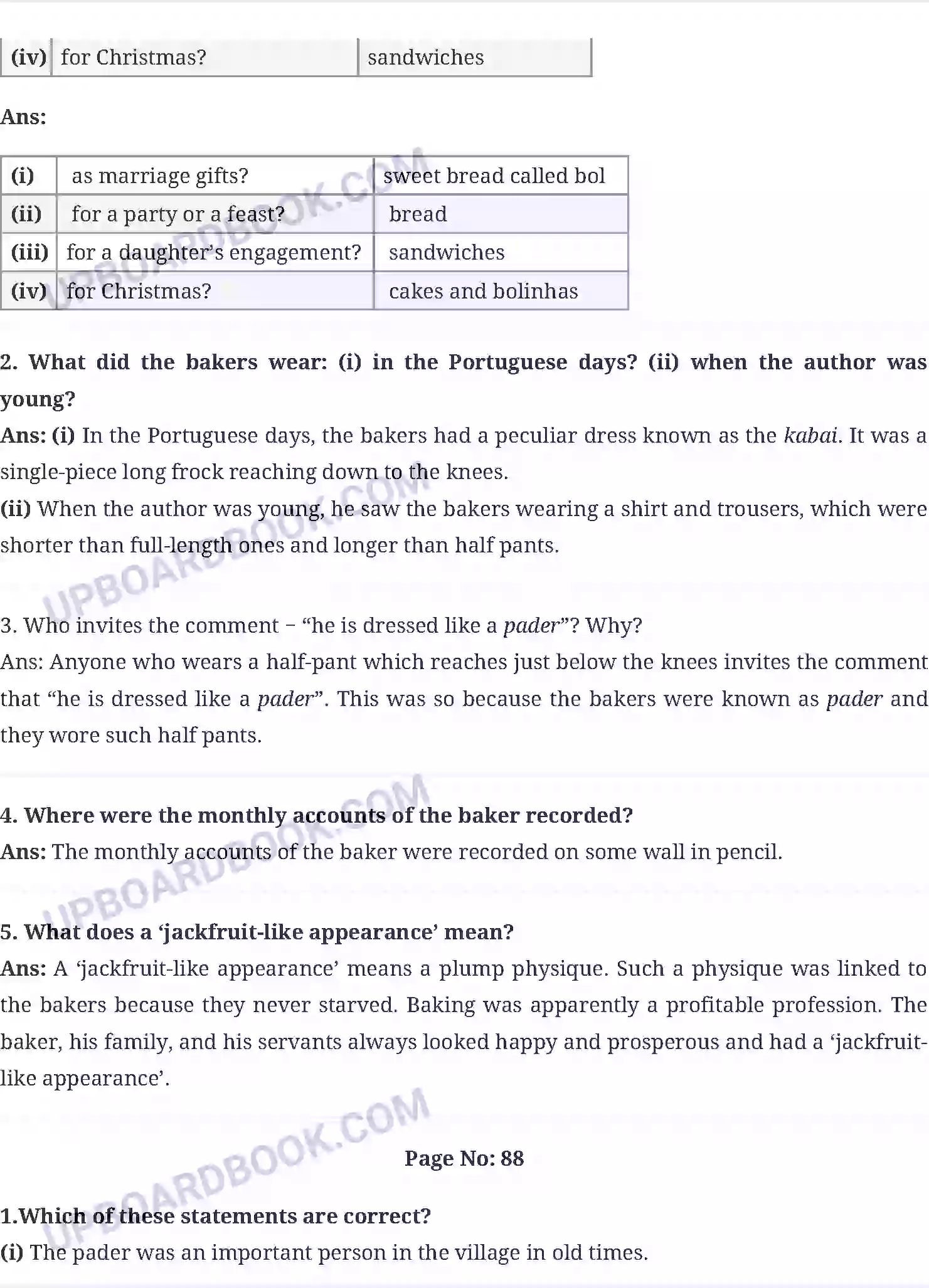
1. Match the following. What is a must
(i) as marriage gifts? cakes and bolinhas
(ii) for a party or a feast? sweet bread called bol
(iii) for a daughter’s engagement? bread
(iv) for Christmas? sandwiches
Ans:
| For what occasion? | What is a must? |
|---|---|
| (i) as marriage gifts? | sweet bread called bol |
| (ii) for a party or a feast? | bread |
| (iii) for a daughter’s engagement? | sandwiches |
| (iv) for Christmas? | cakes and bolinhas |
2. What did the bakers wear: (i) in the Portuguese days? (ii) when the author was young?
Ans:
(i) During the Portuguese rule, bakers wore a distinctive dress known as the kabai. It was a single-piece, long frock that reached down to their knees.
(ii) When the author was a child, he saw bakers wearing a shirt paired with trousers. These trousers were unique—they were shorter than full-length pants but longer than half-pants.
3. Who invites the comment - “he is dressed like a pader”? Why?
Ans: Any person who wears half-pants that end just below the knees is likely to hear the comment, “he is dressed like a pader.” This saying originated because bakers (paders) were famously known for wearing such half-pants as part of their traditional attire.
4. Where were the monthly accounts of the baker recorded?
Ans: The baker’s monthly accounts were not kept in a formal ledger. Instead, they were casually recorded in pencil on a wall in the house.
5. What does a ‘jackfruit-like appearance’ mean?
Ans: A ‘jackfruit-like appearance’ refers to a healthy, plump, and well-fed body. This description was commonly associated with bakers because their profession was prosperous and they never faced hunger. The baker, along with his family and servants, always appeared happy, healthy, and financially stable, hence the comparison to a robust jackfruit.
Page No: 88
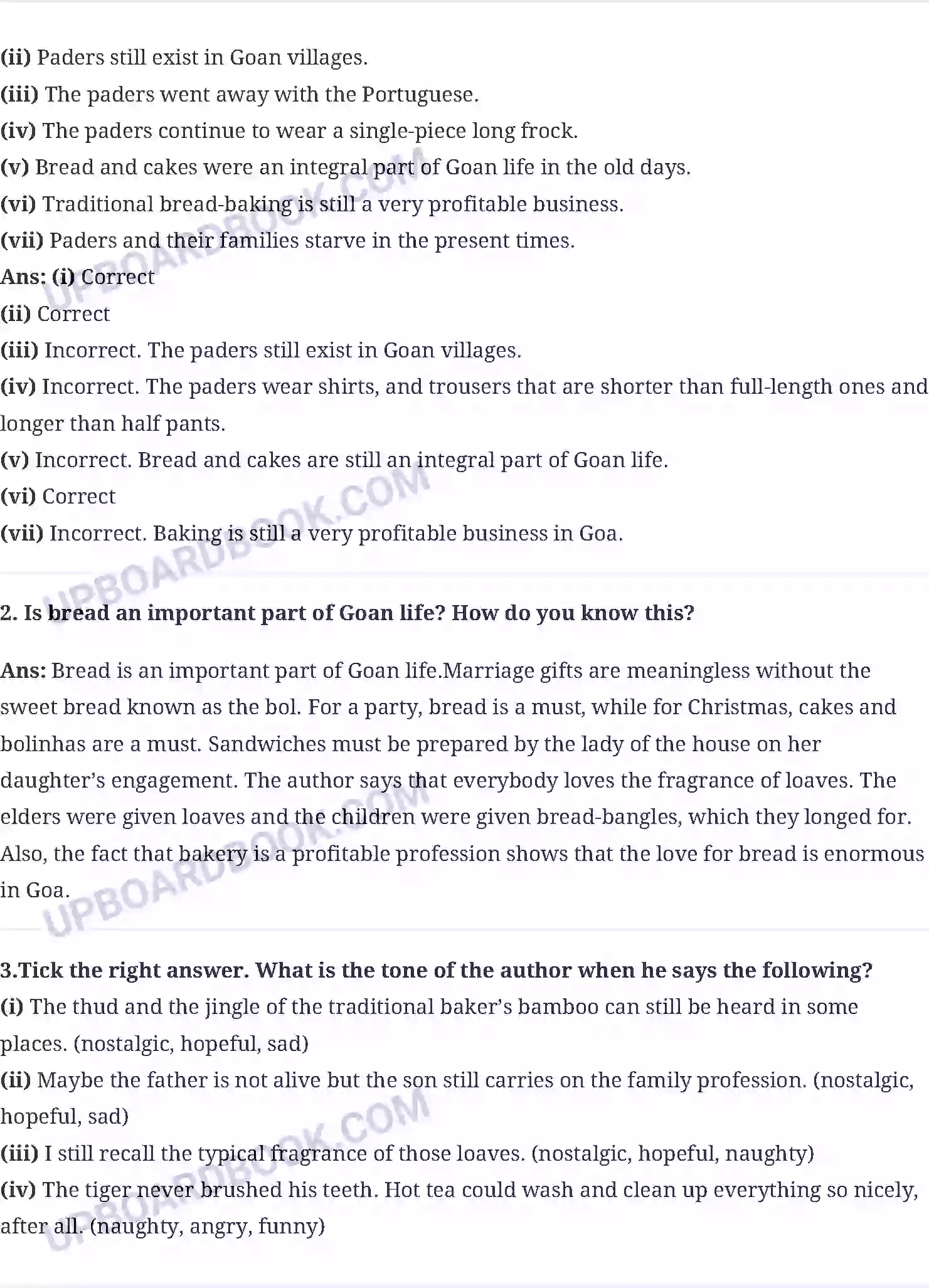
1.Which of these statements are correct?
(i) The pader was an important person in the village in old times.
(ii) Paders still exist in Goan villages.
(iii) The paders went away with the Portuguese.
(iv) The paders continue to wear a single-piece long frock.
(v) Bread and cakes were an integral part of Goan life in the old days.
(vi) Traditional bread-baking is still a very profitable business.
(vii) Paders and their families starve in the present times.
Ans:
(i) Correct. The baker was a central figure in the village community.
(ii) Correct. Bakers (paders) are still found in Goan villages today.
(iii) Incorrect. Paders did not leave with the Portuguese; they continued their trade.
(iv) Incorrect. The traditional kabai is no longer worn. Modern paders wear shirts and trousers.
(v) Incorrect. Bread and cakes are still an integral part of Goan life, not just in the past.
(vi) Correct. Baking remains a lucrative profession in Goa.
(vii) Incorrect. Baking is profitable, so paders and their families do not starve.
2. Is bread an important part of Goan life? How do you know this?
Ans: Yes, bread is an extremely important part of Goan culture and daily life. This is evident from its role in various ceremonies and traditions. The sweet bread known as bol is essential for marriage gifts. No party is complete without bread, and Christmas requires cakes and bolinhas. For a daughter’s engagement, the lady of the house must prepare sandwiches. The author also mentions the beloved fragrance of fresh loaves and how children eagerly awaited bread-bangles. The continued profitability of bakeries further proves Goa’s deep and enduring love for bread.
3.Tick the right answer. What is the tone of the author when he says the following?
(i) The thud and the jingle of the traditional baker’s bamboo can still be heard in some places. (nostalgic, hopeful, sad)
(ii) Maybe the father is not alive but the son still carries on the family profession. (nostalgic, hopeful, sad)
(iii) I still recall the typical fragrance of those loaves. (nostalgic, hopeful, naughty)
(iv) The tiger never brushed his teeth. Hot tea could wash and clean up everything so nicely, after all. (naughty, angry, funny)
(v) Cakes and bolinhas are a must for Christmas as well as other festivals. (sad, hopeful, matter-of-fact)
(vi) The baker and his family never starved. They always looked happy and prosperous. (matter-of-fact, hopeful, sad)
Ans:
(i) Nostalgic
(ii) Nostalgic
(iii) Nostalgic
(iv) Funny
(v) Matter-of-fact
(vi) Matter-of-fact
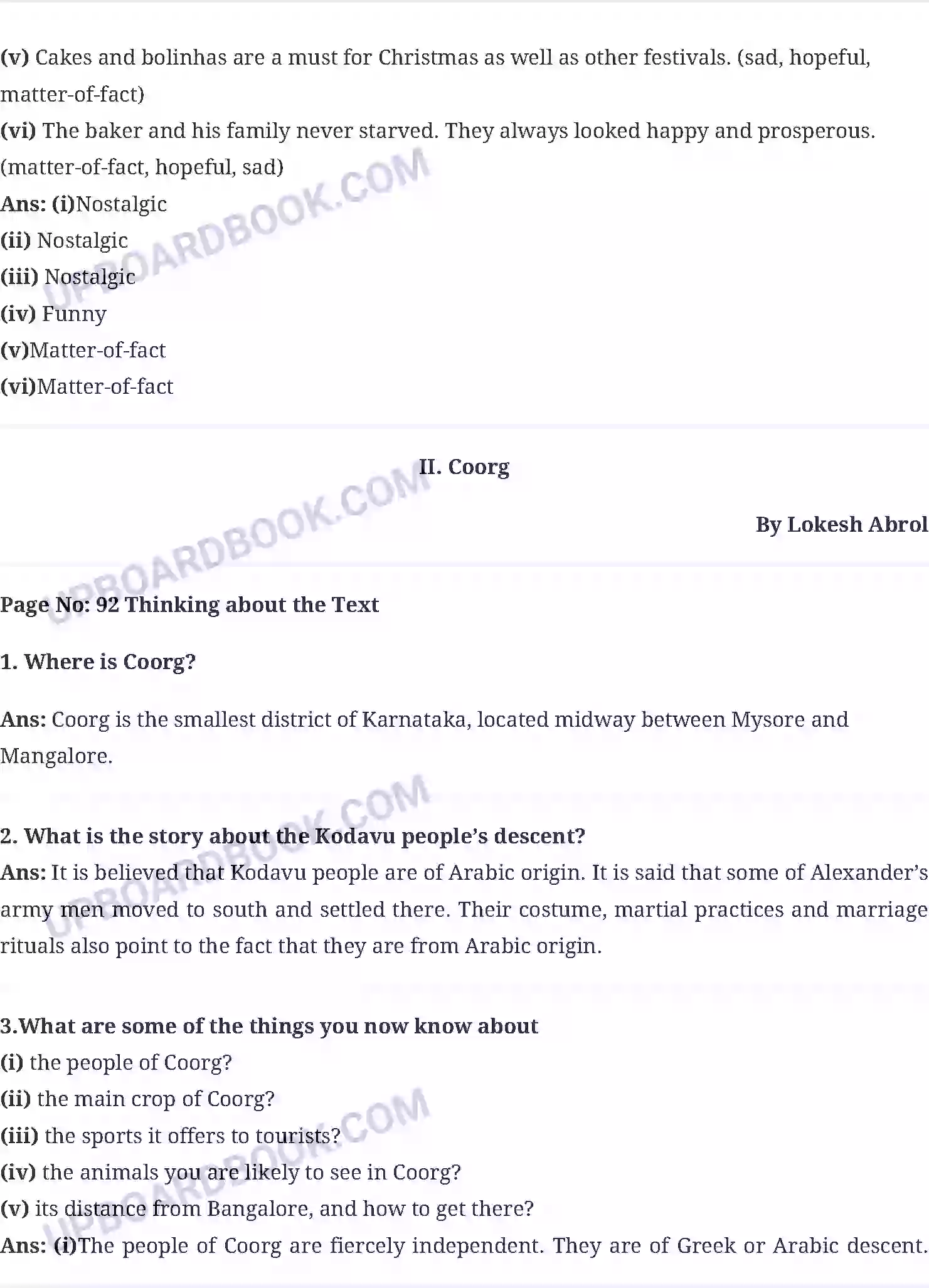
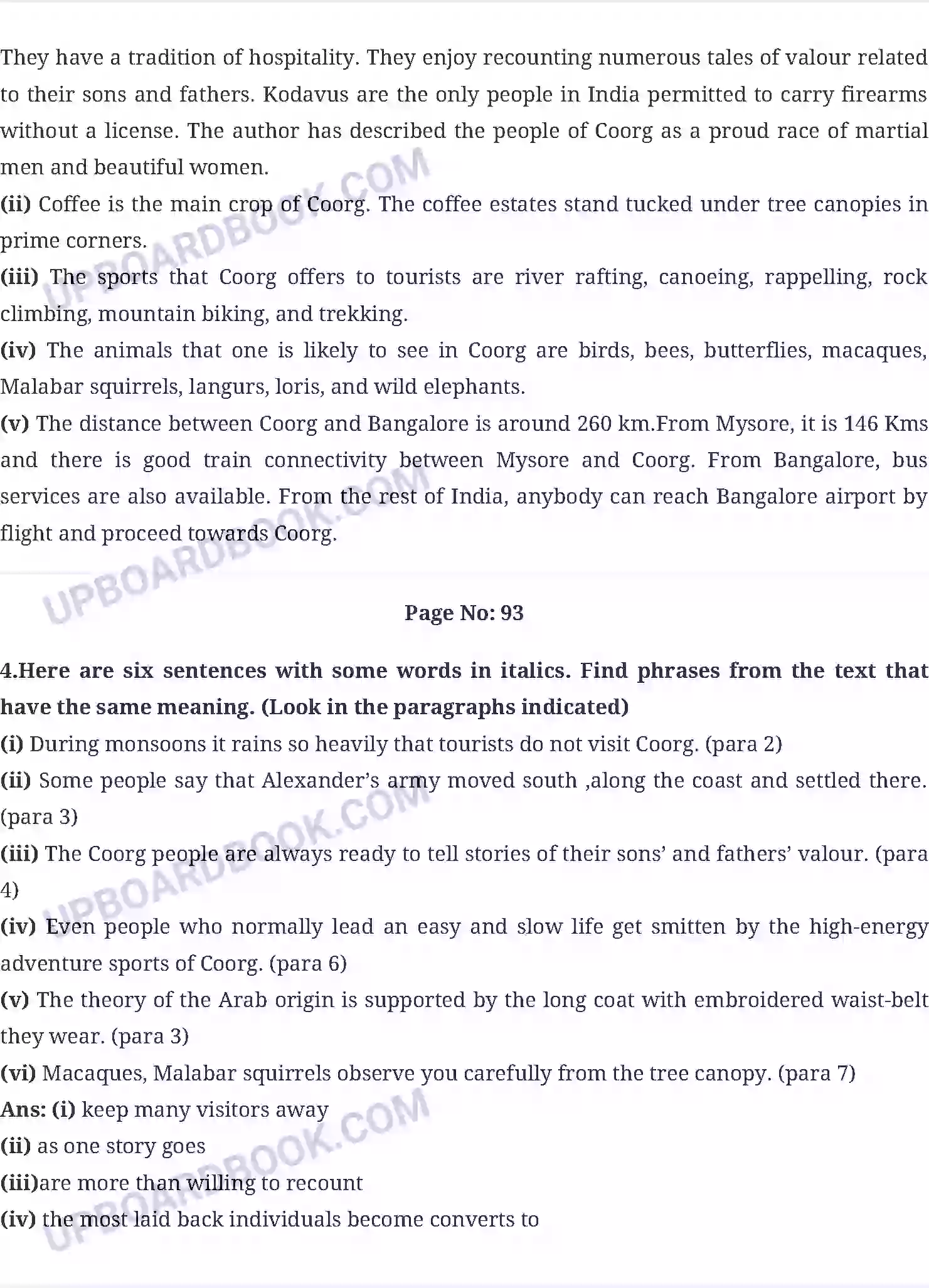
II. Coorg
By Lokesh Abrol
Page No: 92 Thinking about the Text
1. Where is Coorg?
Ans: Coorg, also known as Kodagu, is the smallest district in the state of Karnataka. It is situated approximately halfway between the cities of Mysore and Mangalore.
2. What is the story about the Kodavu people’s descent?
Ans: There are interesting stories about the origin of the Kodavu people. One popular belief is that they are of Arabic descent. Another story suggests that they are descendants of Greek or Iranian soldiers from Alexander the Great’s army, who moved south and settled in Coorg. Their distinct traditional dress (long coats with embroidered belts), martial customs, and marriage rituals seem to support these theories of foreign origin.
3.What are some of the things you now know about
(i) the people of Coorg?
(ii) the main crop of Coorg?
(iii) the sports it offers to tourists?
(iv) the animals you are likely to see in Coorg?
(v) its distance from Bangalore, and how to get there?
Ans:
(i) The people of Coorg are known for their bravery, independence, and hospitality. They are possibly of Greek or Arabic descent. They love to tell stories of courage about their ancestors. Interestingly, they are the only Indians allowed to carry firearms without a license. The author describes them as a proud community of warrior-like men and very beautiful women.
(ii) The main agricultural crop of Coorg is coffee. Vast coffee estates are nestled under the shade of tall trees.
(iii) Coorg offers tourists a range of exciting adventure sports including river rafting, canoeing, rappelling, rock climbing, mountain biking, and trekking.
(iv) In the forests of Coorg, one can see a variety of animals such as birds, bees, butterflies, macaques, Malabar squirrels, langurs, loris, and even wild elephants.
(v) Coorg is about 260 km away from Bangalore. One can take a flight to Bangalore or Mangalore airport and then proceed by road. There are also good bus and train connections via Mysore, which is about 146 km from Coorg.
Page No: 93
4.Here are six sentences with some words in italics. Find phrases from the text that have the same meaning. (Look in the paragraphs indicated)
(i) During monsoons it rains so heavily that tourists do not visit Coorg. (para 2)
(ii) Some people say that Alexander’s army moved south ,along the coast and settled there. (para 3)
(iii) The Coorg people are always ready to tell stories of their sons’ and fathers’ valour. (para 4)
(iv) Even people who normally lead an easy and slow life get smitten by the high-energy adventure sports of Coorg. (para 6)
(v) The theory of the Arab origin is supported by the long coat with embroidered waist-belt they wear. (para 3)
(vi) Macaques, Malabar squirrels observe you carefully from the tree canopy. (para 7)
Ans:
(i) keep many visitors away
(ii) as one story goes
(iii) are more than willing to recount
(iv) the most laid back individuals become converts to
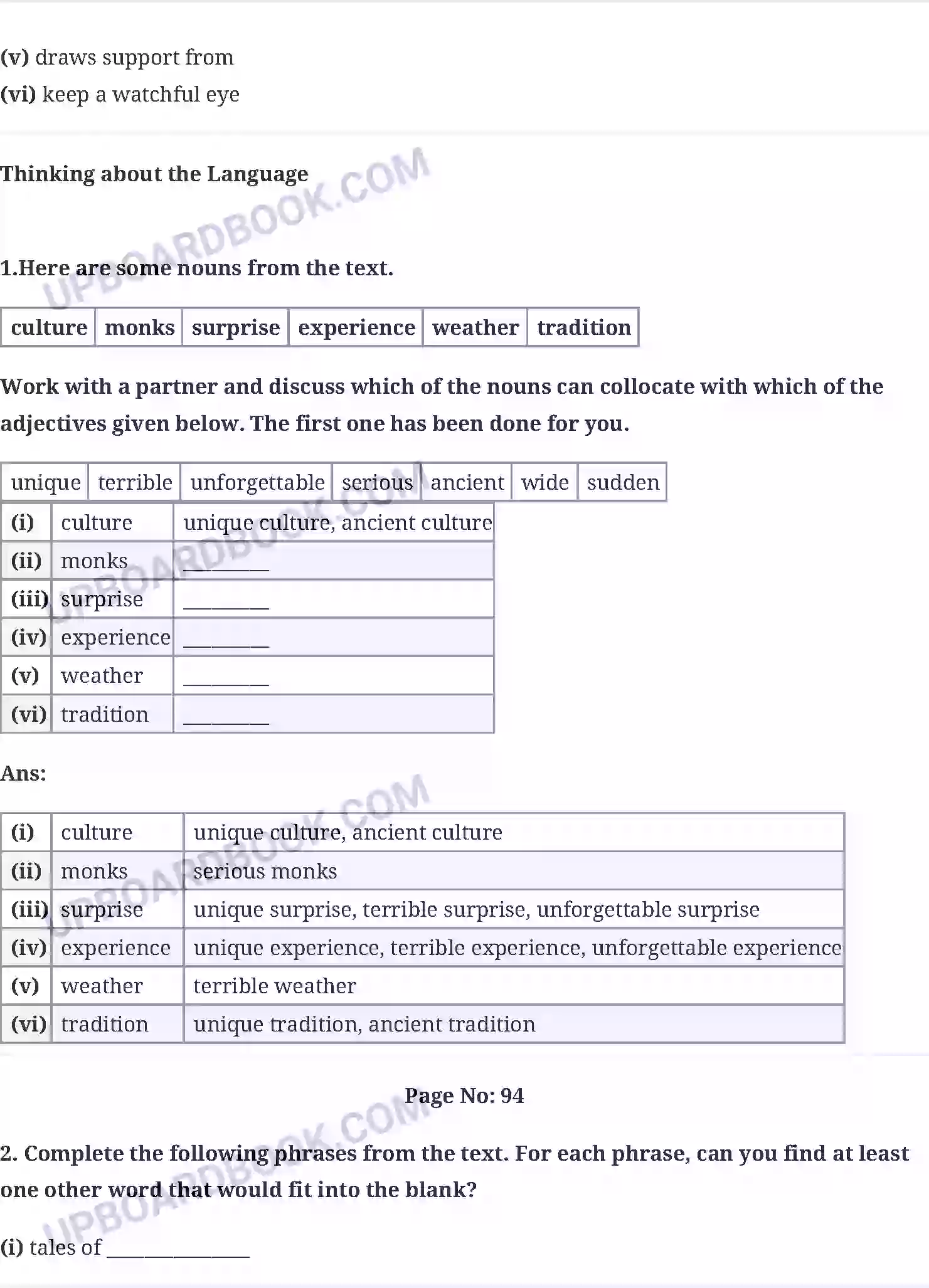
(v) draws support from
(vi) keep a watchful eye
Page No: 93 Thinking about the Language
1.Here are some nouns from the text.
culture | monks | surprise | experience | weather | tradition
Work with a partner and discuss which of the nouns can collocate with which of the adjectives given below. The first one has been done for you.
unique | terrible | unforgettable | serious | ancient | wide | sudden
(i) culture: unique culture, ancient culture
(ii) monks
(iii) surprise
(iv) experience
(v) weather
(vi) tradition
Ans:
(i) culture: unique culture, ancient culture
(ii) monks: serious monks
(iii) surprise: unique surprise, terrible surprise, unforgettable surprise
(iv) experience: unique experience, terrible experience, unforgettable experience
(v) weather: terrible weather
(vi) tradition: unique tradition, ancient tradition
Page No: 94
2. Complete the following phrases from the text. For each phrase, can you find at least one other word that would fit into the blank?
(i) tales of ________
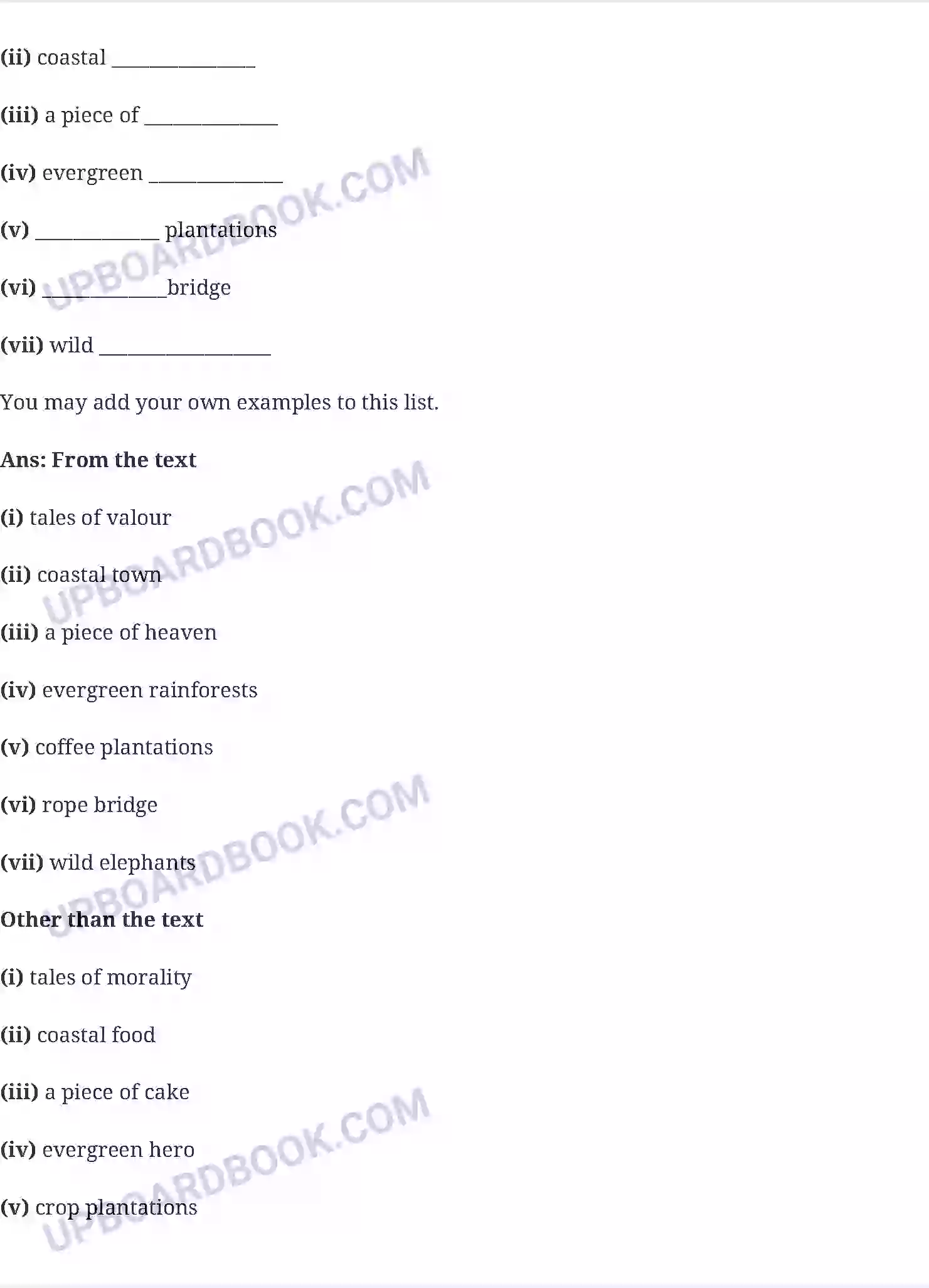
(ii) coastal ________
(iii) a piece of ________
(iv) evergreen ________
(v) ________ plantations
(vi) ________ bridge
(vii) wild ________
Ans:
From the text:
(i) tales of valour
(ii) coastal town
(iii) a piece of heaven
(iv) evergreen rainforests
(v) coffee plantations
(vi) rope bridge
(vii) wild elephants
Other possible words:
(i) tales of morality
(ii) coastal food
(iii) a piece of cake
(iv) evergreen hero
(v) crop plantations
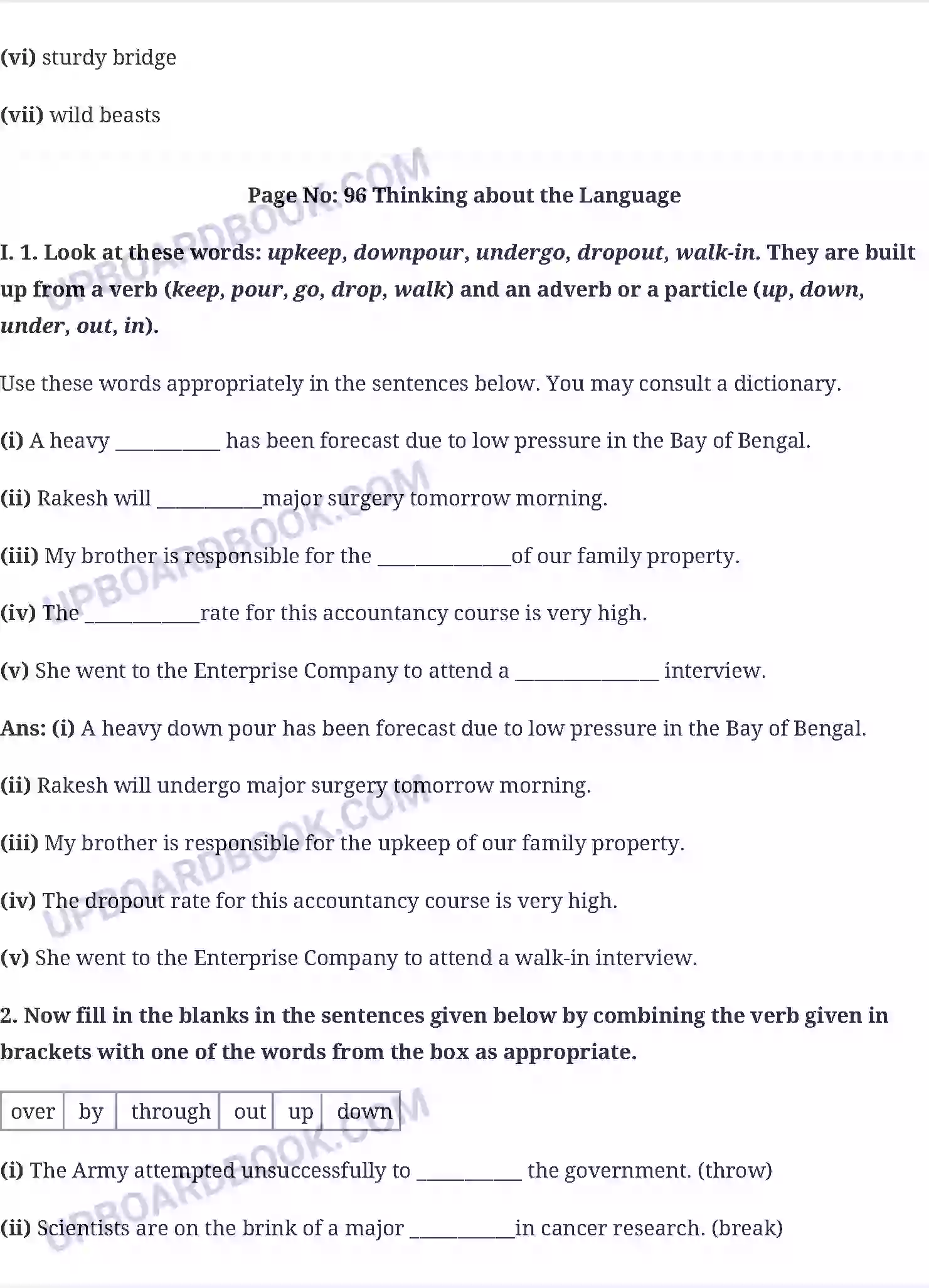
(vi) sturdy bridge
(vii) wild beasts
Page No: 96 Thinking about the Language
I. 1. Look at these words: upkeep, downpour, undergo, dropout, walk-in. They are built up from a verb (keep, pour, go, drop, walk) and an adverb or a particle (up, down, under, out, in).
Use these words appropriately in the sentences below. You may consult a dictionary.
(i) A heavy ________ has been forecast due to low pressure in the Bay of Bengal.
(ii) Rakesh will ________ major surgery tomorrow morning.
(iii) My brother is responsible for the ________ of our family property.
(iv) The ________ rate for this accountancy course is very high.
(v) She went to the Enterprise Company to attend a ________ interview.
Ans:
(i) A heavy downpour has been forecast due to low pressure in the Bay of Bengal.
(ii) Rakesh will undergo major surgery tomorrow morning.
(iii) My brother is responsible for the upkeep of our family property.
(iv) The dropout rate for this accountancy course is very high.
(v) She went to the Enterprise Company to attend a walk-in interview.
2. Now fill in the blanks in the sentences given below by combining the verb given in brackets with one of the words from the box as appropriate.
over | by | through | out | up | down
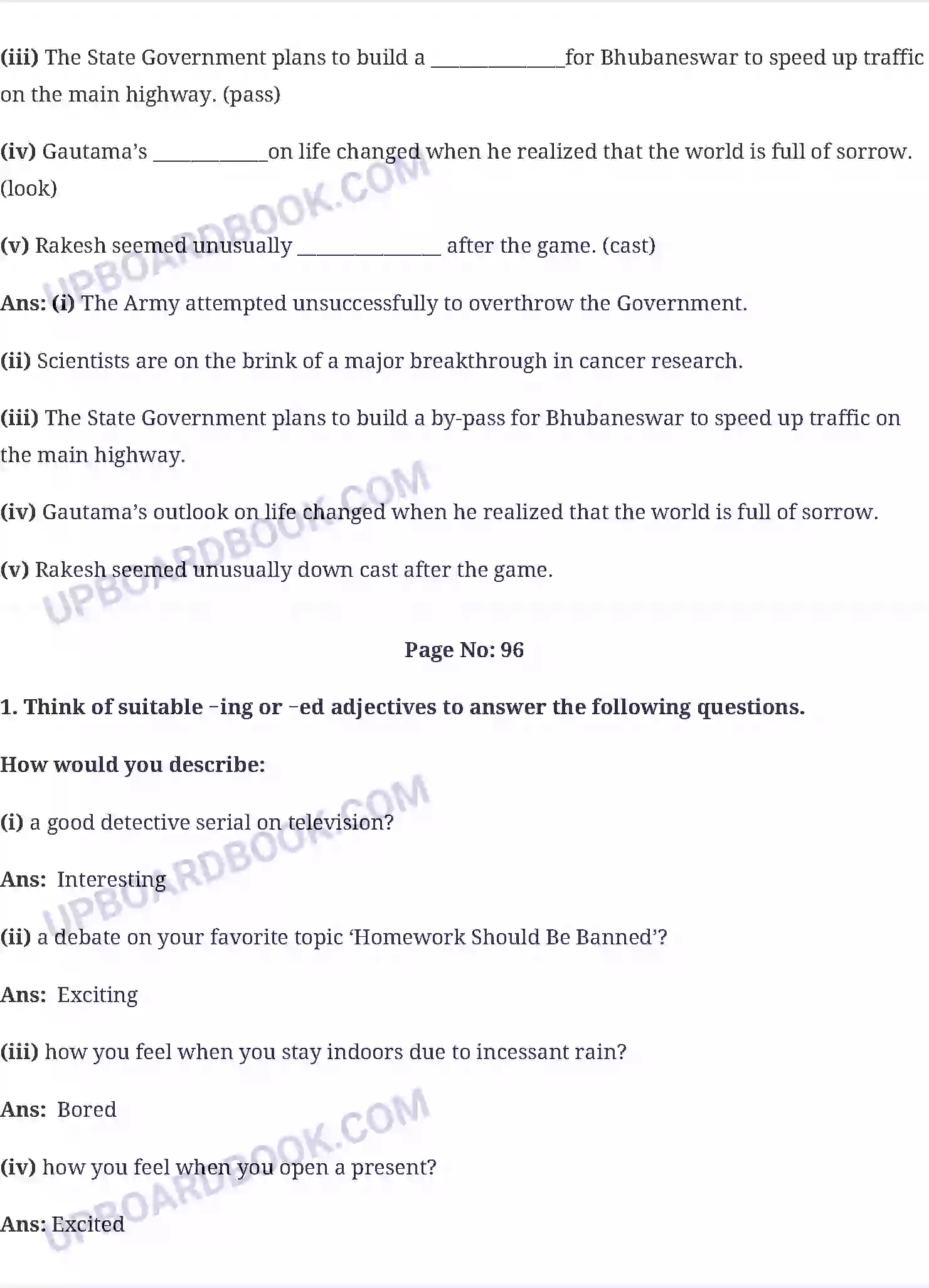
(i) The Army attempted unsuccessfully to ________ the government. (throw)
(ii) Scientists are on the brink of a major ________ in cancer research. (break)
(iii) The State Government plans to build a ________ for Bhubaneswar to speed up traffic on the main highway. (pass)
(iv) Gautama’s ________ on life changed when he realized that the world is full of sorrow. (look)
(v) Rakesh seemed unusually ________ after the game. (cast)
Ans:
(i) The Army attempted unsuccessfully to overthrow the government.
(ii) Scientists are on the brink of a major breakthrough in cancer research.
(iii) The State Government plans to build a by-pass for Bhubaneswar to speed up traffic on the main highway.
(iv) Gautama’s outlook on life changed when he realized that the world is full of sorrow.
(v) Rakesh seemed unusually downcast after the game.
Page No: 96
1. Think of suitable -ing or -ed adjectives to answer the following questions. How would you describe:
(i) a good detective serial on television?
(ii) a debate on your favorite topic ‘Homework Should Be Banned’?
(iii) how you feel when you stay indoors due to incessant rain?
(iv) how you feel when you open a present?
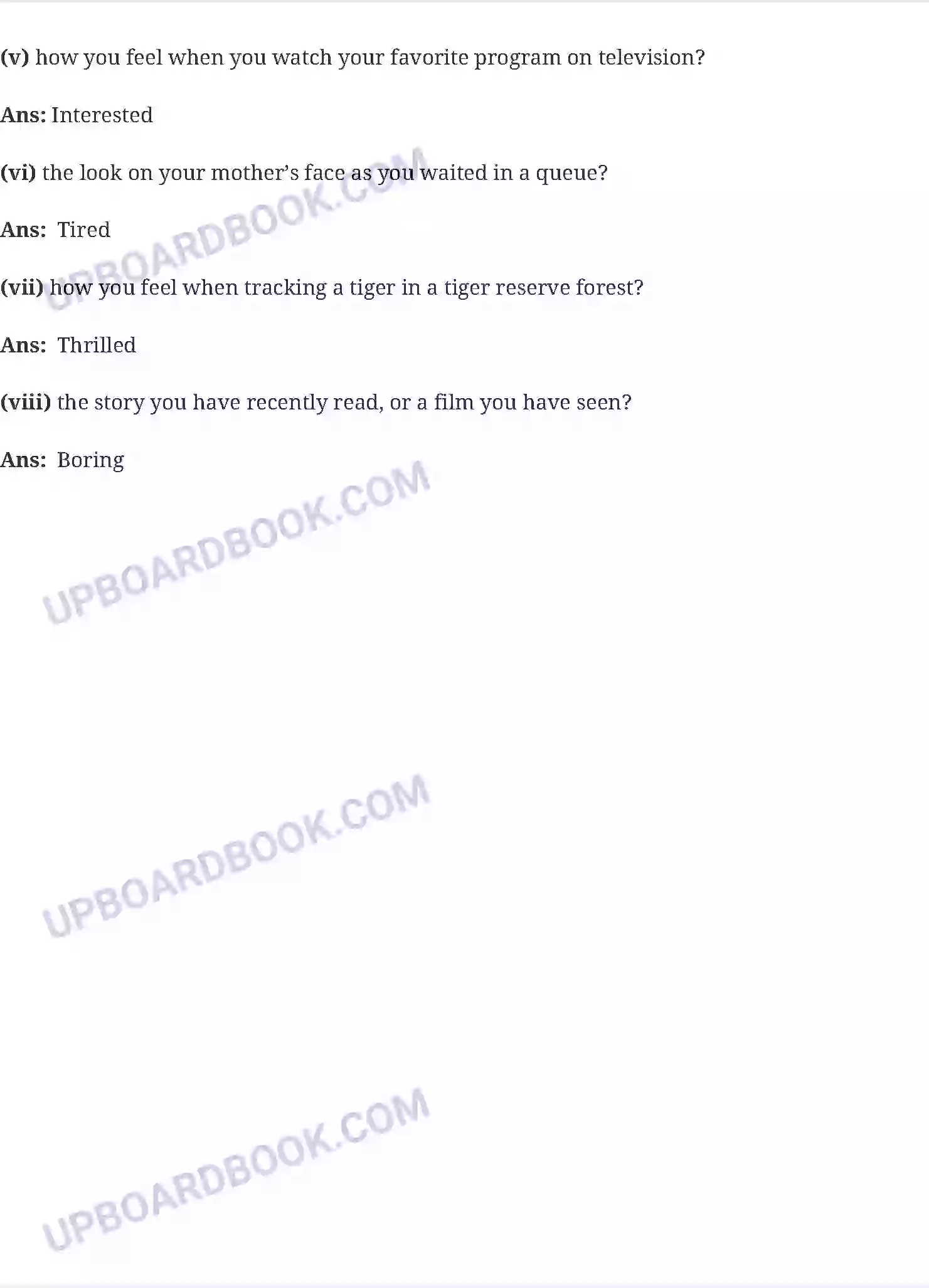
(v) how you feel when you watch your favorite program on television?
(vi) the look on your mother’s face as you waited in a queue?
(vii) how you feel when tracking a tiger in a tiger reserve forest?
(viii) the story you have recently read, or a film you have seen?
Ans:
(i) Interesting
(ii) Exciting
(iii) Bored
(iv) Excited
(v) Interested
(vi) Tired
(vii) Thrilled
(viii) Boring (if it was not good) / Engaging (if it was good)
Get UP Board class 10 English 7. Glimpses of India Solution in Hindi Medium
UP Board class 10 English 7. Glimpses of India Solution is available at our platform https://upboardbook.com in hindi medium for free of cost. Content provided on our website is free of cost and in PDF format which is easily available for download. Getting the UP Board Solutions for class 10 will help student to achieve good learning experience so that they can study effectively. UP board holds examination of more than 3 million students every year and majority of the question of exams are from their UP Board Solutions. That’s why it is important to study using the textSolution issued by UP Board.
Importance of UP Board class 10 English 7. Glimpses of India Text Solutions
It is essential to know the importance of UP Board class 10 English 7. Glimpses of India textSolution issued by UP Board because students completely rely on these Solutions for their study and syllabus offered by UP Board is so balanced that each student should be aware about the importance of it. Below is the list of Importance of UP Board class 10 English 7. Glimpses of India :
- These TextSolutions are very clear and accurate which helps student to understand concept with ease.
- It is also to mention that these text Solutions are prepared by the content experts of subject, thus these Solutions helps student in clearing their doubts and understand the core concept easily.
- It is considered to be the best study material for competitive exam preparation.
Features of UP Board class 10 textSolutions
There are various features of UP Board class 10 TextSolutions, some of them are mentioned below so that you student can understand the value and usability of the contend and understand why Uttarpradesh board has prescribed these Solutions.
- Best feature of these textSolutions is free availability of content in PDF format
- Second feature that content generated and written is clear and easy to read.
- There are various illustration and images are shown in the Solution so that student can easily understand the concept and should be more appealing to the student.
- Each chapter is explained thoroughly
