 UPBoardBook
UP Board Class 6 English (10. The Banyas Tree) solution PDF
UP Board Class 6 English 10. The Banyas Tree is a Hindi Medium Solution which is prescribed by Uttar Pradesh Board for their students. These Solutions is completely prepared considering the latest syllabus and it covers every single topis, so that every student get organised and conceptual learning of the concepts. Class 6 Students of UP Board who have selected hindi medium as their study medium they can use these Hindi medium textSolutions to prepare themselves for exam and learn the concept with ease.
UP Board Class 6 English 10. The Banyas Tree Hindi Medium Solutions - PDF
Click Here to


UP Board Solutions for Class 6 English (Honeysuckle) - Chapter 10: The Banyan Tree
Page No: 131
Working with Text
A. Complete the following sentences.
1. The old banyan tree “did not belong” to Grandfather, but only to the boy, because .
Ans: The grandfather was sixty-five years old and could no longer climb the tall tree, so the boy was the only one who could claim it as his own special place.
2. The small gray squirrel became friendly when
Ans: it realized that the boy never carried any weapons like a catapult or an air-gun to harm it.
3. When the boy started to bring him pieces of cake and biscuit, the squirrel
Ans: gradually lost its fear, became very bold, and started taking food directly from the author's hand.
4. In the spring, the banyan tree and would come there.
Ans: was covered with tiny red figs, which attracted all kinds of beautiful birds to its branches.
5. The banyan tree served the boy as a
Ans: perfect, quiet library where he could read his books peacefully.
6. The young boy spent his afternoons in the tree
Ans: during the cooler parts of the day when the sun was not too harsh and hot.
Page No: 132
B. Answer the following questions.
1. “It was to be a battle of champions.”
(i) What qualities did the two champions have? Pick out words and phrases from the paragraph above this line in the text and write them down.
| Mongoose | Cobra |
|---|---|
| (a) superb fighter | (a) skillful and experienced |
| (b) clever | (b) swift |
| (c) aggressive | (c) had a poisonous bite |
(ii) What did the cobra and the mongoose do, to show their readiness for the fight?
Ans: To show they were ready, the cobra raised the front part of its body off the ground, spread its fearsome hood, and hissed loudly while darting its forked tongue in and out. The mongoose showed its readiness by fluffing up its tail and making the hair on its back stand straight up, making itself look bigger and fiercer.
2. Who were the other two spectators? What did they do? (Did they watch, or did they join in the fight?)
Ans: The other two spectators were a jungle crow and a myna. At first, they just sat on a cactus plant to watch the fight. But they were not passive watchers. They tried to join the fight by suddenly flying down and attacking the cobra whenever they saw a chance.
3. Read the descriptions below of what the snake did and what the mongoose did. Arrange their actions in the proper order.
| Snake (Cobra) | Mongoose |
|---|---|
| (ii) tried to mesmerize the mongoose | refused to look into the snake’s eyes |
| (vi) struck on the side that the mongoose pretended to attack | pretended to attack the cobra on one side |
| (v) struck again and missed | sprang aside, jumped in and bit |
| (iv) struck the crow | darted away and bit the cobra on the back |
| (iii) coiled itself around the mongoose | grabbed the snake by the snout |
| (i) ceased to struggle | dragged the snake into the bushes |
4. (i) What happened to the crow in the end?
(ii) What did the myna do finally?
Ans (i): In the end, the crow was struck hard by the cobra. It was thrown about twenty feet across the garden. After fluttering weakly for some time, it eventually died.
Ans (ii): Finally, the myna carefully came down to the ground. It hopped around, looked into the bushes from a safe distance to make sure the fight was over, and then let out a loud, cheerful cry as if to congratulate the winner before flying away.
Working with Language
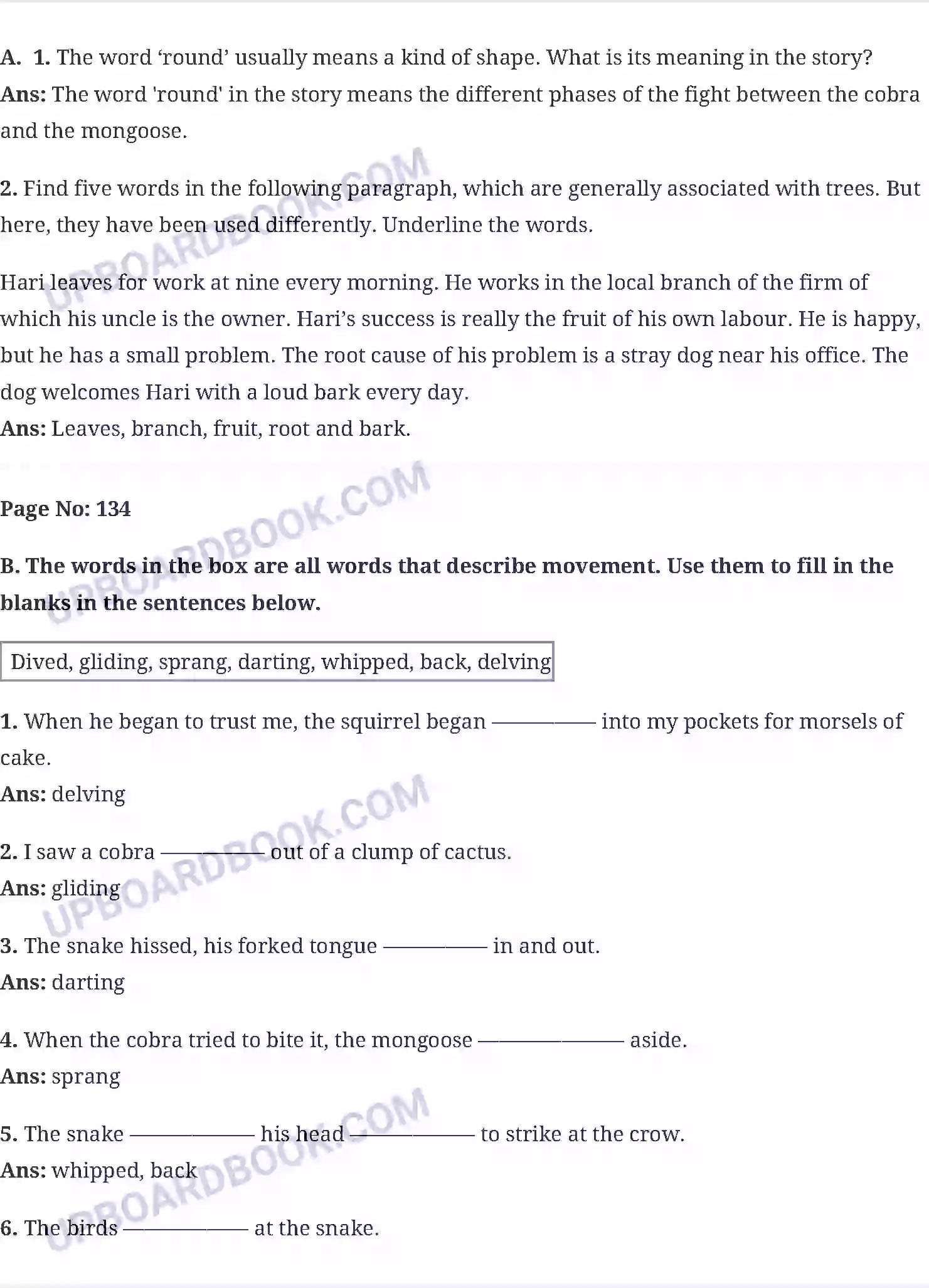
A. 1. The word ‘round’ usually means a kind of shape. What is its meaning in the story?
Ans: In this story, the word 'round' does not mean a circle. It refers to one complete stage or phase of the fight between the cobra and the mongoose. The fight happened in several such 'rounds'.
2. Find five words in the following paragraph, which are generally associated with trees. But here, they have been used differently. Underline the words.
Hari leaves for work at nine every morning. He works in the local branch of the firm of which his uncle is the owner. Hari’s success is really the fruit of his own labour. He is happy, but he has a small problem. The root cause of his problem is a stray dog near his office. The dog welcomes Hari with a loud bark every day.
Ans: The five words are: leaves, branch, fruit, root, and bark. Here, they are not used for a tree but have different meanings related to daily life and work.
Page No: 134
B. The words in the box are all words that describe movement. Use them to fill in the blanks in the sentences below.
dived, gliding, sprang, darting, whipped...back, delving
1. When he began to trust me, the squirrel began —————— into my pockets for morsels of cake.
Ans: delving
2. I saw a cobra —————— out of a clump of cactus.
Ans: gliding
3. The snake hissed, his forked tongue ————— in and out.
Ans: darting
4. When the cobra tried to bite it, the mongoose —--————— aside.
Ans: sprang
5. The snake —-——————_ his head —---—— to strike at the crow.
Ans: whipped, back
6. The birds ————————_ at the snake.
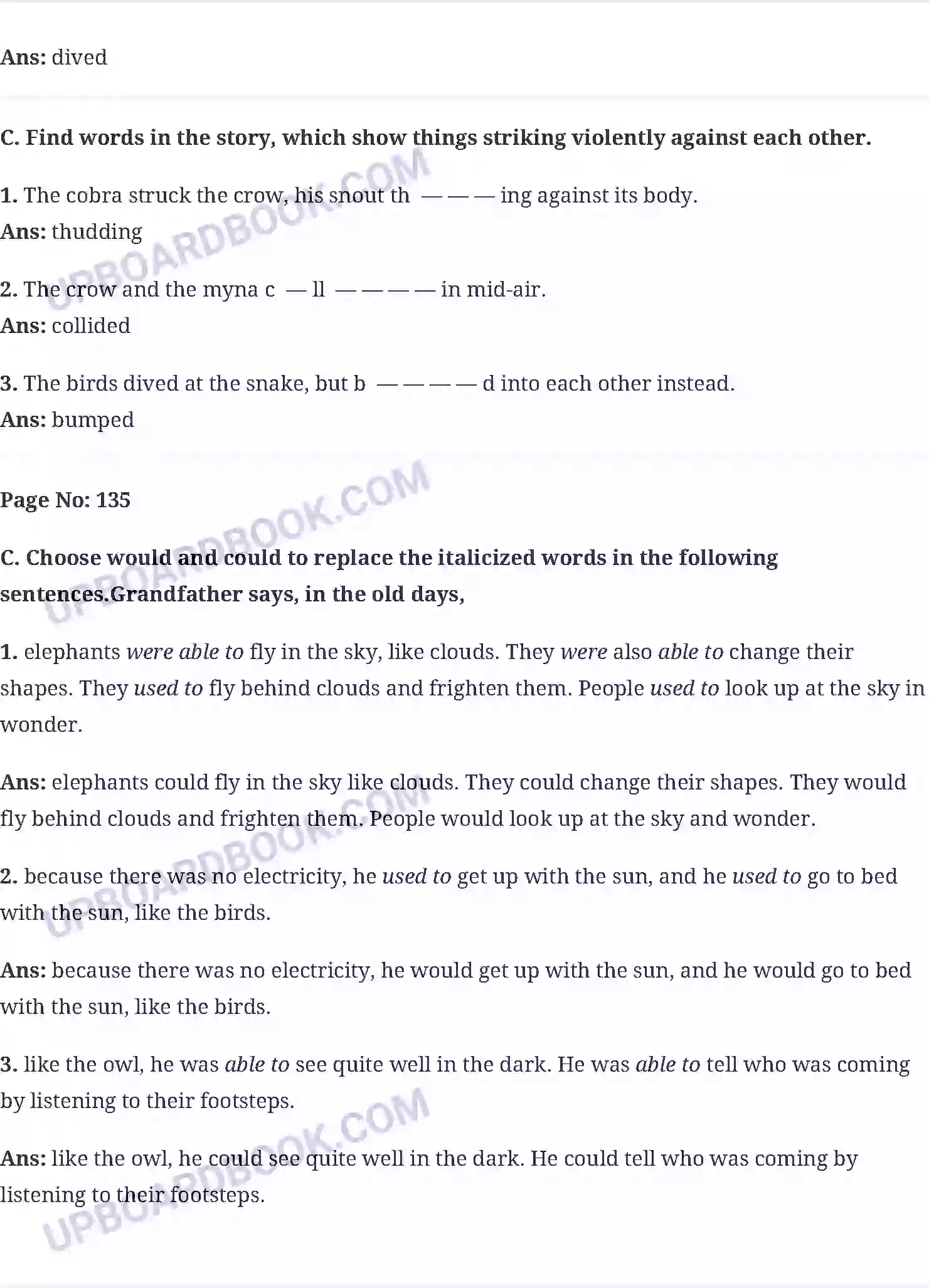
Ans: dived
C. Find words in the story, which show things striking violently against each other.
1. The cobra struck the crow, his snout th — — — ing against its body.
Ans: thudding
2. The crow and the myna c — ll — — — — in mid-air.
Ans: collided
3. The birds dived at the snake, but b — — — —d into each other instead.
Ans: bumped
Page No: 135
C. Choose would and could to replace the italicized words in the following sentences.
Grandfather says, in the old days,
1. elephants were able to fly in the sky, like clouds. They were also able to change their shapes. They used to fly behind clouds and frighten them. People used to look up at the sky in wonder.
Ans: elephants could fly in the sky like clouds. They could change their shapes. They would fly behind clouds and frighten them. People would look up at the sky and wonder.
2. because there was no electricity, he used to get up with the sun, and he used to go to bed with the sun, like the birds.
Ans: because there was no electricity, he would get up with the sun, and he would go to bed with the sun, like the birds.
3. like the owl, he was able to see quite well in the dark. He was able to tell who was coming by listening to their footsteps.
Ans: like the owl, he could see quite well in the dark. He could tell who was coming by listening to their footsteps.
Get UP Board Class 6 English 10. The Banyas Tree Solution in Hindi Medium
UP Board Class 6 English 10. The Banyas Tree Solution is available at our platform https://upboardbook.com in hindi medium for free of cost. Content provided on our website is free of cost and in PDF format which is easily available for download. Getting the UP Board Solutions for Class 6 will help student to achieve good learning experience so that they can study effectively. UP board holds examination of more than 3 million students every year and majority of the question of exams are from their UP Board Solutions. That’s why it is important to study using the textSolution issued by UP Board.
Importance of UP Board Class 6 English 10. The Banyas Tree Text Solutions
It is essential to know the importance of UP Board Class 6 English 10. The Banyas Tree textSolution issued by UP Board because students completely rely on these Solutions for their study and syllabus offered by UP Board is so balanced that each student should be aware about the importance of it. Below is the list of Importance of UP Board Class 6 English 10. The Banyas Tree :
- These TextSolutions are very clear and accurate which helps student to understand concept with ease.
- It is also to mention that these text Solutions are prepared by the content experts of subject, thus these Solutions helps student in clearing their doubts and understand the core concept easily.
- It is considered to be the best study material for competitive exam preparation.
Features of UP Board Class 6 textSolutions
There are various features of UP Board Class 6 TextSolutions, some of them are mentioned below so that you student can understand the value and usability of the contend and understand why Uttarpradesh board has prescribed these Solutions.
- Best feature of these textSolutions is free availability of content in PDF format
- Second feature that content generated and written is clear and easy to read.
- There are various illustration and images are shown in the Solution so that student can easily understand the concept and should be more appealing to the student.
- Each chapter is explained thoroughly
