 UPBoardBook
UP Board Class 12 Physics (13. नाभिक) solution PDF
UP Board Class 12 Physics 13. नाभिक is a Hindi Medium Solution which is prescribed by Uttar Pradesh Board for their students. These Solutions is completely prepared considering the latest syllabus and it covers every single topis, so that every student get organised and conceptual learning of the concepts. Class 12 Students of UP Board who have selected hindi medium as their study medium they can use these Hindi medium textSolutions to prepare themselves for exam and learn the concept with ease.
UP Board Class 12 Physics 13. नाभिक Hindi Medium Solutions - PDF
Click Here to
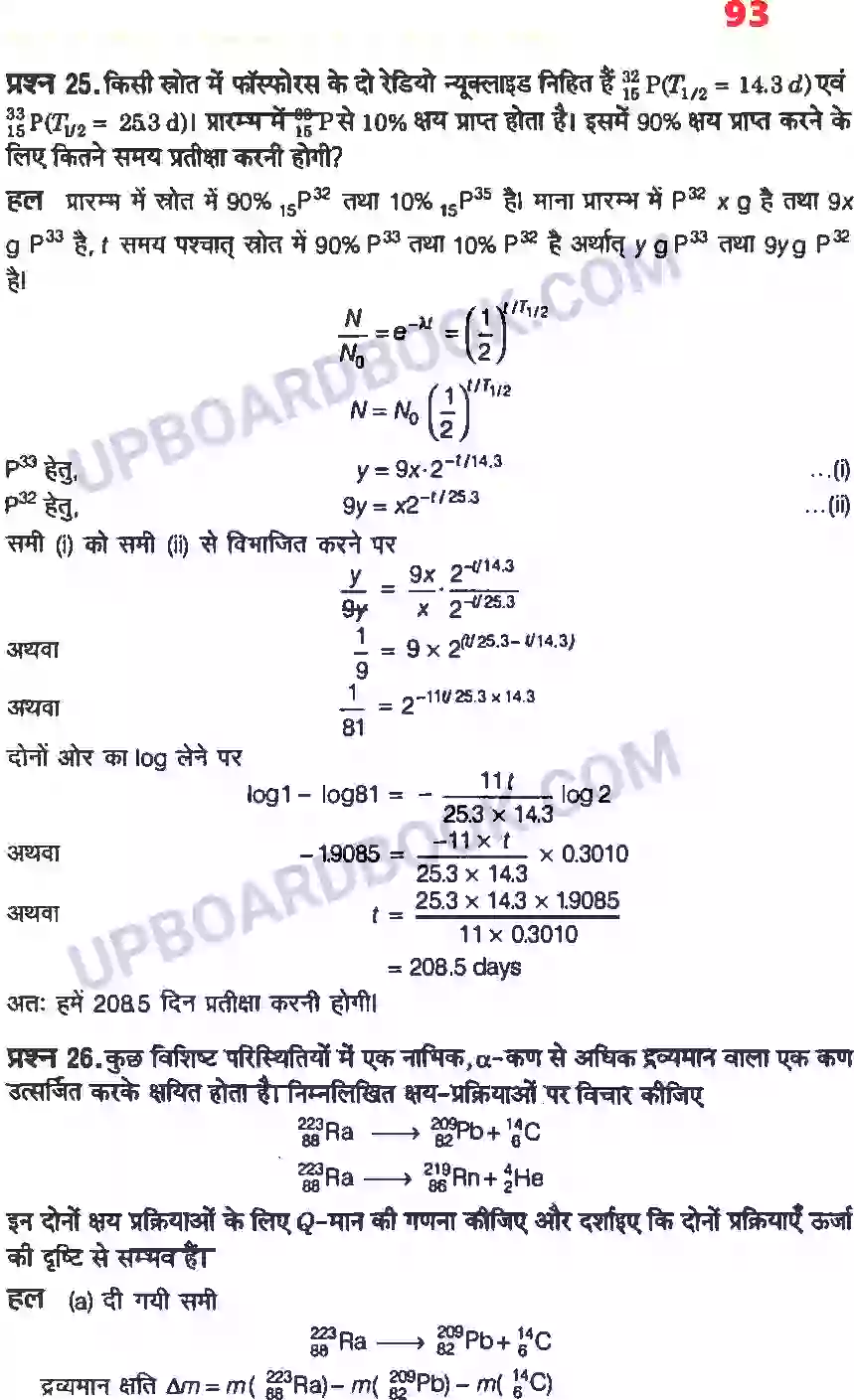
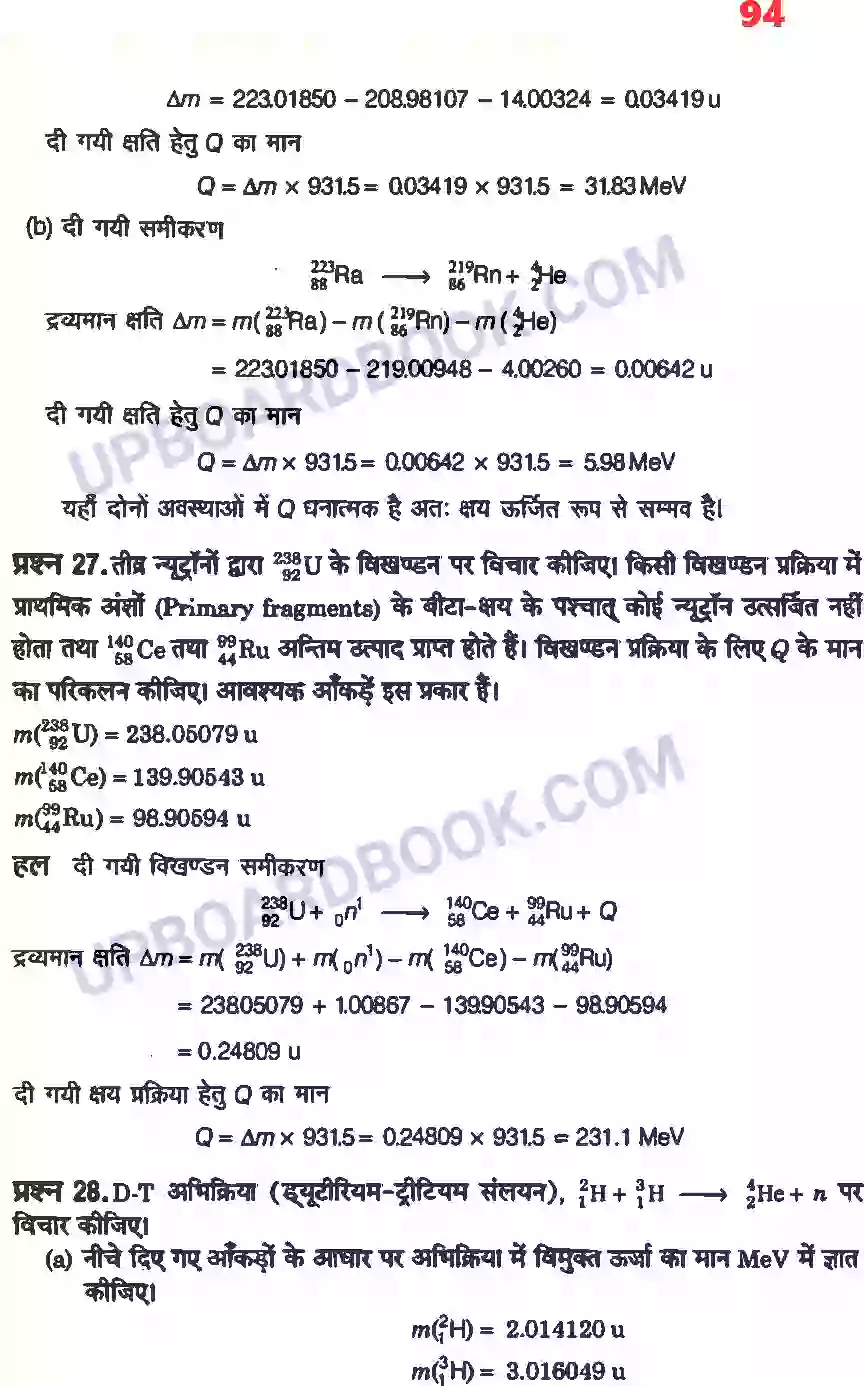
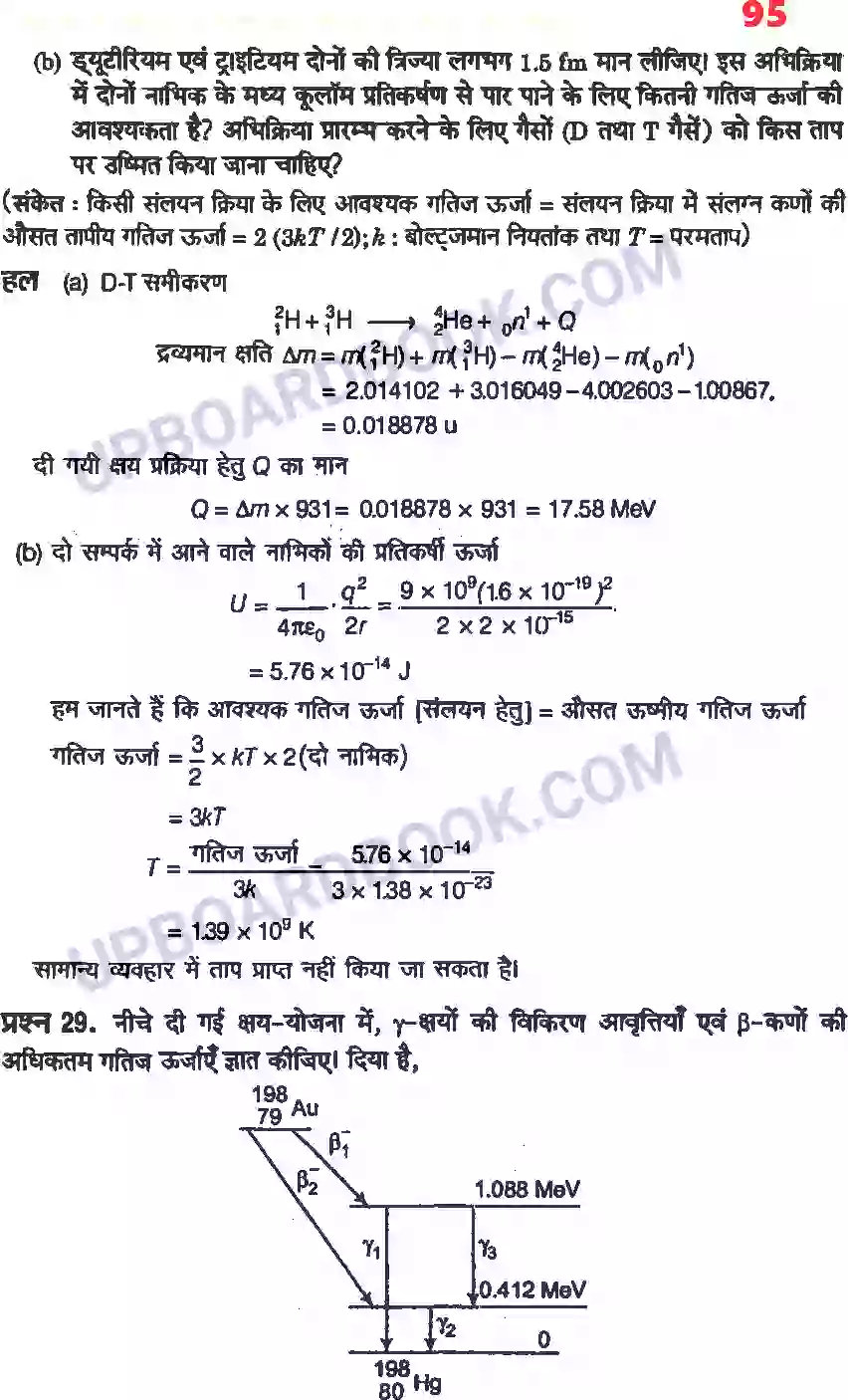
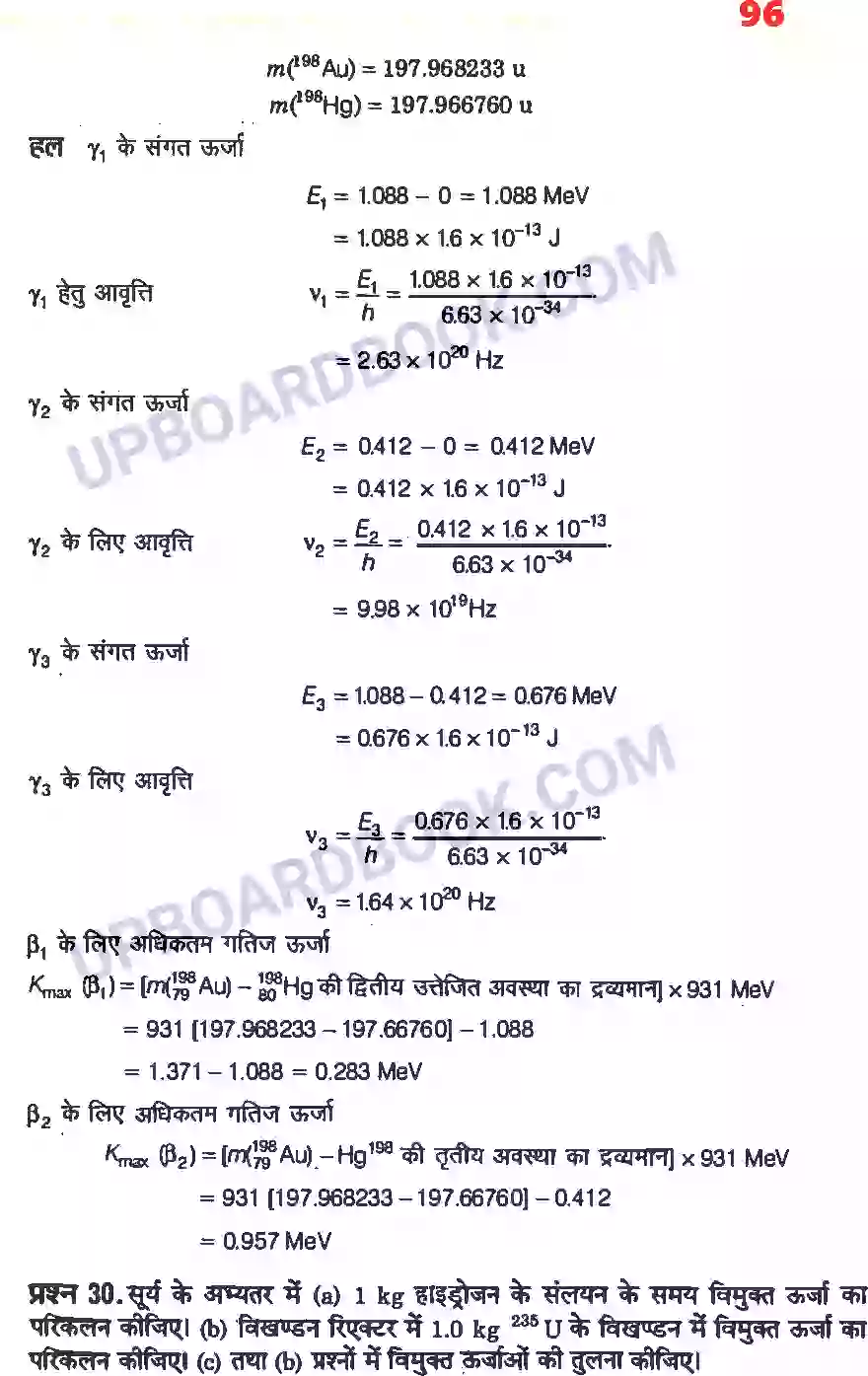
UP Board Solutions for Class 12 Physics
Chapter 13: नाभिक (Nuclei)
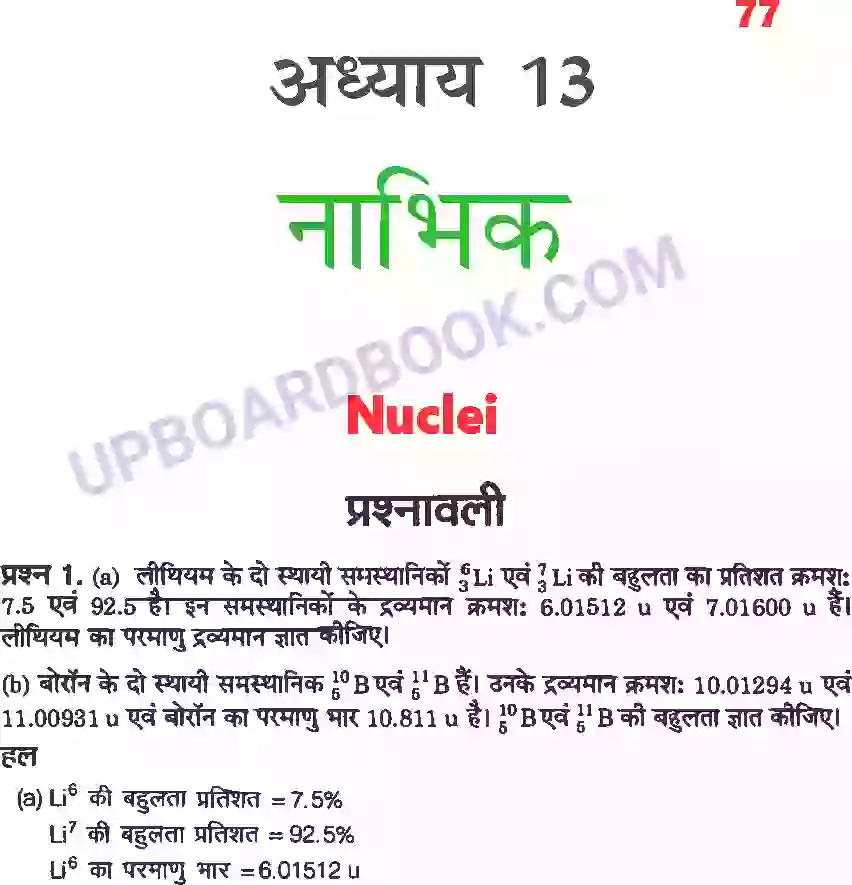
प्रश्न 1.
(a) लीथियम के दो स्थायी समस्थानिकों \(_{3}^{6}\text{Li}\) एवं \(_{3}^{7}\text{Li}\) की बहुलता का प्रतिशत क्रमशः 7.5% एवं 92.5% है। इन समस्थानिकों के द्रव्यमान क्रमशः 6.01512 u एवं 7.01600 u हैं। लीथियम का परमाणु द्रव्यमान ज्ञात कीजिए।
(b) बोरॉन के दो स्थायी समस्थानिक \(_{5}^{10}\text{B}\) एवं \(_{5}^{11}\text{B}\) उनके द्रव्यमान क्रमशः 10.01294 u एवं 11.00931 u एवं बोरॉन का परमाणु भार 10.811 u है। \(_{5}^{10}\text{B}\) एवं \(_{5}^{11}\text{B}\) की बहुलता ज्ञात कीजिए।
हल:
(a) \(_{3}^{6}\text{Li}\) की बहुलता = 7.5%
\(_{3}^{7}\text{Li}\) की बहुलता = 92.5%
\(_{3}^{6}\text{Li}\) का द्रव्यमान = 6.01512 u
\(_{3}^{7}\text{Li}\) का द्रव्यमान = 7.01600 u
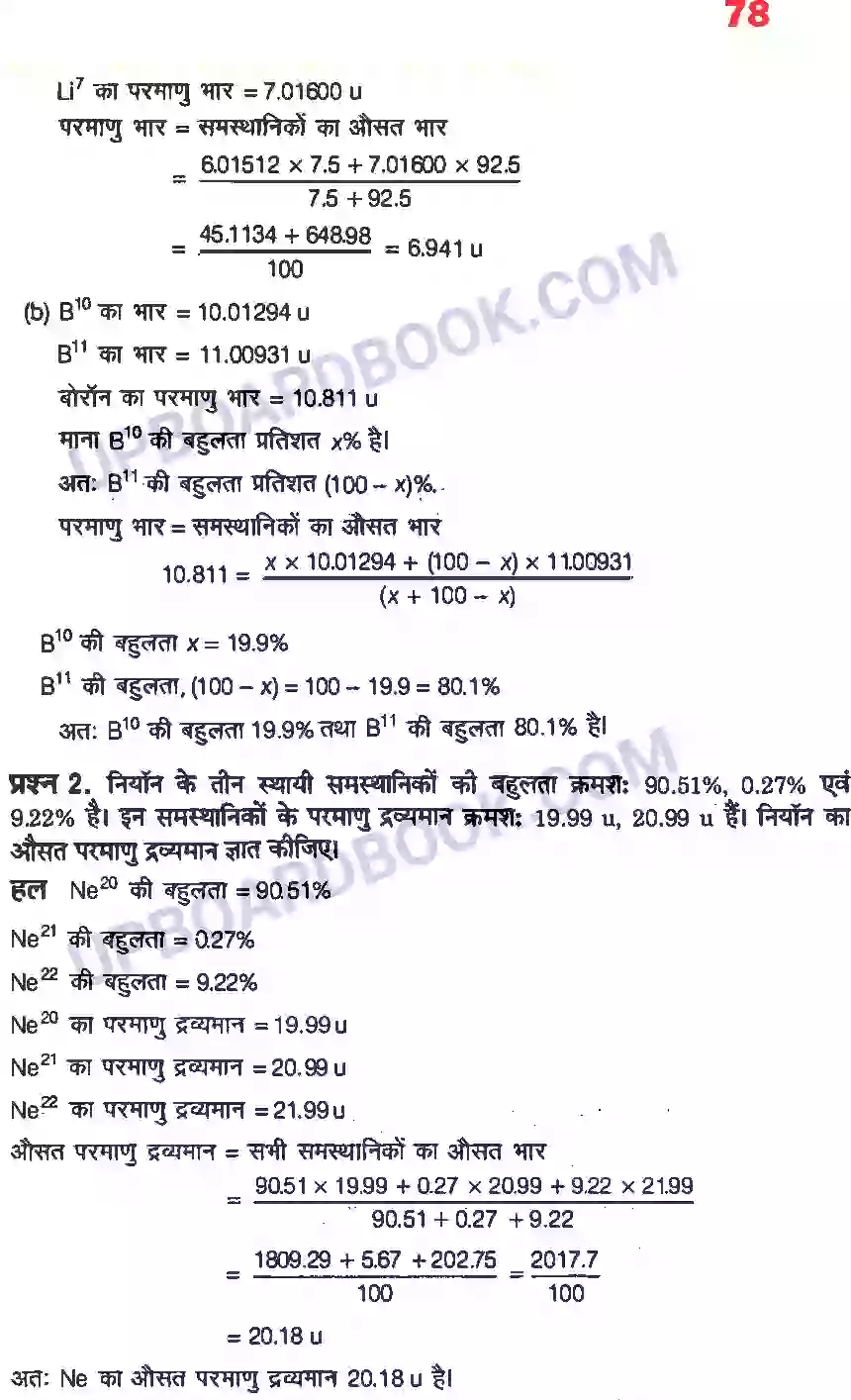
लीथियम का परमाणु द्रव्यमान = समस्थानिकों का औसत द्रव्यमान
\[ = \frac{(6.01512 \times 7.5) + (7.01600 \times 92.5)}{100} \]
\[ = \frac{45.1134 + 648.98}{100} = \frac{694.0934}{100} = 6.941 \, \text{u} \]
(b) माना \(_{5}^{10}\text{B}\) की बहुलता = \(x\%\)
तो \(_{5}^{11}\text{B}\) की बहुलता = \((100 - x)\%\)
बोरॉन का परमाणु द्रव्यमान = 10.811 u
\[ 10.811 = \frac{(10.01294 \times x) + (11.00931 \times (100 - x))}{100} \]
\[ 1081.1 = 10.01294x + 1100.931 - 11.00931x \]
\[ 1081.1 - 1100.931 = -0.99637x \]
\[ -19.831 = -0.99637x \]
\[ x \approx 19.9\% \]
अतः \(_{5}^{10}\text{B}\) की बहुलता = 19.9%
\(_{5}^{11}\text{B}\) की बहुलता = 100 - 19.9 = 80.1%
प्रश्न 2.
नियॉन के तीन स्थायी समस्थानिकों की बहुलता क्रमशः 90.51%, 0.27% एवं 9.22% है। इन समस्थानिकों के परमाणु द्रव्यमान क्रमशः 19.99 u, 20.99 u एवं 21.99 u हैं। नियॉन का औसत परमाणु द्रव्यमान ज्ञात कीजिए।
हल:
औसत परमाणु द्रव्यमान
\[ = \frac{(19.99 \times 90.51) + (20.99 \times 0.27) + (21.99 \times 9.22)}{100} \]
\[ = \frac{1809.2949 + 5.6673 + 202.7478}{100} = \frac{2017.71}{100} = 20.18 \, \text{u} \]
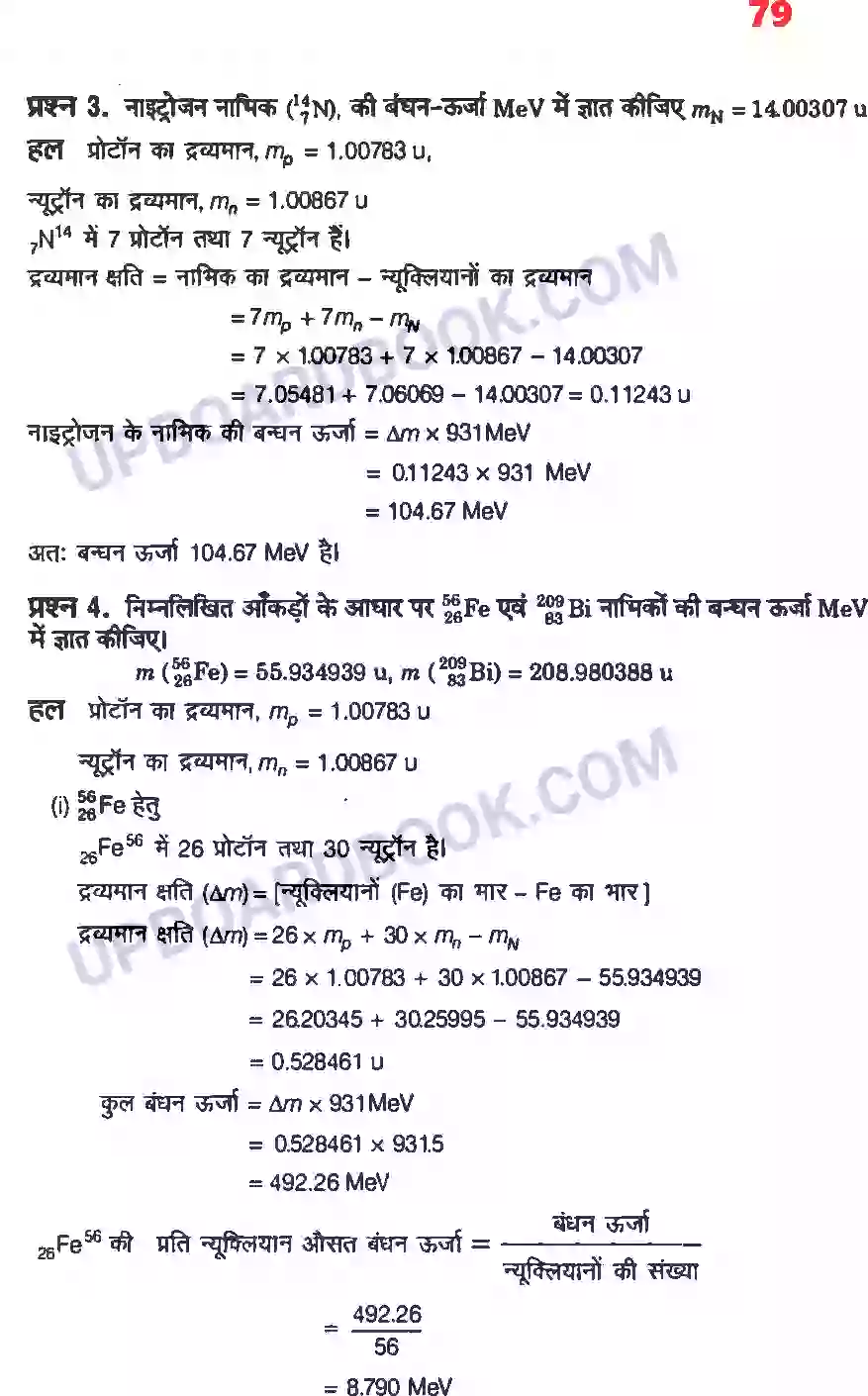
प्रश्न 3.
नाइट्रोजन नाभिक (\(_{7}^{14}\text{N}\)) की बन्धन ऊर्जा MeV में ज्ञात कीजिए। दिया है: \(m(_{7}^{14}\text{N}) = 14.00307 \, \text{u}\)
हल:
प्रोटॉन का द्रव्यमान, \(m_p = 1.00783 \, \text{u}\)
न्यूट्रॉन का द्रव्यमान, \(m_n = 1.00867 \, \text{u}\)
\(_{7}^{14}\text{N}\) में 7 प्रोटॉन तथा 7 न्यूट्रॉन हैं।
द्रव्यमान क्षति \(\Delta m = [7m_p + 7m_n] - m(_{7}^{14}\text{N})\)
\[ = [7 \times 1.00783 + 7 \times 1.00867] - 14.00307 \]
\[ = [7.05481 + 7.06069] - 14.00307 = 0.11243 \, \text{u} \]
बन्धन ऊर्जा \(= \Delta m \times 931 \, \text{MeV}\)
\[ = 0.11243 \times 931 = 104.67 \, \text{MeV} \]
प्रश्न 4.
निम्नलिखित आँकड़ों के आधार पर \(_{26}^{56}\text{Fe}\) एवं \(_{83}^{209}\text{Bi}\) नाभिकों की बन्धन ऊर्जा MeV में ज्ञात कीजिए।
\(m(_{26}^{56}\text{Fe}) = 55.934939 \, \text{u}\), \(m(_{83}^{209}\text{Bi}) = 208.980388 \, \text{u}\)
प्रोटॉन का द्रव्यमान, \(m_p = 1.00783 \, \text{u}\), न्यूट्रॉन का द्रव्यमान, \(m_n = 1.00867 \, \text{u}\)
हल:
(i) \(_{26}^{56}\text{Fe}\) में 26 प्रोटॉन तथा 30 न्यूट्रॉन हैं।
द्रव्यमान क्षति \(\Delta m = [26m_p + 30m_n] - m(_{26}^{56}\text{Fe})\)
\[ = [26 \times 1.00783 + 30 \times 1.00867] - 55.934939 \]
\[ = [26.20358 + 30.2601] - 55.934939 = 0.528741 \, \text{u} \]
बन्धन ऊर्जा \(= 0.528741 \times 931 = 492.26 \, \text{MeV}\)
प्रति न्यूक्लिऑन औसत बन्धन ऊर्जा \(= \frac{492.26}{56} = 8.790 \, \text{MeV}\)
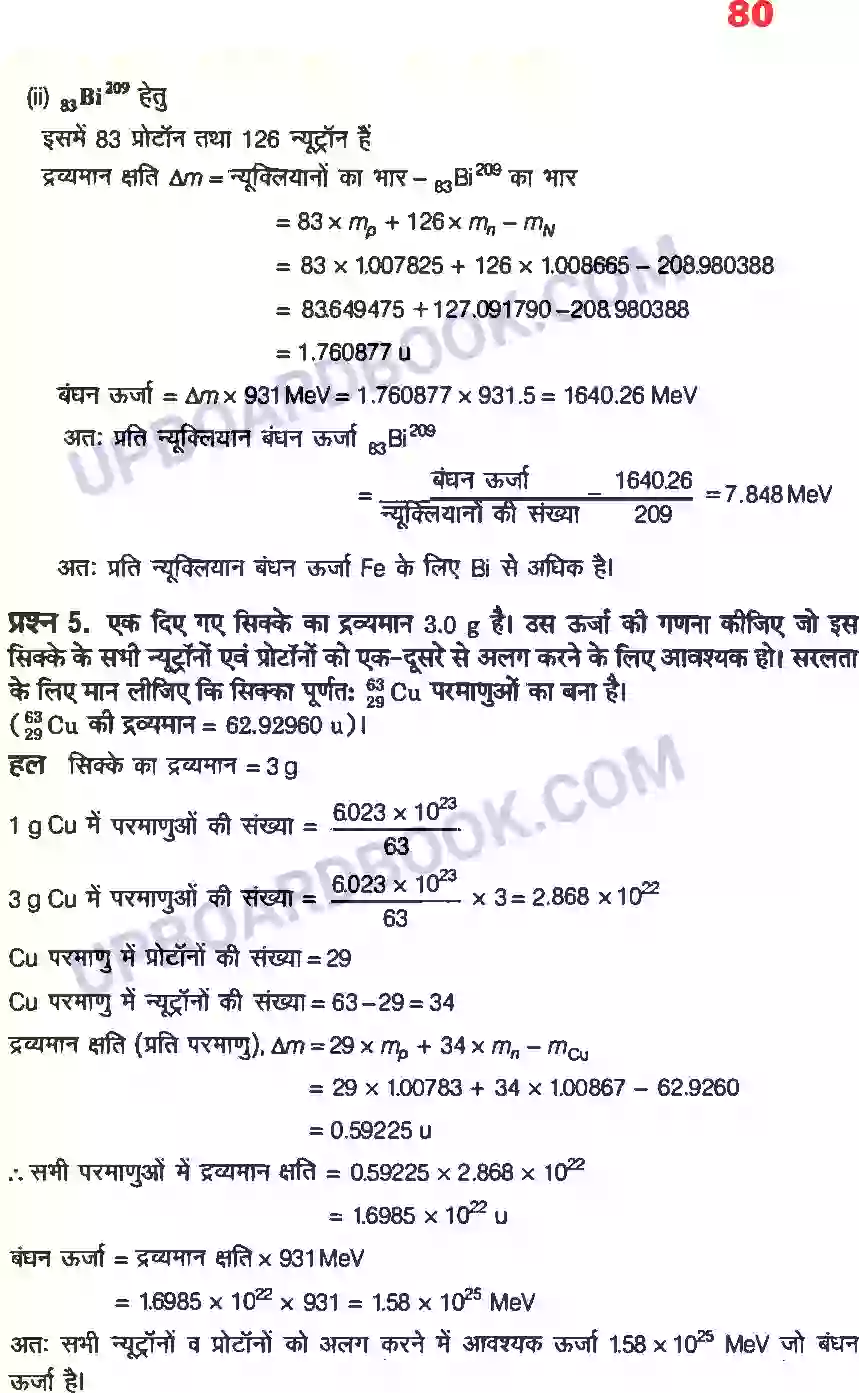
(ii) \(_{83}^{209}\text{Bi}\) में 83 प्रोटॉन तथा 126 न्यूट्रॉन हैं।
द्रव्यमान क्षति \(\Delta m = [83m_p + 126m_n] - m(_{83}^{209}\text{Bi})\)
\[ = [83 \times 1.00783 + 126 \times 1.00867] - 208.980388 \]
\[ = [83.64989 + 127.09242] - 208.980388 = 1.760922 \, \text{u} \]
बन्धन ऊर्जा \(= 1.760922 \times 931 = 1640.26 \, \text{MeV}\)
प्रति न्यूक्लिऑन औसत बन्धन ऊर्जा \(= \frac{1640.26}{209} = 7.848 \, \text{MeV}\)
प्रश्न 5.
एक दिए गए सिक्के का द्रव्यमान 3.0 g है। उस ऊर्जा की गणना कीजिए जो इस सिक्के के सभी न्यूट्रॉनों एवं प्रोटॉनों को एक-दूसरे से अलग करने के लिए आवश्यक हो। सरलता के लिए मान लीजिए कि सिक्का पूर्णतः \(_{29}^{63}\text{Cu}\) परमाणुओं का बना है। (\(m(_{29}^{63}\text{Cu}) = 62.92960 \, \text{u}\))
हल:
सिक्के का द्रव्यमान = 3.0 g
\(_{29}^{63}\text{Cu}\) का मोलर द्रव्यमान = 63 g/mol
परमाणुओं की संख्या \(N = \frac{6.022 \times 10^{23} \times 3}{63} = 2.868 \times 10^{22}\)
एक \(_{29}^{63}\text{Cu}\) परमाणु में द्रव्यमान क्षति:
प्रोटॉन = 29, न्यूट्रॉन = 34
\(\Delta m = [29 \times 1.00783 + 34 \times 1.00867] - 62.92960\)
\(= [29.22707 + 34.29478] - 62.92960 = 0.59225 \, \text{u}\)
कुल द्रव्यमान क्षति = \(0.59225 \times 2.868 \times 10^{22} = 1.6985 \times 10^{22} \, \text{u}\)
आवश्यक ऊर्जा = \(1.6985 \times 10^{22} \times 931 \, \text{MeV} = 1.58 \times 10^{25} \, \text{MeV}\)
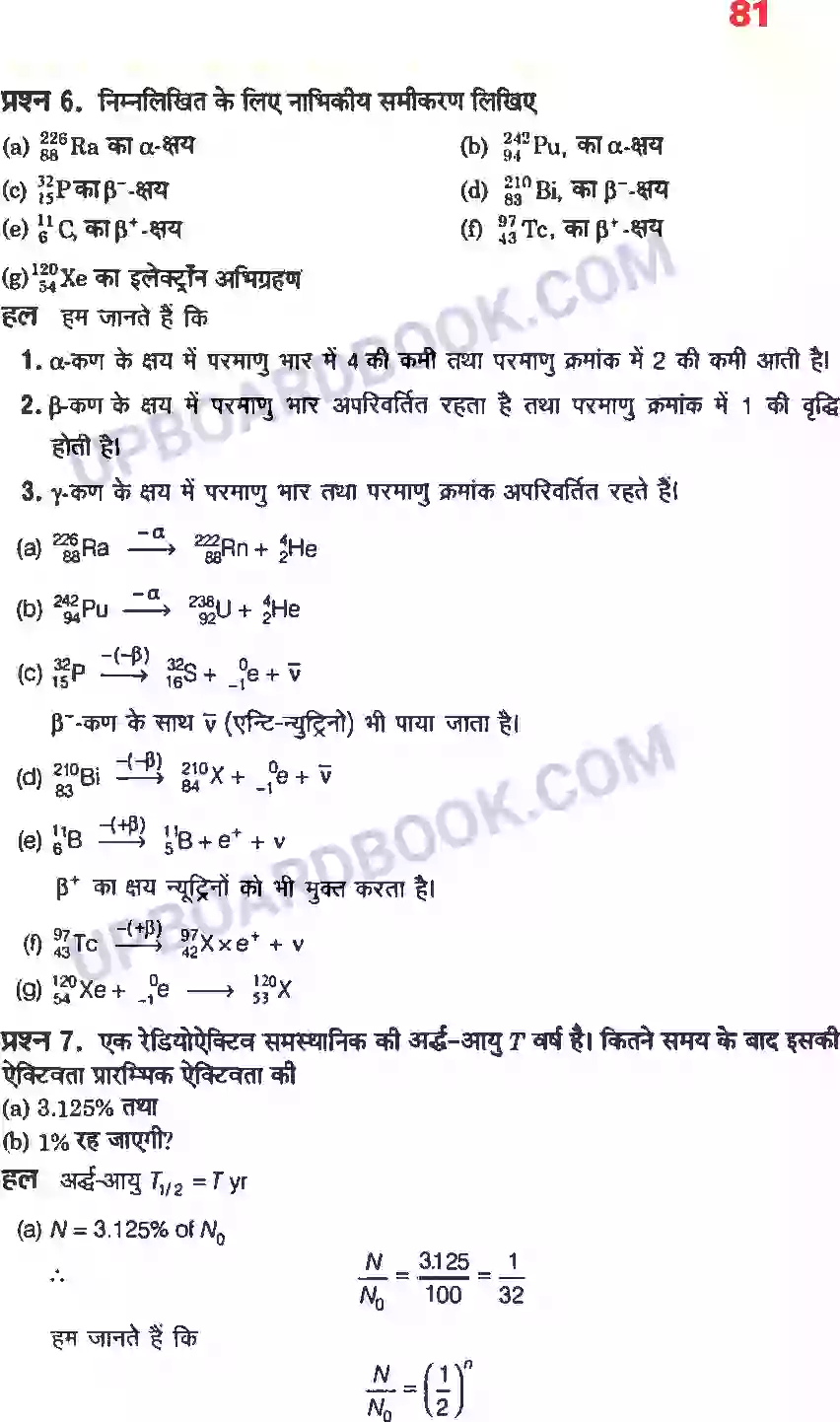
प्रश्न 6.
निम्नलिखित के लिए नाभिकीय समीकरण लिखिए:
(a) \(_{88}^{226}\text{Ra}\) का α-क्षय
(b) \(_{94}^{242}\text{Pu}\) का β⁻-क्षय
(c) \(_{15}^{32}\text{P}\) का β⁻-क्षय
(d) \(_{1}^{3}\text{H}\) का β⁻-क्षय
(e) \(_{6}^{11}\text{C}\) का β⁺-क्षय
(f) \(_{43}^{97}\text{Tc}\) का β⁻-क्षय
(g) \(_{54}^{120}\text{Xe}\) का इलेक्ट्रॉन अभिग्रहण
हल:
(a) \(_{88}^{226}\text{Ra} \rightarrow _{86}^{222}\text{Rn} + _{2}^{4}\text{He}\)
(b) \(_{94}^{242}\text{Pu} \rightarrow _{95}^{242}\text{Am} + _{-1}^{0}\text{e} + \bar{\nu}_e\)
(c) \(_{15}^{32}\text{P} \rightarrow _{16}^{32}\text{S} + _{-1}^{0}\text{e} + \bar{\nu}_e\)
(d) \(_{1}^{3}\text{H} \rightarrow _{2}^{3}\text{He} + _{-1}^{0}\text{e} + \bar{\nu}_e\)
(e) \(_{6}^{11}\text{C} \rightarrow _{5}^{11}\text{B} + _{+1}^{0}\text{e} + \nu_e\)
(f) \(_{43}^{97}\text{Tc} \rightarrow _{44}^{97}\text{Ru} + _{-1}^{0}\text{e} + \bar{\nu}_e\)
(g) \(_{54}^{120}\text{Xe} + _{-1}^{0}e \rightarrow _{53}^{120}\text{I} + \nu_e\)
प्रश्न 7.
एक रेडियोऐक्टिव समस्थानिक की अर्द्ध-आयु T वर्ष है। कितने समय के बाद इसकी ऐक्टिवता प्रारम्भिक ऐक्टिवता की (a) 3.125% तथा (b) 1% रह जाएगी?
हल:
सूत्र: \(N = N_0 \left(\frac{1}{2}\right)^{t/T}\)
(a) \(N = 3.125\% N_0 = \frac{N_0}{32}\)
\(\frac{N_0}{32} = N_0 \left(\frac{1}{2}\right)^{t/T} \Rightarrow \left(\frac{1}{2}\right)^{t/T} = \frac{1}{32} = \left(\frac{1}{2}\right)^5\)
\(\frac{t}{T} = 5 \Rightarrow t = 5T\)
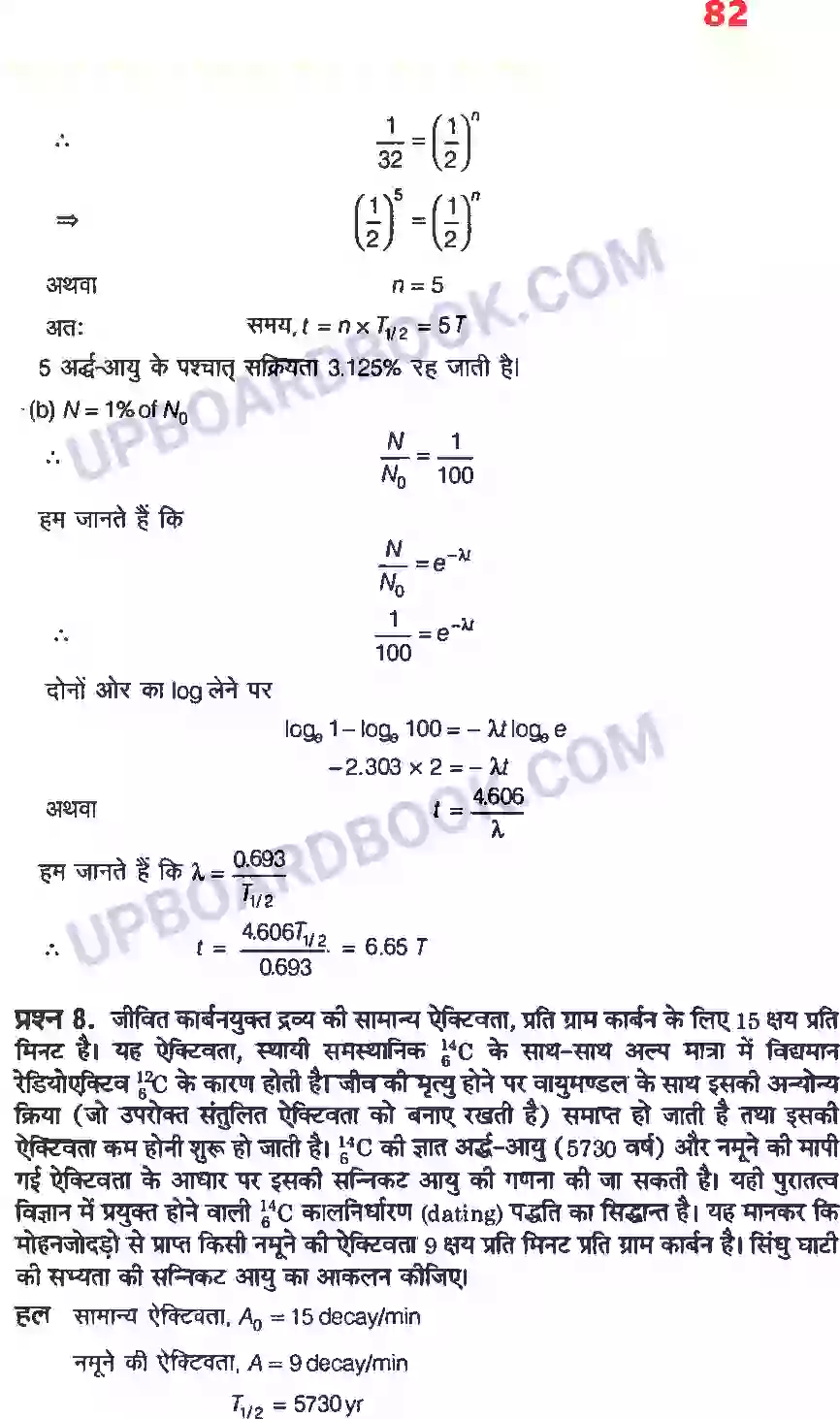
(b) \(N = 1\% N_0 = \frac{N_0}{100}\)
\(\frac{N_0}{100} = N_0 \left(\frac{1}{2}\right)^{t/T} \Rightarrow \left(\frac{1}{2}\right)^{t/T} = \frac{1}{100}\)
दोनों ओर लघुगणक लेने पर:
\(\frac{t}{T} \log(1/2) = \log(1/100)\)
\(\frac{t}{T} (-\log 2) = -2 \log 10\)
\(\frac{t}{T} = \frac{2 \log 10}{\log 2} = \frac{2 \times 1}{0.3010} \approx 6.64\)
\(t \approx 6.64T\)
प्रश्न 8.
जीवित कार्बनयुक्त द्रव्य की सामान्य ऐक्टिवता, प्रति ग्राम कार्बन के लिए 15 क्षय प्रति मिनट है। यह ऐक्टिवता, स्थायी समस्थानिक \(^{12}\text{C}\) के साथ-साथ अल्प मात्रा में विद्यमान रेडियोऐक्टिव \(^{14}\text{C}\) के कारण होती है। जीव की मृत्यु होने पर वायुमण्डल के साथ इसकी अन्योन्य क्रिया (जो उपरोक्त संतुलित ऐक्टिवता को बनाए रखती है) समाप्त हो जाती है तथा इसकी ऐक्टिवता कम होनी शुरू हो जाती है। \(^{14}\text{C}\) की ज्ञात अर्द्ध-आयु (5730 वर्ष) और नमूने की मापी गई ऐक्टिवता के आधार पर इसकी सन्निकट आयु की गणना की जा सकती है। यही पुरातत्व विज्ञान में प्रयुक्त होने वाली \(^{14}\text{C}\) कालनिर्धारण (डेटिंग) पद्धति का सिद्धान्त है। यह मानकर कि मोहनजोदड़ो से प्राप्त किसी नमूने की ऐक्टिवता 9 क्षय प्रति मिनट प्रति ग्राम कार्बन है। सिंधु घाटी की सभ्यता की सन्निकट आयु का आकलन कीजिए।
हल:
\(A_0 = 15 \, \text{क्षय/मिन्ट/ग्राम}\), \(A = 9 \, \text{क्षय/मिन्ट/ग्राम}\), \(T_{1/2} = 5730 \, \text{वर्ष}\)
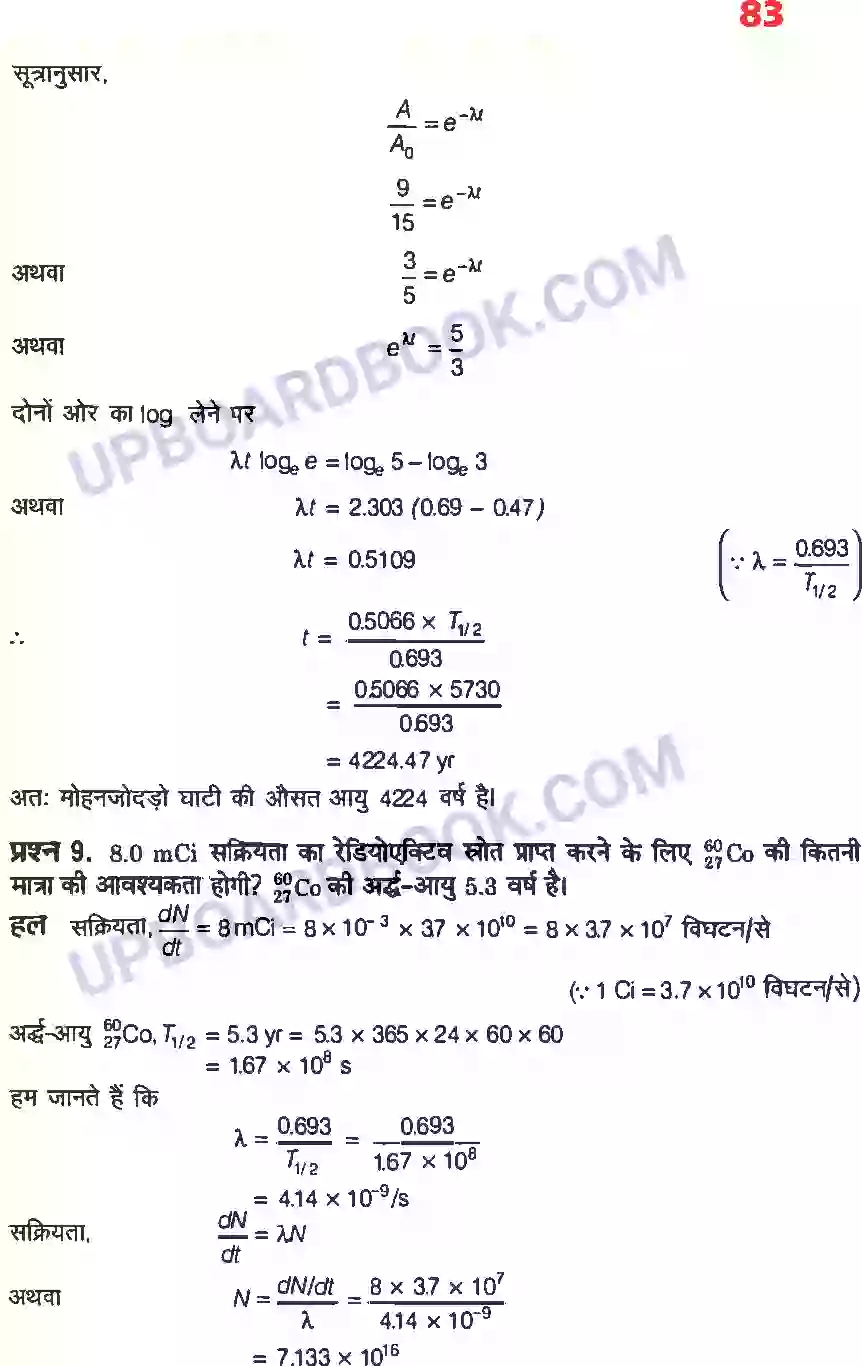
\(A = A_0 e^{-\lambda t} \Rightarrow 9 = 15 e^{-\lambda t}\)
\(e^{-\lambda t} = \frac{9}{15} = 0.6\)
\(-\lambda t = \ln(0.6) \Rightarrow \lambda t = -\ln(0.6) = \ln(5/3)\)
\(\lambda = \frac{\ln 2}{T_{1/2}} = \frac{0.693}{5730}\)
\(t = \frac{\ln(5/3)}{\lambda} = \frac{\ln(5/3)}{0.693} \times 5730\)
\(\ln(5/3) = \ln 5 - \ln 3 = 1.6094 - 1.0986 = 0.5108\)
\(t = \frac{0.5108}{0.693} \times 5730 \approx 0.737 \times 5730 \approx 4224 \, \text{वर्ष}\)
प्रश्न 9.
8.0 mCi सक्रियता का रेडियोऐक्टिव स्रोत प्राप्त करने के लिए \(_{27}^{60}\text{Co}\) की कितनी मात्रा की आवश्यकता होगी? \(_{27}^{60}\text{Co}\) की अर्द्ध-आयु 5.3 वर्ष है।
हल:
\(A = 8.0 \, \text{mCi} = 8 \times 10^{-3} \times 3.7 \times 10^{10} = 2.96 \times 10^8 \, \text{Bq}\)
\(T_{1/2} = 5.3 \, \text{वर्ष} = 5.3 \times 365 \times 24 \times 3600 \approx 1.67 \times 10^8 \, \text{s}\)
\(\lambda = \frac{0.693}{T_{1/2}} = \frac{0.693}{1.67 \times 10^8} \approx 4.15 \times 10^{-9} \, \text{s}^{-1}\)
\(A = \lambda N \Rightarrow N = \frac{A}{\lambda} = \frac{2.96 \times 10^8}{4.15 \times 10^{-9}} \approx 7.13 \times 10^{16} \, \text{परमाणु}\)
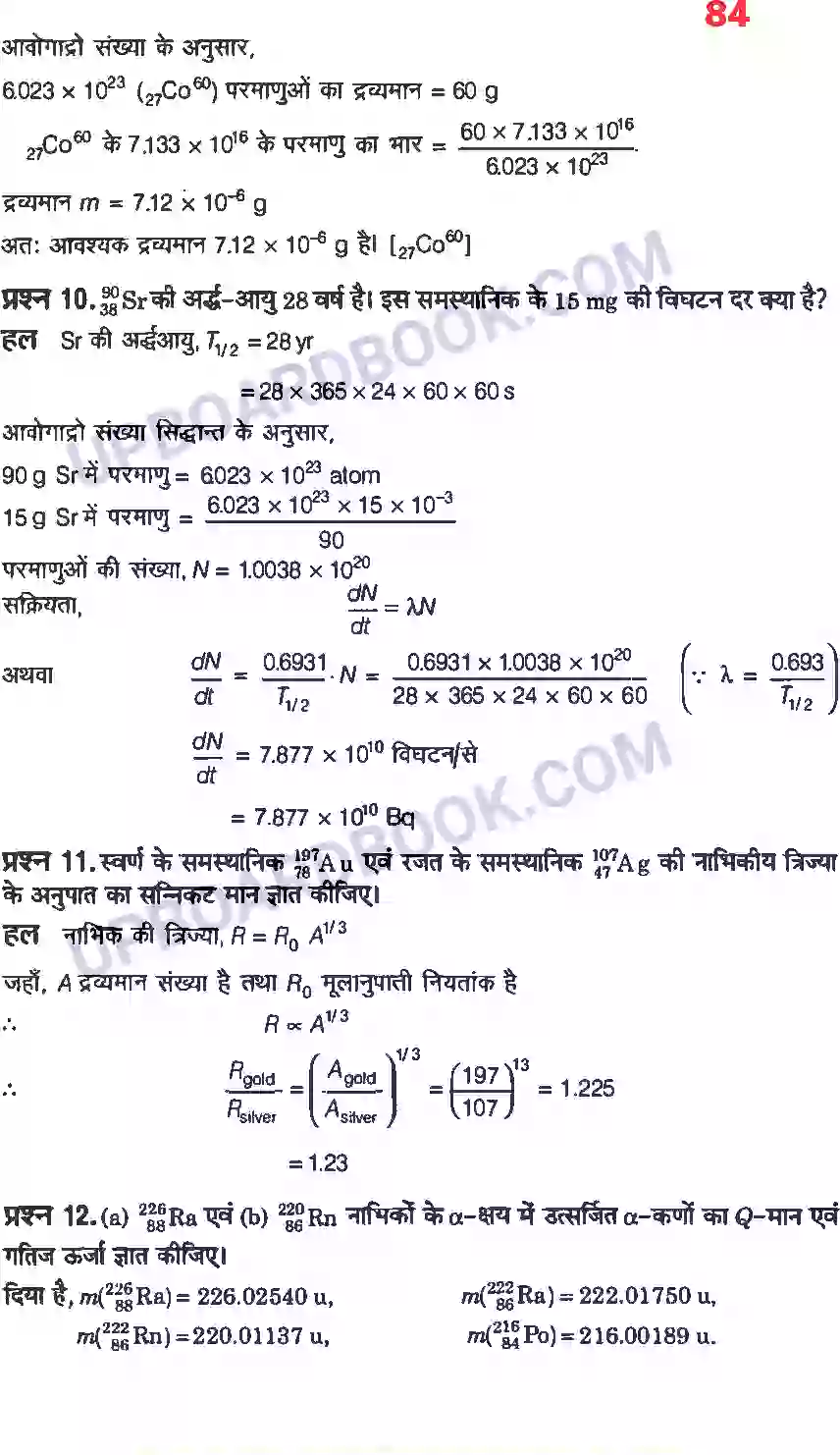
\(_{27}^{60}\text{Co}\) का मोलर द्रव्यमान = 60 g/mol
आवश्यक द्रव्यमान = \(\frac{7.13 \times 10^{16}}{6.022 \times 10^{23}} \times 60 \approx 7.1 \times 10^{-6} \, \text{g}\)
प्रश्न 10.
\(_{38}^{90}\text{Sr}\) की अर्द्ध-आयु 28 वर्ष है। इस समस्थानिक के 15 mg की विघटन दर क्या है?
हल:
\(T_{1/2} = 28 \, \text{वर्ष} = 28 \times 365 \times 24 \times 3600 \approx 8.83 \times 10^8 \, \text{s}\)
द्रव्यमान = 15 mg = 15 × 10⁻³ g
मोलर द्रव्यमान = 90 g/mol
परमाणुओं की संख्या \(N = \frac{15 \times 10^{-3}}{90} \times 6.022 \times 10^{23} \approx 1.0037 \times 10^{20}\)
\(\lambda = \frac{0.693}{8.83 \times 10^8} \approx 7.85 \times 10^{-10} \, \text{s}^{-1}\)
विघटन दर \(A = \lambda N = 7.85 \times 10^{-10} \times 1.0037 \times 10^{20} \approx 7.88 \times 10^{10} \, \text{Bq}\)
प्रश्न 11.
स्वर्ण के समस्थानिक \(_{79}^{197}\text{Au}\) एवं रजत के समस्थानिक \(_{47}^{107}\text{Ag}\) की नाभिकीय त्रिज्या के अनुपात का सन्निकट मान ज्ञात कीजिए।
हल:
नाभिक की त्रिज्या \(R = R_0 A^{1/3}\)
\(\frac{R_{\text{Au}}}{R_{\text{Ag}}} = \left( \frac{197}{107} \right)^{1/3} \approx (1.841)^{1/3} \approx 1.23\)
प्रश्न 12.
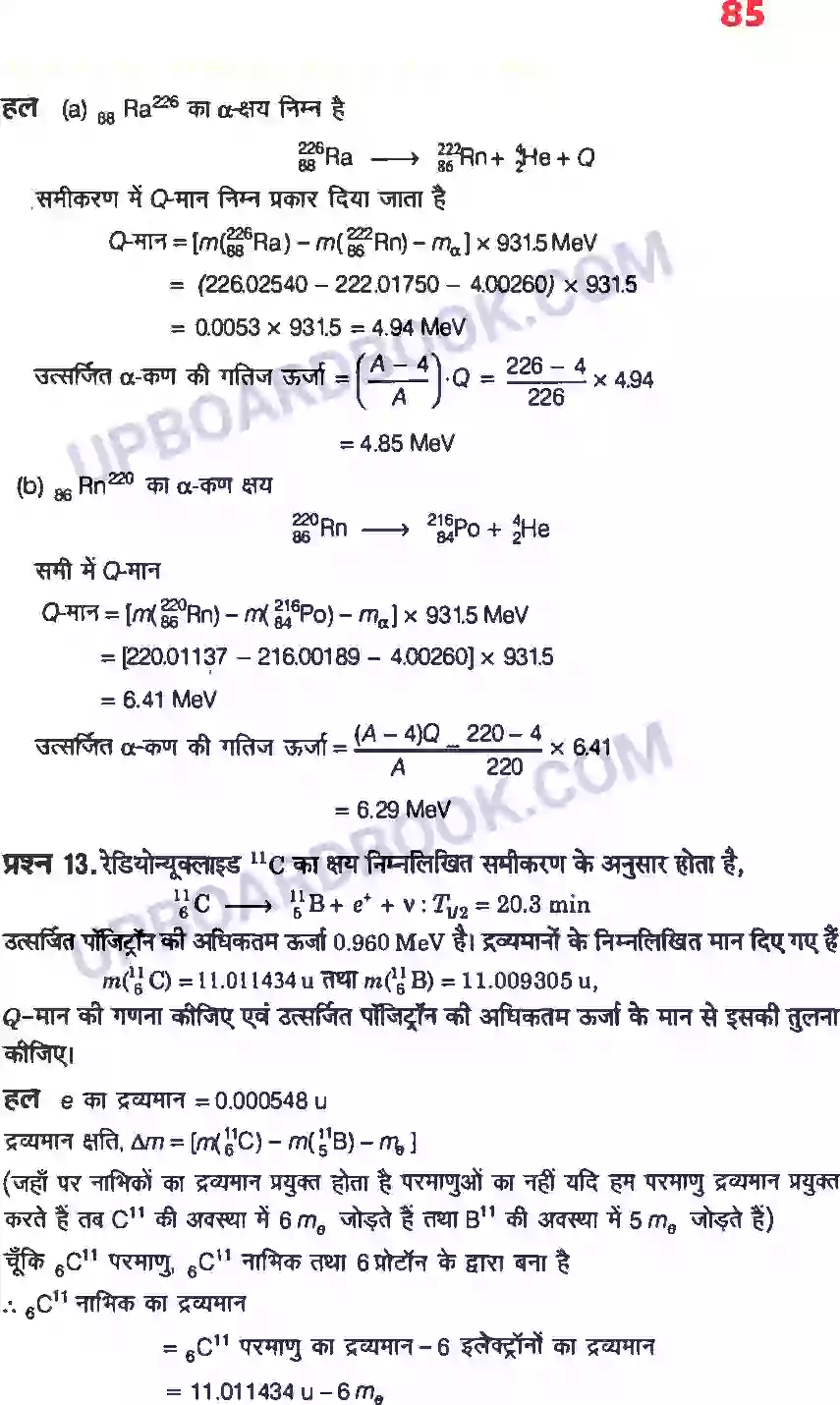
(a) \(_{88}^{226}\text{Ra}\) एवं (b) \(_{86}^{220}\text{Rn}\) नाभिकों के α-क्षय में उत्सर्जित α-कणों का Q-मान एवं गतिज ऊर्जा ज्ञात कीजिए।
दिया है:
\(m(_{88}^{226}\text{Ra}) = 226.02540 \, \text{u}\), \(m(_{86}^{222}\text{Rn}) = 222.01750 \, \text{u}\),
\(m(_{86}^{220}\text{Rn}) = 220.01137 \, \text{u}\), \(m(_{84}^{216}\text{Po}) = 216.00189 \, \text{u}\),
\(m(_{2}^{4}\text{He}) = 4.00260 \, \text{u}\)
हल:
(a) \(_{88}^{226}\text{Ra} \rightarrow _{86}^{222}\text{Rn} + _{2}^{4}\text{He} + Q\)
\(Q = [m(_{88}^{226}\text{Ra}) - m(_{86}^{222}\text{Rn}) - m(_{2}^{4}\text{He})] \times 931.5 \, \text{MeV}\)
\(= (226.02540 - 222.01750 - 4.00260) \times 931.5\)
\(= 0.0053 \times 931.5 \approx 4.94 \, \text{MeV}\)
α-कण की गतिज ऊर्जा \(= \frac{A-4}{A} \times Q = \frac{222}{226} \times 4.94 \approx 4.85 \, \text{MeV}\)
(b) \(_{86}^{220}\text{Rn} \rightarrow _{84}^{216}\text{Po} + _{2}^{4}\text{He} + Q\)
\(Q = (220.01137 - 216.00189 - 4.00260) \times 931.5\)
\(= 0.00688 \times 931.5 \approx 6.41 \, \text{MeV}\)
α-कण की गतिज ऊर्जा \(= \frac{216}{220} \times 6.41 \approx 6.29 \, \text{MeV}\)
प्रश्न 13.
रेडियोन्यूक्लाइड \(_{6}^{11}\text{C}\) का क्षय निम्नलिखित समीकरण के अनुसार होता है:
\(_{6}^{11}\text{C} \rightarrow _{5}^{11}\text{B} + e^+ + \nu\)
\(T_{1/2} = 20.3 \, \text{min}\)
उत्सर्जित पॉजिट्रॉन की अधिकतम ऊर्जा 0.960 MeV है। द्रव्यमानों के निम्नलिखित मान दिए गए हैं:
\(m(_{6}^{11}\text{C}) = 11.011434 \, \text{u}\), \(m(_{5}^{11}\text{B}) = 11.009305 \, \text{u}\)
Q-मान की गणना कीजिए एवं उत्सर्जित पॉजिट्रॉन की अधिकतम ऊर्जा के मान से इसकी तुलना कीजिए।
हल:
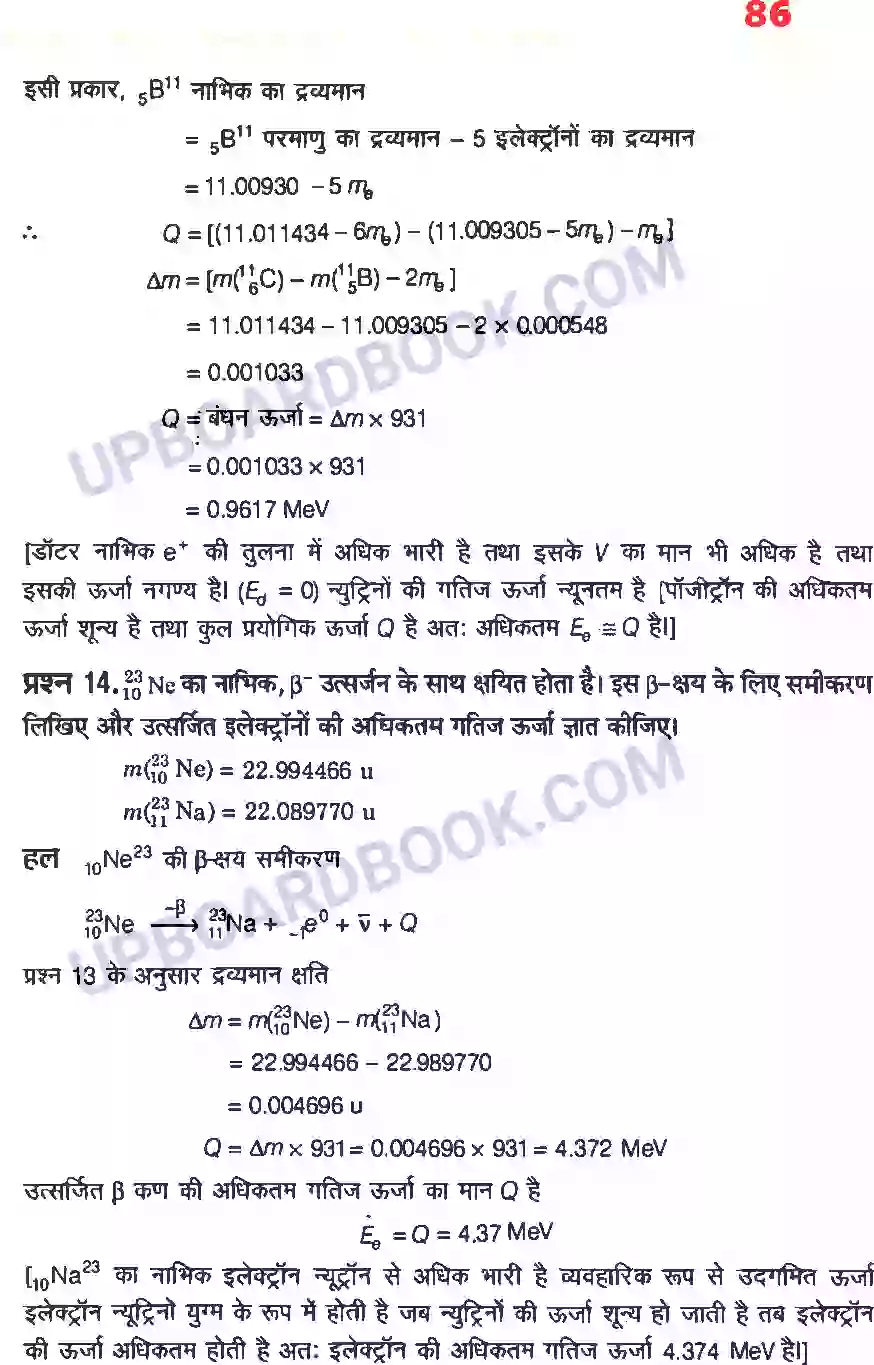
\(Q = [m(_{6}^{11}\text{C}) - m(_{5}^{11}\text{B}) - 2m_e] \times 931.5 \, \text{MeV}\)
\(m_e = 0.000548 \, \text{u}\)
\(Q = (11.011434 - 11.009305 - 2 \times 0.000548) \times 931.5\)
\(= (0.002129 - 0.001096) \times 931.5 = 0.001033 \times 931.5 \approx 0.962 \, \text{MeV}\)
पॉजिट्रॉन की अधिकतम गतिज ऊर्जा = Q - न्यूट्रिनो की ऊर्जा (जो लगभग शून्य मानी जा सकती है) ≈ 0.962 MeV
दिया गया मान 0.960 MeV के करीब है।
प्रश्न 14.
\(_{10}^{23}\text{Ne}\) का नाभिक, β⁻ उत्सर्जन के साथ क्षयित होता है। इस β⁻-क्षय के लिए समीकरण लिखिए और उत्सर्जित इलेक्ट्रॉनों की अधिकतम गतिज ऊर्जा ज्ञात कीजिए।
\(m(_{10}^{23}\text{Ne}) = 22.994466 \, \text{u}\), \(m(_{11}^{23}\text{Na}) = 22.989770 \, \text{u}\)
हल:
\(_{10}^{23}\text{Ne} \rightarrow _{11}^{23}\text{Na} + e^- + \bar{\nu}_e + Q\)
\(Q = [m(_{10}^{23}\text{Ne}) - m(_{11}^{23}\text{Na})] \times 931.5 \, \text{MeV}\)
\(= (22.994466 - 22.989770) \times 931.5 = 0.004696 \times 931.5 \approx 4.37 \, \text{MeV}\)
इलेक्ट्रॉन की अधिकतम गतिज ऊर्जा ≈ Q ≈ 4.37 MeV (जब न्यूट्रिनो की ऊर्जा शून्य हो)
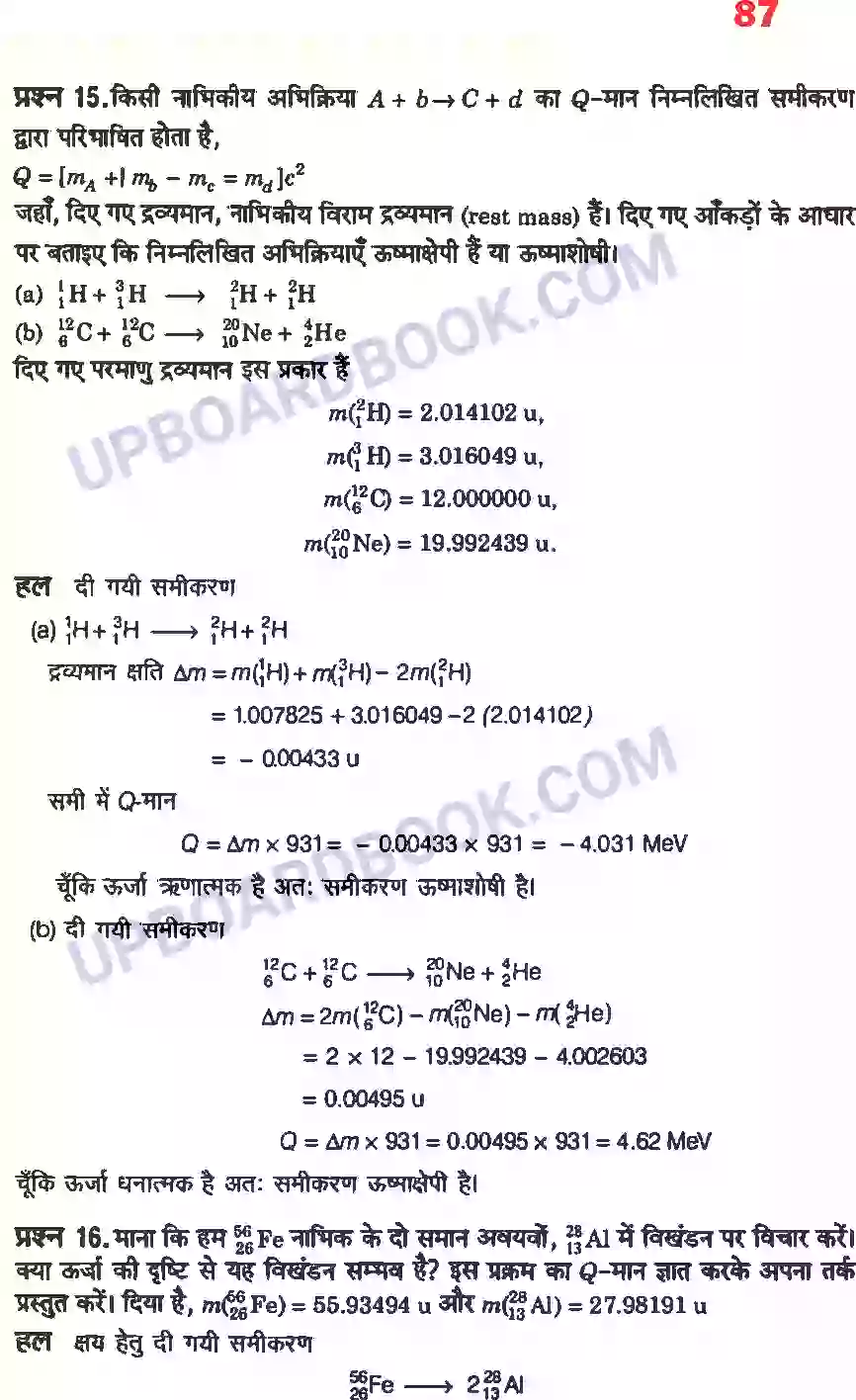
प्रश्न 15.
किसी नाभिकीय अभिक्रिया \(A + b \rightarrow C + d\) का Q-मान निम्नलिखित समीकरण द्वारा परिभाषित होता है:
\(Q = [m_A + m_b - m_C - m_d]c^2\)
जहाँ, दिए गए द्रव्यमान, नाभिकीय विराम द्रव्यमान हैं। दिए गए आँकड़ों के आधार पर बताइए कि निम्नलिखित अभिक्रियाएँ ऊष्माक्षेपी हैं या ऊष्माशोषी।
(a) \(_{1}^{1}\text{H} + _{1}^{3}\text{H} \rightarrow _{1}^{2}\text{H} + _{1}^{2}\text{H}\)
(b) \(_{6}^{12}\text{C} + _{6}^{12}\text{C} \rightarrow _{10}^{20}\text{Ne} + _{2}^{4}\text{He}\)
दिए गए परमाणु द्रव्यमान:
\(m(_{1}^{1}\text{H}) = 1.007825 \, \text{u}\), \(m(_{1}^{2}\text{H}) = 2.014102 \, \text{u}\), \(m(_{1}^{3}\text{H}) = 3.016049 \, \text{u}\),
\(m(_{6}^{12}\text{C}) = 12.000000 \, \text{u}\), \(m(_{10}^{20}\text{Ne}) = 19.992439 \, \text{u}\), \(m(_{2}^{4}\text{He}) = 4.002603 \, \text{u}\)
हल:
(a) \(Q = [m(_{1}^{1}\text{H}) + m(_{1}^{3}\text{H}) - 2m(_{1}^{2}\text{H})] \times 931.5\)
\(= [1.007825 + 3.016049 - 2 \times 2.014102] \times 931.5\)
\(= [4.023874 - 4.028204] \times 931.5 = -0.00433 \times 931.5 \approx -4.03 \, \text{MeV}\)
Q ऋणात्मक है → ऊष्माशोषी अभिक्रिया।
(b) \(Q = [2m(_{6}^{12}\text{C}) - m(_{10}^{20}\text{Ne}) - m(_{2}^{4}\text{He})] \times 931.5\)
\(= [2 \times 12.000000 - 19.992439 - 4.002603] \times 931.5\)
\(= [24.000000 - 23.995042] \times 931.5 = 0.004958 \times 931.5 \approx 4.62 \, \text{MeV}\)
Q धनात्मक है → ऊष्म
Get UP Board Class 12 Physics 13. नाभिक Solution in Hindi Medium
UP Board Class 12 Physics 13. नाभिक Solution is available at our platform https://upboardbook.com in hindi medium for free of cost. Content provided on our website is free of cost and in PDF format which is easily available for download. Getting the UP Board Solutions for Class 12 will help student to achieve good learning experience so that they can study effectively. UP board holds examination of more than 3 million students every year and majority of the question of exams are from their UP Board Solutions. That’s why it is important to study using the textSolution issued by UP Board.
Importance of UP Board Class 12 Physics 13. नाभिक Text Solutions
It is essential to know the importance of UP Board Class 12 Physics 13. नाभिक textSolution issued by UP Board because students completely rely on these Solutions for their study and syllabus offered by UP Board is so balanced that each student should be aware about the importance of it. Below is the list of Importance of UP Board Class 12 Physics 13. नाभिक :
- These TextSolutions are very clear and accurate which helps student to understand concept with ease.
- It is also to mention that these text Solutions are prepared by the content experts of subject, thus these Solutions helps student in clearing their doubts and understand the core concept easily.
- It is considered to be the best study material for competitive exam preparation.
Features of UP Board Class 12 textSolutions
There are various features of UP Board Class 12 TextSolutions, some of them are mentioned below so that you student can understand the value and usability of the contend and understand why Uttarpradesh board has prescribed these Solutions.
- Best feature of these textSolutions is free availability of content in PDF format
- Second feature that content generated and written is clear and easy to read.
- There are various illustration and images are shown in the Solution so that student can easily understand the concept and should be more appealing to the student.
- Each chapter is explained thoroughly
