UP Board class 8 English 1. The Best Christmas Present In The World is a Hindi Medium Solution which is prescribed by Uttar Pradesh Board for their students. These Solutions is completely prepared considering the latest syllabus and it covers every single topis, so that every student get organised and conceptual learning of the concepts. class 8 Students of UP Board who have selected hindi medium as their study medium they can use these Hindi medium textSolutions to prepare themselves for exam and learn the concept with ease.
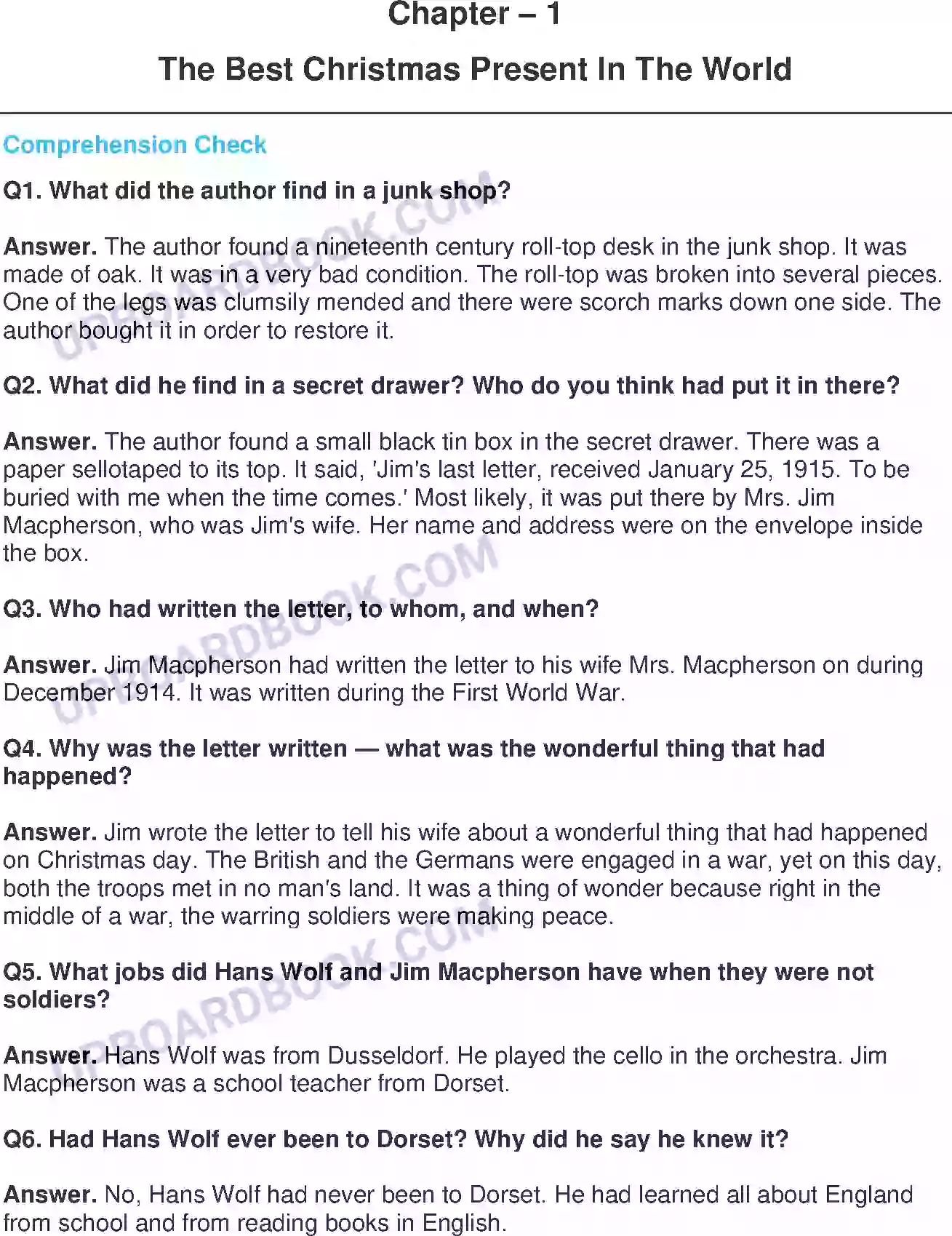
Answer: In a junk shop in Bridport, the author discovered a roll-top desk from the nineteenth century. It was crafted from oak wood but was in a terrible state. The roll-top was shattered into many fragments, one leg had been poorly repaired, and there were burn marks along one side. The author decided to purchase it with the intention of repairing and restoring it to its former glory.
Answer: Inside a hidden compartment of the desk, the author found a small, black tin box. A note was attached to its lid with sellotape, reading: ‘Jim's last letter, received January 25, 1915. To be buried with me when the time comes.’ It is strongly believed that this box was placed there by Mrs. Connie Macpherson, Jim's wife, as her name and address were written on the envelope kept inside the box.
Answer: The letter was written by Captain Jim Macpherson of the British army. He wrote it to his beloved wife, Connie Macpherson, during the festive season of December 1914, amidst the turmoil of the First World War.
Answer: Jim wrote this letter to share an extraordinary and heartwarming event with his wife. On Christmas Day, in the middle of a fierce war, British and German soldiers spontaneously declared a temporary truce. They met in the 'no man's land' between the trenches, exchanged greetings, shared food, and even played a friendly football match. This moment of humanity and peace in the midst of war was the wonderful thing he described.
Answer: Before becoming soldiers, Hans Wolf was a musician who played the cello in an orchestra in Dusseldorf, Germany. Jim Macpherson, on the other hand, was a school teacher from the peaceful countryside of Dorset in England.
Answer: No, Hans Wolf had never actually visited Dorset. His knowledge about the place came entirely from books. He was an avid reader of English literature and had learned about England's geography and culture through his studies and reading.
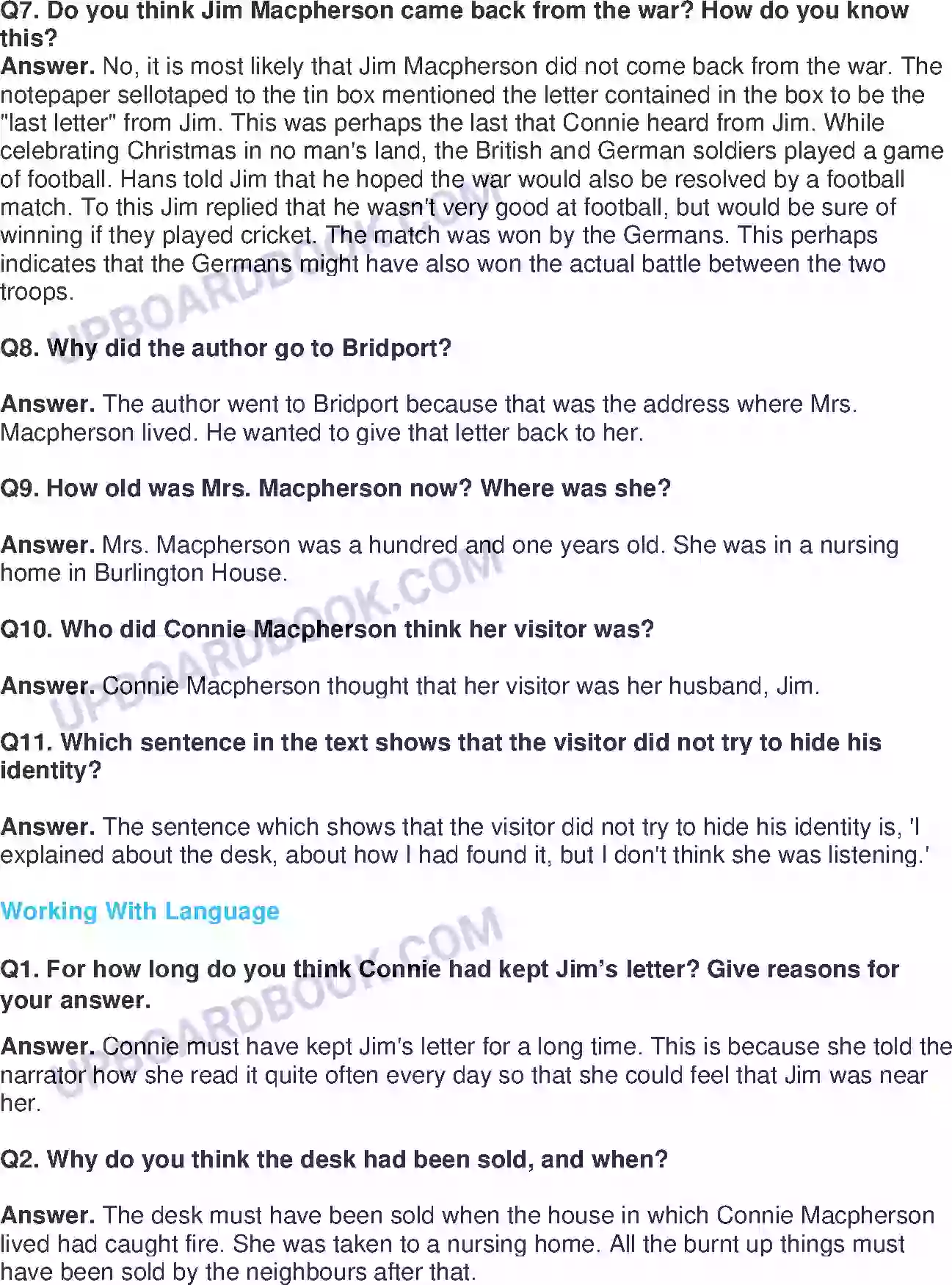
Answer: No, it appears that Jim Macpherson did not return from the war. The note on the tin box explicitly called it his "last letter," suggesting Connie never received another. Furthermore, the story implies the battle after Christmas was fierce. The Germans won the football match they played, and Hans had jokingly said he hoped the war would be decided by a match. This detail symbolically hints that the Germans might have won the subsequent battle as well, where Jim was likely killed.
Answer: The author travelled to Bridport because it was the address written on the envelope inside the tin box. He wished to personally return this precious last letter to Jim's wife, Mrs. Macpherson, feeling it was the right thing to do.
Answer: Mrs. Connie Macpherson was one hundred and one years old. After a fire damaged her home, she was moved to a nursing home called Burlington House for care and safety.
Answer: In her old age and confusion, Connie Macpherson mistook the visitor (the author) for her husband, Jim, believing he had finally come back home to her as he had promised in his letter.
Answer: The sentence that shows the visitor was honest about who he was is: 'I explained about the desk, about how I had found it, but I don't think she was listening.' This indicates he tried to tell her the truth from the beginning.
Answer: Connie had kept Jim's letter safe for decades, probably since she received it in 1915. She told the narrator that she read it every day, often multiple times, to feel close to Jim. This daily ritual over many years shows how deeply she treasured it, making it her most prized possession for almost her entire adult life.
Answer: The desk was most likely sold after the fire accident at Connie's house. When she was moved to the nursing home, her burnt and damaged belongings were probably cleared out and sold off by neighbours or authorities. The desk, being scorched and broken, would have been considered junk and sold in a shop.
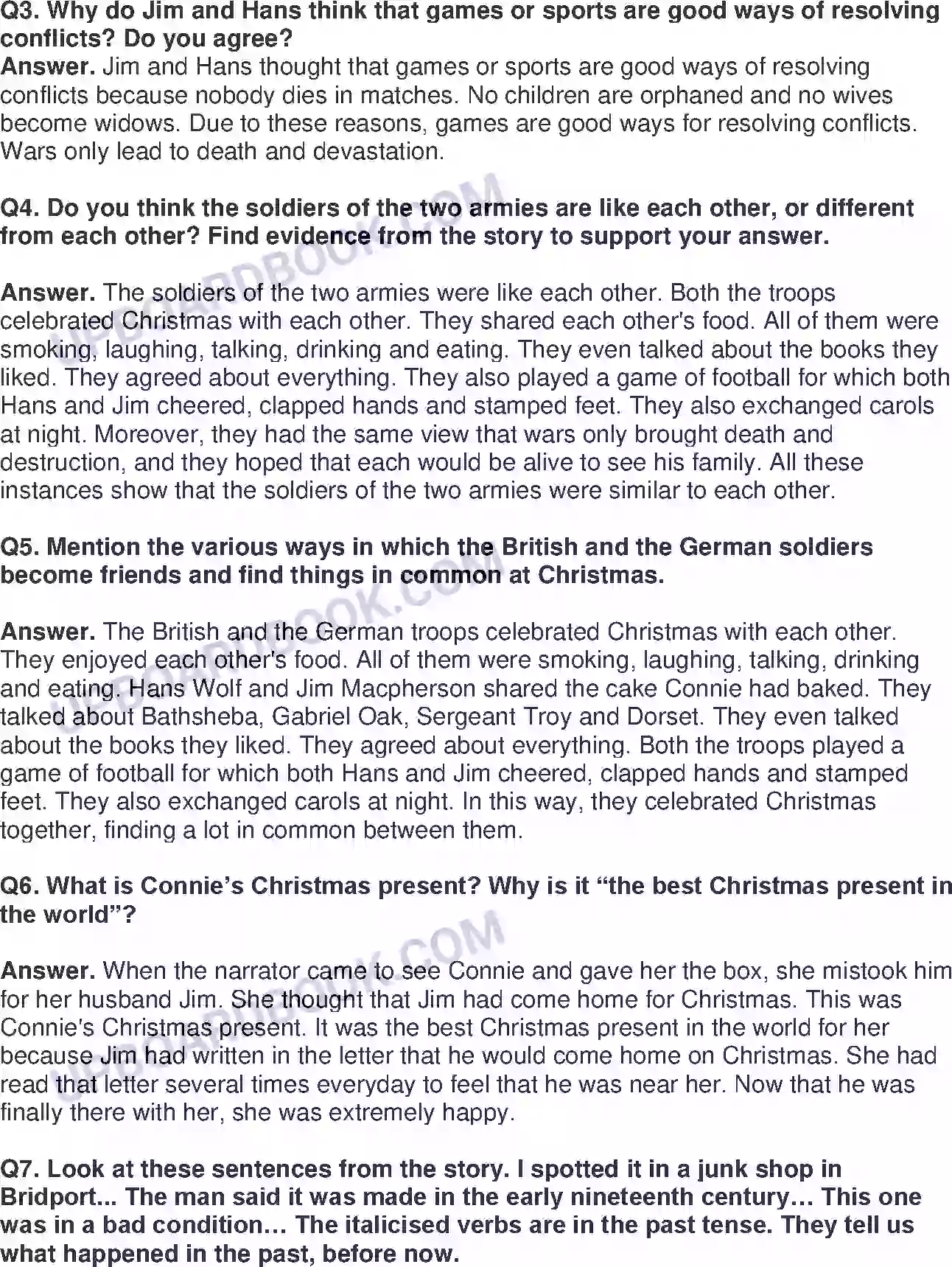
Answer: Jim and Hans believe sports are a better way to settle disputes because in a game, no one dies, no children are orphaned, and no wives become widows. It's a contest of skill and spirit without the horrific cost of war. Yes, this is a noble idea. While sports may not solve deep political conflicts, they promote healthy competition, build bridges between people, and are certainly a far more humane alternative to violence.
Answer: The soldiers were fundamentally alike. Despite being on opposing sides, they shared the same human desires for peace, companionship, and home. Evidence: They celebrated Christmas together, shared food, drinks, and cigarettes. They laughed, talked, and found common ground in literature. They played a friendly football match, cheering and clapping together. They even sang carols for each other. This shows they were not enemies by choice but ordinary men caught in a war.
Answer: The soldiers became friends in several beautiful ways: They initiated a truce by waving white flags and calling out "Happy Christmas." They met in no man's land, shaking hands and introducing themselves. They shared delicacies like cake, sausage, schnapps, and rum. They showed each other family photographs. Jim and Hans discussed novels and authors they both enjoyed. Finally, they played a spirited game of football, breaking down all barriers of nationality.
Answer: Connie's Christmas present was the joyful delusion that her husband Jim had returned. When the author gave her the letter, she mistook him for Jim, believing he had kept his promise to come home for Christmas. For her, this moment of believing her long-lost love was back was priceless. It brought her immense happiness and peace, making it truly "the best Christmas present in the world."
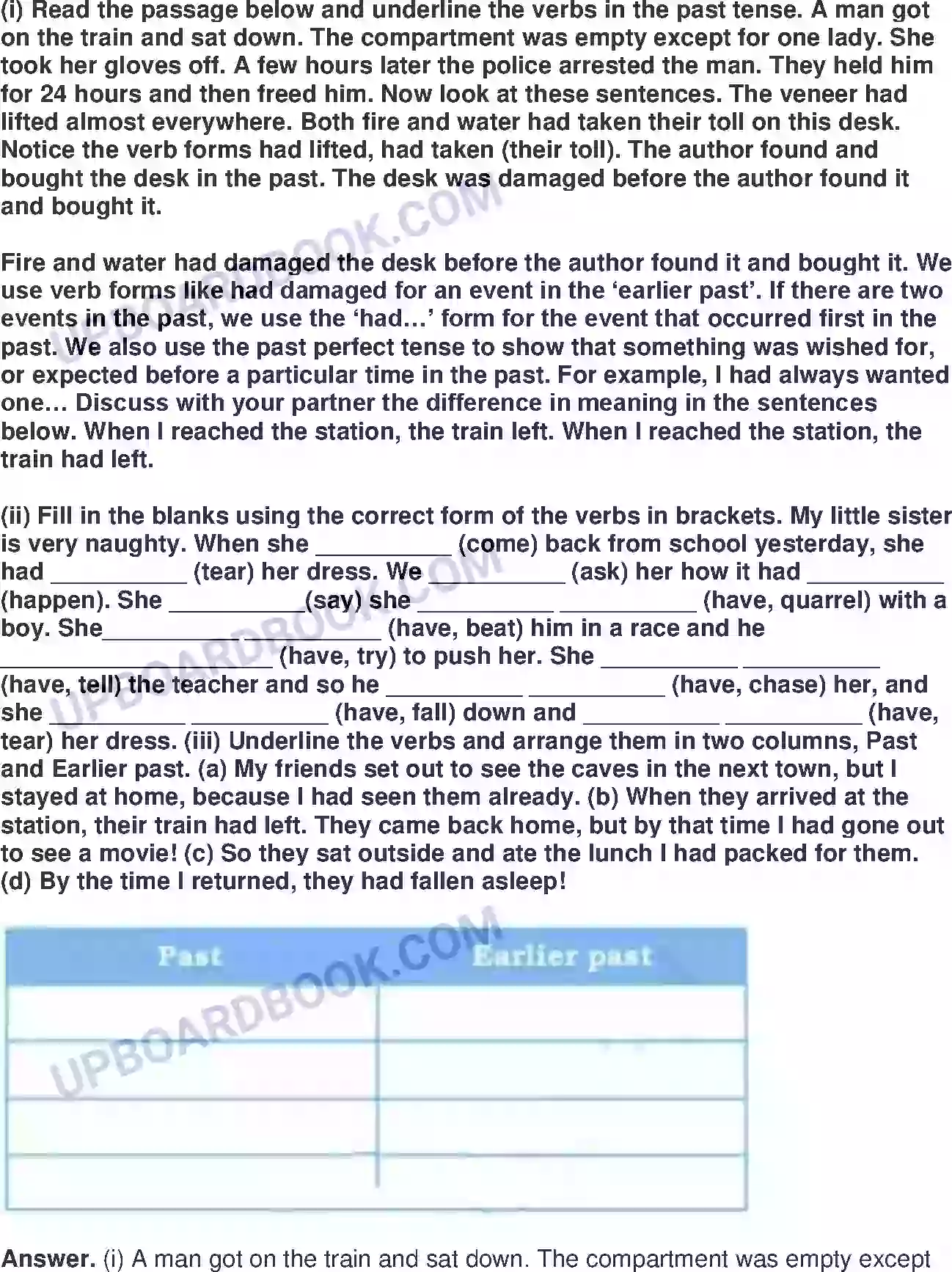
(i) Read the passage below and underline the verbs in the past tense.
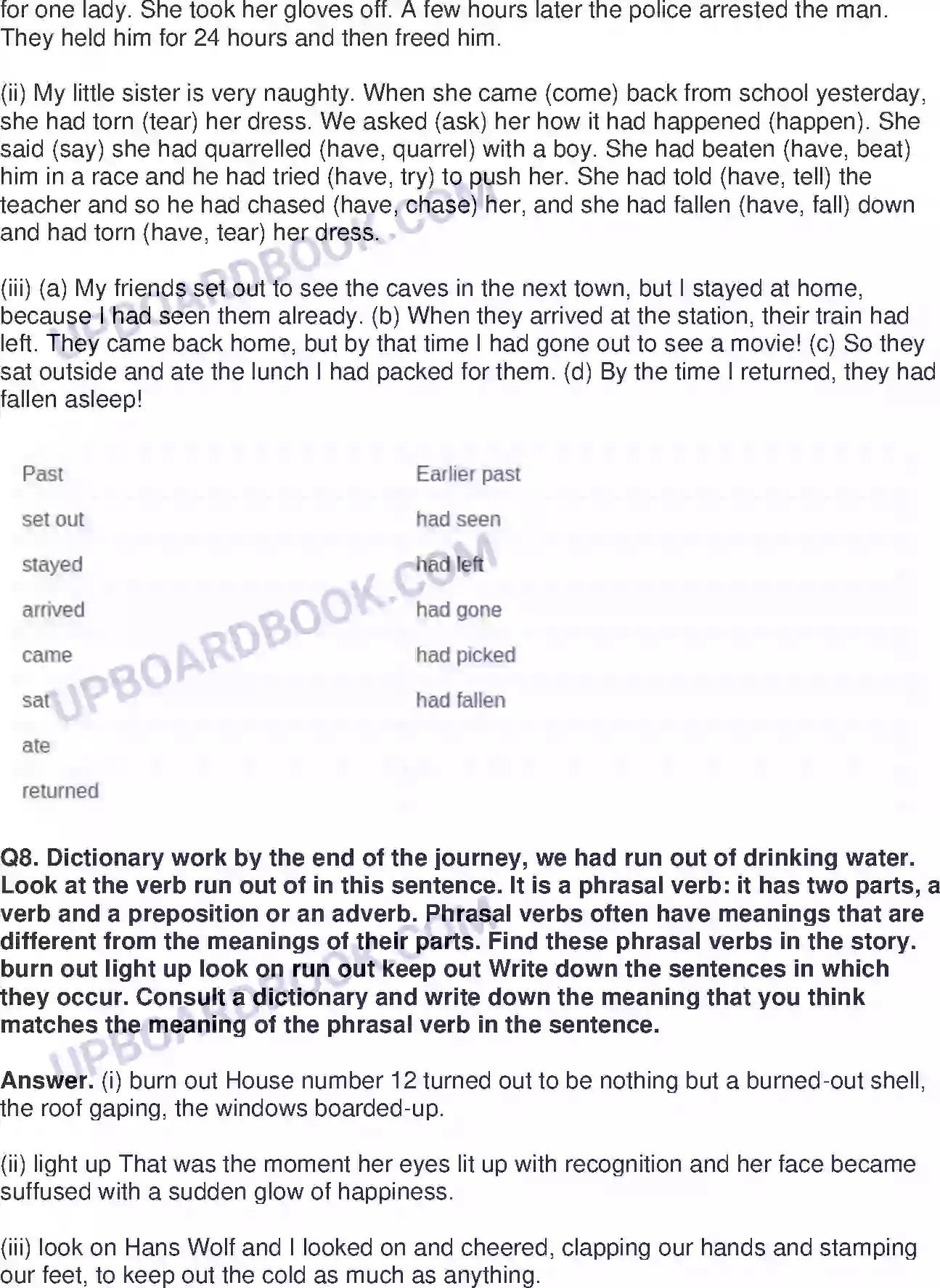
A man got on the train and sat down. The compartment was empty except for one lady. She took her gloves off. A few hours later the police arrested the man. They held him for 24 hours and then freed him.
(ii) Fill in the blanks using the correct form of the verbs in brackets.
My little sister is very naughty. When she came (come) back from school yesterday, she had torn (tear) her dress. We asked (ask) her how it had happened (happen). She said (say) she had quarrelled (have, quarrel) with a boy. She had beaten (have, beat) him in a race and he had tried (have, try) to push her. She had told (have, tell) the teacher and so he had chased (have, chase) her, and she had fallen (have, fall) down and had torn (have, tear) her dress.
(iii) Underline the verbs and arrange them in two columns, Past and Earlier past.
(a) My friends set out to see the caves in the next town, but I stayed at home, because I had seen them already.
(b) When they arrived at the station, their train had left. They came back home, but by that time I had gone out to see a movie!
(c) So they sat outside and ate the lunch I had packed for them.
(d) By the time I returned, they had fallen asleep!
| Past | Earlier Past |
|---|---|
| set out | had seen |
| stayed | had left |
| arrived | had gone |
| came | had packed |
| sat | had fallen |
| ate | |
| returned |
Answer:
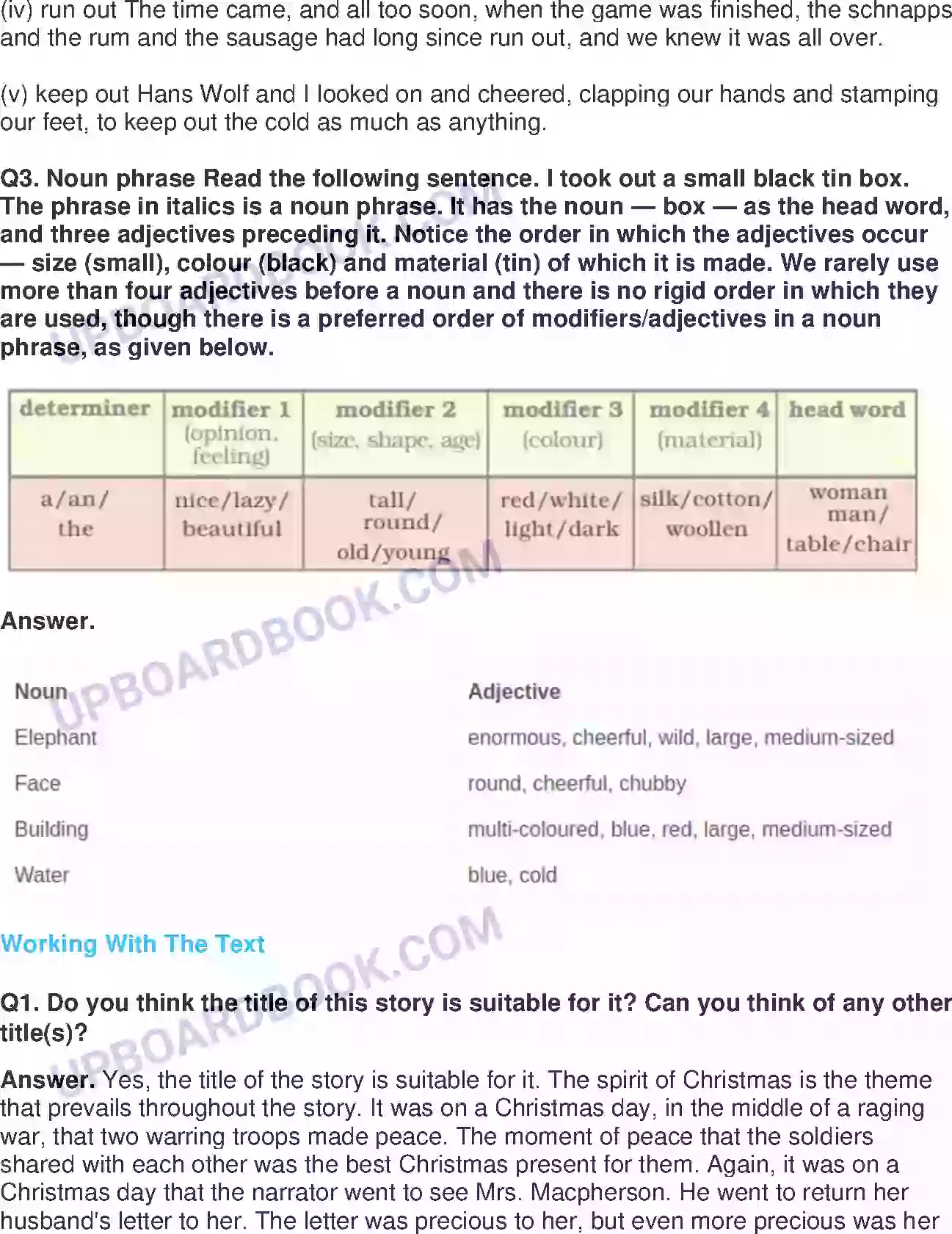
1. burn out: "House number 12 turned out to be nothing but a burned-out shell..." (Meaning: destroyed by fire)
2. light up: "That was the moment her eyes lit up with recognition..." (Meaning: to become bright with expression)
3. look on: "Hans Wolf and I looked on and cheered..." (Meaning: to watch something happening)
4. run out: "...the schnapps and the rum and the sausage had long since run out..." (Meaning: to be used up or finished)
5. keep out: "...stamping our feet, to keep out the cold as much as anything." (Meaning: to prevent something from entering)
Answer: Yes, the title is perfectly suitable and poignant. The story presents two "best Christmas presents": the magical moment of peace for the soldiers in 1914, and the profound happiness the letter brought to Connie in her old age. Another suitable title could be "The Christmas Truce" or "Jim's Last Letter."
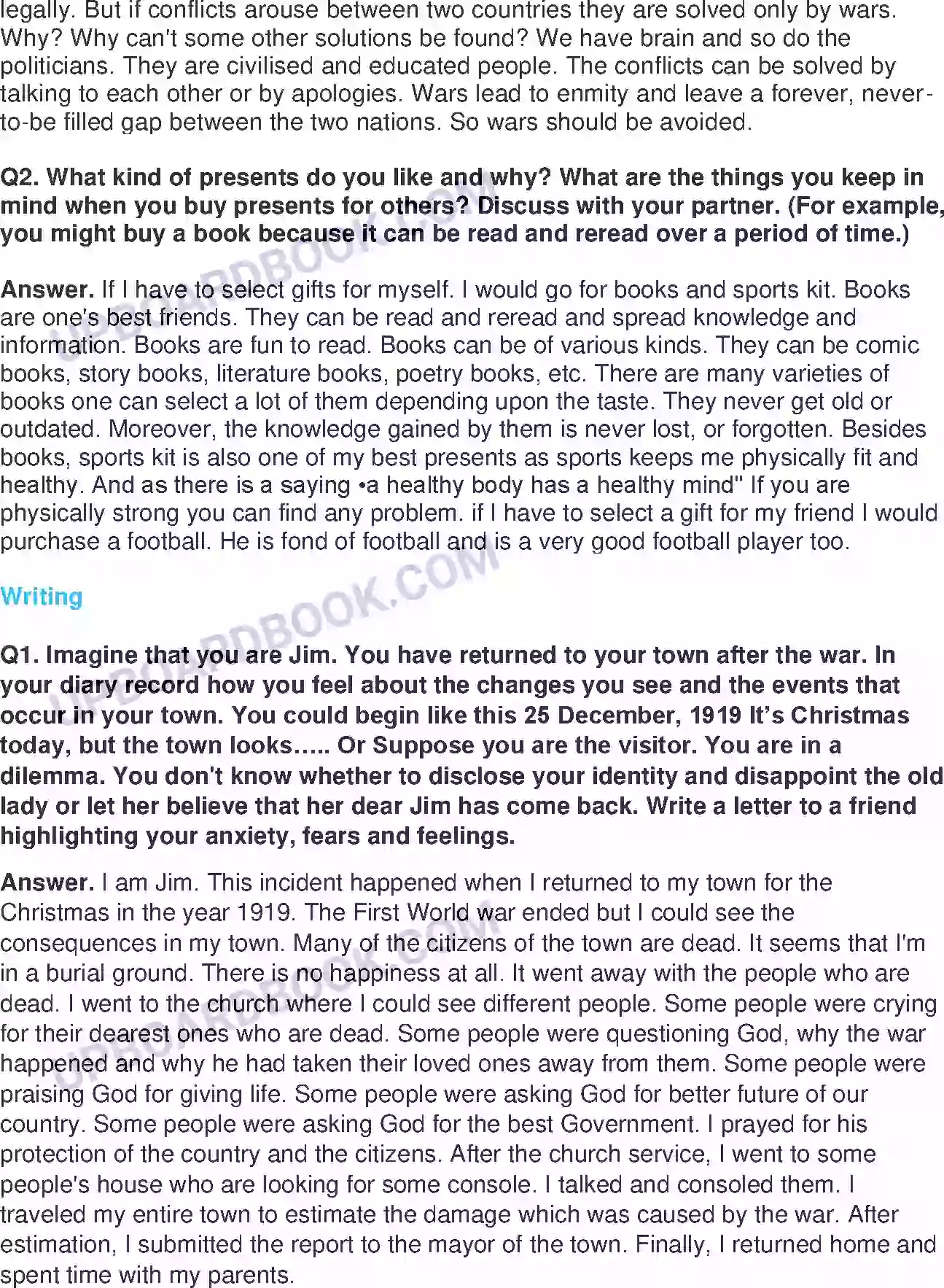
Answer: (Points for discussion) Wars are a destructive and tragic way to resolve conflicts. They cause immense loss of life, leave families shattered, destroy infrastructure, and create lasting hatred between nations. Conflicts should ideally be resolved through peaceful means like dialogue, negotiation, diplomacy, and international mediation. The story itself shows that even enemies crave peace and share common humanity.
Answer: (Sample answer) I prefer presents that are thoughtful, useful, or create lasting memories. For example, I love receiving books because they offer knowledge and can be revisited anytime. A plant is a great gift as it grows and reminds you of the person. Experiences, like a ticket to a concert or a promise for a day out, are wonderful as they create happy memories rather than just adding to possessions.
Answer (Option 2 - The Visitor's Letter):
Dear [Friend's Name],
I am writing to you in a state of complete emotional turmoil. Today, I met Mrs. Connie Macpherson to return her husband's letter. What I thought would be a simple, kind act has turned into a moral dilemma I can't shake off.
When she saw me, her eyes lit up with a joy I've never witnessed. She called me "Jim" and believed, with all her heart, that I was her husband returned from the war. I tried to explain about the desk and the letter, but she was lost in her own beautiful, heartbreaking reality. She was so happy, holding my hand, thinking her long wait was over.
Now I am torn. Should I shatter her world by insisting on the truth? That would crush her spirit. Or should I let this gentle, 101-year-old lady have her "best Christmas present" and live her final days in blissful belief? It feels wrong to deceive her, but correcting her feels crueler.
What would you do? I feel the weight of this decision heavily.
Yours anxiously,
[Your Name]
Answer:
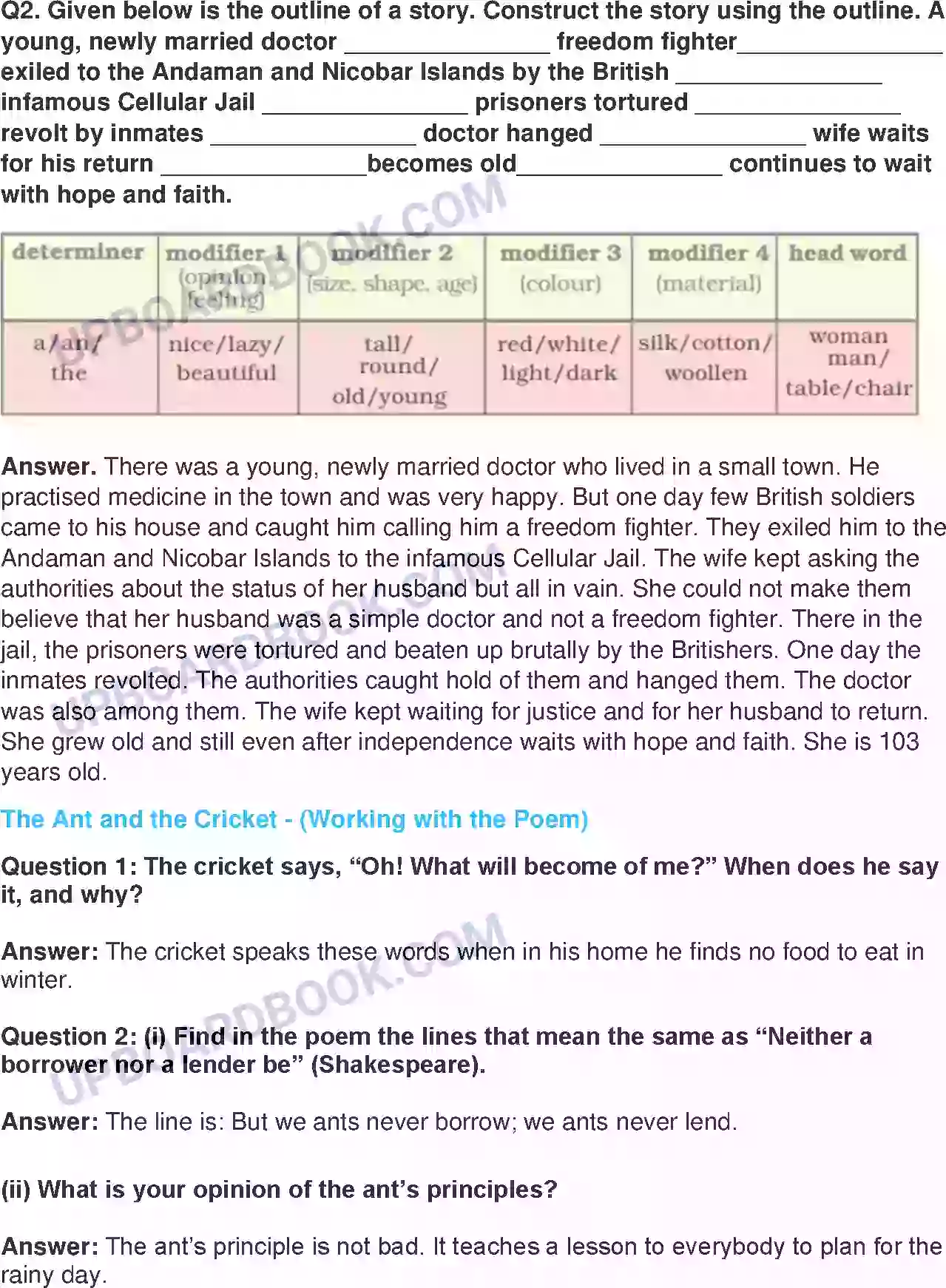
Dr. Arjun was a young, compassionate doctor newly married to his wife, Leela. His life in a small Indian town was upended when British soldiers, suspecting him of aiding freedom fighters, arrested him. Without a fair trial, he was exiled to the notorious Cellular Jail in the Andaman Islands.
Back home, Leela fought tirelessly for justice, but her pleas fell on deaf ears. In the jail, Dr. Arjun tended to the other inmates, who were brutally tortured. A planned revolt was discovered by the authorities. In a brutal reprisal, Dr. Arjun, along with other prisoners, was hanged.
Leela, unaware of his fate, never lost hope. Every day, she would wait at the doorstep, watching the road. Seasons changed, years turned into decades. Her hair turned white, her posture bent, but her eyes still held the same unwavering faith. Even after India gained independence, the now 103-year-old Leela continues to wait, her heart clinging to the hope that her Arjun will one day walk down that road, keeping his promise to return.
Answer: The cricket cries out in despair when winter arrives. Having sung and enjoyed himself all through the warm summer and spring, he finds his cupboard completely empty with no food to survive the cold, harsh season.
Answer: The ant's principle is reflected in the line: "But we ants never borrow; we ants never lend."
(ii) What is your opinion of the ant’s principles?
The ant's principle of hard work and saving for the future is very wise and practical. It teaches us the importance of responsibility and planning ahead. While helping others is good, being self-reliant ensures we are not a burden on others during difficult times.
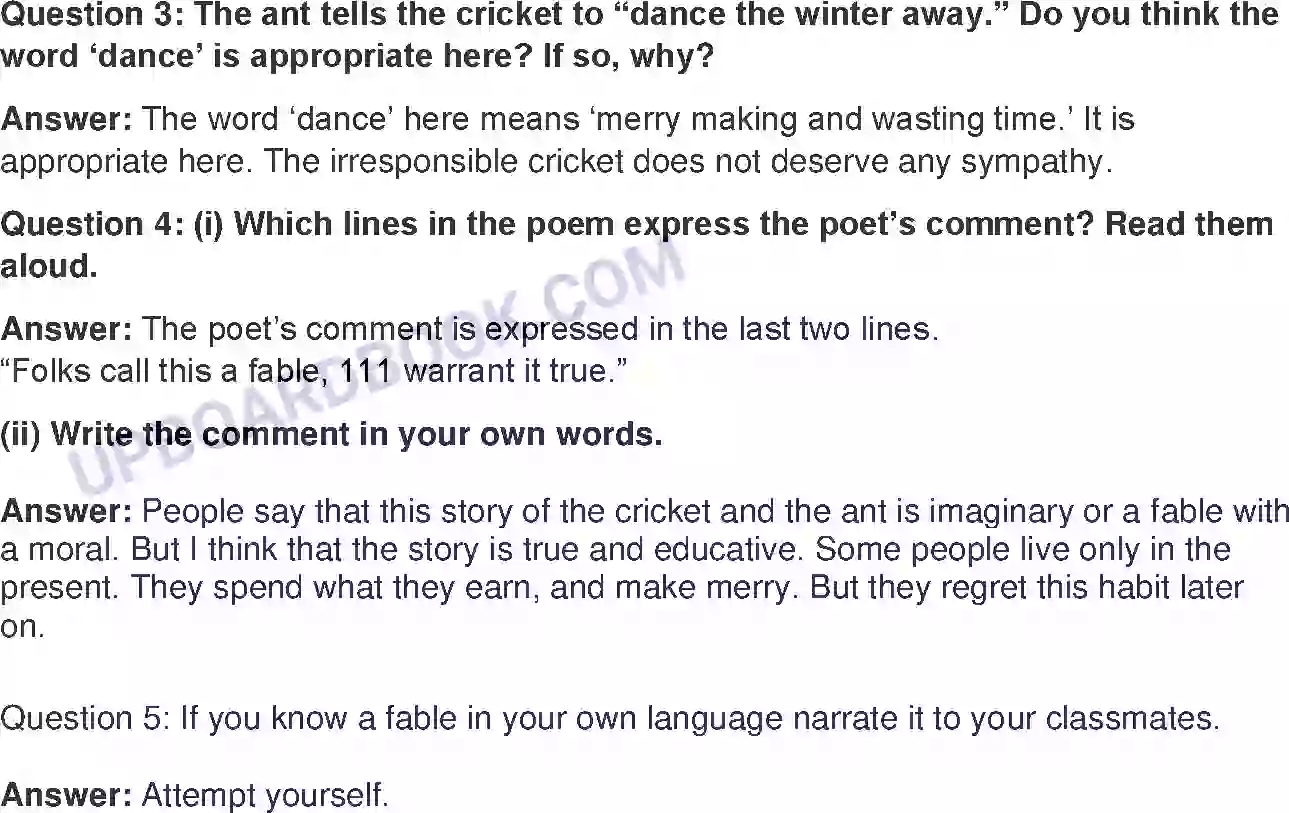
Answer: Yes, the word 'dance' is very appropriate and used sarcastically. During summer, the cricket was literally 'dancing' and singing, which is a metaphor for his carefree and irresponsible behaviour. The ant is mockingly telling him to go back to what he was doing—merrymaking—since he didn't do the useful work of gathering food when he had the chance.
Answer: The poet's direct comment is in the final two lines of the poem: "Folks call this a fable. I'll warrant it true."
(ii) Write the comment in your own words.
The poet says that people might think this story of the ant and cricket is just a made-up tale with a moral. However, he firmly believes that its lesson is genuine and applicable to real life. It truthfully portrays the consequences of laziness and the value of hard work and foresight.
Answer: This is a classroom activity. Students should share fables like The Tortoise and the Hare (slow and steady wins the race) or The Crow and the Pitcher (where thought and effort solve a problem).
UP Board class 8 English 1. The Best Christmas Present In The World Solution is available at our platform https://upboardSolution.com in hindi medium for free of cost. Content provided on our website is free of cost and in PDF format which is easily available for download. Getting the UP Board Solutions for class 8 will help student to achieve good learning experience so that they can study effectively. UP board holds examination of more than 3 million students every year and majority of the question of exams are from their UP Board Solutions. That’s why it is important to study using the textSolution issued by UP Board.
It is essential to know the importance of UP Board class 8 English 1. The Best Christmas Present In The World textSolution issued by UP Board because students completely rely on these Solutions for their study and syllabus offered by UP Board is so balanced that each student should be aware about the importance of it. Below is the list of Importance of UP Board class 8 English 1. The Best Christmas Present In The World :
There are various features of UP Board class 8 TextSolutions, some of them are mentioned below so that you student can understand the value and usability of the contend and understand why Uttarpradesh board has prescribed these Solutions.