UP Board class 8 English 3. Glimpses Of The Past is a Hindi Medium Solution which is prescribed by Uttar Pradesh Board for their students. These Solutions is completely prepared considering the latest syllabus and it covers every single topis, so that every student get organised and conceptual learning of the concepts. class 8 Students of UP Board who have selected hindi medium as their study medium they can use these Hindi medium textSolutions to prepare themselves for exam and learn the concept with ease.
Answer: The opening lines of the famous patriotic song are "Ae mere watan ke logon...". The legendary singer is Lata Mangeshkar. The picture also features several prominent figures from Indian history, including Pandit Jawaharlal Nehru, Lal Bahadur Shastri, Indira Gandhi, Bahadur Shah Zafar, Rani Laxmi Bai, Bal Gangadhar Tilak, Lala Lajpat Rai, Bhagat Singh, Subhash Chandra Bose, and Mahatma Gandhi.
Answer: The term "superior weapons" refers to the advanced military technology possessed by the British East India Company. This included modern guns, cannons, and disciplined army strategies. Indian rulers, often engaged in conflicts with each other, lacked this technology. To gain an advantage, they frequently sought the Company's military help. This dependence allowed the British to interfere and eventually overpower the divided Indian states one after another.
Answer: An artisan is a skilled craftsperson who creates handmade goods, which can be either useful everyday items or beautiful decorative pieces. The artisans suffered greatly due to two main British policies. First, they were burdened with extremely high taxes, which pushed them into poverty. Second, cheap, machine-made goods were imported from Britain and flooded the Indian markets. People started buying these factory products instead of the traditional handmade items, destroying the livelihood of Indian artisans.
Answer: According to the comic, Picture 7, titled 'The Sparks', clearly reveals the first sparks of the fire of revolt against British rule.
Answer: Yes, the Indian princes were indeed short-sighted. Instead of uniting against the common foreign threat, they were busy fighting each other for small gains. They made the critical mistake of inviting the British to help them in these internal wars. This allowed the East India Company to enter Indian politics as "helpers," but they soon became the real masters, controlling the princes and their territories.
Answer: The East India Company subdued the Indian princes by cleverly taking advantage of their internal rivalries and lack of unity. The princes were constantly at war with each other. They would ask the British for military assistance, offering money or favors in return. The Company used this strategy of "divide and rule" – helping one prince defeat another, and in the process, gaining political influence, money, and land. Slowly, they made the princes dependent on them and took control of their kingdoms.
Answer: Raja Ram Mohan Roy explained the unity of all religions using a simple and beautiful analogy. He said, "Cows are of different colours, but the colour of their milk is the same. Different teachers have different opinions, but the essence of every religion is the same."
Answer: British officers exploited Indians in several oppressive ways:
1. Economic Exploitation: They imposed heavy taxes on farmers, forcing many to abandon their land. They removed import duties on British goods, which made them cheaper than Indian products and destroyed local industries.
2. Legal Injustice: They passed laws like Regulation III in 1818, which allowed them to jail any Indian without a fair trial.
3. Personal Gain: British officers drew huge salaries from the Company and also made personal fortunes through private trade.
4. Drain of Wealth: By 1829, India was buying British goods worth crores of rupees, enriching Britain while India's economy suffered.
(i) The ruler who fought pitched battles against the British and died fighting.
(ii) The person who wanted to reform the society.
(iii) The person who recommended the introduction of English education in India.
(iv) Two popular leaders who led the revolt (Choices may vary.)
Answer:
(i) Kunwar Singh
(ii) Raja Ram Mohan Roy
(iii) Lord Macaulay
(iv) Maulvi Ahmedullah of Faizabad and Peshwa Nana Saheb
(i) Two examples of social practices prevailing then.
(ii) Two oppressive policies of the British.
(iii) Two ways in which common people suffered.
(iv) Four reasons for the discontent that led to the 1857 War of Independence.
Answer:
(i) Prevalent social practices included untouchability and child marriage.
(ii) Oppressive British policies were: (a) Abolishing import duty on English goods to crush Indian industries. (b) Passing Regulation III to imprison Indians without any trial.
(iii) Common people suffered as they (a) lost their traditional jobs and lands, and (b) faced forceful attempts at religious conversion by some British missionaries.
(iv) Four major reasons for the 1857 revolt were:
1. Indians felt their native kings had become powerless puppets of the British.
2. Peasants were ruined by high taxes and unfair land revenue systems.
3. Indian soldiers (sepoys) in the Company's army were paid very little compared to British soldiers and were denied promotions.
4. Religious feelings were hurt when the new rifle cartridges were rumored to be greased with cow and pig fat, offending both Hindus and Muslims.
(i) First man: We must educate our brothers.
Second man: And try to improve their material conditions.
Third man: For that we must convey our grievances to the British Parliament.
The first man said that ____
The second man added that _
The third man suggested that
(ii) First soldier: The white soldier gets huge pay, mansions and servants.
Second soldier: We get a pittance and slow promotions.
Third soldier: Who are the British to abolish our customs?
The first soldier said that ____
The second soldier remarked that ____
The third soldier asked ____
Answer:
(i) The first man said that they must educate their brothers. The second man added that they must try to improve their material conditions. The third man suggested that for that purpose, they must convey their grievances to the British Parliament.
(ii) The first soldier said that the white soldier got huge pay, mansions and servants. The second soldier remarked that they got a pittance and slow promotions. The third soldier asked who the British were to abolish their customs.
Answer: (Dialogue Form)
First Farmer: The British are taking away almost all the crops I grow as tax!
Second Farmer: It's worse for me! Even after taking my entire harvest, they say I still owe them money. They are threatening to send me to jail for these arrears.
First Farmer: Remember when our cotton fetched a good price in the market? Now they force us to sell it to them at a very low, fixed rate.
Second Farmer: And these frequent famines have broken our backs completely.
First Farmer: Yes, the skies show no sign of rain this year either.
Second Farmer: It's a cruel fate. We grow food, yet we are slowly dying of hunger.
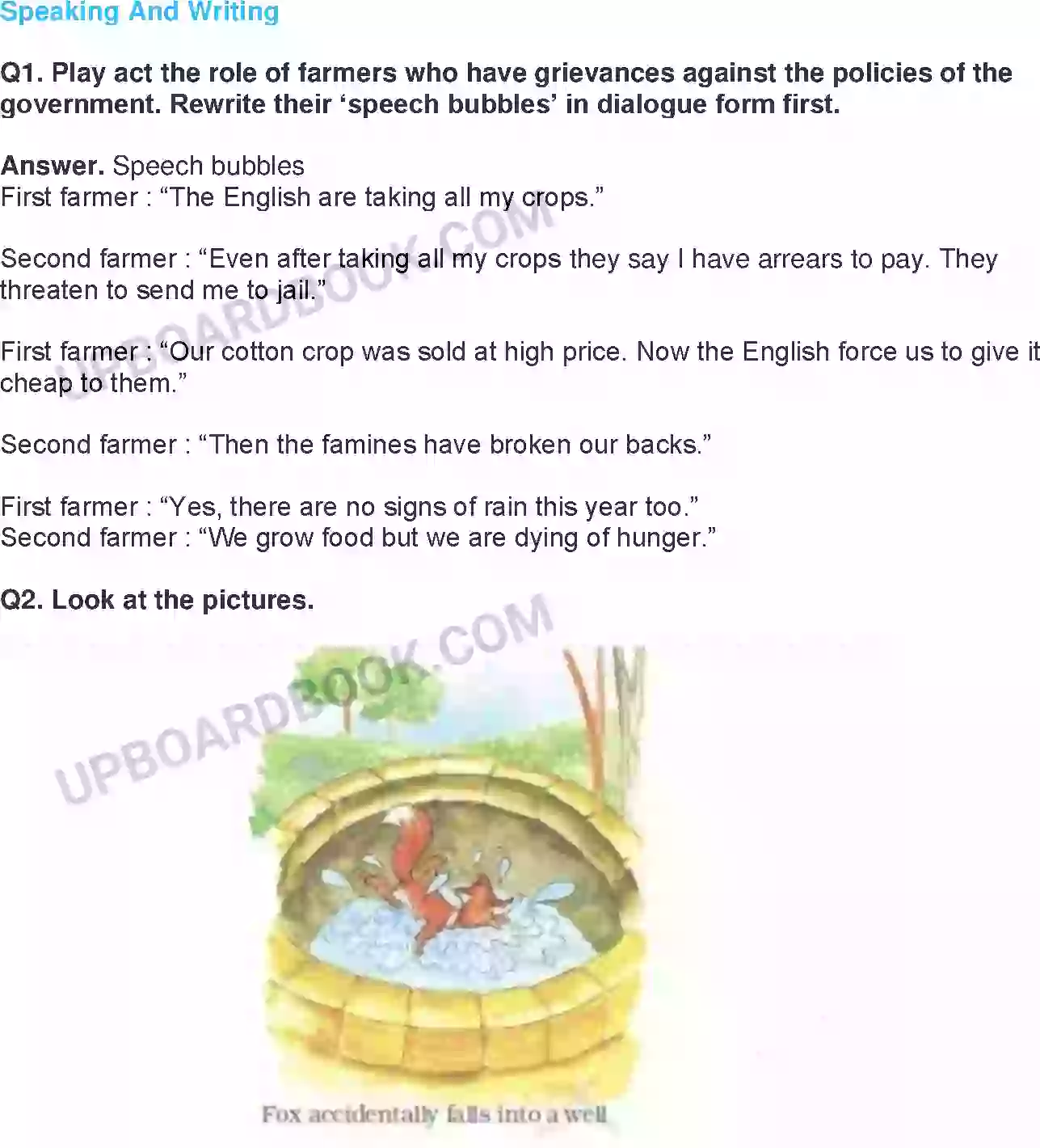
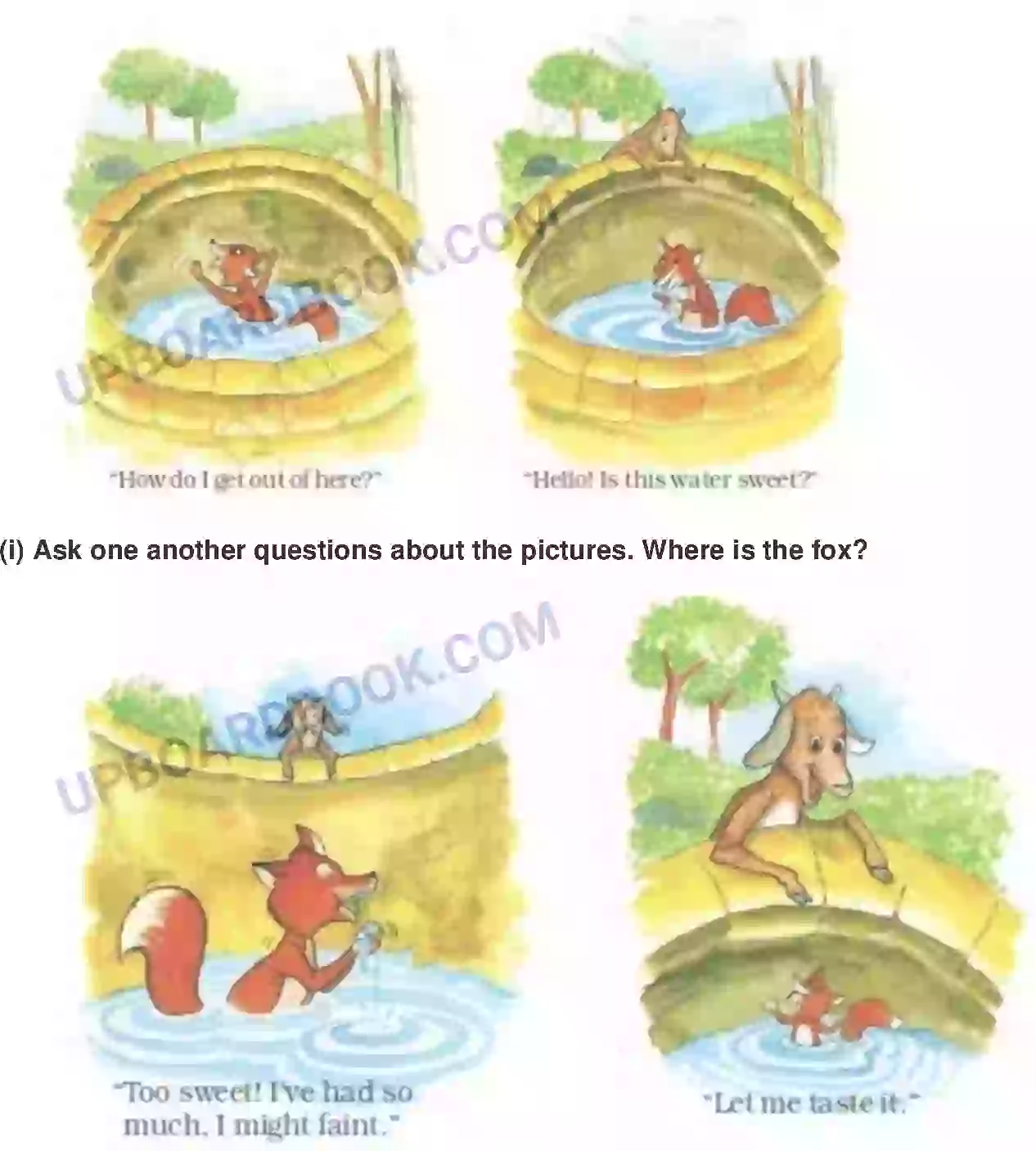
(i) Ask one another questions about the pictures.
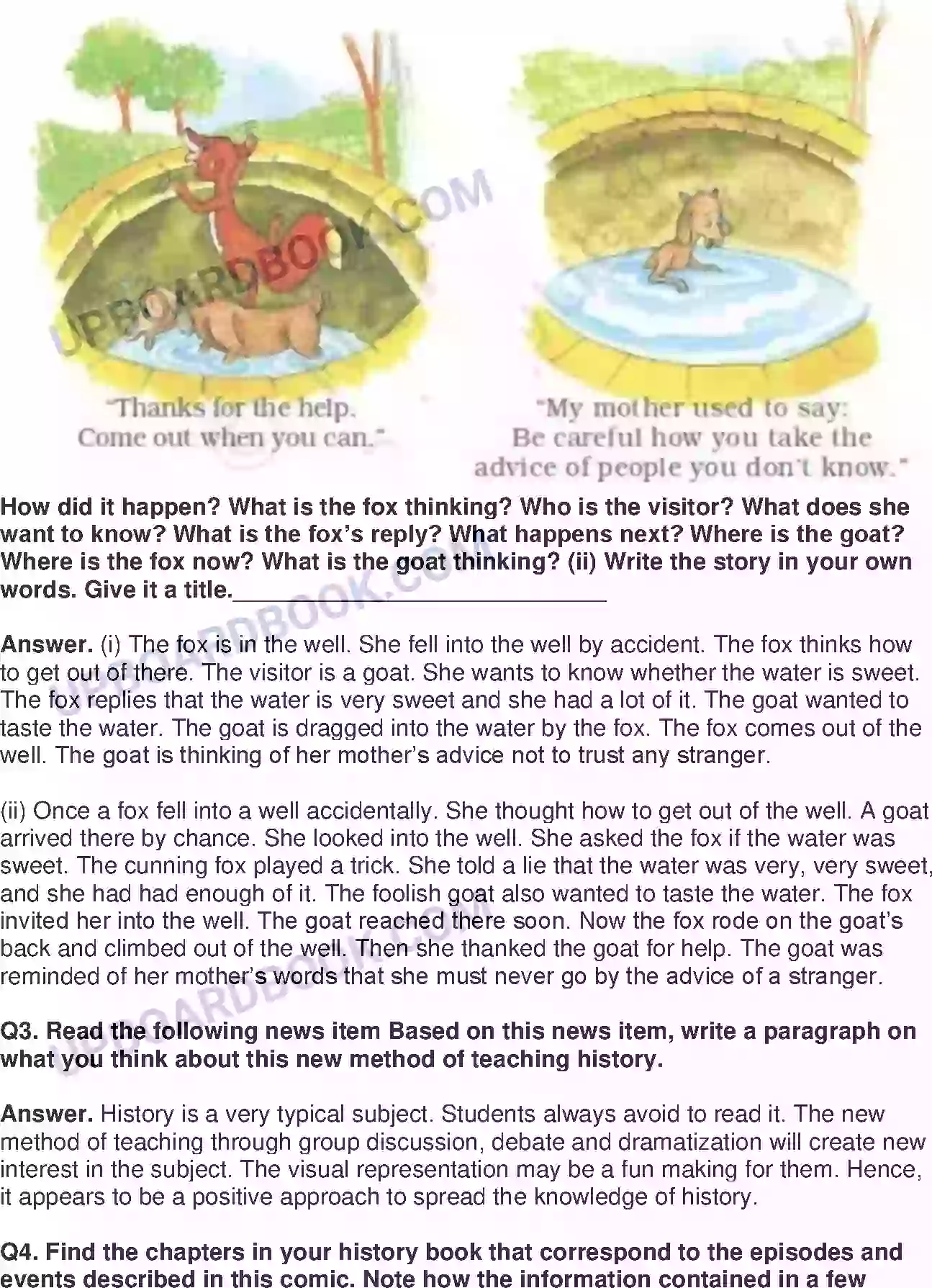
(ii) Write the story in your own words. Give it a title.
Answer (i):
- The fox is at the bottom of a well.
- She fell in accidentally while wandering.
- The fox is thinking, "How can I get out of here?"
- The visitor is a curious goat.
- The goat wants to know if the water in the well is sweet and good to drink.
- The fox replies that the water is excellent and she has drunk so much she might not want more.
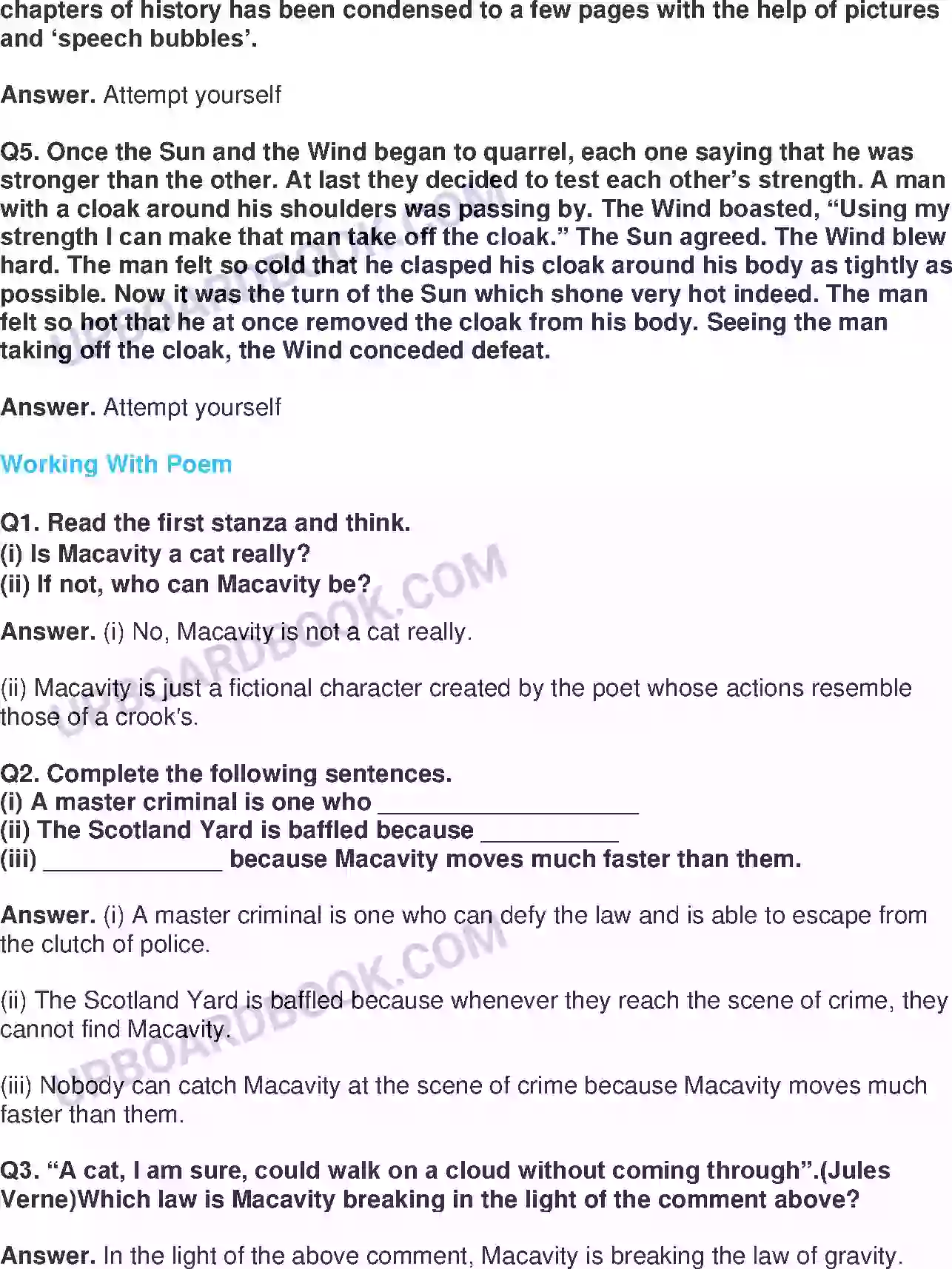
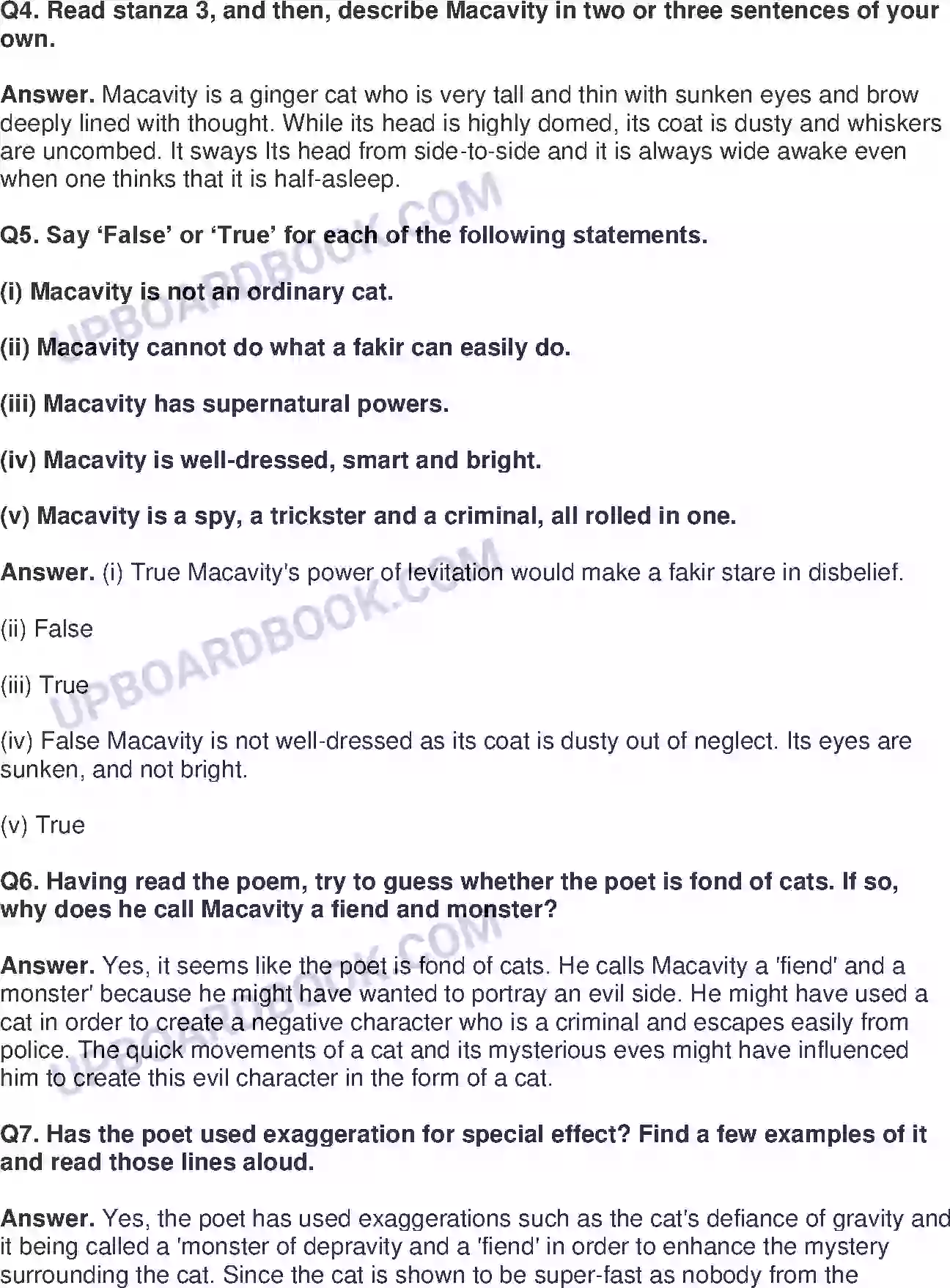
- The goat jumps in to taste the water.
- The fox quickly uses the goat's back as a step to jump out of the well.
- The goat is now trapped in the well.
- The goat thinks, "I should have listened to my mother's advice about not trusting strangers!"
Answer (ii): Title: The Cunning Fox and the Foolish Goat
One day, a fox accidentally fell into a deep well. She was trapped and worried about how to escape. Soon, a thirsty goat happened to pass by and peeped into the well. Seeing the fox, she asked if the water was good. The cunning fox saw her chance. She pretended the water was delicious and said she had drunk so much she couldn't have more. Believing her, the foolish goat immediately jumped into the well. As soon as she did, the fox cleverly stepped on the goat's back, leaped out of the well, and ran away. The goat was left alone in the well, realizing too late that she should never trust a stranger's advice.
Answer: The new method of teaching history through activities like group discussions, debates, role-plays, and visual aids like comics is a wonderful and positive change. History, which students sometimes find heavy with dates and facts, can become lively and engaging. When students discuss, act out events, or see pictures with dialogues, they understand the emotions and causes behind historical events much better. This interactive approach not only makes learning fun but also helps students remember the lessons for a long time. It encourages them to think critically and participate actively, moving beyond rote memorization.
Answer: (Note: This is a self-study activity. Students should refer to their UP Board History textbook for Class 8. Look for chapters on "East India Company's Expansion", "Social Reforms in the 19th Century", and "The Revolt of 1857". Observe how the comic presents the same information in a concise, visual, and engaging format using pictures and speech bubbles, making complex historical processes easier to grasp.)
Answer: (Note: This is a creative writing activity. Students should write the story of "The Sun and the Wind" in their own words based on the given outline, highlighting the moral that gentle persuasion (like the Sun's warmth) is often more effective than force (like the Wind's bluster).)
Answer:
(i) No, Macavity is not really an ordinary cat.
(ii) Macavity can be seen as a symbol or a metaphor for a perfect, elusive master criminal. The poet uses the clever and mysterious nature of a cat to describe a brilliant law-breaker who always escapes capture.
(i) A master criminal is one who ____
(ii) The Scotland Yard is baffled because ____
(iii) ____ because Macavity moves much faster than them.
Answer:
(i) A master criminal is one who breaks the law effortlessly and is never found at the scene of the crime.
(ii) The Scotland Yard is baffled because whenever they rush to the location of a crime, Macavity is never there.
(iii) Nobody can catch Macavity at the scene of crime because Macavity moves much faster than them.
Answer: In light of this comment, Macavity seems to be breaking the law of gravity. The poet suggests Macavity has the supernatural ability to float or levitate, defying the natural force that pulls everything down.
Answer: Macavity is a tall, thin, ginger-colored cat with deeply lined brows and sunken, thoughtful eyes. His appearance is somewhat neglected, with dusty fur and unkempt whiskers. He moves his head in a snake-like manner and is always alert, even when he appears to be half-asleep.
(i) Macavity is not an ordinary cat.
(ii) Macavity cannot do what a fakir can easily do.
(iii) Macavity has supernatural powers.
(iv) Macavity is well-dressed, smart and bright.
(v) Macavity is a spy, a trickster and a criminal, all rolled in one.
Answer:
(i) True
(ii) False (The poem says his powers of levitation would make a fakir stare, meaning he can do things even a fakir cannot.)
(iii) True
(iv) False (He is described as having a dusty coat and sunken eyes, not being well-dressed or bright-looking.)
(v) True
Answer: Yes, the poet T.S. Eliot seems to be fond of cats, as he has written a whole book of poems about them. He calls Macavity a 'fiend' and a 'monster' not out of dislike for cats, but to creatively highlight the character's evil and mysterious nature. He is using the cat as a clever disguise for a master criminal. The words emphasize how wicked, clever, and beyond ordinary Macavity is, adding to the fun and mystery of the poem.
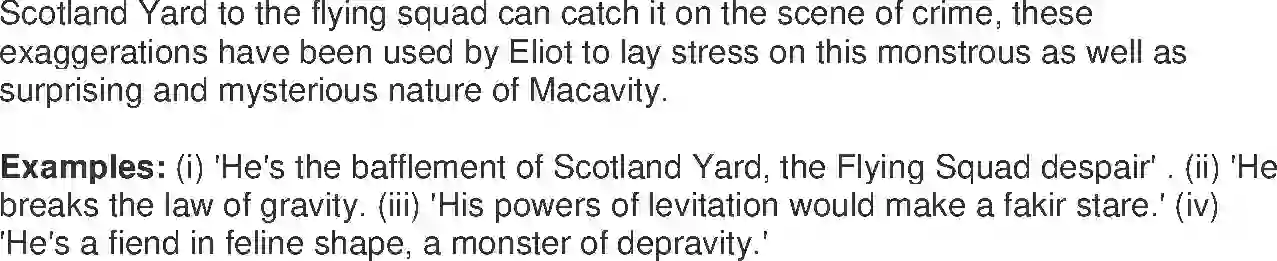
Answer: Yes, the poet has used a lot of exaggeration (hyperbole) to create a humorous and mysterious effect. Examples:
1. "He's the bafflement of Scotland Yard, the Flying Squad's despair." (Exaggerates how he confuses the best police.)
2. "He breaks the law of gravity." (An impossible, exaggerated power.)
3. "His powers of levitation would make a fakir stare." (Exaggerates his supernatural skill.)
4. "He's a fiend in feline shape, a monster of depravity." (Extreme exaggeration of his wickedness.)
UP Board class 8 English 3. Glimpses Of The Past Solution is available at our platform https://upboardSolution.com in hindi medium for free of cost. Content provided on our website is free of cost and in PDF format which is easily available for download. Getting the UP Board Solutions for class 8 will help student to achieve good learning experience so that they can study effectively. UP board holds examination of more than 3 million students every year and majority of the question of exams are from their UP Board Solutions. That’s why it is important to study using the textSolution issued by UP Board.
It is essential to know the importance of UP Board class 8 English 3. Glimpses Of The Past textSolution issued by UP Board because students completely rely on these Solutions for their study and syllabus offered by UP Board is so balanced that each student should be aware about the importance of it. Below is the list of Importance of UP Board class 8 English 3. Glimpses Of The Past :
There are various features of UP Board class 8 TextSolutions, some of them are mentioned below so that you student can understand the value and usability of the contend and understand why Uttarpradesh board has prescribed these Solutions.