UP Board class 8 English 8. A Short Monsoon Diary is a Hindi Medium Solution which is prescribed by Uttar Pradesh Board for their students. These Solutions is completely prepared considering the latest syllabus and it covers every single topis, so that every student get organised and conceptual learning of the concepts. class 8 Students of UP Board who have selected hindi medium as their study medium they can use these Hindi medium textSolutions to prepare themselves for exam and learn the concept with ease.
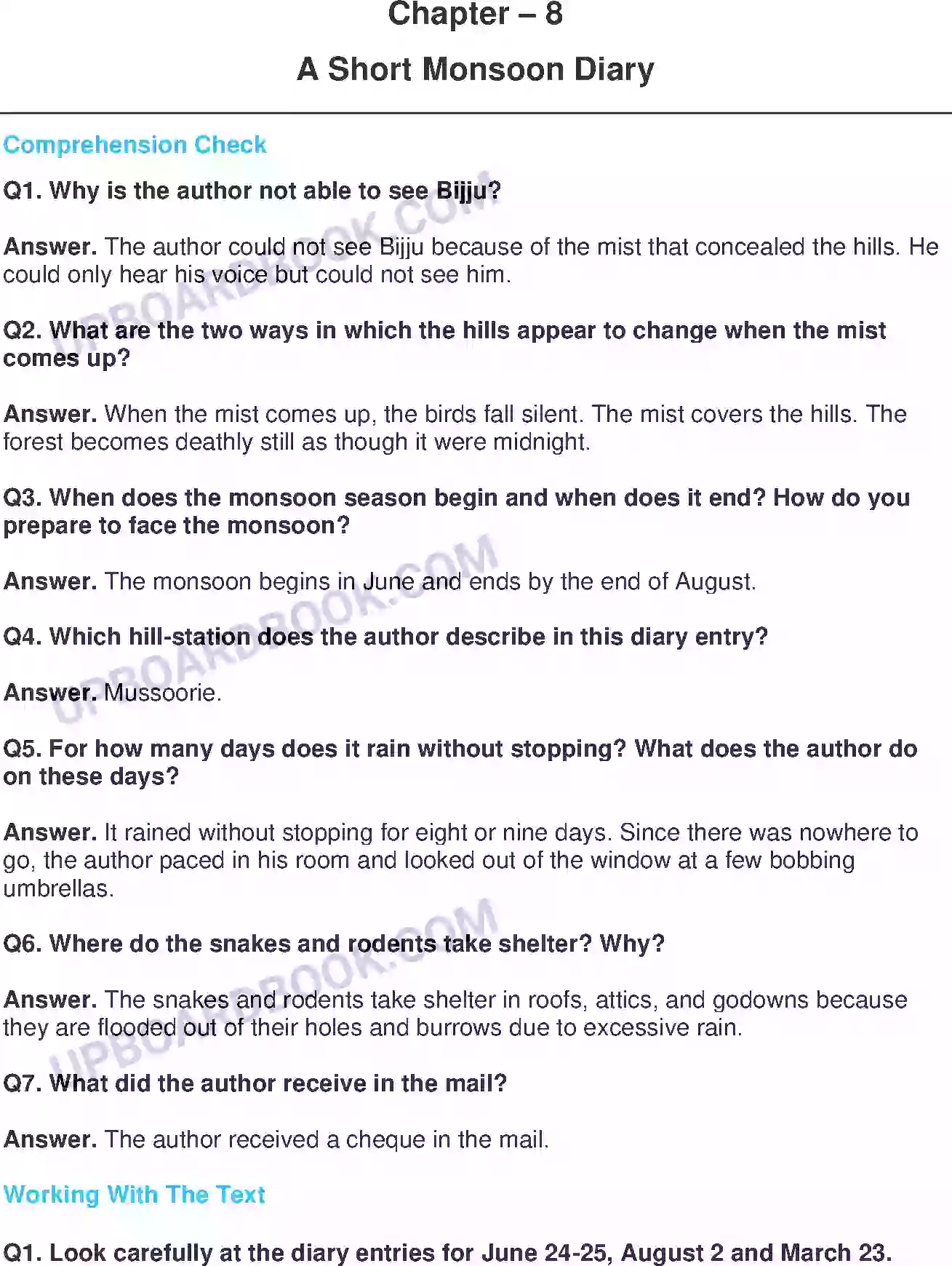
Answer: The author cannot see Bijju due to the thick monsoon mist that covers the hills and valleys, making everything invisible. Although he can hear Bijju's voice calling out to his sister, the dense fog acts like a curtain, hiding him from view.
Answer: When the mist rises, two significant changes occur: First, all the birds suddenly stop singing, creating an eerie silence. Second, the entire forest becomes incredibly still and quiet, as if it were the middle of the night, even during the day.
Answer: In the hills, the monsoon season typically begins in June and lasts until the end of August. To prepare, one should ensure proper rain gear like umbrellas and raincoats are ready, check for leaks in the roof, keep essentials dry, and be mentally prepared for damp, humid weather and possible disruptions.
Answer: The author describes the hill-station of Mussoorie.
Answer: It rains continuously for about eight or nine days. With nowhere to go outdoors, the author spends his time walking back and forth in his room. He passes the time by looking out of the window at the few people braving the rain, identified only by their bobbing umbrellas.
Answer: Snakes and rodents are forced to take shelter inside houses, specifically in roofs, attics, and storage rooms (godowns). This happens because their natural homes—holes and burrows in the ground—get completely flooded and filled with water during the heavy, non-stop rains.
Answer: The author received a cheque in the mail.
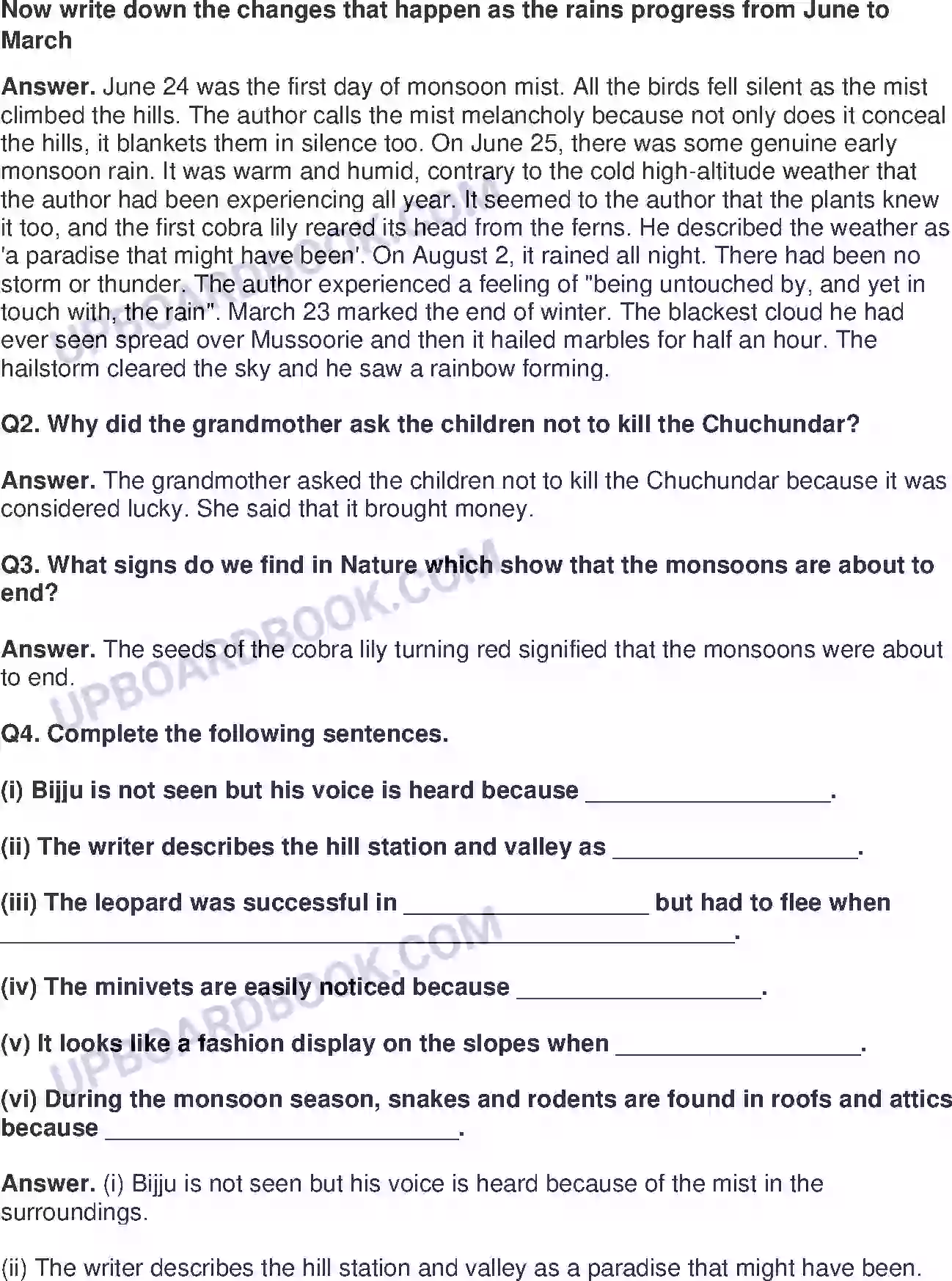
Answer: The diary entries show a beautiful progression of the monsoon and its aftermath:
June 24: The monsoon announces itself with mist, which silences the birds and blankets the hills in a melancholy quiet.
June 25: The first real monsoon rain arrives, bringing warm, humid air. Nature responds instantly, with the first cobra lily emerging from the ferns.
August 2: In the peak monsoon, a gentle, all-night rain creates a unique feeling of being protected under a tin roof yet intimately connected to the sound of the rain.
March 23 (Next Year): At winter's end, a dramatic hailstorm with marble-sized hail clears the sky, leading to the appearance of a brilliant rainbow, signaling a change in season.
Answer: The grandmother stopped the children because, according to traditional belief, the shrew (Chuchundar) is considered a lucky creature. She specifically said that it is believed to bring money and good fortune.
Answer: A clear sign that the monsoon is ending is when the seeds of the cobra lily turn red. This change in color acts as a natural indicator of the changing season.
Answer:
(i) Bijju is not seen but his voice is heard because the thick mist hides him from sight.
(ii) The writer describes the hill station and valley as "a paradise that might have been".
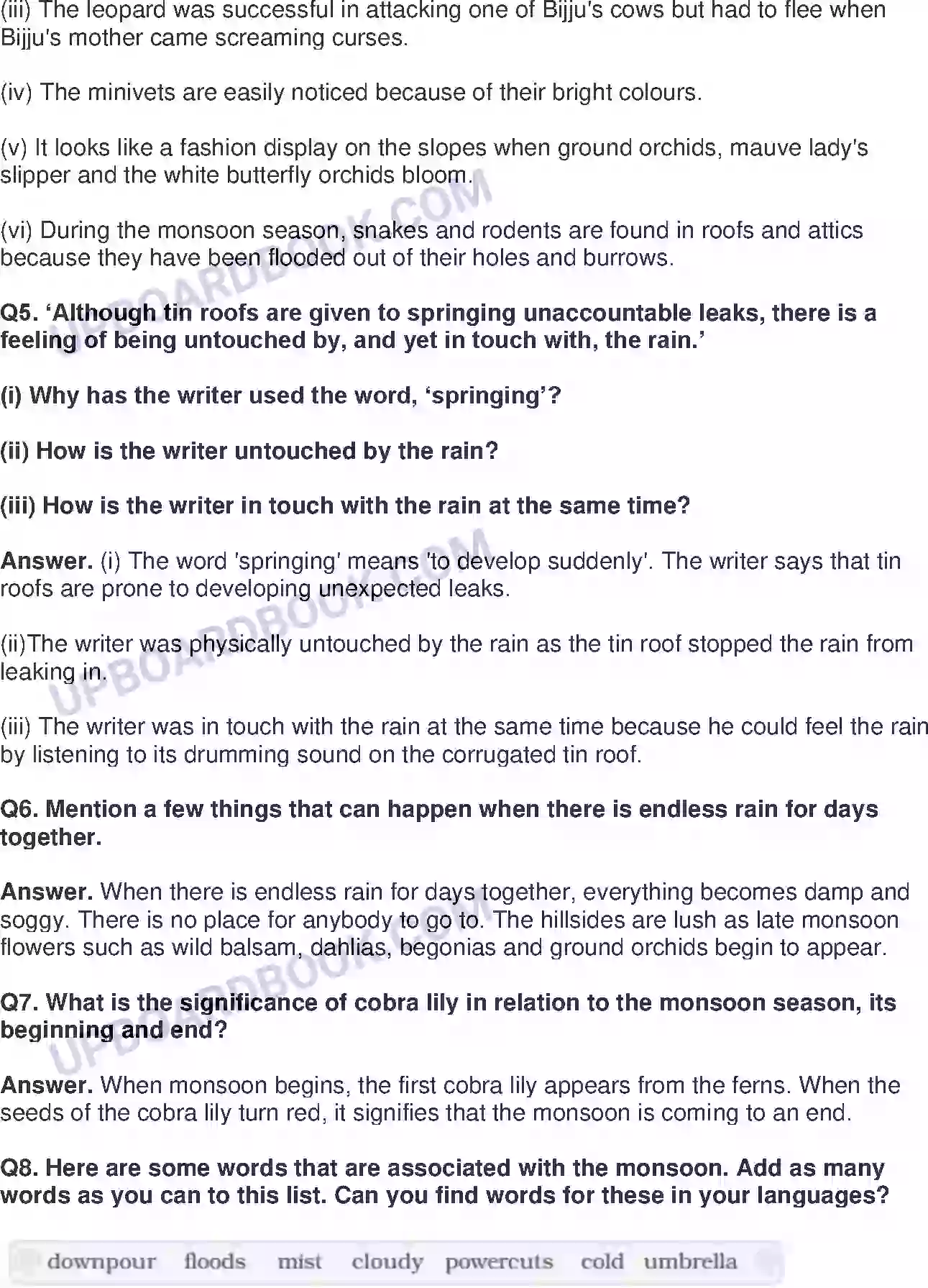
(iii) The leopard was successful in attacking one of Bijju's cows but had to flee when Bijju's mother arrived, shouting loudly.
(iv) The minivets are easily noticed because of their strikingly bright and colourful feathers.
(v) It looks like a fashion display on the slopes when different orchids like the ground orchid, mauve lady's slipper, and the white butterfly orchid are in full bloom.
(vi) During the monsoon season, snakes and rodents are found in roofs and attics because their underground homes are flooded, forcing them to seek dry shelter.
Answer:
(i) The word 'springing' is used to describe how leaks in a tin roof appear suddenly and unexpectedly, as if popping up out of nowhere.
(ii) The writer remains physically dry and untouched because the roof, despite its leaks, still protects him from the direct downpour.
(iii) He feels in touch with the rain because he can constantly hear its rhythm—the drumming sound it makes as it falls on the corrugated tin roof above him.
Answer: Continuous rain for many days leads to a damp world: clothes won't dry, walls feel moist, and the air is heavy with humidity. Outdoor movement becomes difficult, confining people indoors. On the positive side, the hillsides become intensely green and lush, and late-monsoon flowers like wild balsam, dahlias, and begonias add splashes of color everywhere.
Answer: The cobra lily is a natural calendar for the monsoon. Its first appearance from the ferns marks the beginning of the rainy season. Later, when its seeds turn a bright red, it signals that the monsoon is coming to an end.
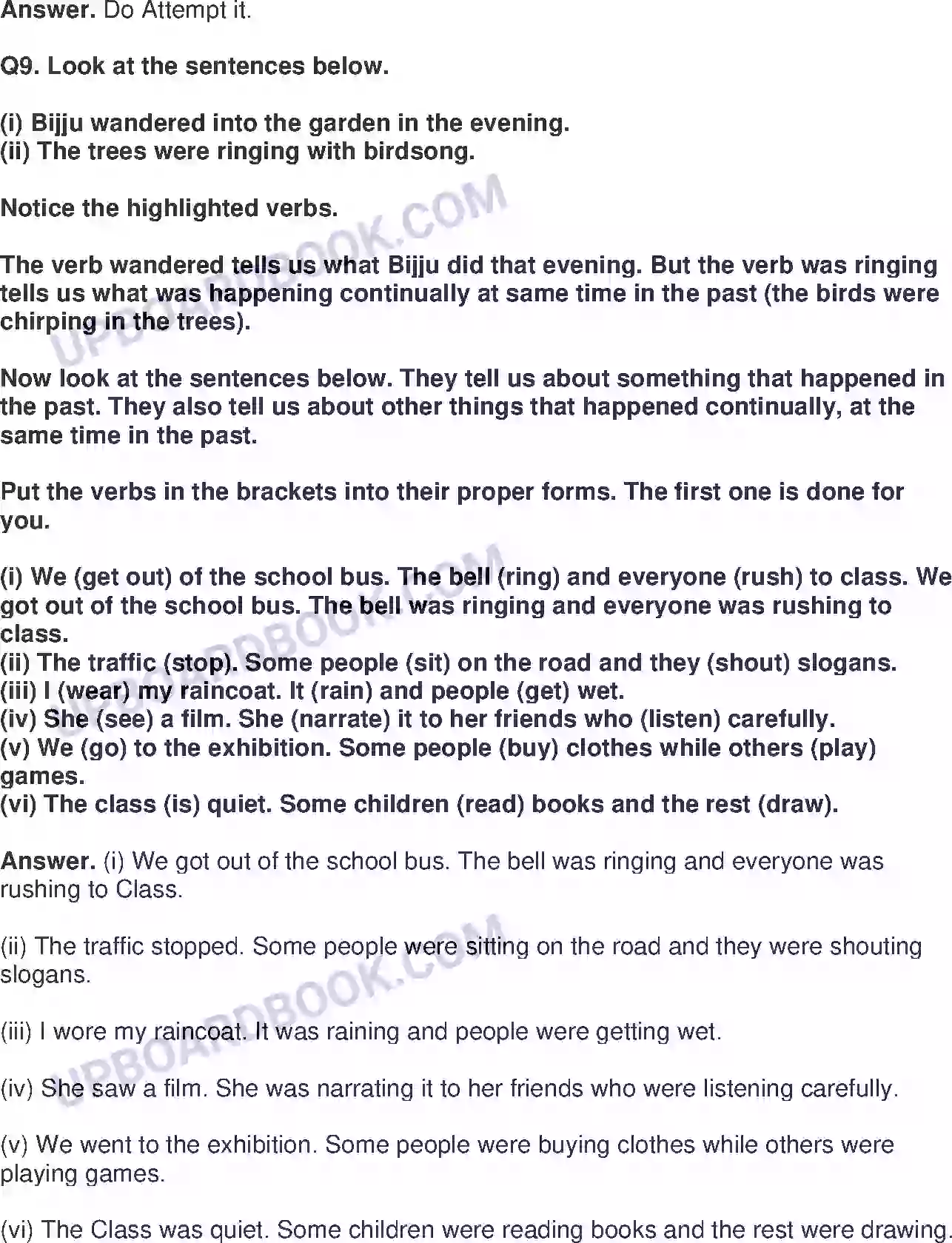
Answer: Students should attempt this themselves. Additional words could be: puddles, humidity, landslides, greenery, frogs, raincoat, thunder, lightning, drizzle, showers, etc.
Answer:
(i) We got out of the school bus. The bell was ringing and everyone was rushing to class.
(ii) The traffic stopped. Some people were sitting on the road and they were shouting slogans.
(iii) I wore my raincoat. It was raining and people were getting wet.
(iv) She saw a film. She was narrating it to her friends who were listening carefully.
(v) We went to the exhibition. Some people were buying clothes while others were playing games.
(vi) The class was quiet. Some children were reading books and the rest were drawing.
Answer:
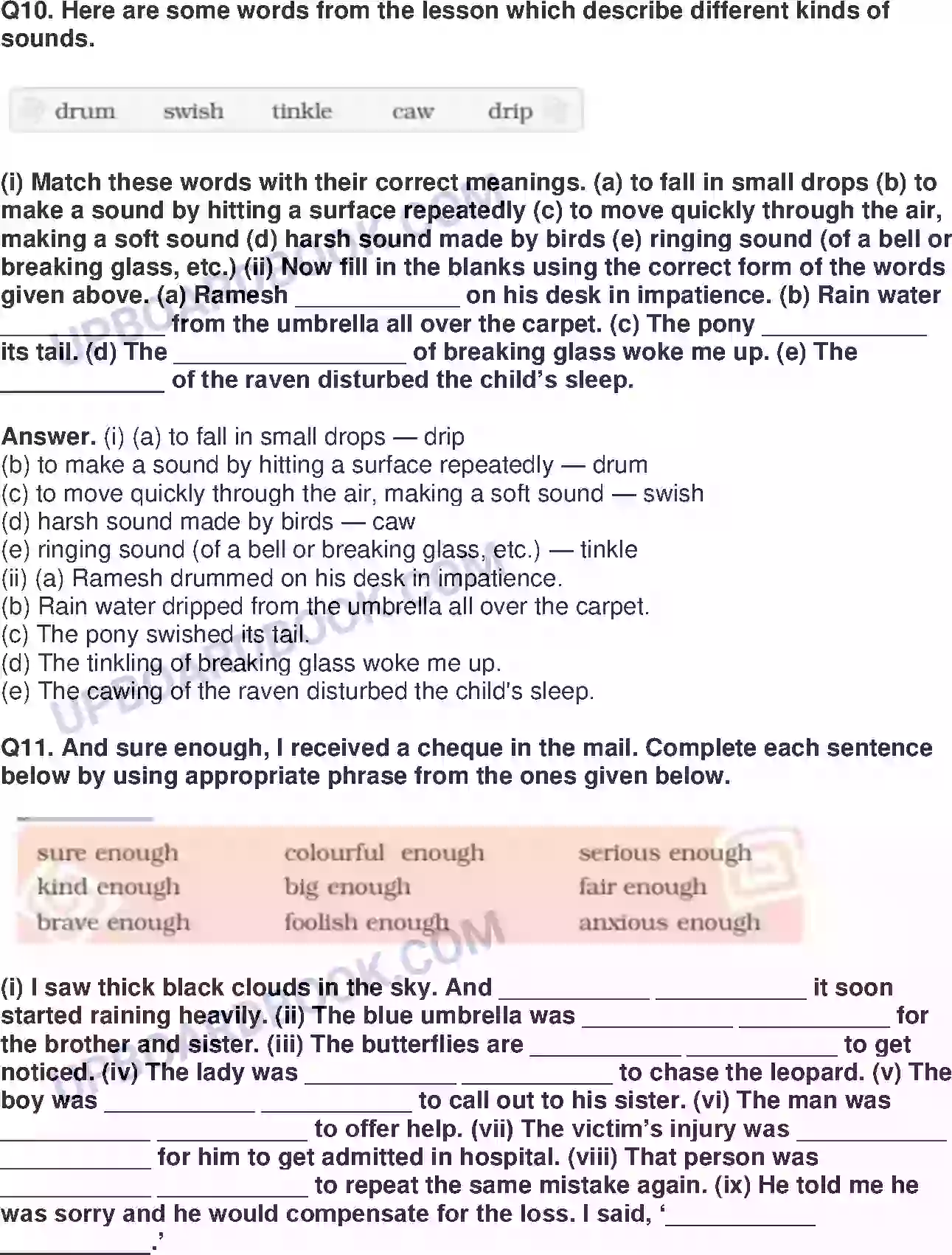
(i) Matching:
(a) to fall in small drops — drip
(b) to make a sound by hitting a surface repeatedly — drum
(c) to move quickly through the air, making a soft sound — swish
(d) harsh sound made by birds — caw
(e) ringing sound (of a bell or breaking glass, etc.) — tinkle
(ii) Filling the blanks:
(a) Ramesh drummed on his desk in impatience.
(b) Rain water dripped from the umbrella all over the carpet.
(c) The pony swished its tail.
(d) The tinkling of breaking glass woke me up.
(e) The cawing of the raven disturbed the child’s sleep.
Answer:
(i) I saw thick black clouds in the sky. And sure enough it started raining heavily.
(ii) The blue umbrella was big enough for the brother and sister.
(iii) The butterflies are colourful enough to get noticed.
(iv) The lady was brave enough to chase the leopard.
(v) The boy was anxious enough to call out to his sister.
(vi) The man was kind enough to offer help.
(vii) The victim’s injury was serious enough for him to get admitted in hospital.
(viii) That person was foolish enough to repeat the same mistake again.
(ix) He told me he was sorry and he would compensate for the loss. I said, ‘fair enough.’
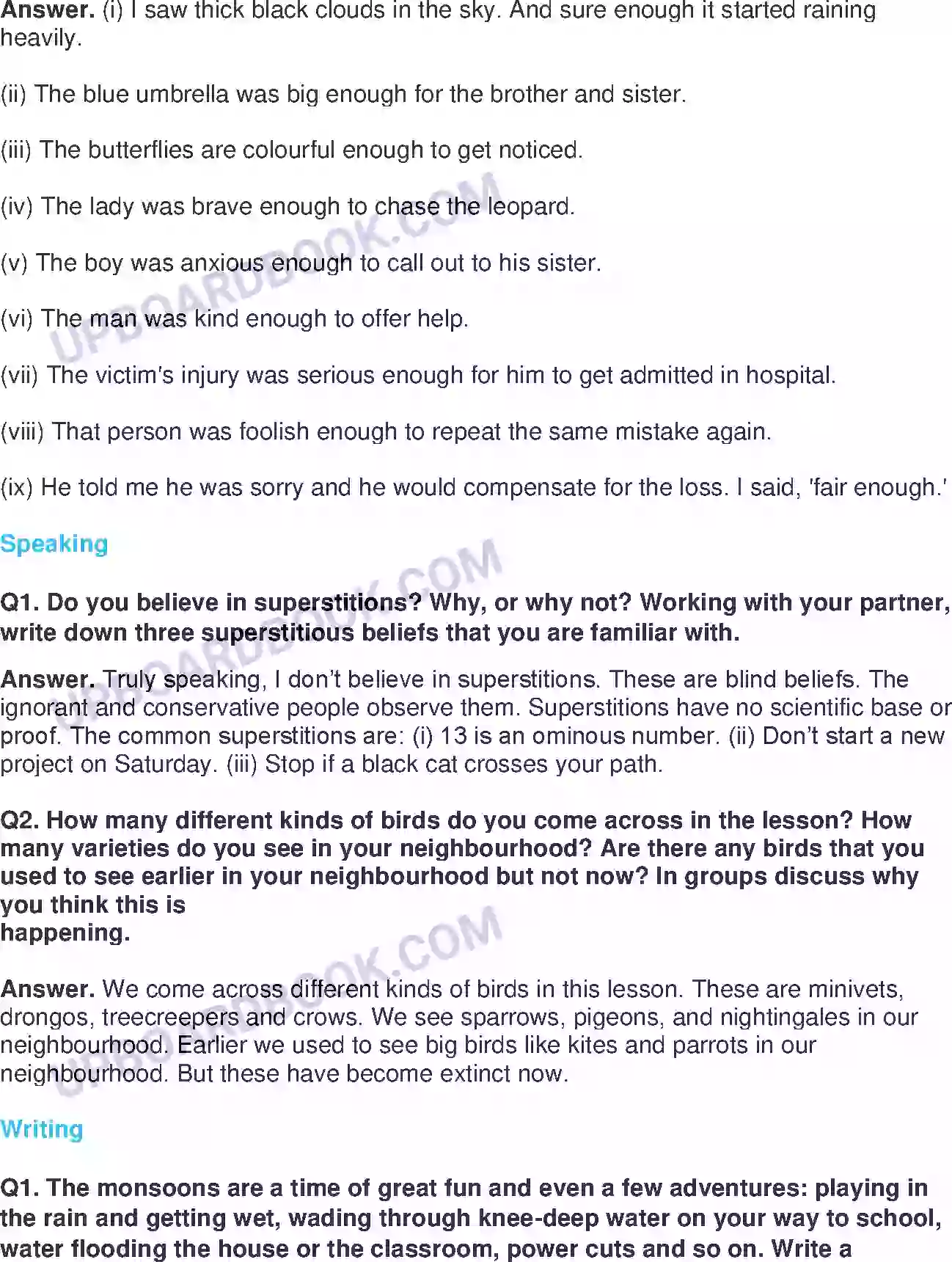
Answer: This is a personal response. A sample answer could be: I do not believe in superstitions as they are not based on scientific reasoning or evidence. They are often traditional beliefs passed down without proof. Three common superstitions are: 1) It is bad luck if a black cat crosses your path. 2) Breaking a mirror brings seven years of bad luck. 3) Do not start a journey or new work on a Saturday.
Answer: The lesson mentions birds like minivets, drongos, tree-creepers, and crows. In my neighbourhood, I commonly see sparrows, pigeons, mynas, and crows. Sadly, birds like sparrows and parrots that were once very common are now seen less frequently. This decline could be due to reasons like loss of trees for nesting, increased pollution, excessive use of pesticides, and reduced availability of food and water in urban areas.
Answer: This is a creative writing task. Students should attempt it themselves.
Answer: This definition beautifully captures the essence of poetry. Unlike ordinary prose, a poem carefully selects and arranges words to create rhythm, rhyme, and imagery. When spoken with emotion, this arrangement turns into a kind of music that enhances the meaning and makes the poem memorable and powerful.
Answer: According to the poem, 'the poetry of earth' is made of the natural sounds and songs created by creatures like birds and insects. It is the endless, joyful music of nature that never ceases.
Answer:
(i) "He has never done with his delights."
(ii) "The cricket’s song, in warmth increasing ever."
Answer: "warmth"
Answer: The two seasons are summer and winter. In the heat of summer, the grasshopper's voice represents the poetry of earth. During the cold of winter, the cricket's song takes over this role, ensuring the music of nature never stops.
UP Board class 8 English 8. A Short Monsoon Diary Solution is available at our platform https://upboardSolution.com in hindi medium for free of cost. Content provided on our website is free of cost and in PDF format which is easily available for download. Getting the UP Board Solutions for class 8 will help student to achieve good learning experience so that they can study effectively. UP board holds examination of more than 3 million students every year and majority of the question of exams are from their UP Board Solutions. That’s why it is important to study using the textSolution issued by UP Board.
It is essential to know the importance of UP Board class 8 English 8. A Short Monsoon Diary textSolution issued by UP Board because students completely rely on these Solutions for their study and syllabus offered by UP Board is so balanced that each student should be aware about the importance of it. Below is the list of Importance of UP Board class 8 English 8. A Short Monsoon Diary :
There are various features of UP Board class 8 TextSolutions, some of them are mentioned below so that you student can understand the value and usability of the contend and understand why Uttarpradesh board has prescribed these Solutions.