 UPBoardBook
UP Board class 9 English (1. The Fun They Had) solution PDF
UP Board class 9 English 1. The Fun They Had is a Hindi Medium Solution which is prescribed by Uttar Pradesh Board for their students. These Solutions is completely prepared considering the latest syllabus and it covers every single topis, so that every student get organised and conceptual learning of the concepts. class 9 Students of UP Board who have selected hindi medium as their study medium they can use these Hindi medium textSolutions to prepare themselves for exam and learn the concept with ease.
UP Board class 9 English 1. The Fun They Had Hindi Medium Solutions - PDF
Click Here to
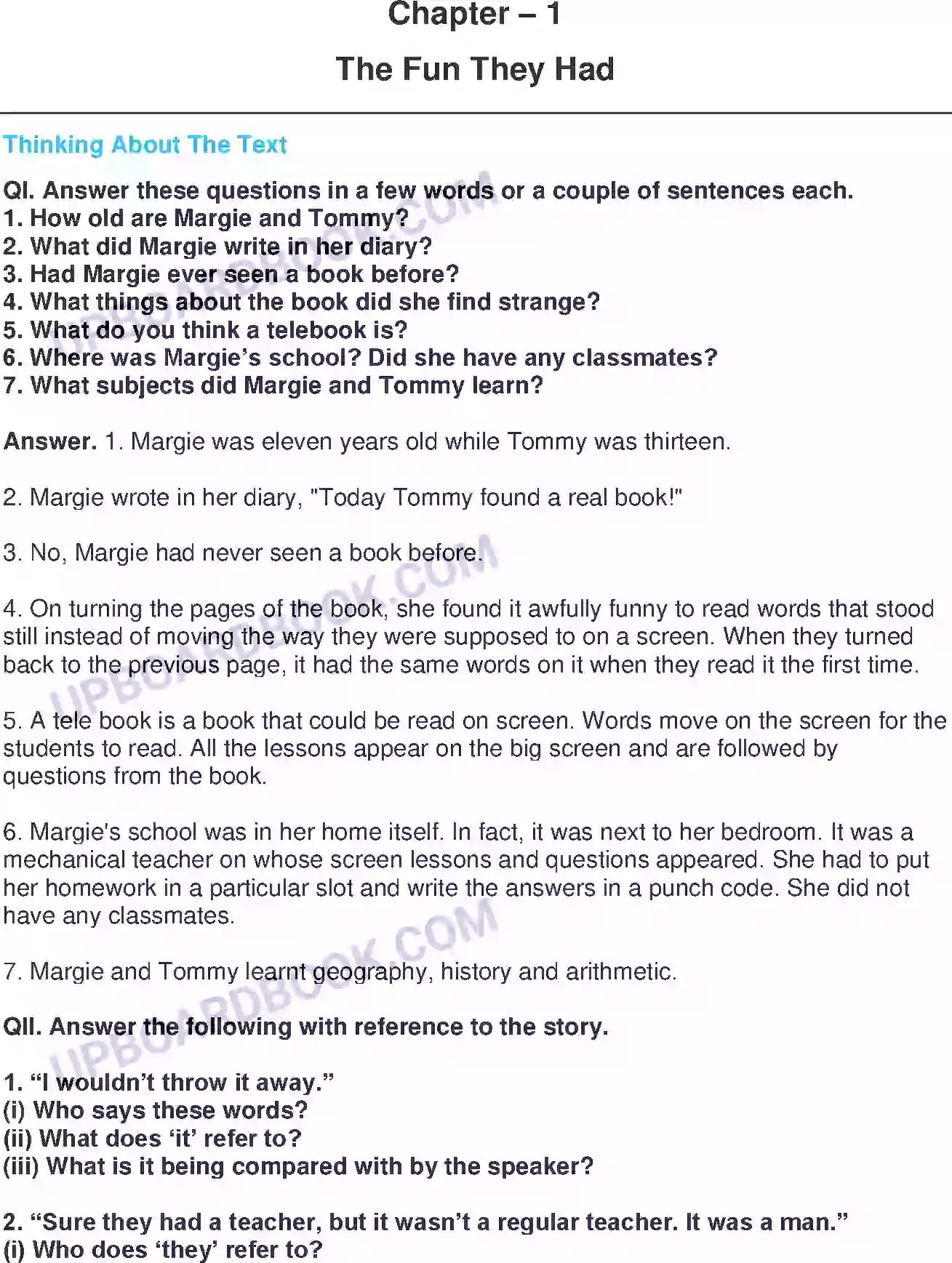
Chapter — 1 The Fun They Had
QI. Answer these questions in a few words or a couple of sentences each. . How old are Margie and Tommy?
Margie is eleven years old, and Tommy is thirteen years old.
. What did Margie write in her diary?
In her diary, Margie wrote with excitement: "Today Tommy found a real book!"
. Had Margie ever seen a book before?
No, Margie had never seen a physical, paper book before the one Tommy discovered.
. What things about the book did she find strange?
She found it very odd that the words on the pages were static and did not move like they do on a screen. She was also surprised that the same words remained fixed on a page even when she turned back to it.
. What do you think a telebook is?
A telebook is a digital book read on a screen. The text scrolls or moves on the display, and all lessons and questions appear electronically.
. Where was Margie’s school? Did she have any classmates?
Margie's school was a special room right next to her bedroom in her own house. She did not have any classmates; she learned alone with her mechanical teacher.
. What subjects did Margie and Tommy learn?
They learned subjects like Geography, History, and Arithmetic from their mechanical teachers.
QIll. Answer the following with reference to the story.
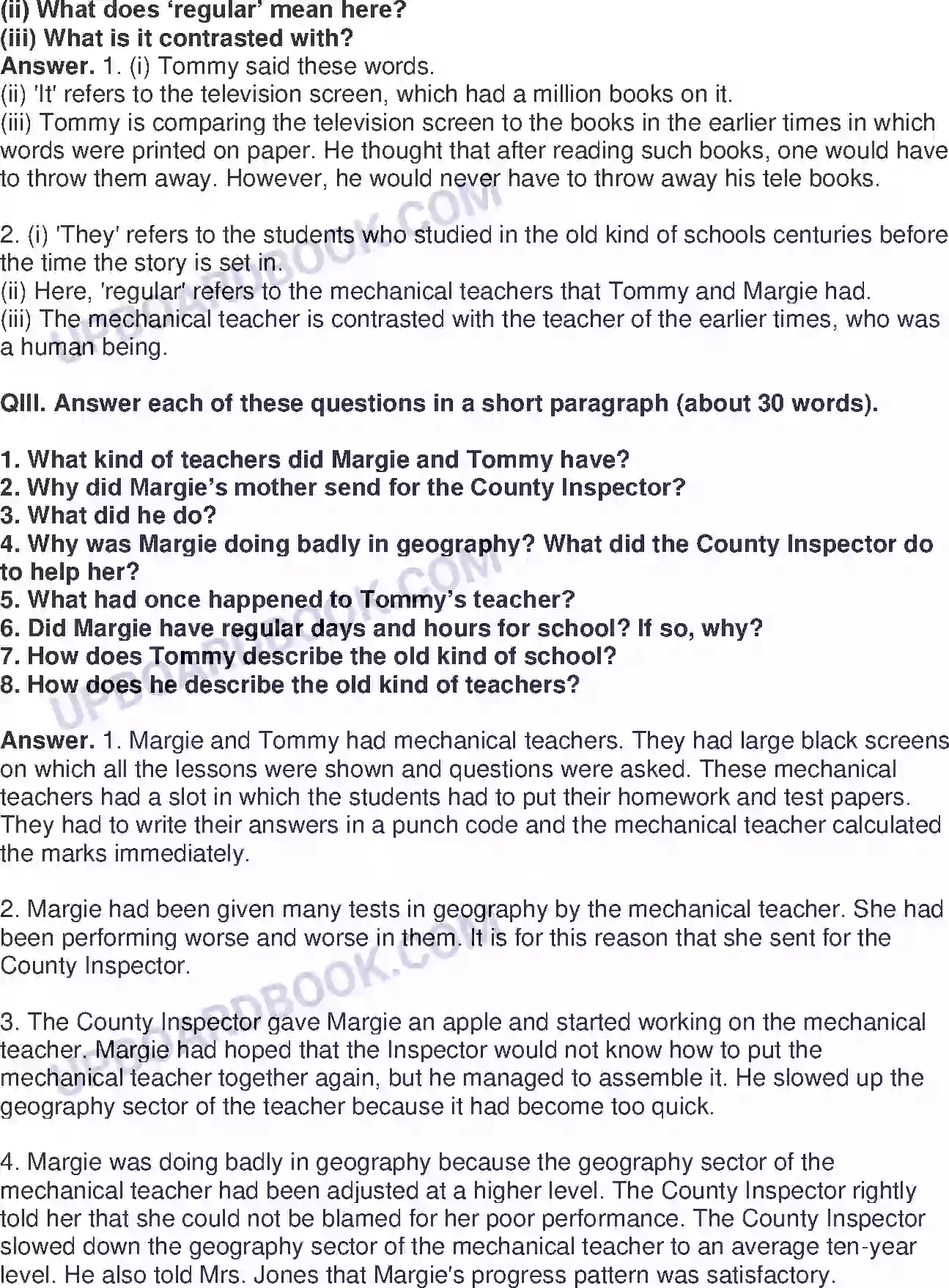
1. “I wouldn’t throw it away.”
(i) Who says these words?
(ii) What does ‘it’ refer to?
(iii) What is it being compared with by the speaker?
(i) Tommy says these words.
(ii) 'It' refers to the television or computer screen on which he reads his telebooks.
(iii) Tommy is comparing his telebook screen with the old paper books. He thinks you would have to throw away a paper book after reading it, but his screen can hold a million books and never needs to be discarded.
2. “Sure they had a teacher, but it wasn’t a regular teacher. It was a man.”
(i) Who does ‘they’ refer to?
(ii) What does ‘regular’ mean here?
(iii) What is it contrasted with?
(i) 'They' refers to the students who went to school centuries ago, in the past.
(ii) Here, 'regular' means the usual or normal teacher for Tommy and Margie—which is a mechanical, robotic teacher.
(iii) The human teacher from the old days is contrasted with the mechanical teachers of Tommy and Margie's time.
Qlll. Answer each of these questions in a short paragraph (about 30 words).
1. What kind of teachers did Margie and Tommy have?
They had mechanical, robotic teachers. These were large machines with black screens that displayed lessons, asked questions, and had a slot for submitting homework and tests written in a punch code.
2. Why did Margie’s mother send for the County Inspector?
Margie's mother called the County Inspector because Margie was continuously performing poorly in her geography tests given by the mechanical teacher.
3. What did he do?
The County Inspector opened up the mechanical teacher, worked on it, and adjusted its geography sector. He slowed it down because it had been set at a level too advanced for Margie.
4. Why was Margie doing badly in geography? What did the County Inspector do to help her?
Margie was doing badly because the geography sector's speed and difficulty were too high. The Inspector fixed this by slowing it down to a level appropriate for a ten-year-old student.
5. What had once happened to Tommy’s teacher?
Tommy's mechanical teacher was once taken away for almost a month because its entire history section had stopped working completely.
6. Did Margie have regular days and hours for school? If so, why?
Yes, her school ran at fixed times every day except weekends. Her mother believed that young girls learn more effectively when they follow a strict, regular schedule.
7. How does Tommy describe the old kind of school?
Tommy describes old schools as special buildings where all the children from the neighborhood gathered. They were taught the same lessons by a human teacher, grouped according to their age.
8. How does he describe the old kind of teachers?
He says the old teachers were men who taught the kids inside a school building. They gave homework, asked questions, and were not machines. He even argued that a man could know as much as a mechanical teacher.
QIV. Answer each of these questions in two or three paragraphs (100 —150 words).
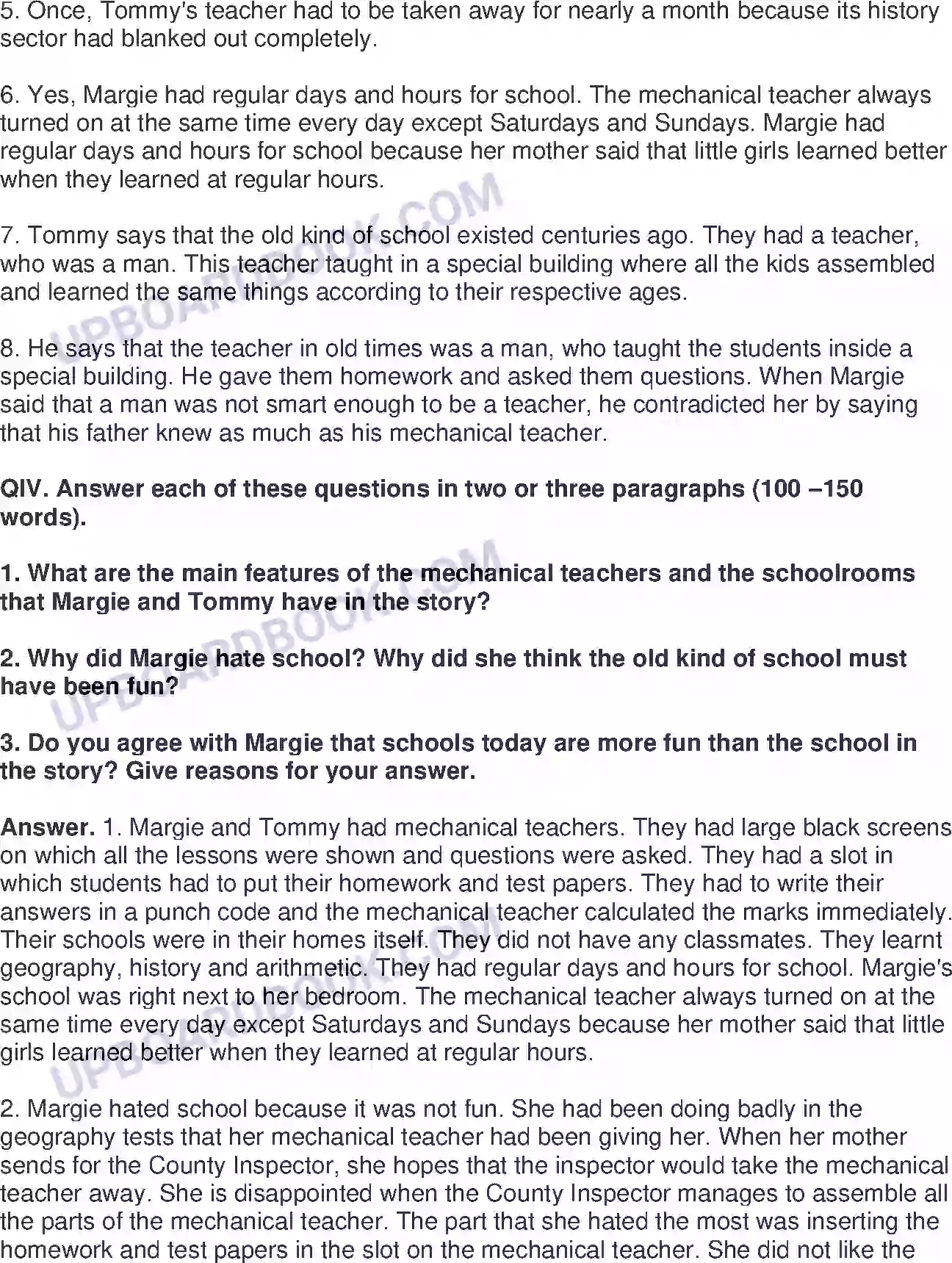
1. What are the main features of the mechanical teachers and the schoolrooms that Margie and Tommy have in the story?
The mechanical teachers are robotic devices with large black screens. All lessons and tests appear on these screens. Students submit their homework by inserting paper into a slot and writing answers in a special punch code. The machine grades the work instantly. Their "schoolroom" is simply a dedicated room in their own homes. Margie's is right next to her bedroom. They have no human classmates. Learning is a solitary activity, scheduled at fixed hours every day except Saturdays and Sundays, as their parents believe regularity improves learning.
2. Why did Margie hate school? Why did she think the old kind of school must have been fun?
Margie hated school because it was lonely and boring. She struggled with geography and disliked inserting homework into the machine's slot and using the punch code. She imagined old schools were fun because all the children from the area would learn together in a lively building. She pictured them laughing in the schoolyard, sitting together in class, helping each other with homework, and walking back home together. The idea of human teachers and friends made the old system seem joyful and social, unlike her isolated, mechanical learning.
3. Do you agree with Margie that schools today are more fun than the school in the story? Give reasons for your answer.
Yes, schools today are undoubtedly more fun than the school in the story. Modern schools are based on social interaction, where students learn together, play together, and form friendships. Teachers are human beings who can explain concepts with emotions, tell stories, and understand a student's individual needs. Group projects, sports, cultural events, and simple classroom discussions create a lively and supportive environment. This interaction makes learning engaging and helps in overall personality development, which is completely missing in the lonely, machine-driven education of Margie's time.
Thinking about Language
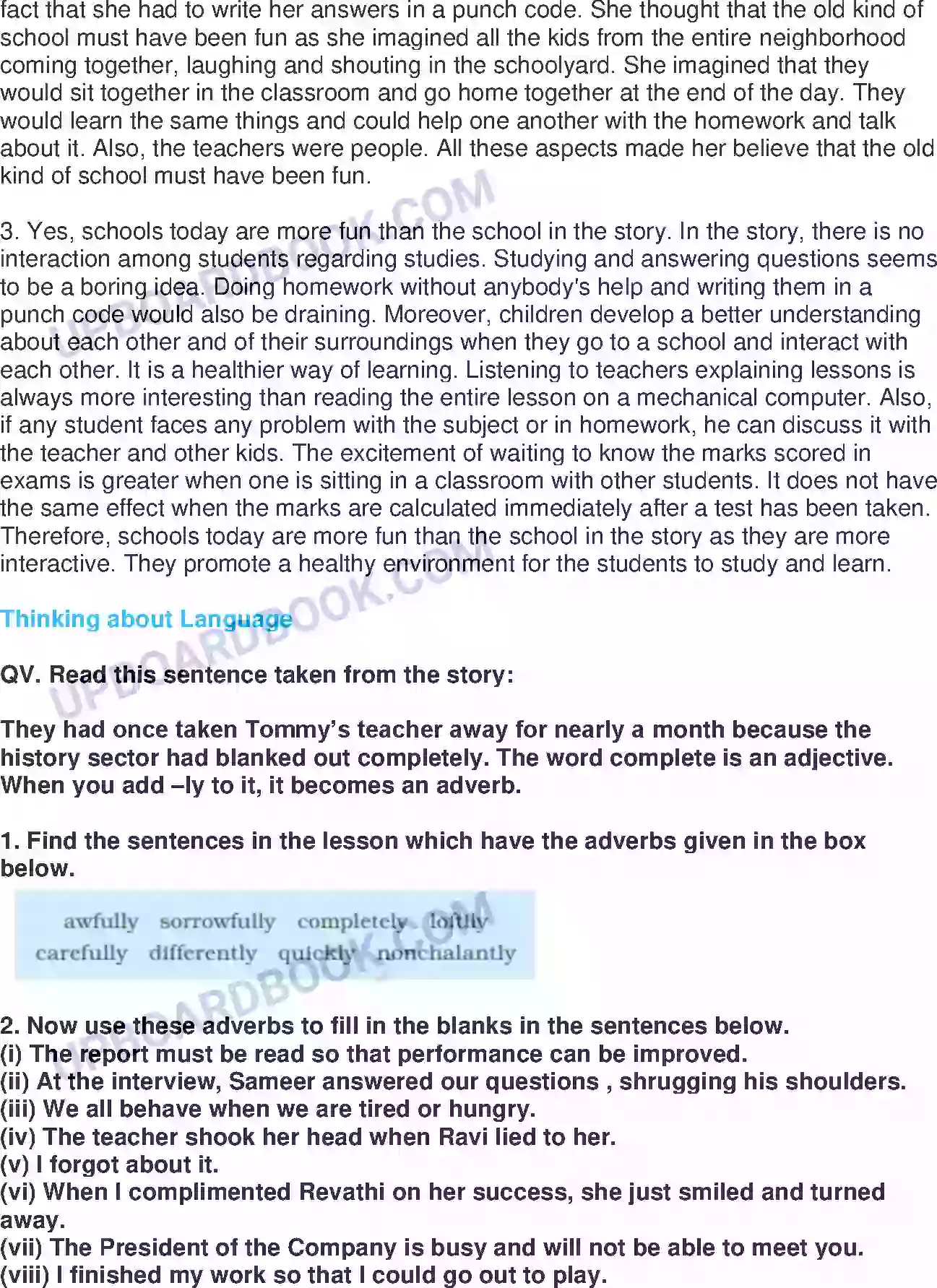
QV. 1. Find the sentences in the lesson which have the adverbs given in the box below.
awfully sorrowfully completely loftily carefully differently quickly nonchalantly
awfully: ...it was awfully funny to read words that stood still...
sorrowfully: ...her mother had shaken her head sorrowfully...
completely: ...the history sector had blanked out completely.
loftily: He added loftily, pronouncing the word carefully...
carefully: He added loftily, pronouncing the word carefully...
differently: ...each kid has to be taught differently.
quickly: "I didn't say I didn't like it," Margie said quickly.
nonchalantly: "May be," he said nonchalantly.
2. Now use these adverbs to fill in the blanks in the sentences below.
(i) The report must be read carefully so that performance can be improved.
(ii) At the interview, Sameer answered our questions loftily, shrugging his shoulders.
(iii) We all behave differently when we are tired or hungry.
(iv) The teacher shook her head sorrowfully when Ravi lied to her.
(v) I completely forgot about it.
(vi) When I complimented Revathi on her success, she just smiled nonchalantly and turned away.
(vii) The President of the Company is awfully busy and will not be able to meet you.
(viii) I finished my work quickly so that I could go out to play.
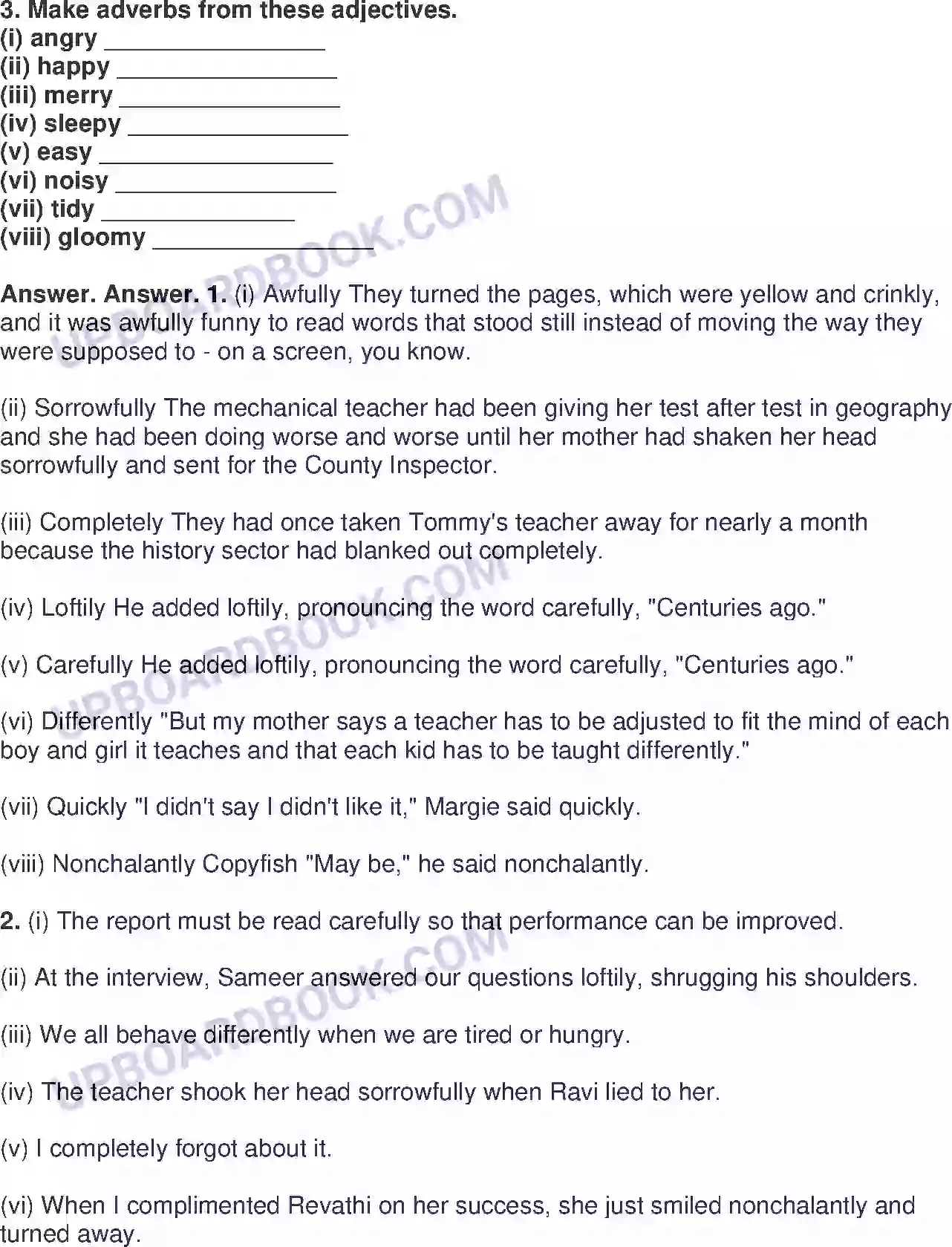
3. Make adverbs from these adjectives.
(i) angry – angrily
(ii) happy – happily
(iii) merry – merrily
(iv) sleepy – sleepily
(v) easy – easily
(vi) noisy – noisily
(vii) tidy – tidily
(viii) gloomy – gloomily
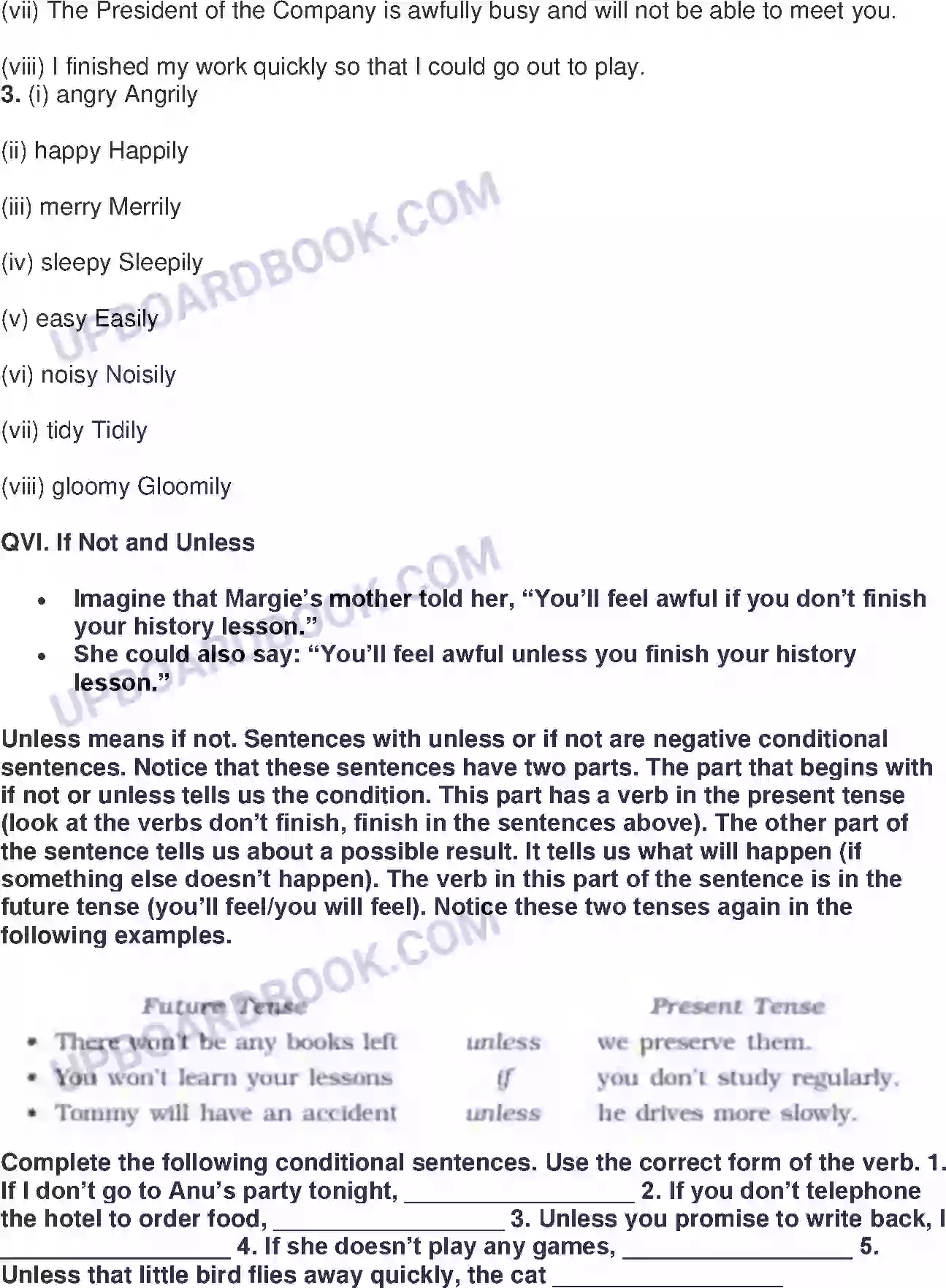
QVI. Complete the following conditional sentences. Use the correct form of the verb.
1. If I don’t go to Anu’s party tonight, she will be upset.
2. If you don’t telephone the hotel to order food, you will have nothing to eat.
3. Unless you promise to write back, I shall not write to you again.
4. If she doesn’t play any games, she will not remain healthy.
5. Unless that little bird flies away quickly, the cat will catch it.
Writing
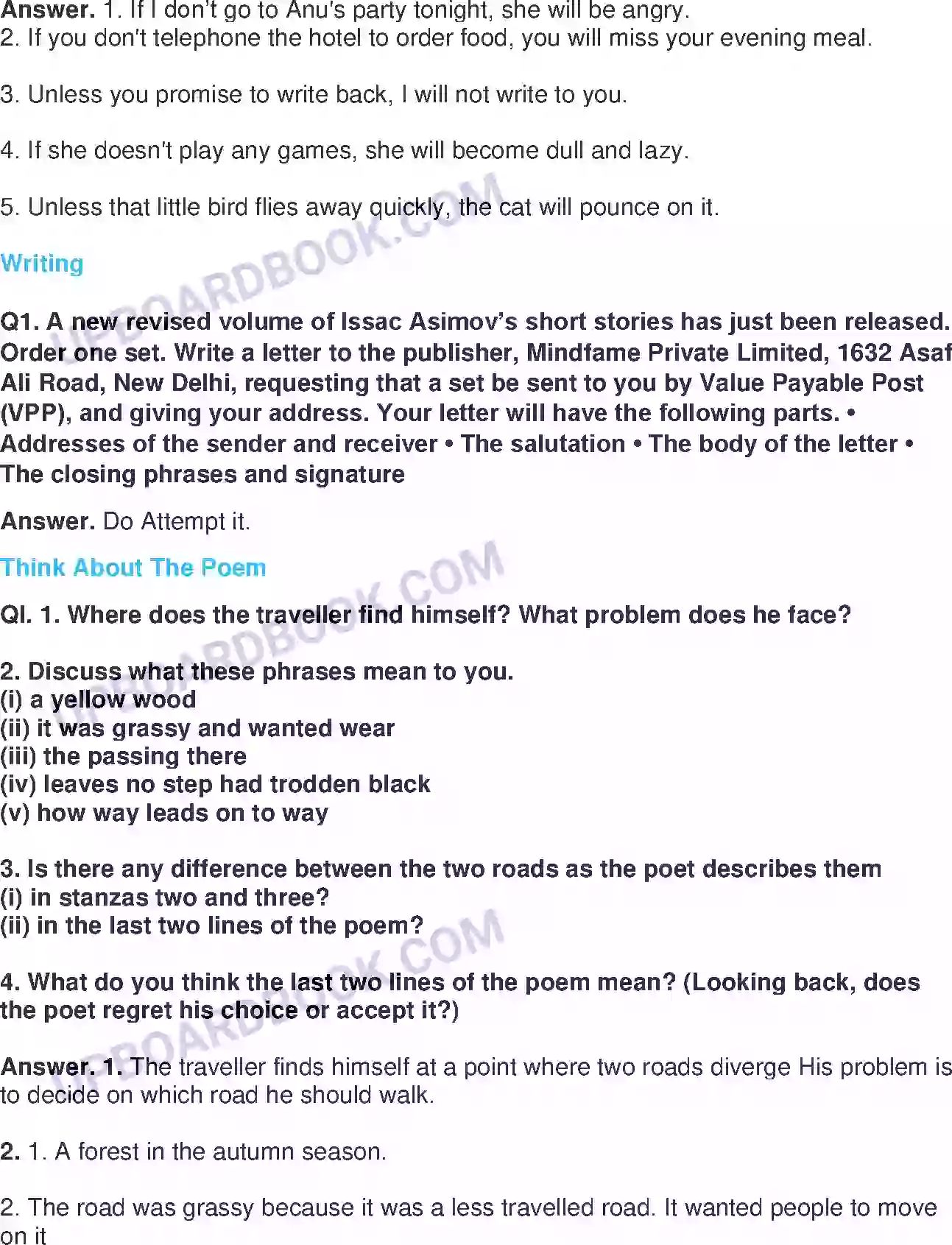
Q1. A new revised volume of Issac Asimov’s short stories has just been released. Order one set. Write a letter to the publisher, Mindfame Private Limited, 1632 Asaf Ali Road, New Delhi, requesting that a set be sent to you by Value Payable Post (VPP), and giving your address.
[Students should attempt this letter-writing question on their own. Follow the format: Sender's address, Date, Receiver's address, Salutation, Body of the letter (stating your request clearly), Closing phrases, and Signature.]
Think About The Poem (The Road Not Taken)
QI. 1. Where does the traveller find himself? What problem does he face?
The traveller finds himself at a fork in a road through a yellow forest. His problem is to decide which of the two paths he should take for his journey.
2. Discuss what these phrases mean to you.
(i) a yellow wood
(i) A forest in the autumn season where leaves have turned yellow.
(ii) it was grassy and wanted wear
(ii) This path was covered with grass because fewer people had walked on it. It seemed to need someone to use it.
(iii) the passing there
(iii) Refers to the act of walking or travelling on that road.
(iv) leaves no step had trodden black
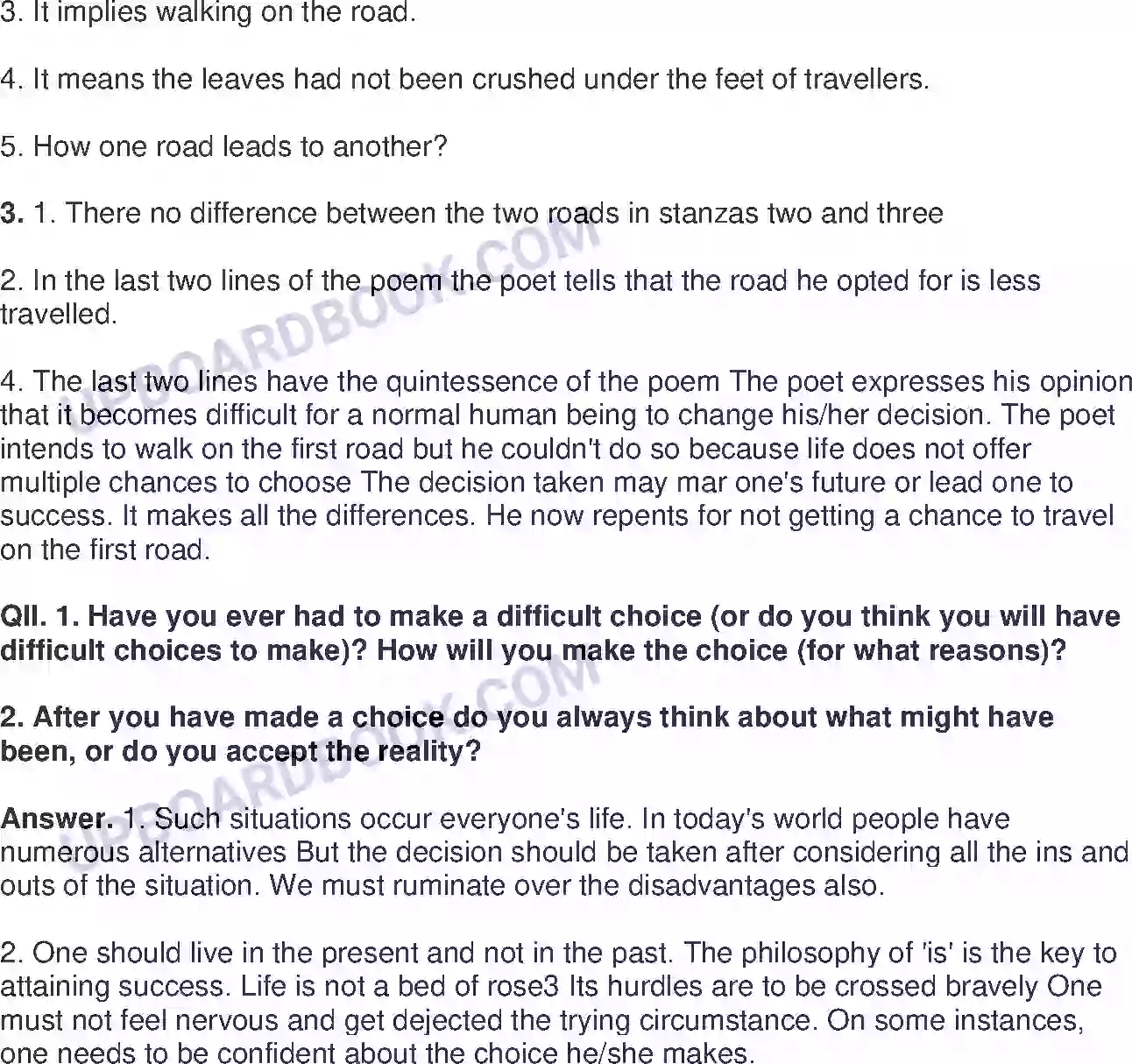
(iv) The leaves on that road were fresh and not darkened or crushed by the footsteps of travellers.
(v) how way leads on to way
(v) It means that one road leads to another, and another, making it impossible to come back and take the other path you left behind.
3. Is there any difference between the two roads as the poet describes them (i) in stanzas two and three? (ii) in the last two lines of the poem?
(i) In stanzas two and three, the poet initially points out minor differences (like one being grassier), but concludes that both roads were equally worn that morning.
(ii) In the last two lines, looking back in the future, the poet claims he took the road "less travelled by," suggesting a significant difference that made all the difference in his life.
4. What do you think the last two lines of the poem mean? (Looking back, does the poet regret his choice or accept it?)
The last lines mean that the poet will someday tell people that he chose the less common path, and that choice profoundly shaped his life's journey. He seems to accept his choice with a sense of pride and significance, though a hint of wistfulness about the road not taken remains.
QIl. 1. Have you ever had to make a difficult choice (or do you think you will have difficult choices to make)? How will you make the choice (for what reasons)?
Yes, everyone faces difficult choices, like choosing a stream after Class 10. To make such a choice, one should consider their own interests, strengths, future opportunities, and also seek guidance from elders and teachers, weighing the pros and cons carefully.
2. After you have made a choice do you always think about what might have been, or do you accept the reality?
It is natural to sometimes wonder "what if," but it is healthier to accept reality and focus on making the best of the chosen path. Dwelling on the past can hinder progress. The key is to learn from every experience and move forward with confidence.
Get UP Board class 9 English 1. The Fun They Had Solution in Hindi Medium
UP Board class 9 English 1. The Fun They Had Solution is available at our platform https://upboardbook.com in hindi medium for free of cost. Content provided on our website is free of cost and in PDF format which is easily available for download. Getting the UP Board Solutions for class 9 will help student to achieve good learning experience so that they can study effectively. UP board holds examination of more than 3 million students every year and majority of the question of exams are from their UP Board Solutions. That’s why it is important to study using the textSolution issued by UP Board.
Importance of UP Board class 9 English 1. The Fun They Had Text Solutions
It is essential to know the importance of UP Board class 9 English 1. The Fun They Had textSolution issued by UP Board because students completely rely on these Solutions for their study and syllabus offered by UP Board is so balanced that each student should be aware about the importance of it. Below is the list of Importance of UP Board class 9 English 1. The Fun They Had :
- These TextSolutions are very clear and accurate which helps student to understand concept with ease.
- It is also to mention that these text Solutions are prepared by the content experts of subject, thus these Solutions helps student in clearing their doubts and understand the core concept easily.
- It is considered to be the best study material for competitive exam preparation.
Features of UP Board class 9 textSolutions
There are various features of UP Board class 9 TextSolutions, some of them are mentioned below so that you student can understand the value and usability of the contend and understand why Uttarpradesh board has prescribed these Solutions.
- Best feature of these textSolutions is free availability of content in PDF format
- Second feature that content generated and written is clear and easy to read.
- There are various illustration and images are shown in the Solution so that student can easily understand the concept and should be more appealing to the student.
- Each chapter is explained thoroughly
