UP Board class 9 English 6. My Childhood is a Hindi Medium Solution which is prescribed by Uttar Pradesh Board for their students. These Solutions is completely prepared considering the latest syllabus and it covers every single topis, so that every student get organised and conceptual learning of the concepts. class 9 Students of UP Board who have selected hindi medium as their study medium they can use these Hindi medium textSolutions to prepare themselves for exam and learn the concept with ease.
1. Where was Abdul Kalam’s house?
Answer: Abdul Kalam's house was located on Mosque Street in the town of Rameswaram, which was part of the former Madras State.
2. What do you think Dinamani is the name of? Give a reason for your answer.
Answer: Dinamani is most likely the name of a newspaper. Abdul Kalam mentions trying to find news about the Second World War in its headlines, which his brother-in-law used to discuss.
3. Who were Abdul Kalam’s school friends? What did they later become?
Answer: His three close school friends were Ramanadha Sastry, Aravindan, and Sivaprakasan. Ramanadha Sastry became the head priest of the Rameswaram temple, Aravindan started a transport business for pilgrims, and Sivaprakasan became a catering contractor for the Southern Railways.
4. How did Abdul Kalam earn his first wages?
Answer: He earned his first wages by helping his cousin Samsuddin. During the war, newspapers were thrown from moving trains, and Abdul Kalam's job was to catch the bundles to assist in their distribution.
5. Had he earned any money before that? In what way?
Answer: Yes, he had earned a little money before that by collecting and selling tamarind seeds. There was a sudden demand for them during the war, and he would sell his daily collection to a provision shop for about one anna.
1. How does the author describe: (i) his father, (ii) his mother, (iii) himself?
Answer: (i) His father, Jainulabdeen, was a man of great wisdom and generosity, who lived a simple and austere life despite limited formal education or wealth.
(ii) His mother, Ashiamma, was a kind and supportive partner who generously fed a large number of people, including many outsiders, every day.
(iii) He describes himself as a short boy with ordinary looks, who enjoyed a very secure and happy childhood, both emotionally and materially.
2. What characteristics does he say he inherited from his parents?
Answer: From his father, he inherited honesty and self-discipline. From his mother, he inherited faith in goodness and deep kindness.
1. “On the whole, the small society of Rameswaram was very rigid in terms of the segregation of different social groups,” says the author.
(i) Which social groups does he mention? Were these groups easily identifiable (for example, by the way they dressed)?
Answer: (i) He mentions the Hindu and Muslim communities. Yes, they were easily identifiable. Abdul Kalam, as a Muslim, wore a cap, while his friend Ramanadha Sastry, a Hindu Brahmin, wore the sacred thread.
(ii) Were they aware only of their differences or did they also naturally share friendships and experiences? (Think of the bedtime stories in Kalam’s house; of who his friends were; and of what used to take place in the pond near his house.)
Answer: (ii) Despite the segregation, they naturally shared deep friendships and experiences. Kalam's closest friends were from orthodox Hindu families. His family actively participated in Hindu religious ceremonies, and bedtime stories in his home included tales from both the Ramayana and the life of Prophet Muhammad, showing a shared cultural space.
(iii) The author speaks both of people who were very aware of the differences among them and those who tried to bridge these differences. Can you identify such people in the text?
Answer: (iii) People aware of differences: the new schoolteacher who separated Kalam from his Hindu friend, and the conservative wife of his science teacher, Sivasubramania Iyer. People who bridged differences: Lakshmana Sastry (Ramanadha's father) who corrected the teacher, and Sivasubramania Iyer himself, who insisted on treating Kalam as an equal.
(iv) Narrate two incidents that show how differences can be created, and also how they can be resolved. How can people change their attitudes?
Answer: (iv) Incident 1 (Creating Difference): A new teacher forced Kalam to sit away from his Brahmin friend, Ramanadha, planting the seed of communal division. Resolution: Lakshmana Sastry confronted the teacher, making him apologize and retract his action, showing that firm, principled opposition can correct prejudice.
Incident 2 (Creating Difference): Sivasubramania Iyer's wife refused to let Kalam, a Muslim, eat in her "pure" Hindu kitchen. Resolution: Iyer served Kalam himself, setting a personal example. His patience and his wife's eventual change of heart show that consistent, kind actions can gradually transform deep-seated attitudes.
2. (i) Why did Abdul Kalam want to leave Rameswaram?
Answer: (i) Abdul Kalam wanted to leave Rameswaram to pursue higher studies at the district headquarters in Ramanathapuram, seeking greater educational opportunities.
(ii) What did his father say to this?
Answer: (ii) His father calmly supported his decision, saying he knew Kalam had to leave "to grow." He used the metaphor of a seagull that flies alone and quoted Khalil Gibran, explaining that children are life's own creation, not possessions of their parents.
(iii) What do you think his words mean? Why do you think he spoke those words?
Answer: (iii) His words mean that parents must let their children go to find their own path and fulfill their potential. Children have their own thoughts and destinies. He spoke these profound words primarily to reassure Kalam's mother, who was hesitant about her son leaving home, by framing it as a natural and necessary part of life.
Look these words up in a dictionary which gives examples of how they are used. Now answer the following questions.
1. What are the things that can erupt? Use examples to explain the various meanings of erupt. Now do the same for the word surge. What things can surge?
Answer: 1. Things that can erupt: A volcano, war, anger, laughter, a rash, or a crisis.
Meanings of 'erupt':
- (Volcano) To burst out violently (e.g., The volcano erupted lava).
- (Conflict) To break out suddenly (e.g., Fighting erupted in the streets).
- (Emotion) To express feelings suddenly (e.g., The crowd erupted in cheers).
Things that can surge: Waves, crowds, emotions, prices, or power.
Meanings of 'surge':
- (Wave) To move suddenly and powerfully forward (e.g., The waves surged against the shore).
- (Increase) To increase rapidly (e.g., Feelings of pride surged within him).
- (Crowd) To move forward in a mass (e.g., The protesters surged towards the gate).
2. What are the meanings of the word trace and which of the meanings is closest to the word in the text?
Answer: 2. Meanings of 'trace': to find, to discover, to copy, to follow a path, or a very small amount. In the text, when Kalam tried to "trace" the stories of the war, it means 'to find or discover' them in the newspaper headlines. This is the closest meaning.
3. Can you find the word undistinguished in your dictionary? (If not, look up the word distinguished and say what undistinguished must mean.)
Answer: 3. The word "undistinguished" is often not found directly. "Distinguished" means successful, respected, or excellent. Therefore, undistinguished must mean ordinary, not remarkable, or lacking any special features—exactly how Kalam describes his childhood looks.
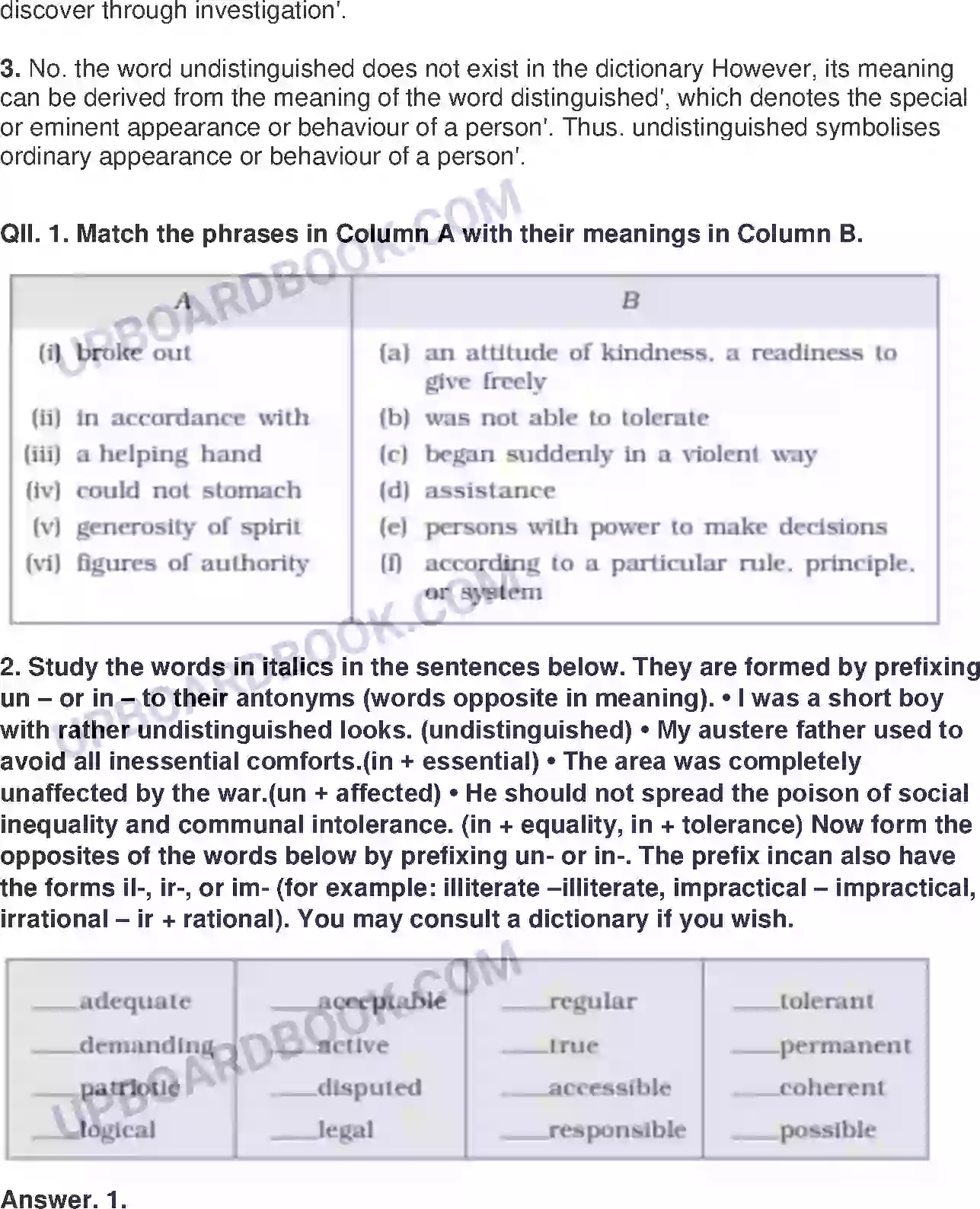
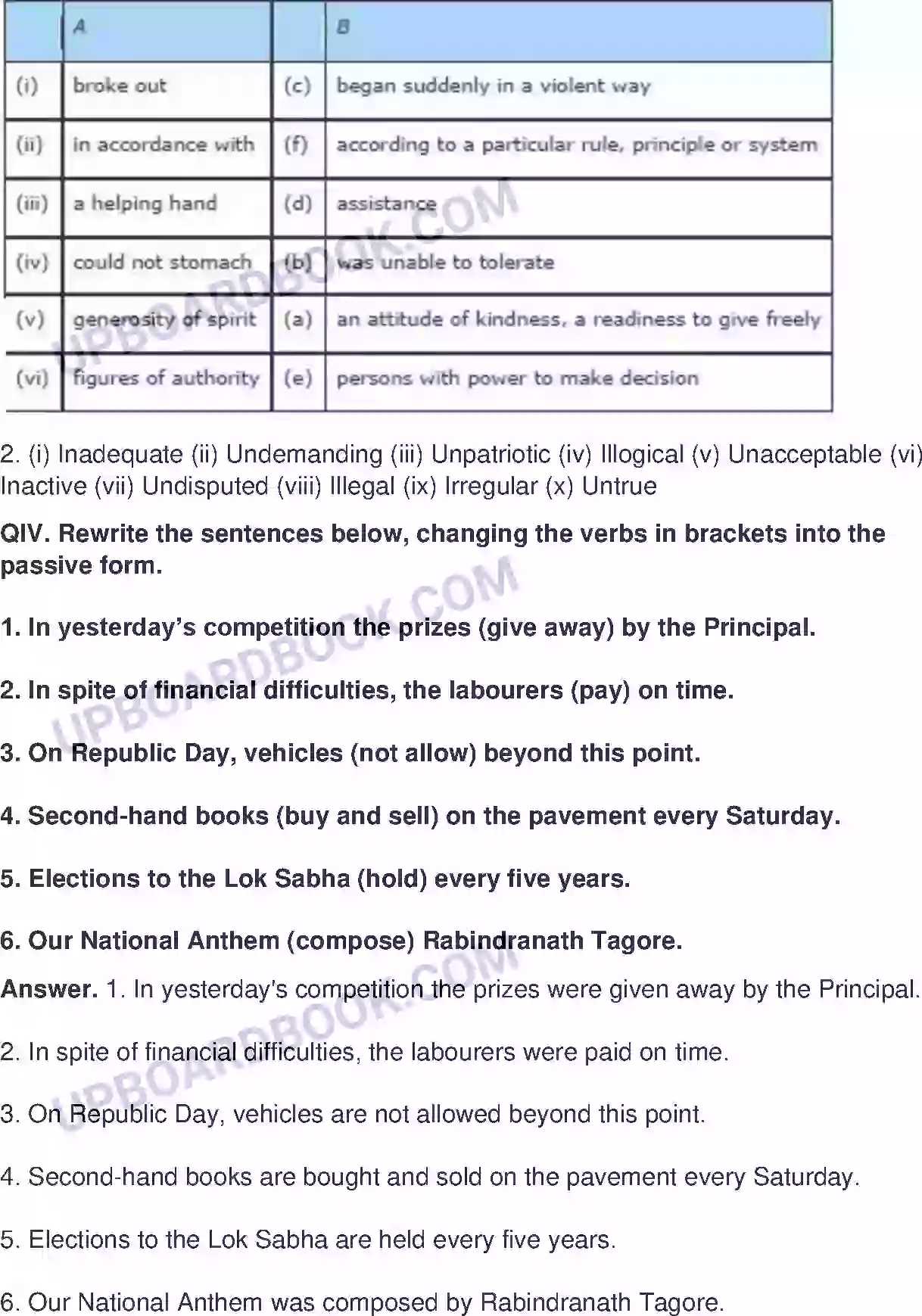
Answer: 1.
(i) broke out - (c) began suddenly in a violent way
(ii) in accordance with - (f) according to a particular rule, principle or system
(iii) a helping hand - (d) assistance
(iv) could not stomach - (b) was unable to tolerate
(v) generosity of spirit - (a) an attitude of kindness, a readiness to give freely
(vi) figures of authority - (e) persons with power to make decisions
2. Now form the opposites of the words below by prefixing un- or in-.
Answer: 2.
adequate - inadequate
demanding - undemanding
patriotic - unpatriotic
logical - illogical
acceptable - unacceptable
active - inactive
disputed - undisputed
legal - illegal
regular - irregular
true - untrue
permanent - impermanent
accessible - inaccessible
coherent - incoherent
responsible - irresponsible
possible - impossible
tolerant - intolerant
Answer:
1. In yesterday’s competition the prizes were given away by the Principal.
2. In spite of financial difficulties, the labourers were paid on time.
3. On Republic Day, vehicles are not allowed beyond this point.
4. Second-hand books are bought and sold on the pavement every Saturday.
5. Elections to the Lok Sabha are held every five years.
6. Our National Anthem was composed by Rabindranath Tagore.
1.How Helmets Came To Be Used in Cricket
Answer: 1. Nari Contractor was the Captain and an opening batsman for India in the 1960s. The Indian cricket team went on a tour to the West Indies in 1962. In a match against Barbados in Bridgetown, Nari Contractor was seriously injured and collapsed. In those days helmets were not worn. Contractor was hit on the head by a bouncer from Charlie Griffith. Contractor’s skull was fractured. The entire team was deeply concerned. The West Indies players were worried. Contractor was rushed to hospital. He was accompanied by Frank Worrell, the Captain of the West Indies Team. Blood was donated by the West Indies players. Thanks to the timely help, Contractor was saved. Nowadays helmets are routinely used against bowlers.
2. Oil from Seeds
Answer: 2. Vegetable oils are made from seeds and fruits of many plants growing all over the world, from tiny sesame seeds to big, juicy coconuts. Oil is produced from cotton seeds, groundnuts, soybeans and sunflower seeds. Olive oil is used for cooking, salad dressing etc. Olives are shaken from the trees and gathered up, usually by hand. The olives are ground to a thick paste which is spread onto special mats. Then the mats are layered up on the pressing machine which will gently squeeze them to produce olive oil.
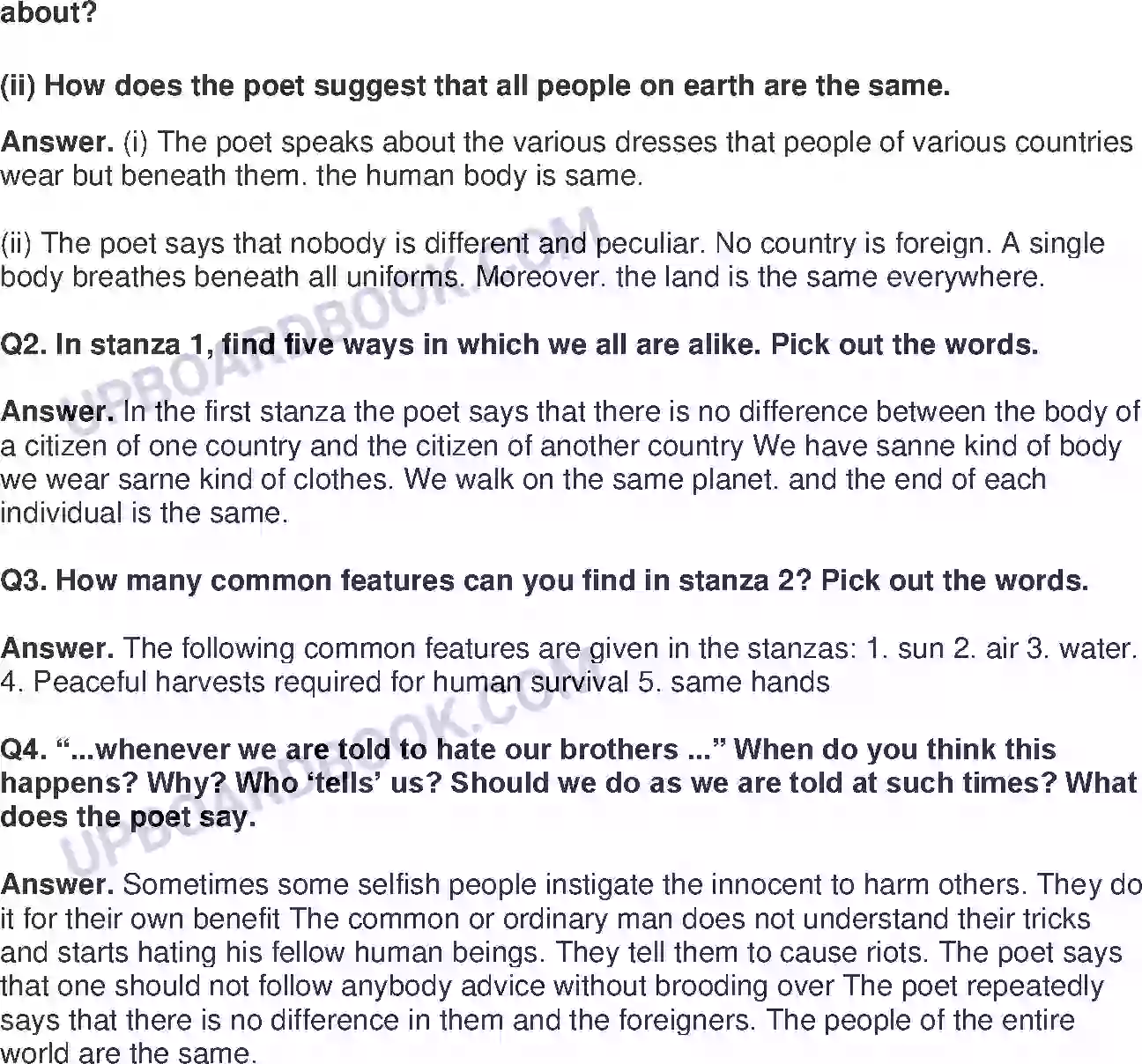
Answer: (i) The "uniforms" refer to the different traditional dresses, military uniforms, or national costumes worn by people belonging to various countries, races, or professions.
(ii) How does the poet suggest that all people on earth are the same.
Answer: (ii) The poet suggests our sameness by stating that beneath all external clothing (uniforms), every human has the same physical body. We all walk upon the same earth, are nourished by the same air and sun, and share the same basic needs and emotions.
Answer: 2. The words that show we are alike are: uniform (same body), walk (on the same earth), land (same to live on), aware (of our surroundings), and lie (in the same earth when dead).
Answer: 3. Five common features in stanza 2: sun, air, water, peaceful harvests, and hands (that labour).
Answer: 4. This happens during times of political tension, war, or when selfish leaders or propagandists spread hatred for their own gain. They 'tell' us through propaganda, speeches, or misinformation. The poet strongly implies that we should not blindly follow such orders. He urges us to remember our fundamental unity, recognize that "no men are strange," and refuse to hate our fellow human beings.
UP Board class 9 English 6. My Childhood Solution is available at our platform https://upboardSolution.com in hindi medium for free of cost. Content provided on our website is free of cost and in PDF format which is easily available for download. Getting the UP Board Solutions for class 9 will help student to achieve good learning experience so that they can study effectively. UP board holds examination of more than 3 million students every year and majority of the question of exams are from their UP Board Solutions. That’s why it is important to study using the textSolution issued by UP Board.
It is essential to know the importance of UP Board class 9 English 6. My Childhood textSolution issued by UP Board because students completely rely on these Solutions for their study and syllabus offered by UP Board is so balanced that each student should be aware about the importance of it. Below is the list of Importance of UP Board class 9 English 6. My Childhood :
There are various features of UP Board class 9 TextSolutions, some of them are mentioned below so that you student can understand the value and usability of the contend and understand why Uttarpradesh board has prescribed these Solutions.