 UPBoardBook
UP Board class 9 English (2. The Sound Of Music) solution PDF
UP Board class 9 English 2. The Sound Of Music is a Hindi Medium Solution which is prescribed by Uttar Pradesh Board for their students. These Solutions is completely prepared considering the latest syllabus and it covers every single topis, so that every student get organised and conceptual learning of the concepts. class 9 Students of UP Board who have selected hindi medium as their study medium they can use these Hindi medium textSolutions to prepare themselves for exam and learn the concept with ease.
UP Board class 9 English 2. The Sound Of Music Hindi Medium Solutions - PDF
Click Here to
UP Board Solutions for Class 9 English Beehive
Chapter 2 – The Sound Of Music
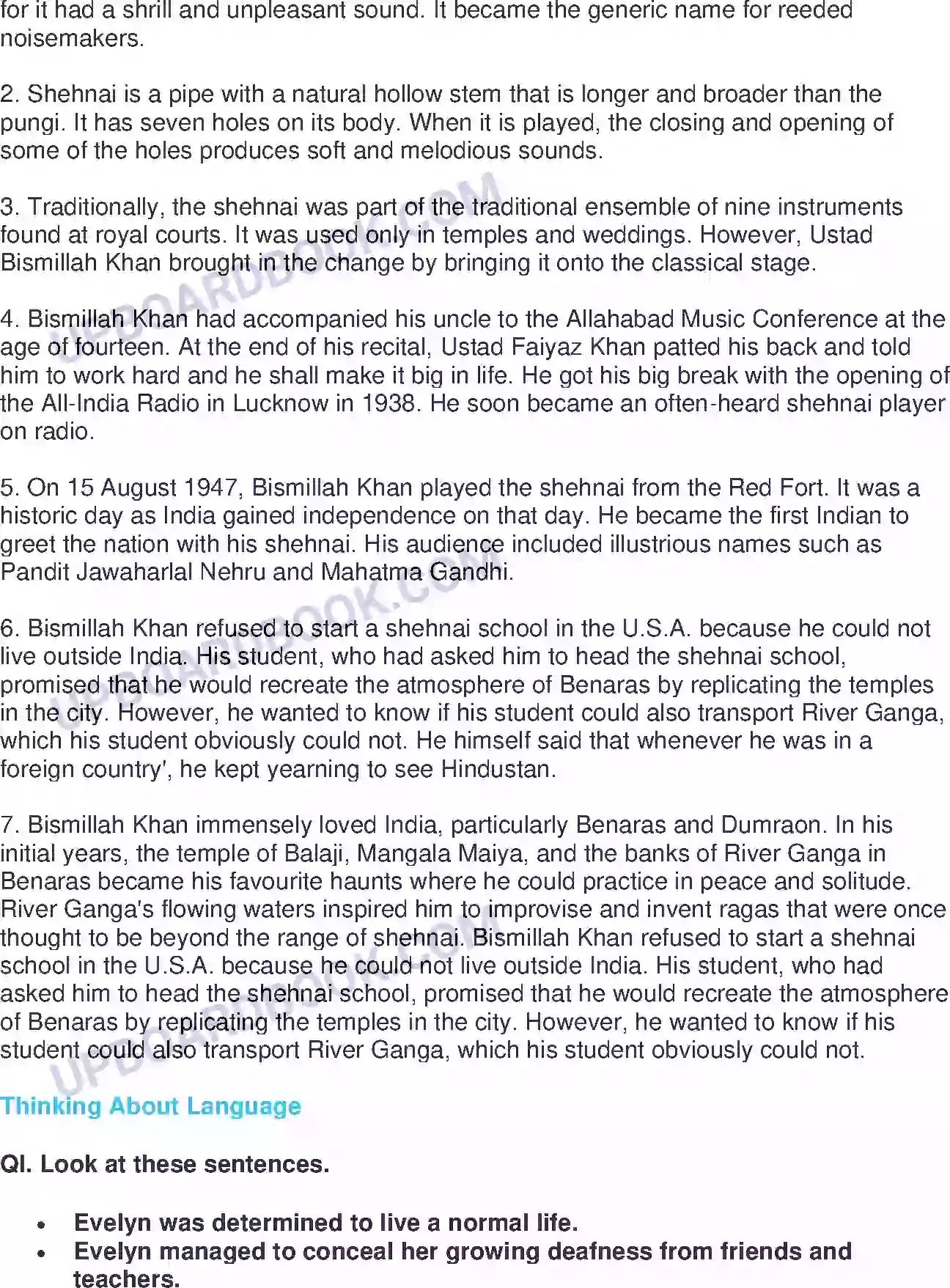
Thinking About The Text
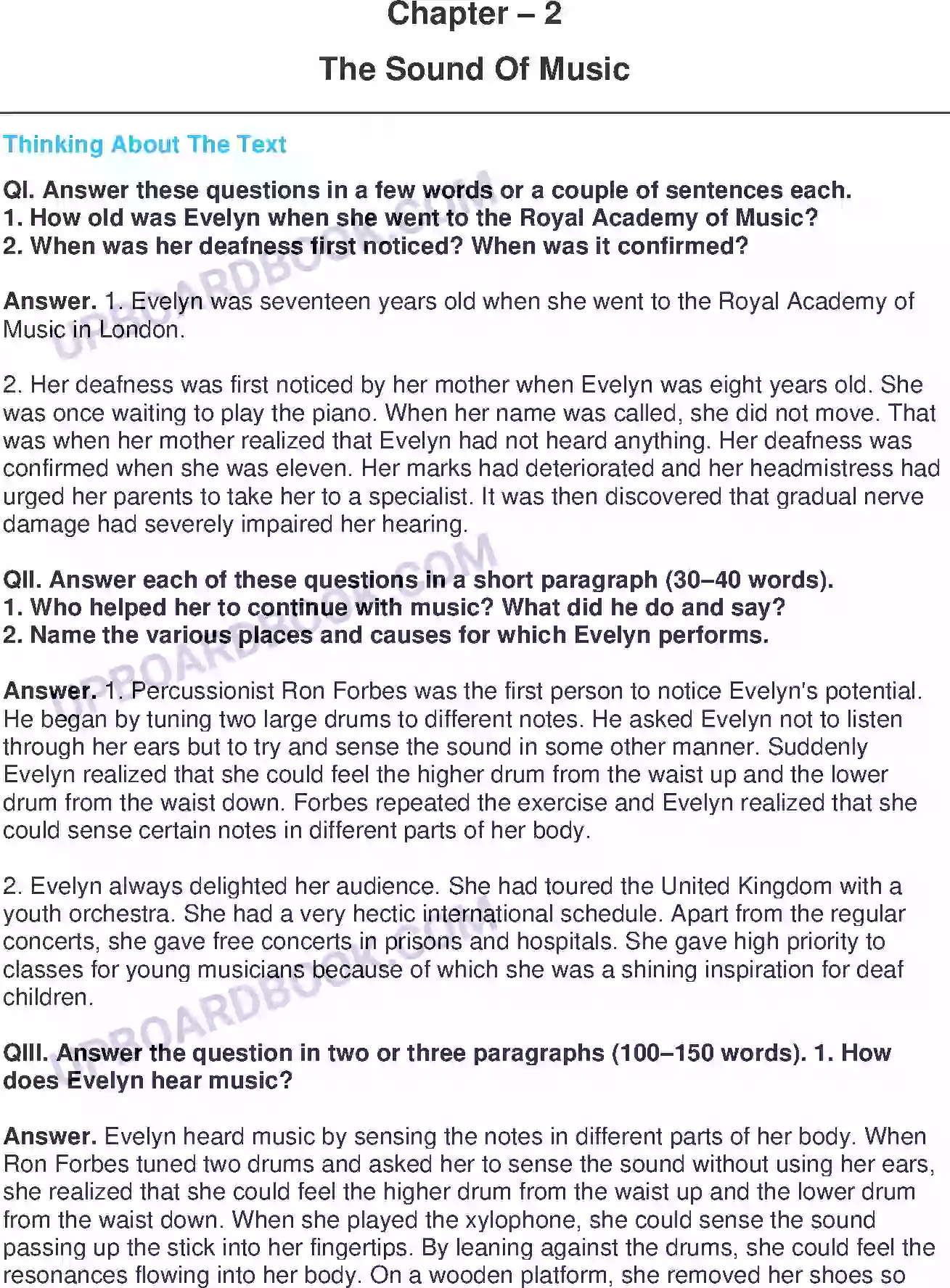
Ql. Answer these questions in a few words or a couple of sentences each.
1. How old was Evelyn when she went to the Royal Academy of Music?
2. When was her deafness first noticed? When was it confirmed?
Answer:
1. Evelyn was seventeen years old when she got admission to the Royal Academy of Music in London.
2. Her mother first noticed Evelyn's hearing problem when she was eight years old. Evelyn did not respond when her name was called to play the piano. The deafness was medically confirmed when she was eleven, after her school performance dropped and a specialist diagnosed her with irreversible nerve damage.
Qll. Answer each of these questions in a short paragraph (30-40 words).
1. Who helped her to continue with music? What did he do and say?
2. Name the various places and causes for which Evelyn performs.
Answer:
1. Percussionist Ron Forbes recognized Evelyn's talent. He tuned two drums to different notes and told her to "listen" not through her ears but to feel the vibrations. This exercise helped Evelyn realize she could sense different notes in various parts of her body.
2. Evelyn performs worldwide in regular concerts. She also dedicates her talent to social causes by giving free concerts in prisons and hospitals. She is passionate about teaching young musicians and serves as a role model for children with disabilities.
Qlll. Answer the question in two or three paragraphs (100-150 words).
1. How does Evelyn hear music?
Answer:
Evelyn Glennie perceives music through vibrations and physical sensations in her body, not through her ears. Her breakthrough came when her teacher, Ron Forbes, asked her to feel the sound of two differently tuned drums. She felt the higher-pitched drum's vibrations in the upper part of her body and the lower drum's vibrations from the waist down.
She applies this technique to all instruments. When playing the xylophone, she feels the sound travel up the sticks into her fingertips. She leans against drums to feel the resonances and often performs barefoot on wooden floors to let the vibrations travel through her feet. Evelyn describes the experience as music flowing through every part of her—tingling in her skin, cheekbones, and even her hair.
Part II – The Shehnai of Bismillah Khan
Thinking about the Text
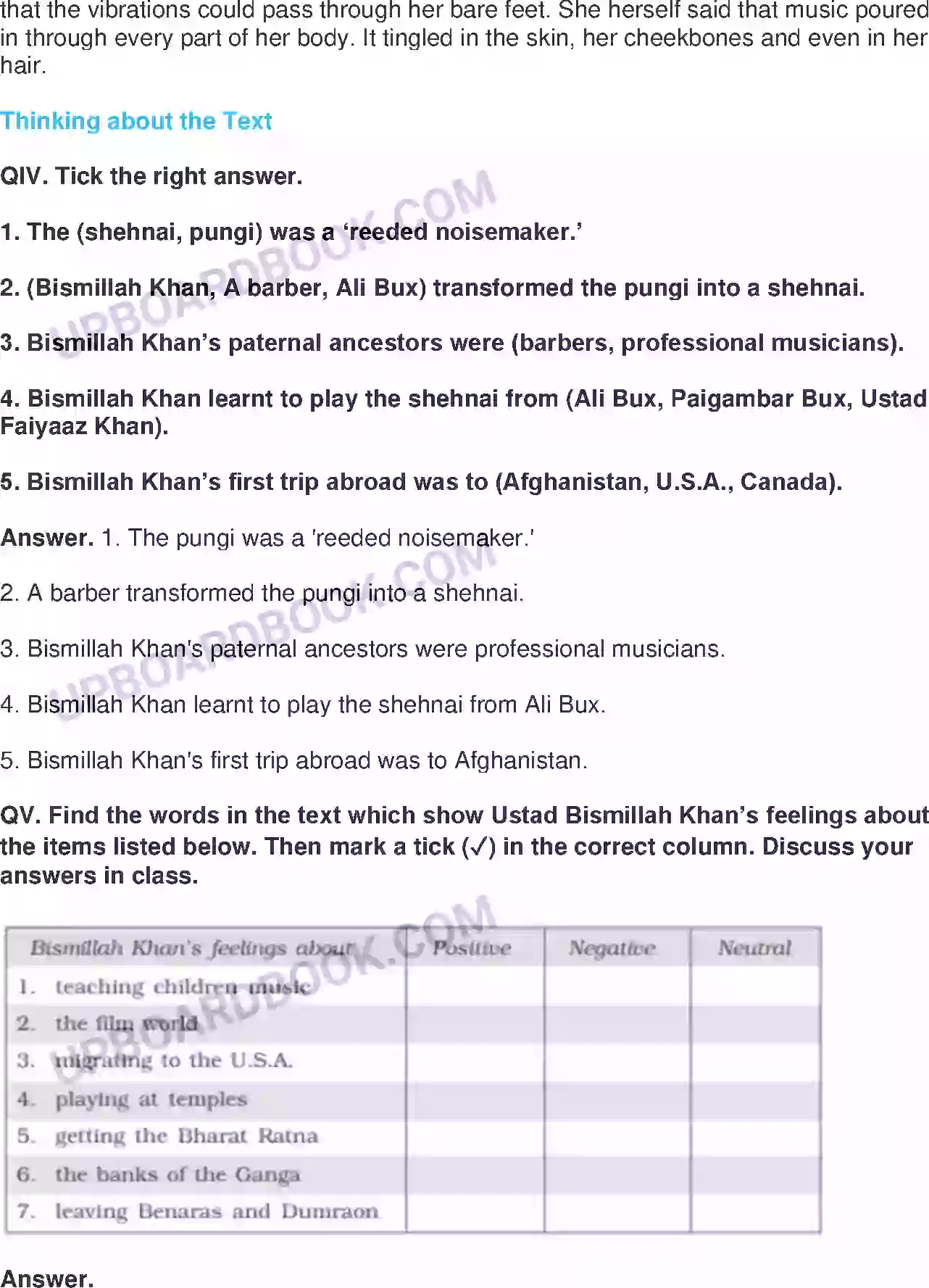
QIV. Tick the right answer.
1. The (shehnai, pungi) was a ‘reeded noisemaker.’
2. (Bismillah Khan, A barber, Ali Bux) transformed the pungi into a shehnai.
3. Bismillah Khan’s paternal ancestors were (barbers, professional musicians).
4. Bismillah Khan learnt to play the shehnai from (Ali Bux, Paigambar Bux, Ustad Faiyaaz Khan).
5. Bismillah Khan’s first trip abroad was to (Afghanistan, U.S.A., Canada).
Answer:
1. The pungi was a 'reeded noisemaker.'
2. A barber transformed the pungi into a shehnai.
3. Bismillah Khan's paternal ancestors were professional musicians.
4. Bismillah Khan learnt to play the shehnai from Ali Bux.
5. Bismillah Khan’s first trip abroad was to Afghanistan.
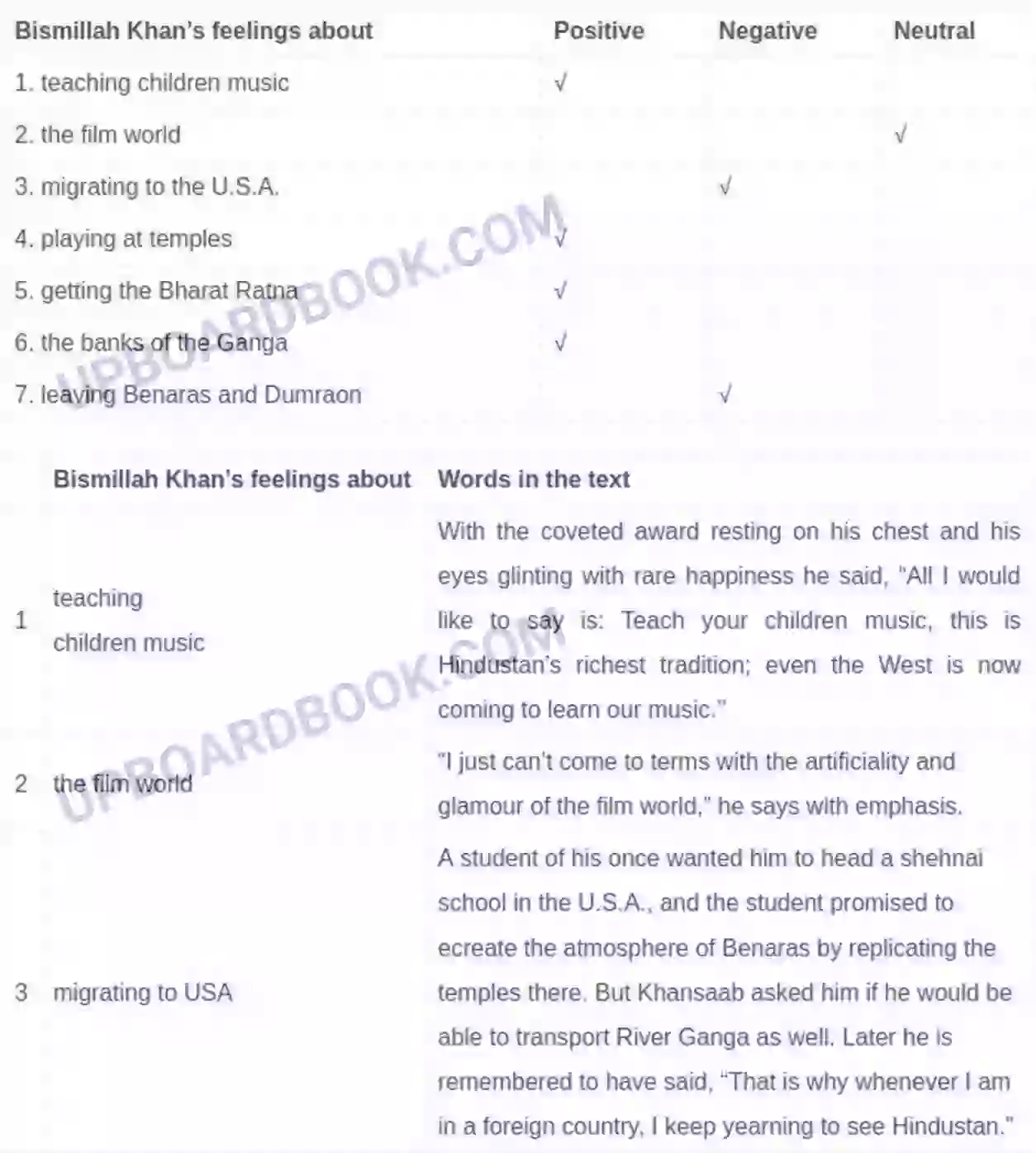
QV. Find the words in the text which show Ustad Bismillah Khan’s feelings about the items listed below. Then mark a tick (V) in the correct column. Discuss your answers in class.
| Bismillah Khan’s feelings about | Positive | Negative | Neutral | Words in the text |
|---|---|---|---|---|
| 1. teaching children music | "Teach your children music, this is Hindustan’s richest tradition..." | |||
| 2. the film world | "I just can’t come to terms with the artificiality and glamour..." | |||
| 3. migrating to the U.S.A. | He asked if his student could transport the River Ganga too, and said he yearned for India when abroad. | |||
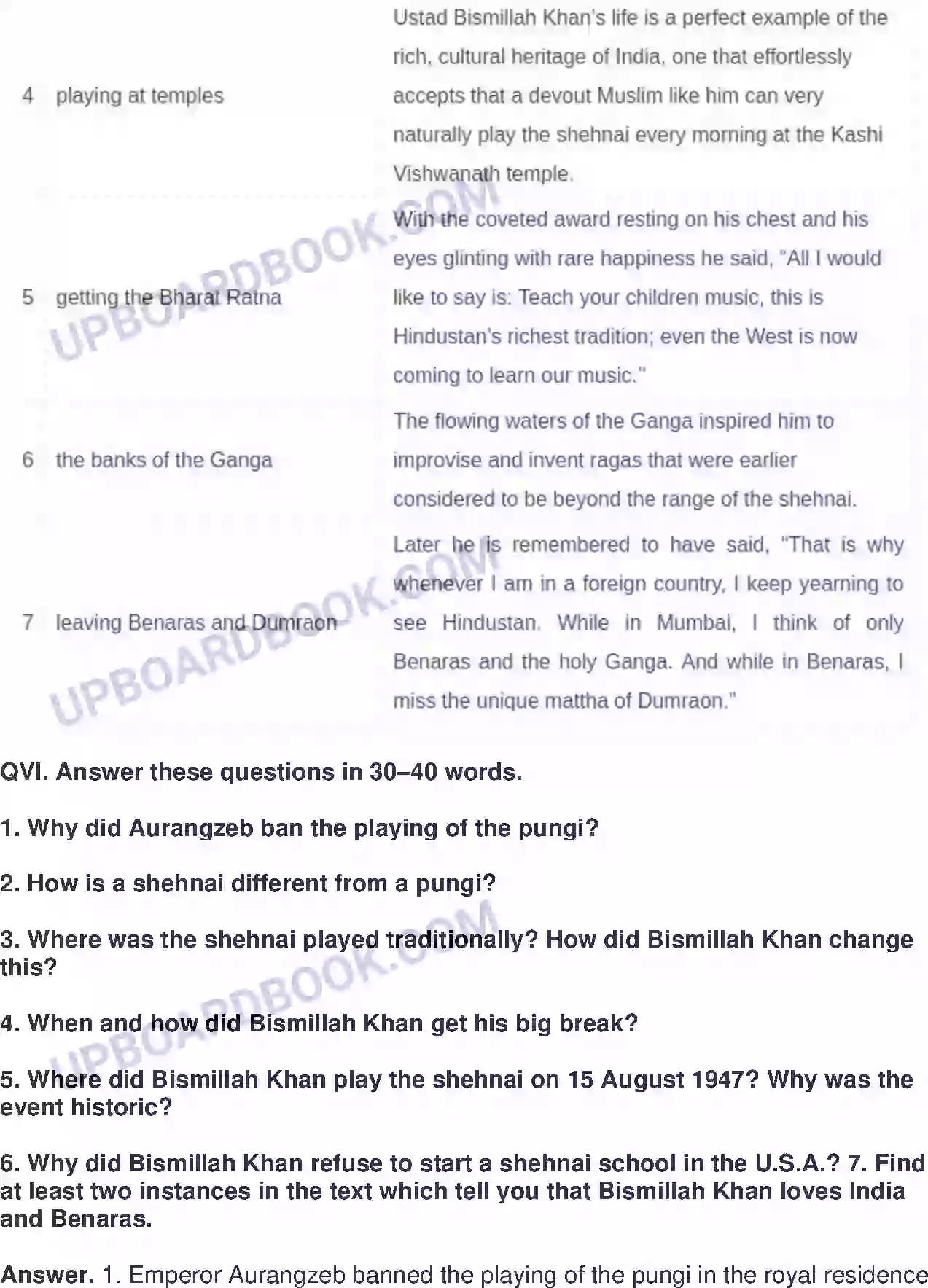
| 4. playing at temples | His life shows a Muslim can naturally play shehnai at the Kashi Vishwanath temple. | |||
| 5. getting the Bharat Ratna | He spoke with "eyes glinting with rare happiness" about the award. | |||
| 6. the banks of the Ganga | The flowing waters inspired him to improvise new ragas. | |||
| 7. leaving Benaras and Dumraon | In Mumbai, he thought of Benaras and the Ganga; in Benaras, he missed Dumraon. |
QVI. Answer these questions in 30-40 words.
1. Why did Aurangzeb ban the playing of the pungi?
2. How is a shehnai different from a pungi?
3. Where was the shehnai played traditionally? How did Bismillah Khan change this?
4. When and how did Bismillah Khan get his big break?
5. Where did Bismillah Khan play the shehnai on 15 August 1947? Why was the event historic?
6. Why did Bismillah Khan refuse to start a shehnai school in the U.S.A.?
7. Find at least two instances in the text which tell you that Bismillah Khan loves India and Benaras.
Answer:
1. Emperor Aurangzeb banned the pungi in the royal court because it produced a shrill, unpleasant, and jarring sound that was considered a mere noisemaker.
2. The shehnai is a refined version of the pungi. It is a longer, broader wooden pipe with seven holes that produce soft, melodious music, unlike the harsh sound of the pungi.
3. Traditionally, the shehnai was played at temples and Indian weddings. Bismillah Khan elevated its status by bringing it onto the national and international classical music stage.
4. Bismillah Khan got his big break when All India Radio started in Lucknow in 1938. His talent was recognized earlier when Ustad Faiyaz Khan praised him at a music conference in Allahabad.
5. On 15 August 1947, he played the shehnai at the Red Fort in Delhi. The event was historic because it marked India's Independence Day, and he was the first to greet the nation with his instrument.
6. He refused because he deeply loved India and could not imagine living away from the holy River Ganga and the spiritual atmosphere of Benaras, which were his true inspirations.
7. First, he refused to leave India, asking if one could also transport the Ganga to America. Second, he found his greatest inspiration on the banks of the Ganga in Benaras and missed it dearly when away.
Thinking About Language
QI. Look at these sentences.
• Evelyn was determined to live a normal life.
• Evelyn managed to conceal her growing deafness from friends and teachers.
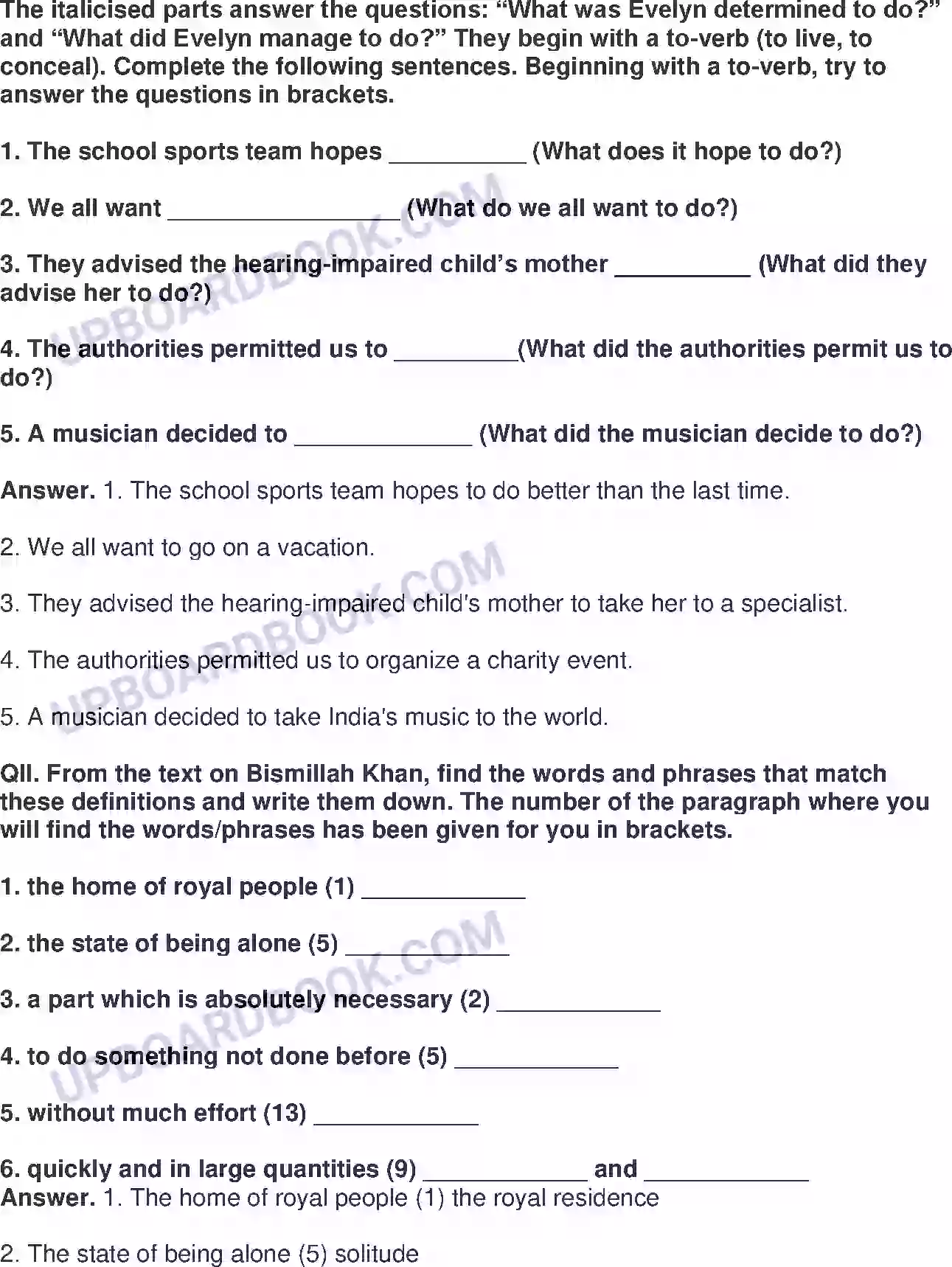
The italicised parts answer the questions: “What was Evelyn determined to do?” and “What did Evelyn manage to do?” They begin with a to-verb (to live, to conceal). Complete the following sentences. Beginning with a to-verb, try to answer the questions in brackets.
1. The school sports team hopes (What does it hope to do?)
2. We all want (What do we all want to do?)
3. They advised the hearing-impaired child’s mother (What did they advise her to do?)
4. The authorities permitted us to (What did the authorities permit us to do?)
5. A musician decided to (What did the musician decide to do?)
Answer:
1. The school sports team hopes to win the championship this year.
2. We all want to succeed in our chosen fields.
3. They advised the hearing-impaired child’s mother to consult a good audiologist.
4. The authorities permitted us to use the auditorium for the event.
5. A musician decided to compose a song for the national festival.
QIl. From the text on Bismillah Khan, find the words and phrases that match these definitions and write them down. The number of the paragraph where you will find the words/phrases has been given for you in brackets.
1. the home of royal people (1)
2. the state of being alone (5)
3. a part which is absolutely necessary (2)
4. to do something not done before (5)
5. without much effort (13)
6. quickly and in large quantities (9)
Answer:
1. the royal residence
2. solitude
3. indispensable
4. invent
5. effortlessly
6. thick and fast
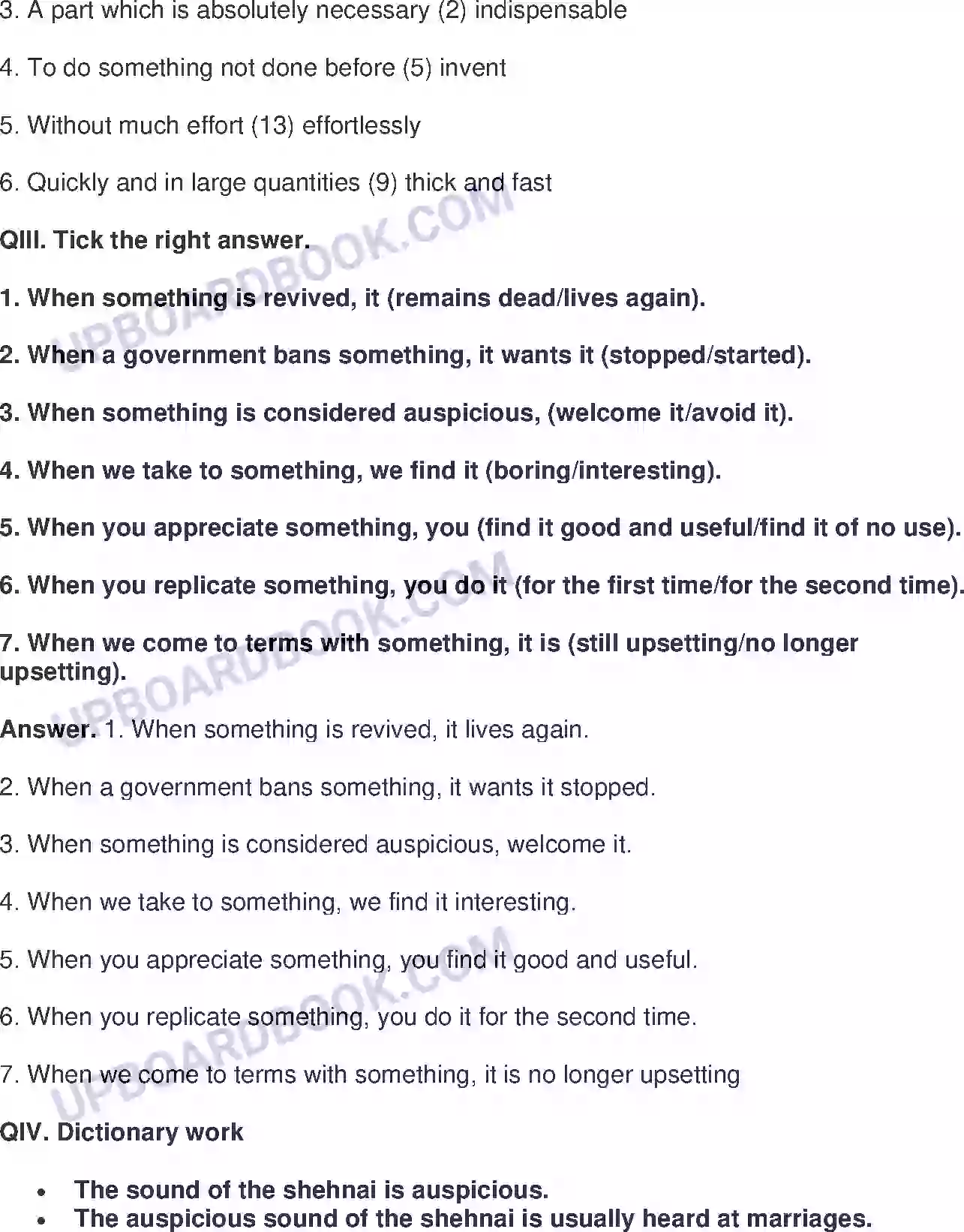
Qlll. Tick the right answer.
1. When something is revived, it (remains dead/lives again).
2. When a government bans something, it wants it (stopped/started).
3. When something is considered auspicious, (welcome it/avoid it).
4. When we take to something, we find it (boring/interesting).
5. When you appreciate something, you (find it good and useful/find it of no use).
6. When you replicate something, you do it (for the first time/for the second time).
7. When we come to terms with something, it is (still upsetting/no longer upsetting).
Answer:
1. lives again
2. stopped
3. welcome it
4. interesting
5. find it good and useful
6. for the second time
7. no longer upsetting
QIV. Dictionary work
• The sound of the shehnai is auspicious.
• The auspicious sound of the shehnai is usually heard at marriages.
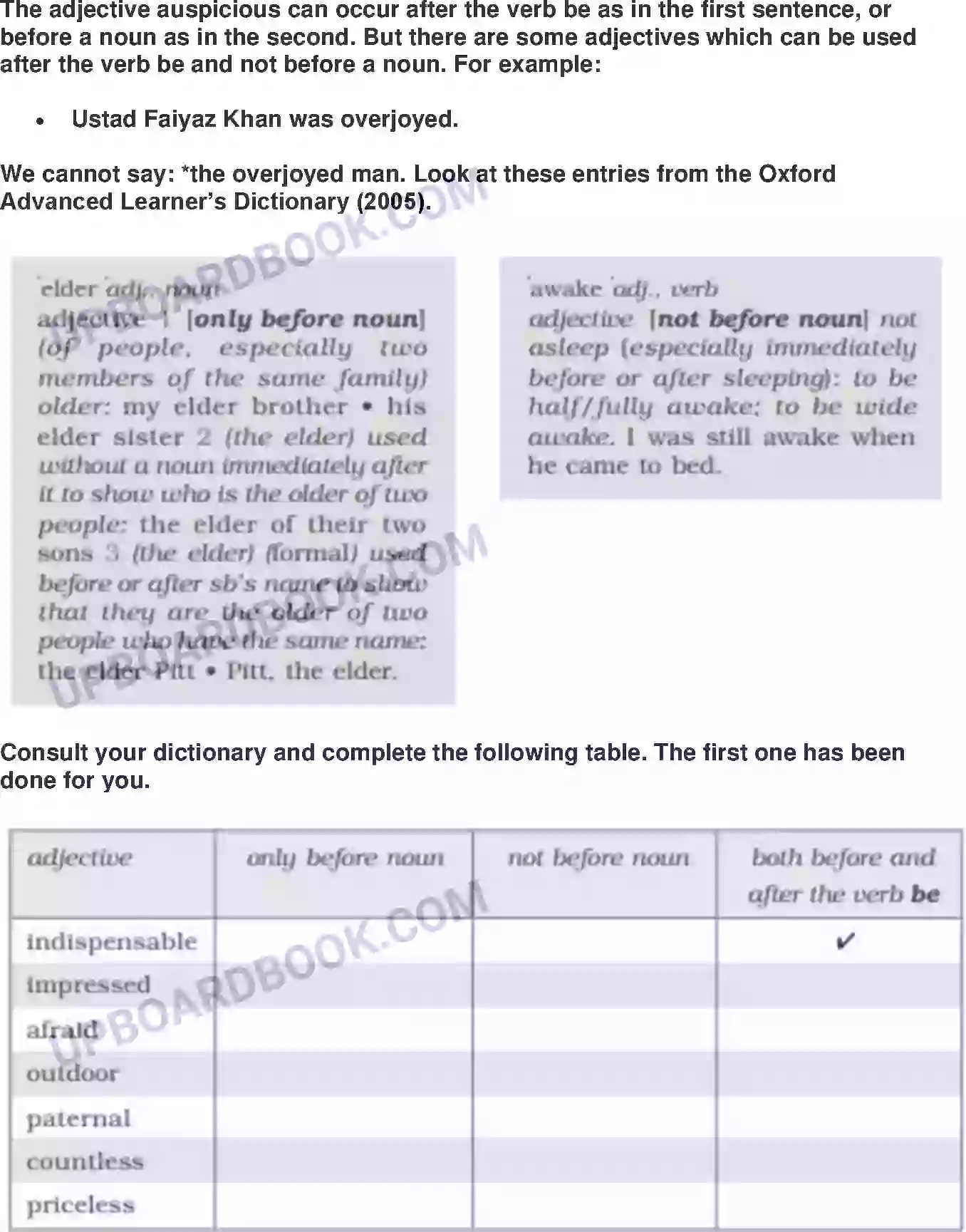
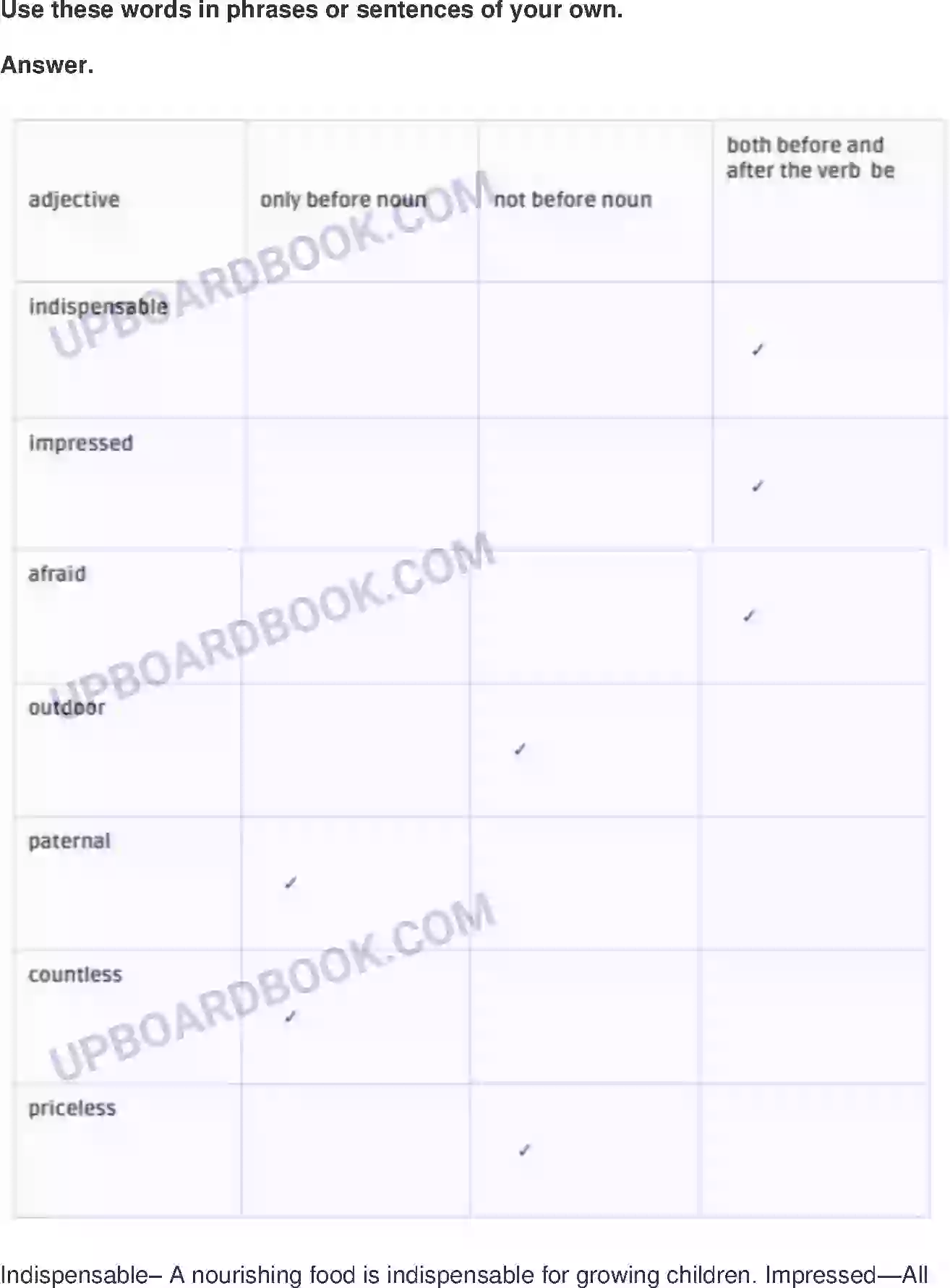
The adjective auspicious can occur after the verb be as in the first sentence, or before a noun as in the second. But there are some adjectives which can be used after the verb be and not before a noun. For example:
• Ustad Faiyaz Khan was overjoyed.
We cannot say: *the overjoyed man.
Consult your dictionary and complete the following table. The first one has been done for you.
| adjective | only before noun | not before noun | both before and after the verb be |
|---|---|---|---|
| indispensable | |||
| impressed | |||
| afraid | |||
| outdoor | |||
| paternal | |||
| countless | |||
| priceless |
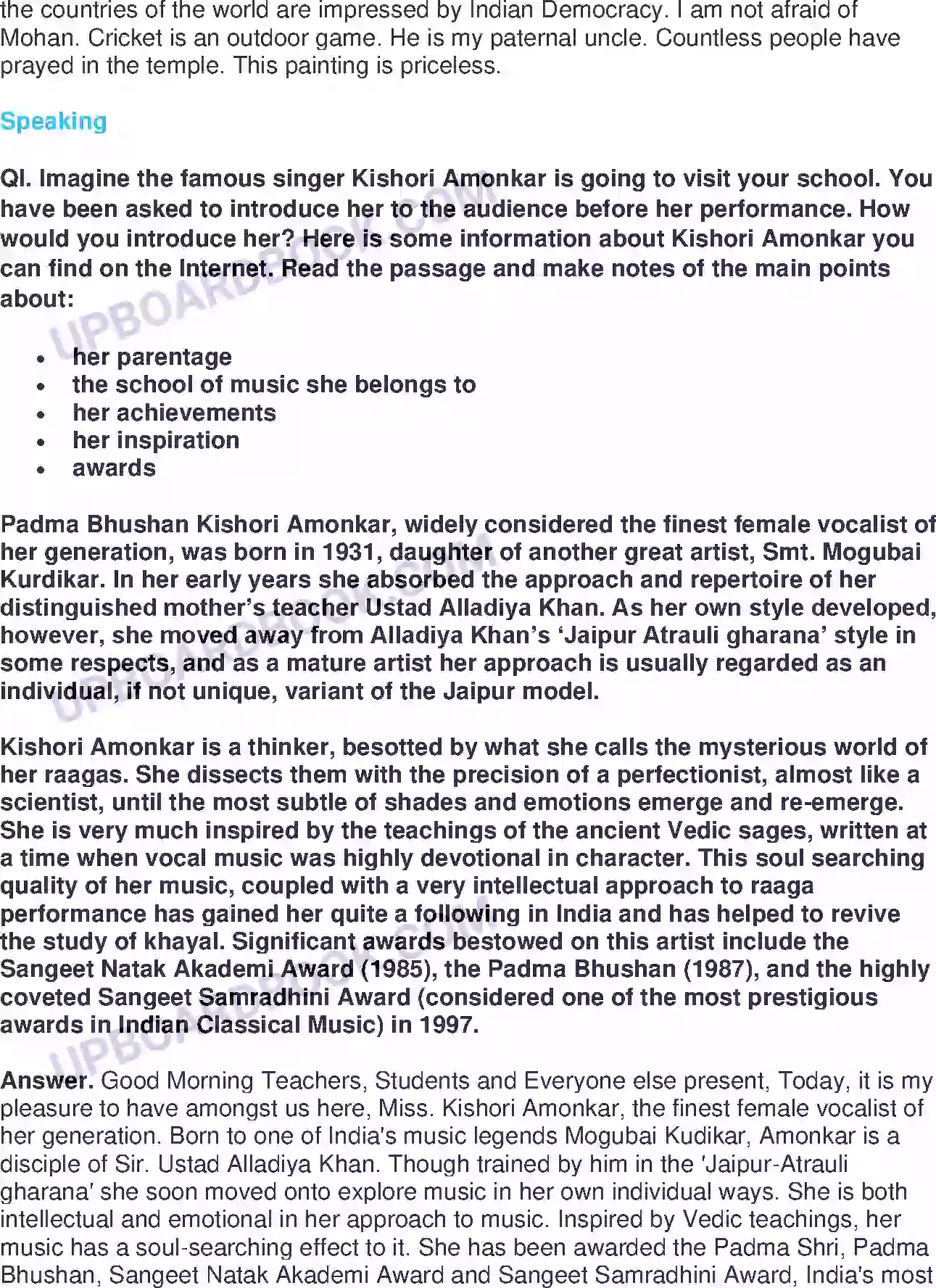
Use these words in phrases or sentences of your own.
• Indispensable: Water is indispensable for life.
• Impressed: The teacher was impressed by the student's project.
• Afraid: The child was afraid of the dark.
• Outdoor: We planned an outdoor picnic for Sunday.
• Paternal: My paternal grandfather tells the best stories.
• Countless: There are countless stars in the sky.
• Priceless: The memories of our trip are priceless.
Speaking
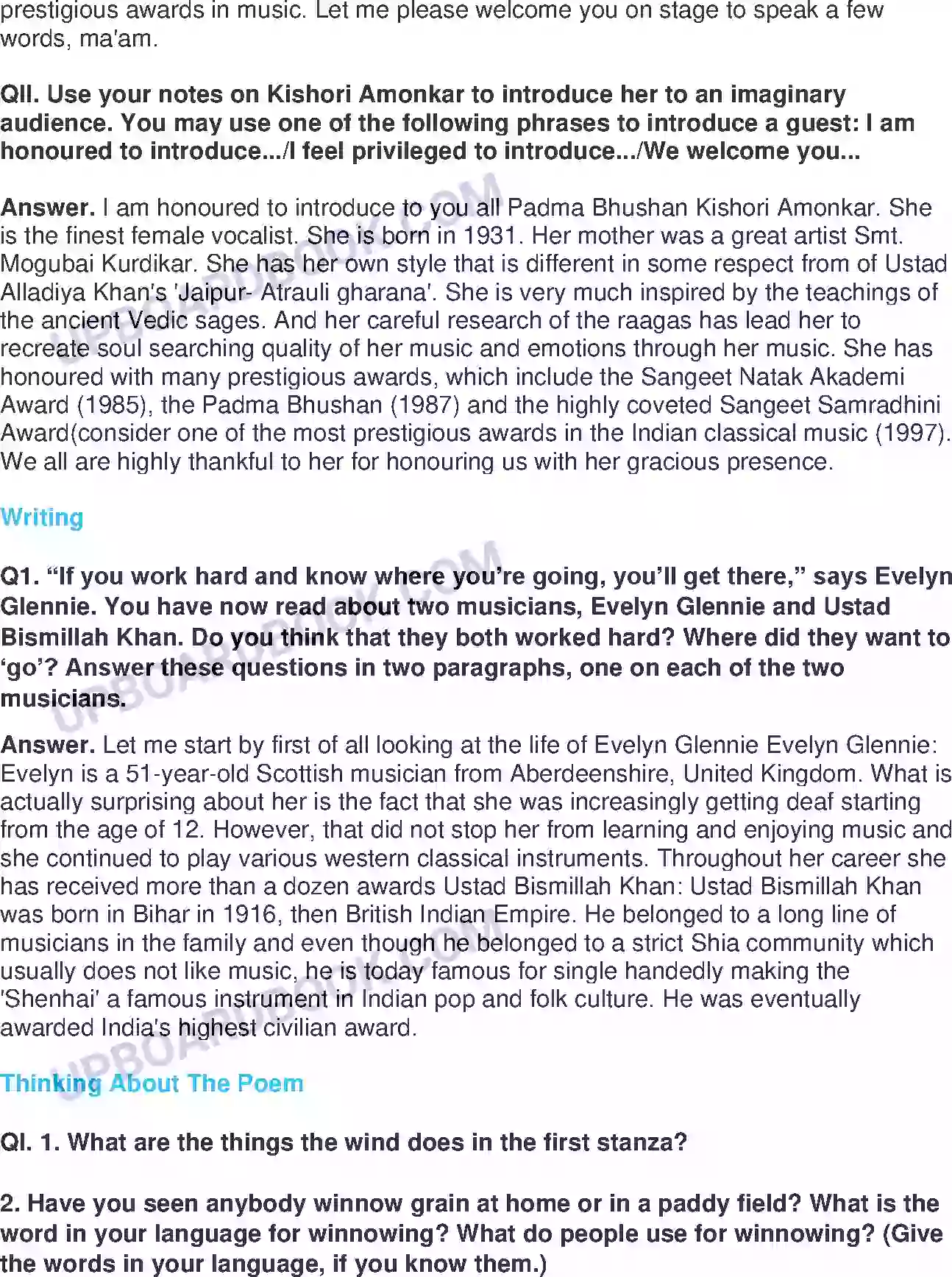
QI. Imagine the famous singer Kishori Amonkar is going to visit your school. You have been asked to introduce her to the audience before her performance. How would you introduce her?
Answer:
Respected Principal, teachers, and my dear friends,
It is my great privilege to introduce to you a legend of Indian classical music, Padma Bhushan Kishori Amonkar Ji. Born in 1931, she is the daughter of the renowned vocalist Smt. Mogubai Kurdikar. Trained in the Jaipur-Atrauli Gharana, she has developed a unique, deeply thoughtful style of her own. Her music is not just melody; it is a spiritual exploration inspired by ancient Vedic wisdom. A recipient of the Sangeet Natak Akademi Award and the coveted Sangeet Samradhini Award, she is truly a national treasure. Let us welcome her with a huge round of applause.
Qll. Use your notes on Kishori Amonkar to introduce her to an imaginary audience. You may use one of the following phrases to introduce a guest: I am honoured to introduce.../I feel privileged to introduce.../We welcome you...
Answer:
I feel privileged to introduce Padma Bhushan Kishori Amonkar, one of the most celebrated classical vocalists of India. The daughter of the great artist Mogubai Kurdikar, she has carved her own distinct path in music, moving beyond her traditional training to create a soulful and intellectual style. Deeply inspired by Vedic philosophy, her renditions are a profound spiritual experience. Her numerous accolades, including the Padma Bhushan and the Sangeet Samradhini Award, are a testament to her monumental contribution to Indian art and culture. We welcome you, ma'am, to our humble gathering.
Writing
Q1. “If you work hard and know where you’re going, you’ll get there,” says Evelyn Glennie. You have now read about two musicians, Evelyn Glennie and Ustad Bismillah Khan. Do you think that they both worked hard? Where did they want to ‘go’? Answer these questions in two paragraphs, one on each of the two musicians.
Answer:
Evelyn Glennie: Evelyn Glennie's life is a powerful testament to hard work and determination. Despite becoming profoundly deaf at a young age, she was determined to become a musician. She worked tirelessly to learn to perceive music through vibrations and feeling. Her goal was to live a normal life and become a world-class percussionist, not letting her disability define her limits. Through relentless practice and innovation, she achieved her dream, winning numerous awards and performing globally.
Ustad Bismillah Khan: Ustad Bismillah Khan's dedication was rooted in relentless riyaaz (practice) and a deep love for his art. From a young age, he practiced for hours on the banks of the Ganga. He wanted to elevate the shehnai from a folk instrument to a respected presence on the classical stage. His goal was to spread the beauty of Indian music and remain true to his roots. His hard work paid off, earning him India's highest civilian honour, the Bharat Ratna, and a permanent place in the nation's cultural heart.
Thinking About The Poem (Wind)
QI.
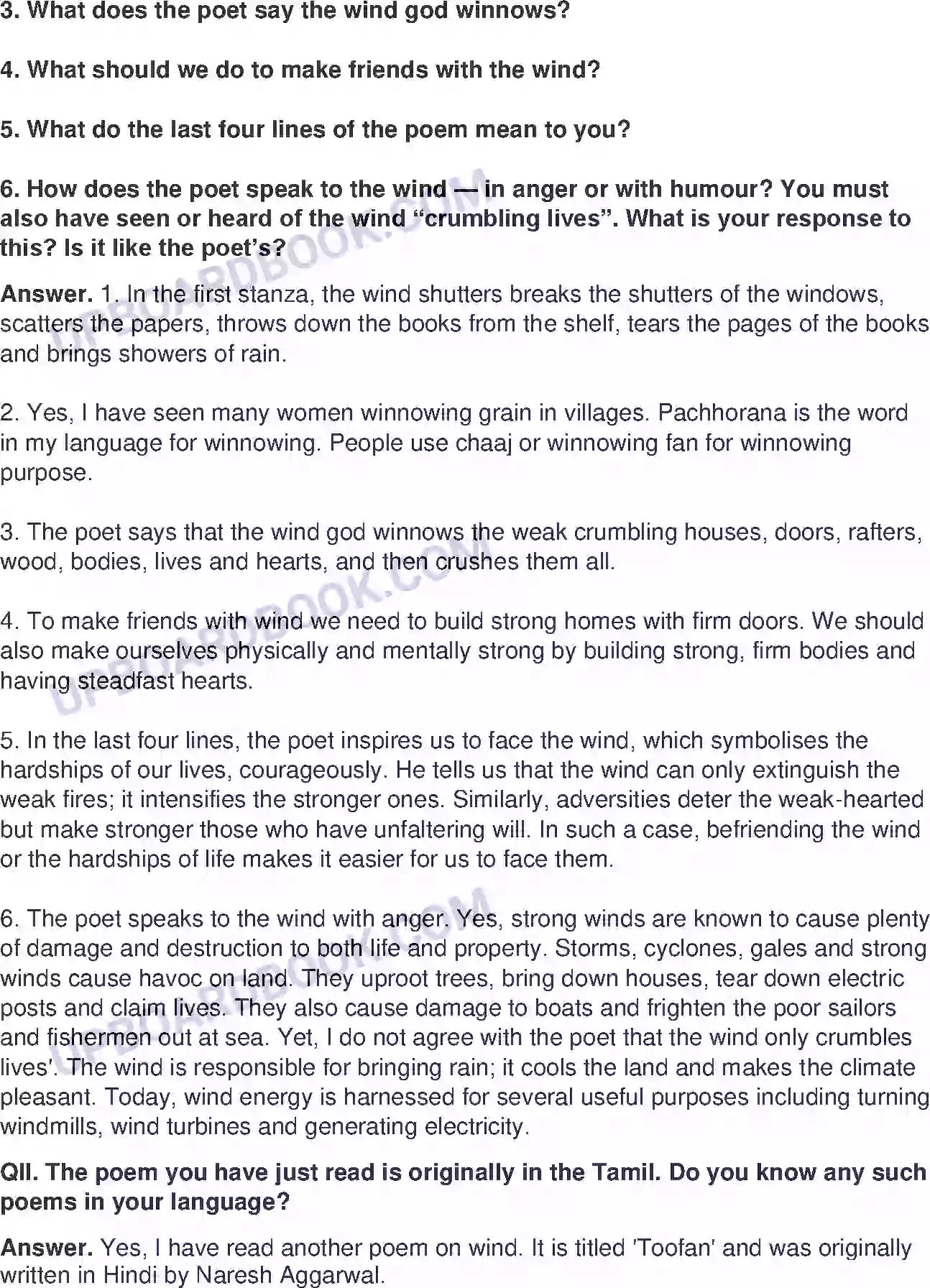
1. What are the things the wind does in the first stanza?
2. Have you seen anybody winnow grain at home or in a paddy field? What is the word in your language for winnowing? What do people use for winnowing? (Give the words in your language, if you know them.)
3. What does the poet say the wind god winnows?
4. What should we do to make friends with the wind?
5. What do the last four lines of the poem mean to you?
6. How does the poet speak to the wind — in anger or with humour? You must also have seen or heard of the wind “crumbling lives”. What is your response to this? Is it like the poet’s?
Answer:
1. In the first stanza, the wind breaks shutters, scatters papers, throws books down, tears their pages, and brings rain.
2. Yes, I have seen women winnowing grain. In Hindi, it is called 'फटकना' (fatkana) or 'सूप से छाँटना'. People use a winnowing fan or basket, called 'सूप' (soop) or 'चालनी' (chaalni).
3. The poet says the wind god winnows and crushes all that is weak—houses, doors, rafters, wood, bodies, lives, and hearts.
4. To make friends with the wind, we must build strong homes with firm doors. More importantly, we must build strong bodies and steadfast hearts to withstand life's challenges.
5. The last four lines mean that the wind, symbolizing hardship, destroys the weak but strengthens the strong. If we are powerful and determined, the wind becomes a friend that helps us grow even stronger.
6. The poet speaks to the wind with a tone of challenge and slight anger, blaming it for destruction. While I agree that strong winds can cause devastation like storms and cyclones, I believe the wind is also essential. It brings rain, cools the air, and its energy can be harnessed for good, unlike the poet's purely destructive view.
QIl. The poem you have just read is originally in the Tamil. Do you know any such poems in your language?
Answer:
Yes, many Indian poets have written about natural forces like the wind. For example, the famous Hindi poet Harivansh Rai Bachchan has written powerful poems about storms and challenges in his collection 'Madhushala'. Another poem titled "Pawan" (Wind) by various poets describes its dual nature—both as a destroyer and a life-giver.
Get UP Board class 9 English 2. The Sound Of Music Solution in Hindi Medium
UP Board class 9 English 2. The Sound Of Music Solution is available at our platform https://upboardbook.com in hindi medium for free of cost. Content provided on our website is free of cost and in PDF format which is easily available for download. Getting the UP Board Solutions for class 9 will help student to achieve good learning experience so that they can study effectively. UP board holds examination of more than 3 million students every year and majority of the question of exams are from their UP Board Solutions. That’s why it is important to study using the textSolution issued by UP Board.
Importance of UP Board class 9 English 2. The Sound Of Music Text Solutions
It is essential to know the importance of UP Board class 9 English 2. The Sound Of Music textSolution issued by UP Board because students completely rely on these Solutions for their study and syllabus offered by UP Board is so balanced that each student should be aware about the importance of it. Below is the list of Importance of UP Board class 9 English 2. The Sound Of Music :
- These TextSolutions are very clear and accurate which helps student to understand concept with ease.
- It is also to mention that these text Solutions are prepared by the content experts of subject, thus these Solutions helps student in clearing their doubts and understand the core concept easily.
- It is considered to be the best study material for competitive exam preparation.
Features of UP Board class 9 textSolutions
There are various features of UP Board class 9 TextSolutions, some of them are mentioned below so that you student can understand the value and usability of the contend and understand why Uttarpradesh board has prescribed these Solutions.
- Best feature of these textSolutions is free availability of content in PDF format
- Second feature that content generated and written is clear and easy to read.
- There are various illustration and images are shown in the Solution so that student can easily understand the concept and should be more appealing to the student.
- Each chapter is explained thoroughly
