UP Board class 9 English 3. The Little Girl is a Hindi Medium Solution which is prescribed by Uttar Pradesh Board for their students. These Solutions is completely prepared considering the latest syllabus and it covers every single topis, so that every student get organised and conceptual learning of the concepts. class 9 Students of UP Board who have selected hindi medium as their study medium they can use these Hindi medium textSolutions to prepare themselves for exam and learn the concept with ease.
A B
1. fear or terror (i) father comes into her room to give her a goodbye kiss
2. glad sense of relief (ii) noise of the carriage grows fainter
3. a “funny” feeling, perhaps of understanding (iii) father comes home
(iv) speaking to father
(v) going to bed when alone at home
(vi) father comforts her and falls asleep
(vii) father stretched out on the sofa, snoring
Answer:
1. fear or terror — (iv) speaking to father, (v) going to bed when alone at home, (vii) father stretched out on the sofa, snoring
2. glad sense of relief — (ii) noise of the carriage grows fainter
3. a “funny” feeling, perhaps of understanding — (i) father comes into her room to give her a goodbye kiss, (iii) father comes home, (vi) father comforts her and falls asleep
Answer:
1. Kezia was afraid of her father because he appeared strict, often scolded her for small mistakes, and his loud, commanding manner made her nervous.
2. Kezia's family consisted of her father, her mother, and her grandmother.
3. (i) Before going to his office, Kezia's father would quickly come into her room to give her a formal goodbye kiss.
(ii) After coming back from his office, he would speak loudly, asking for his tea, the newspaper, and his slippers.
(iii) On Sundays, he would relax by stretching out on the sofa in the drawing room and sleep, often with a handkerchief over his face.
4. Kezia's grandmother encouraged her by sending her to the drawing-room to talk to her parents on Sundays. She also suggested that Kezia make a pin-cushion as a birthday gift for her father to show her love.
Answer:
1. Kezia's attempts to please her father often backfired because of her fear. When she tried to speak to him, she would stutter, which irritated him. The biggest incident happened when she decided to make a pin-cushion for his birthday. Not knowing the importance of the papers she found, she tore up her father's important Port Authority speech to use as stuffing. When her father discovered this, he was furious and punished her severely. Thus, her good intention led to a terrible outcome, displeasing him greatly.
2. Kezia observed Mr. Macdonald, their next-door neighbour, playing joyfully with his children. He would laugh, run around with them, and even carry the baby on his shoulders. He seemed friendly and approachable. In contrast, Kezia's own father was stern, undemonstrative, and rarely showed affection or played with her. He was more concerned with discipline and order. Seeing Mr. Macdonald's playful nature made Kezia realize that fathers could be different and more loving.
3. Kezia's perspective changed one night when her mother and grandmother were away. She had a nightmare and cried out. Her father, instead of scolding her, came to her room, carried her to his bed, and tucked her in warmly. He let her snuggle close to him to get warm. Seeing him fall asleep quickly from tiredness, she understood that he worked hard all day and had no one to look after him. She felt sympathy for him, regretted tearing his speech, and realized he had a "big heart" despite his rough exterior.
Answer:
(i) delighted
(ii) thrilled
(iii) overjoyed
(iv) pleased
(v) happy
Answer:
(i) Older / more mature
(ii) Most important / significant
(iii) Grand / ambitious / excellent
(iv) Very popular / hugely important
(v) Great / ardent / enthusiastic
(vi) Someone who eats large quantities of food
(vii) Kind, generous, and loving
Answer:
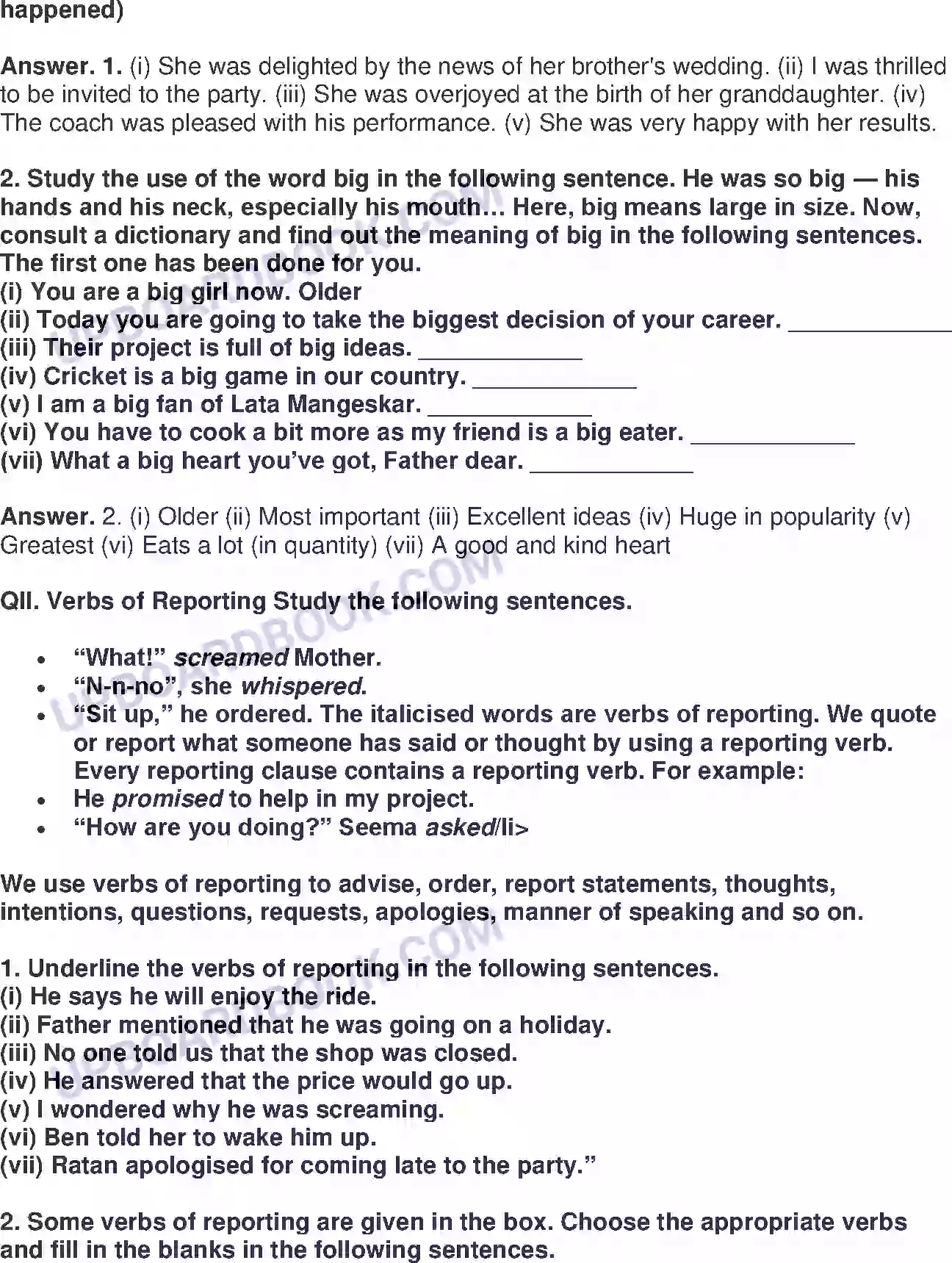
(i) says
(ii) mentioned
(iii) told
(iv) answered
(v) wondered
(vi) told
(vii) apologised
Answer:
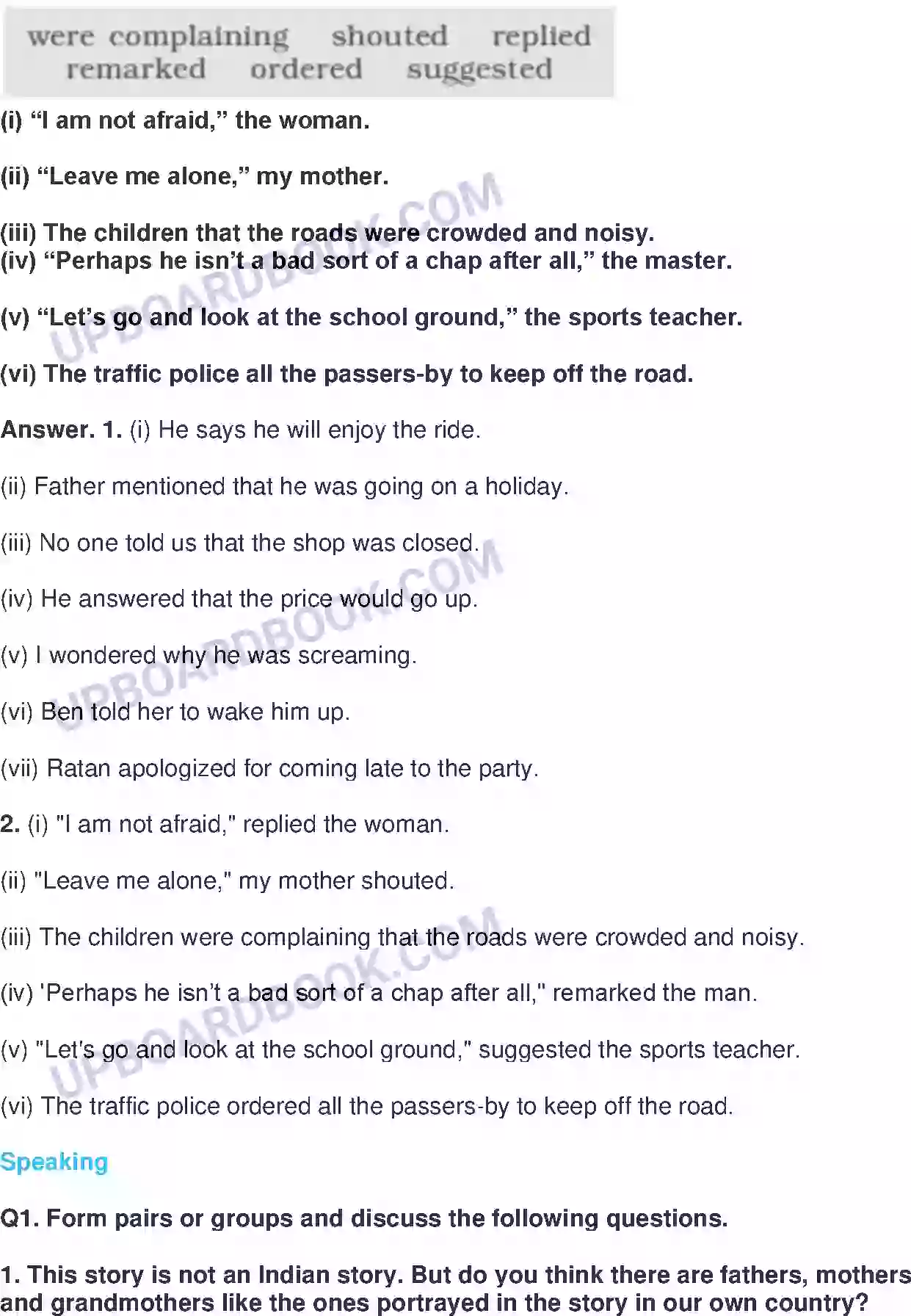
(i) replied
(ii) shouted
(iii) were complaining
(iv) remarked
(v) suggested
(vi) ordered
Answer:
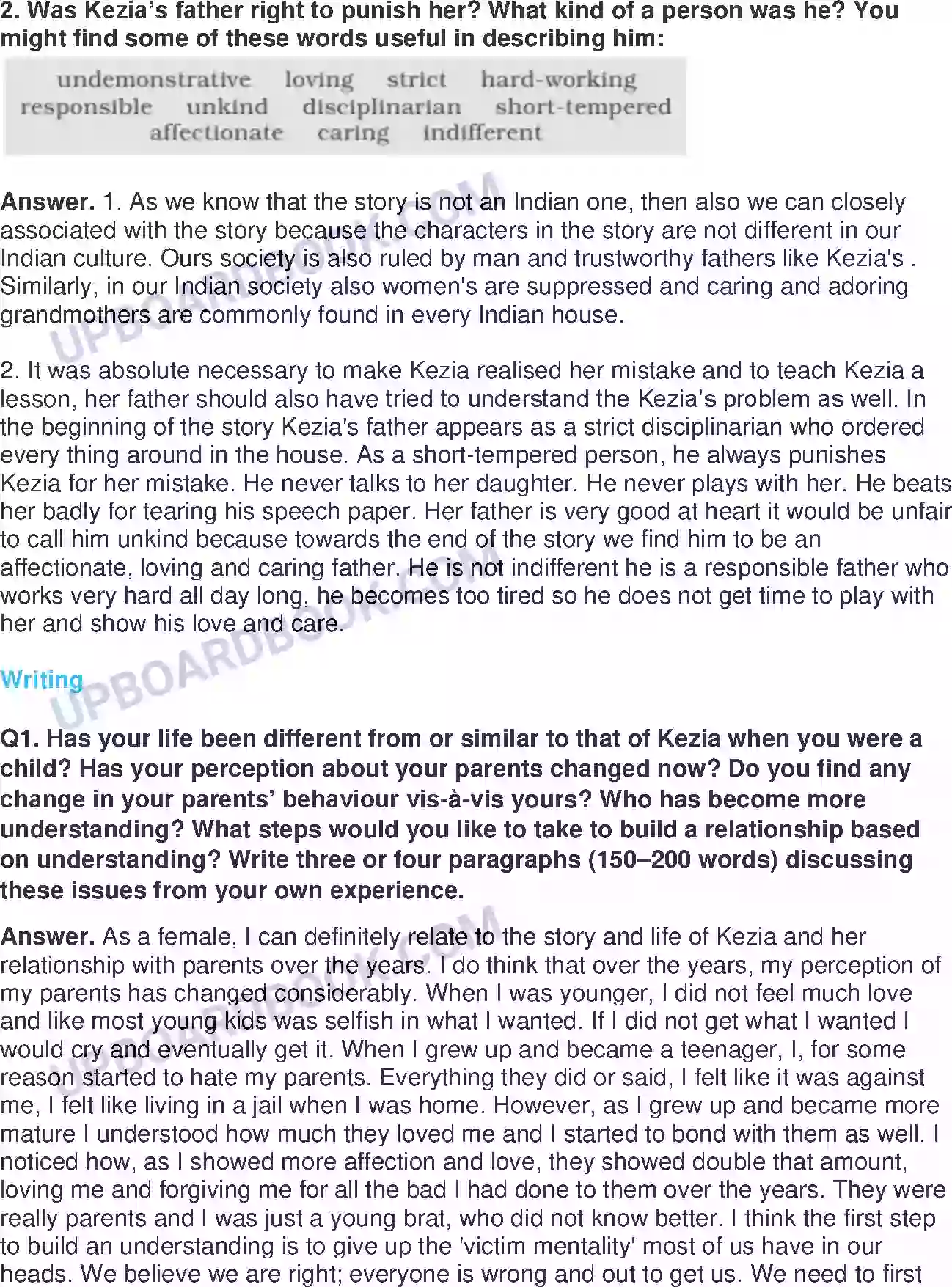
1. Yes, the characters in the story are very relatable in the Indian context as well. Many Indian families have fathers who are strict disciplinarians due to societal pressures, mothers who are busy with household work, and loving, caring grandmothers who bridge the gap between parents and children.
2. While Kezia needed to understand the value of important documents, her father's harsh punishment (beating her with a ruler) was excessive. He failed to see her innocent intention behind the mistake. Kezia's father can be described as strict, hard-working, responsible, short-tempered, and a disciplinarian. However, he was not truly unkind or indifferent. Deep down, he was caring and affectionate, as shown when he comforted Kezia during her nightmare. His behaviour was shaped by his role as a sole breadwinner and the pressures of his time.
Answer:
My childhood had similarities with Kezia's. Like her, I saw my father as a strict figure focused on rules and results, which sometimes created a distance. My perception, however, has changed significantly as I've grown older. I now understand that his strictness stemmed from a deep sense of responsibility and a desire to prepare me for life's challenges.
Over the years, I notice a change in my parents' behaviour as well. They have become more consultative and less authoritative. The understanding has grown from both sides. While I have become more understanding of their sacrifices, they have also become more patient and open to my perspective.
To build a stronger relationship based on understanding, I believe in taking proactive steps. First, open and respectful communication is key—sharing my thoughts while also listening to theirs without judgment. Second, showing appreciation for their efforts, even for small things, can bridge emotional gaps. Finally, spending quality time together, free from digital distractions, helps rebuild connection and mutual respect, transforming a parent-child relationship into a lifelong friendship.
Answer:
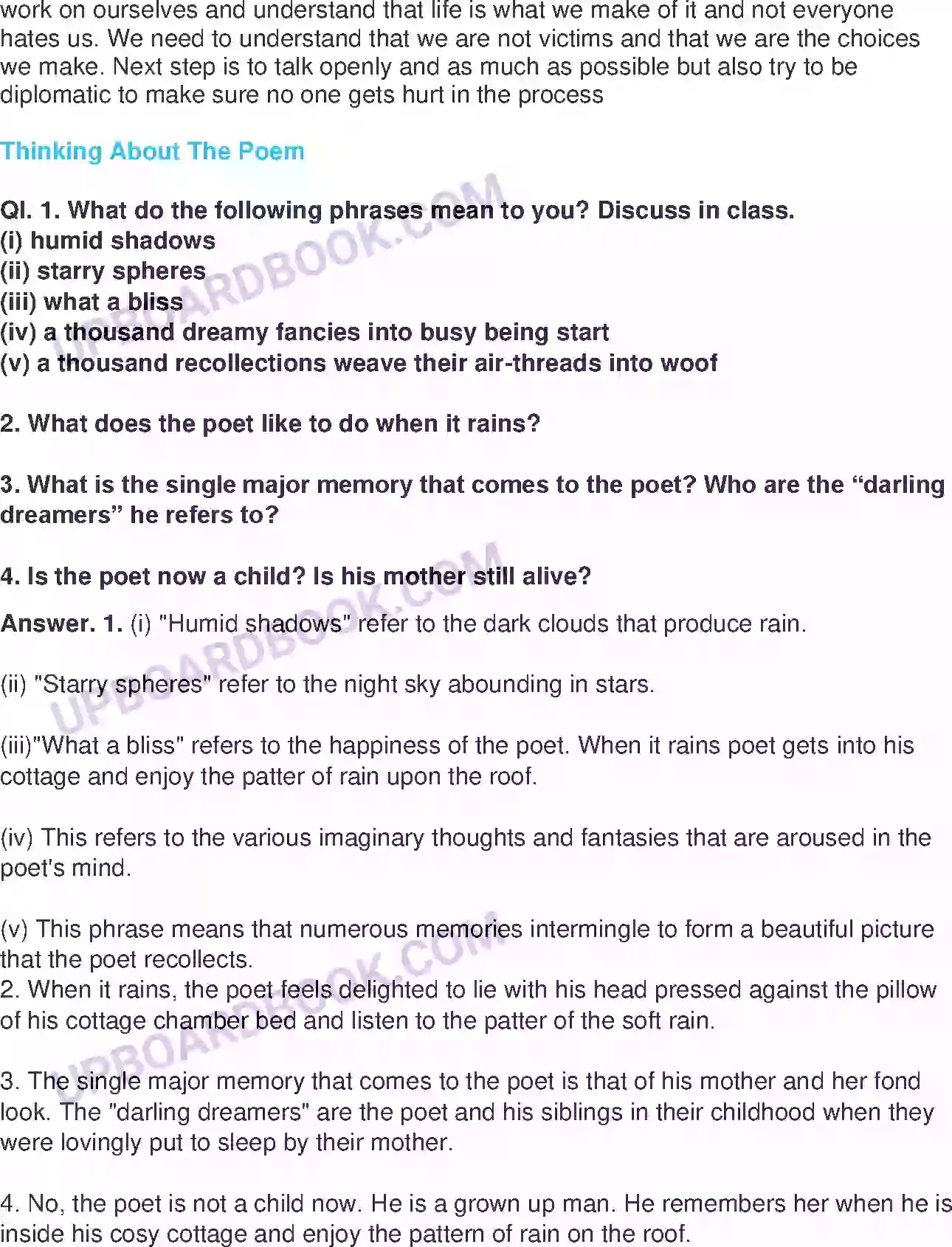
(i) Humid shadows: This refers to the dark, moisture-laden rain clouds that cover the sky before it rains.
(ii) Starry spheres: This describes the night sky which looks like a huge sphere or dome filled with countless stars.
(iii) What a bliss: It expresses the poet's feeling of ultimate happiness and contentment as he listens to the rain from the comfort of his bed.
(iv) A thousand dreamy fancies into busy being start: The sound of the rain triggers the poet's imagination, giving rise to numerous dreams and creative thoughts in his mind.
(v) A thousand recollections weave their air-threads into woof: This means that countless memories from the past come together in the poet's mind, intertwining like threads on a loom to create a beautiful tapestry of remembrance.
Answer:
2. When it rains, the poet loves to lie in his cosy bed in his cottage, press his head against the pillow, and listen to the gentle, rhythmic sound (patter) of raindrops falling on the roof.
3. The single major memory that comes to the poet is of his mother putting him and his siblings to bed years ago and watching over them with love. The "darling dreamers" refer to the poet and his brothers and sisters when they were young, dreaming in their sleep under their mother's care.
4. No, the poet is not a child now; he is an adult reminiscing about his childhood. The poem suggests his mother is no longer alive, as he fondly remembers her, indicating she exists now only in his memories.
Answer:
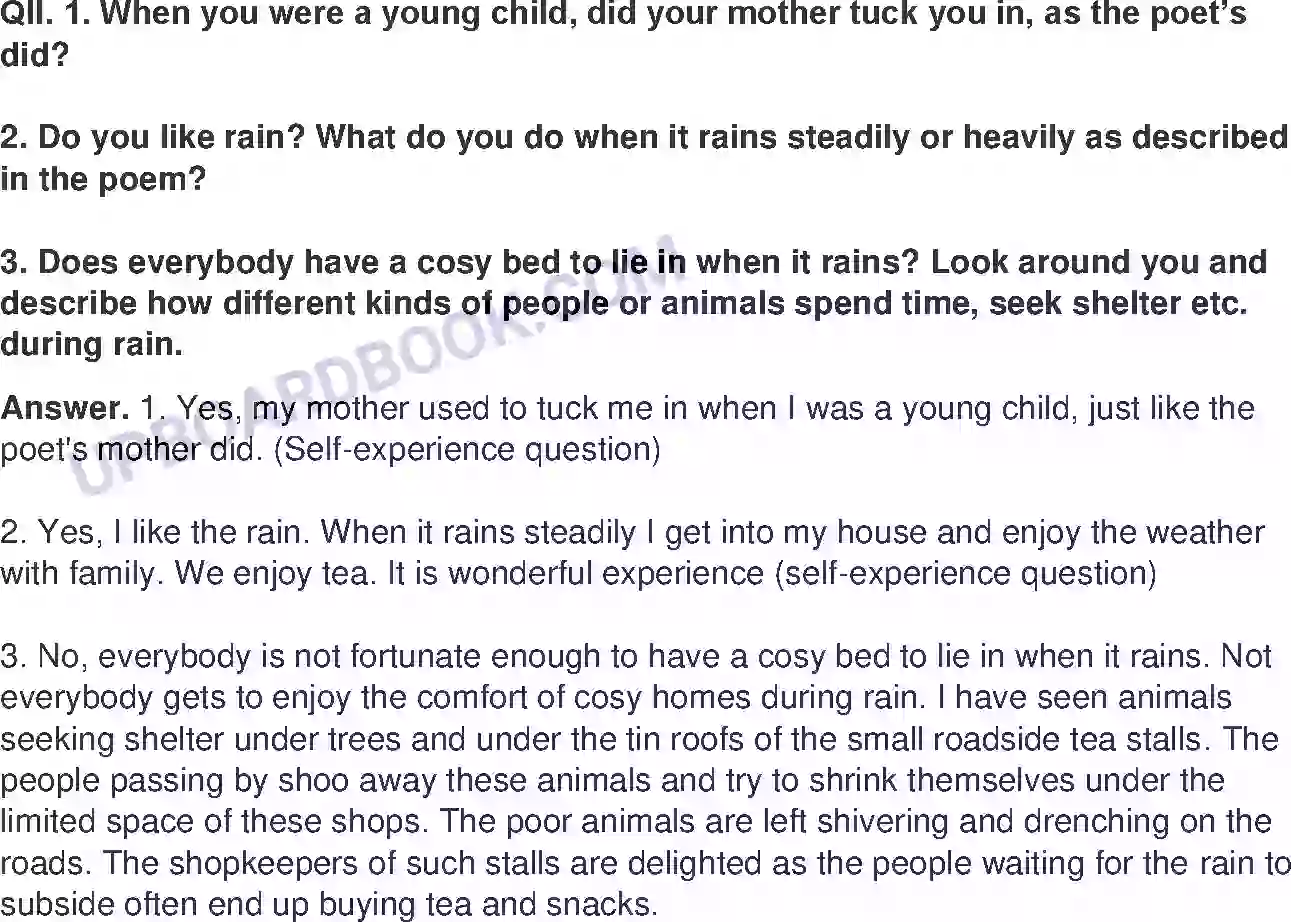
1. (This is a personal response. A sample is given.) Yes, when I was a child, my mother would often tuck me into bed, ensuring I was warm and comfortable, much like the poet's mother. It is a cherished memory of care and security.
2. (This is a personal response. A sample is given.) Yes, I enjoy the rain. When it rains steadily, I like to sit by a window, read a book, or simply watch the rain. Sometimes, I enjoy a hot cup of tea with my family, making the atmosphere feel very peaceful and cosy.
3. No, not everyone is fortunate enough to have a cosy bed during the rain. From observation, street animals like dogs and cats seek shelter under parked vehicles, shop awnings, or trees. Street vendors and rickshaw pullers often huddle under makeshift tarpaulin sheets. Homeless people try to find dry spots under bridges or bus stands. In contrast, those with homes enjoy the rain from their balconies or windows, much like the poet did, highlighting a stark difference in comfort and security.
UP Board class 9 English 3. The Little Girl Solution is available at our platform https://upboardSolution.com in hindi medium for free of cost. Content provided on our website is free of cost and in PDF format which is easily available for download. Getting the UP Board Solutions for class 9 will help student to achieve good learning experience so that they can study effectively. UP board holds examination of more than 3 million students every year and majority of the question of exams are from their UP Board Solutions. That’s why it is important to study using the textSolution issued by UP Board.
It is essential to know the importance of UP Board class 9 English 3. The Little Girl textSolution issued by UP Board because students completely rely on these Solutions for their study and syllabus offered by UP Board is so balanced that each student should be aware about the importance of it. Below is the list of Importance of UP Board class 9 English 3. The Little Girl :
There are various features of UP Board class 9 TextSolutions, some of them are mentioned below so that you student can understand the value and usability of the contend and understand why Uttarpradesh board has prescribed these Solutions.