UP Board class 9 English 10. Kathmandu is a Hindi Medium Solution which is prescribed by Uttar Pradesh Board for their students. These Solutions is completely prepared considering the latest syllabus and it covers every single topis, so that every student get organised and conceptual learning of the concepts. class 9 Students of UP Board who have selected hindi medium as their study medium they can use these Hindi medium textSolutions to prepare themselves for exam and learn the concept with ease.
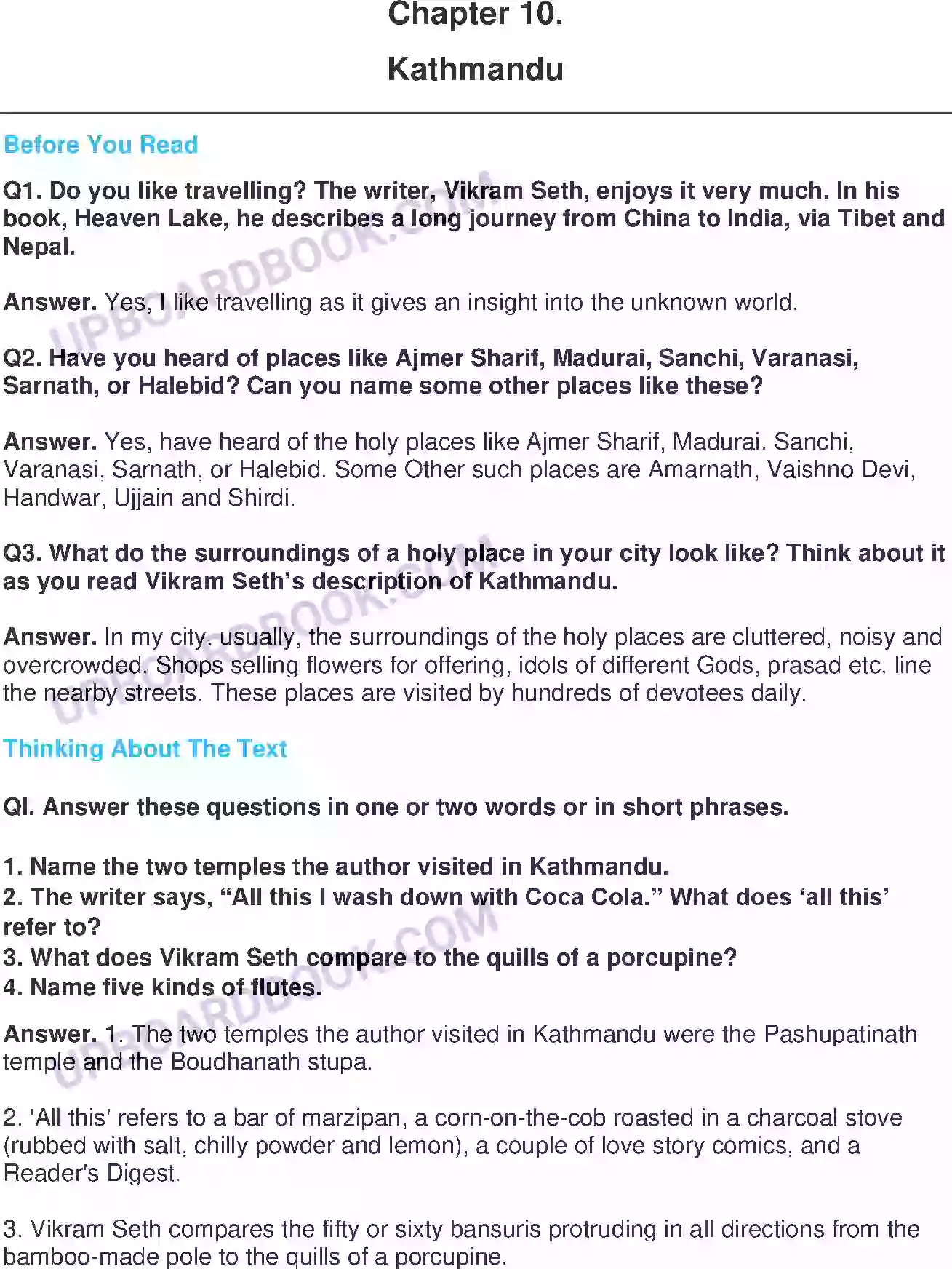
Answer: Yes, I enjoy travelling. It allows us to explore new places, learn about different cultures, and gain a broader perspective of the world, much like Vikram Seth does in his writings.
Answer: Yes, I have heard of these famous religious and historical sites. Other similar places of spiritual and cultural significance include Amarnath, Vaishno Devi, Haridwar, Ujjain, Shirdi, and the Golden Temple in Amritsar.
Answer: The areas around holy places in my city are typically bustling and lively. The streets are often lined with small shops selling flowers, religious idols, offerings ('prasad'), and souvenirs. The constant movement of devotees creates a crowded and sometimes noisy atmosphere, filled with a sense of devotion and community.
1. Name the two temples the author visited in Kathmandu.
2. The writer says, “All this I wash down with Coca Cola.” What does ‘all this’ refer to?
3. What does Vikram Seth compare to the quills of a porcupine?
4. Name five kinds of flutes.
Answer:
1. The author visited the Pashupatinath Temple and the Boudhanath Stupa.
2. 'All this' refers to the snacks and items he bought: a bar of marzipan, a roasted corn-on-the-cob seasoned with salt, chilli, and lemon, a couple of love story comics, and a copy of Reader's Digest.
3. He compares the cluster of fifty or sixty bamboo flutes (bansuris) sticking out in all directions from a pole to the quills of a porcupine.
4. The five kinds of flutes are: the reed neh, the Japanese shakuhachi, the deep bansuri of Hindustani classical music, the clear or breathy flutes of South America, and the high-pitched Chinese flutes.
Answer: The author observes a stark contrast. The other hawkers are loud, actively shouting to sell their goods. The flute seller, however, is calm and detached. He does not shout. Instead, he occasionally selects a flute and plays it slowly and thoughtfully. His serene music stands out clearly above the chaos of the street, making his way of selling unique and meditative.
Answer: At the Pashupatinath temple, there is a small shrine that appears to be emerging slowly from the riverbank platform. The belief among devotees is that when this shrine fully comes out, the goddess within it will escape. This event is said to mark the end of the current evil age, known as Kaliyuga, on Earth.
Answer:
(i) Atmosphere of 'Febrile Confusion':
Answer: The atmospheres at the two sacred sites are completely different. Pashupatinath Temple is a scene of vibrant chaos and sensory overload. It is crowded with pushy devotees, noisy monkeys, and rituals like cremations on the Bagmati riverbank. There is a sense of frantic energy and febrile confusion. In sharp contrast, the Boudhanath Stupa is an oasis of peace. Its huge white dome exudes calm. The surrounding area is quiet, with fewer people and a serene, meditative ambiance. While Pashupatinath is intensely active and Hindu in its devotion, Boudhanath offers a haven of Buddhist stillness amidst the city's bustle.
Answer: Vikram Seth describes Kathmandu's busiest streets as narrow lanes bursting with chaotic life and colour. They are crammed with a mix of sacred and commercial elements: small flower-adorned shrines stand beside shops selling everything from postcards and chocolates to Western cosmetics and Nepalese antiques. The air is filled with a cacophony of sounds—blaring Bollywood music, honking horns, ringing bicycle bells, and the persistent cries of vendors. Amidst this hustle, the quiet flute seller, with his pole of bansuris, provides a striking and serene contrast.
Answer: The author says this because the flute, found in virtually every culture worldwide, represents a beautiful universal language. While each type of flute—like the Indian bansuri or the Japanese shakuhachi—has its own unique sound and cultural associations, they all share one fundamental thing: they are played by human breath. This breath is a symbol of life itself, common to all people regardless of nationality, religion, or culture. Therefore, listening to a flute reminds us of this shared human essence, drawing us into a feeling of global connection and commonality.
1. A communal war broke out when the princess was abducted by the neighbouring prince.
2. The cockpit broke off from the plane during the plane crash.
3. The car broke down on the way and we were left stranded in the jungle.
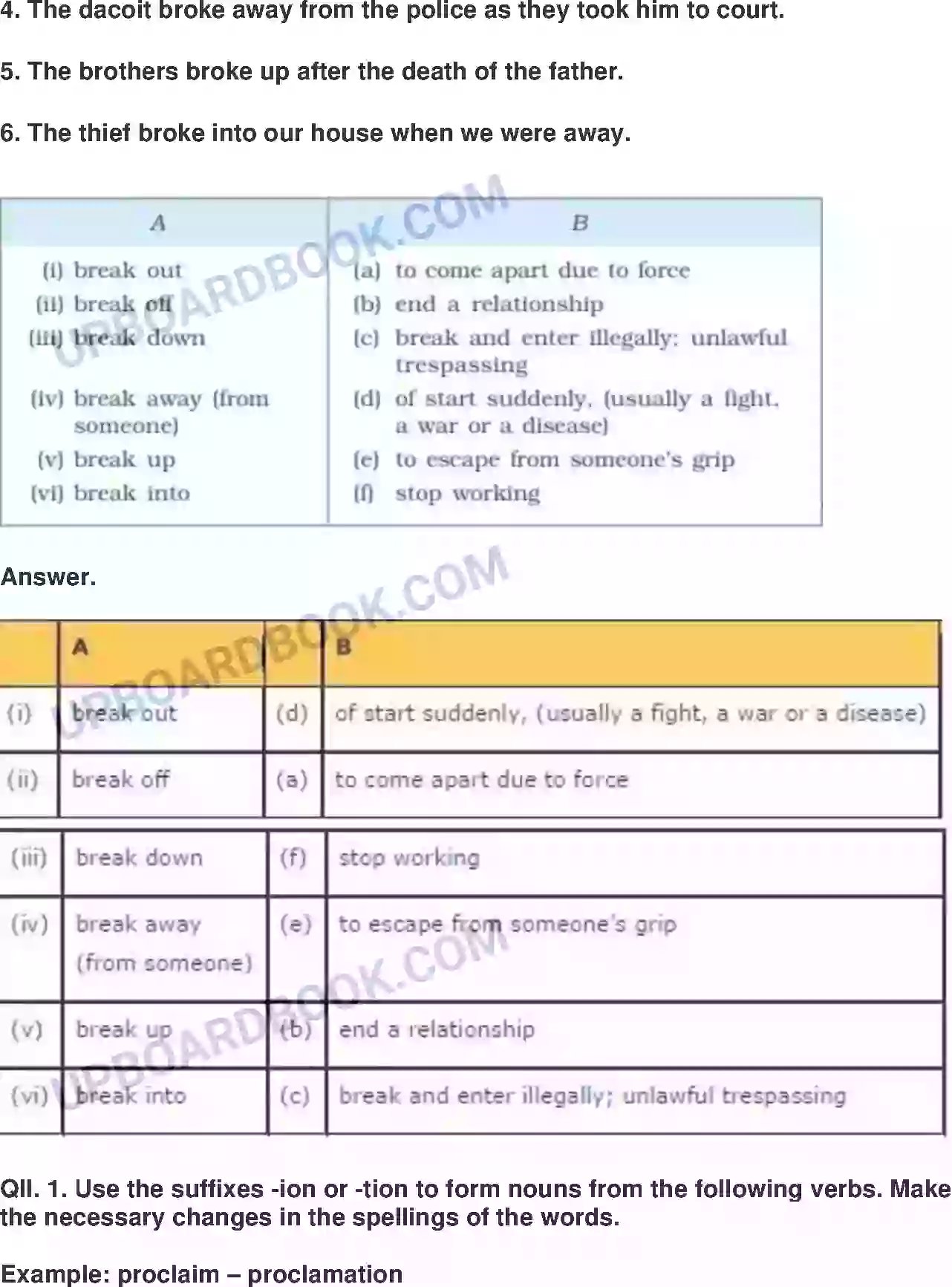
4. The dacoit broke away from the police as they took him to court.
5. The brothers broke up after the death of the father.
6. The thief broke into our house when we were away.
| Column A | Column B |
|---|---|
| (i) break out | (d) to start suddenly (usually a fight, war, or disease) |
| (ii) break off | (a) to come apart due to force |
| (iii) break down | (f) to stop working |
| (iv) break away (from someone) | (e) to escape from someone's grip |
| (v) break up | (b) to end a relationship |
| (vi) break into | (c) to enter a place illegally or by force |
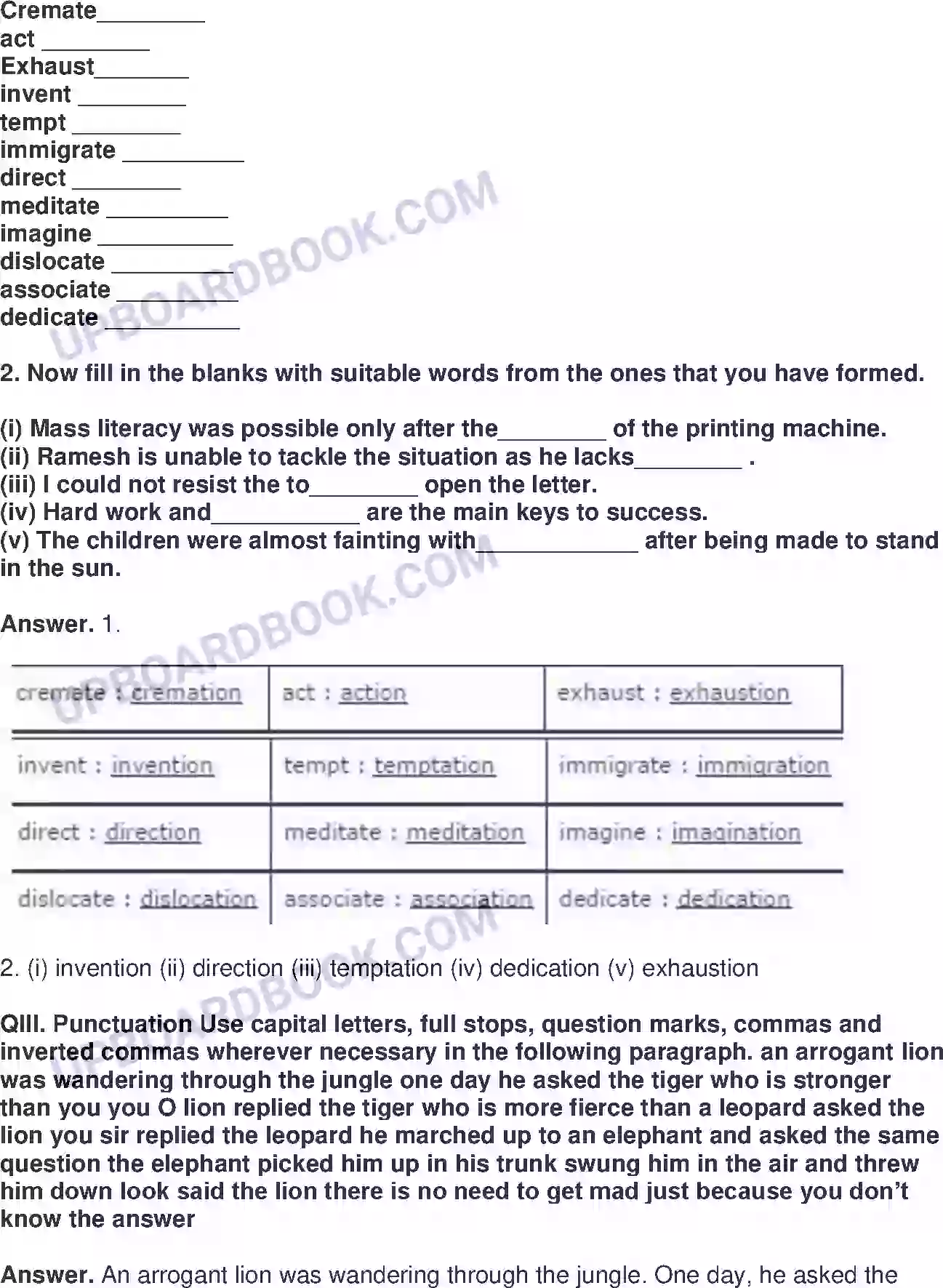
cremate, act, exhaust, invent, tempt, immigrate, direct, meditate, imagine, dislocate, associate, dedicate
Answer:
cremate – cremation
act – action
exhaust – exhaustion
invent – invention
tempt – temptation
immigrate – immigration
direct – direction
meditate – meditation
imagine – imagination
dislocate – dislocation
associate – association
dedicate – dedication
(i) Mass literacy was possible only after the ________ of the printing machine.
(ii) Ramesh is unable to tackle the situation as he lacks ________.
(iii) I could not resist the ________ to open the letter.
(iv) Hard work and ________ are the main keys to success.
(v) The children were almost fainting with ________ after being made to stand in the sun.
Answer:
(i) invention
(ii) direction
(iii) temptation
(iv) dedication
(v) exhaustion
an arrogant lion was wandering through the jungle one day he asked the tiger who is stronger than you you O lion replied the tiger who is more fierce than a leopard asked the lion you sir replied the leopard he marched up to an elephant and asked the same question the elephant picked him up in his trunk swung him in the air and threw him down look said the lion there is no need to get mad just because you don’t know the answer
Answer:
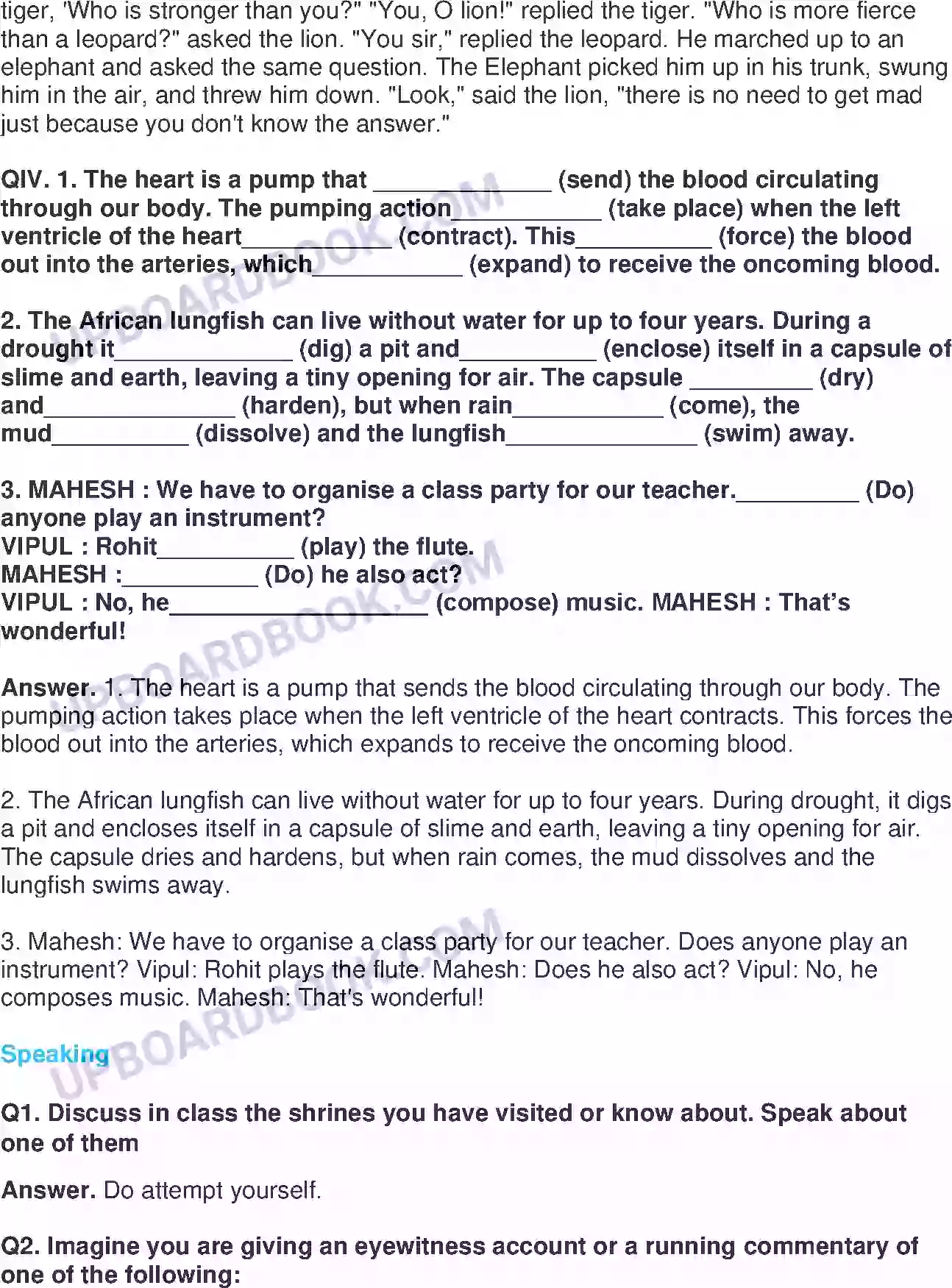
An arrogant lion was wandering through the jungle. One day, he asked the tiger, "Who is stronger than you?" "You, O lion!" replied the tiger. "Who is more fierce than a leopard?" asked the lion. "You, sir," replied the leopard. He marched up to an elephant and asked the same question. The elephant picked him up in his trunk, swung him in the air, and threw him down. "Look," said the lion, "there is no need to get mad just because you don’t know the answer."
Answer: The heart is a pump that sends the blood circulating through our body. The pumping action takes place when the left ventricle of the heart contracts. This forces the blood out into the arteries, which expand to receive the oncoming blood.
Answer: The African lungfish can live without water for up to four years. During a drought it digs a pit and encloses itself in a capsule of slime and earth, leaving a tiny opening for air. The capsule dries and hardens, but when rain comes, the mud dissolves and the lungfish swims away.
Answer:
MAHESH: We have to organise a class party for our teacher. Does anyone play an instrument?
VIPUL: Rohit plays the flute.
MAHESH: Does he also act?
VIPUL: No, he composes music.
MAHESH: That’s wonderful!
Answer: [This is an activity to be done in class. Students should speak about their personal experiences visiting a shrine, describing its location, significance, architecture, and the atmosphere there.]
Answer: [This is a speaking activity. Example for a cricket match: "Kohli is taking strike now. The bowler runs in and delivers a good length ball. Kohli drives it beautifully through the covers! The ball is racing to the boundary. The crowd is cheering loudly. What a magnificent shot!"]
Answer: [This is a writing activity. Students should create their own point-form notes based on the description in the chapter. Example points: Reaching: Crowded streets, smell of incense and flowers. Inside: Priests performing rituals, devotees offering prayers, elaborate architecture. Doing: Observing quietly, feeling the intense spiritual energy. Outside: Monkeys playing, river Bagmati with cremation pyres, shops and hawkers. Impression: A place of powerful contrasts—chaotic yet deeply sacred, overwhelming but fascinating.]
Answer: [This is a writing activity. Students should expand the given diary points into a descriptive paragraph. They can add sensory details (sights, sounds, feelings) and use descriptive language to bring the experience to life.]
Answer: The poet is initially stunned into a numb silence, as if in a deep slumber. His reaction is not of loud, bitter grief but of a profound and quiet sorrow. He feels a deep sense of loss and the shocking finality of death. The peace he describes is not joyful, but rather the eternal, motionless peace of death that has separated him from his beloved.
Answer: The lines that say this are: "She seemed a thing that could not feel / The touch of earthy years."
Answer: The poet imagines her as becoming a permanent part of nature. He does not picture her in a heavenly afterlife. Instead, he sees her merged with the earth's elements, rolling around in its daily rotation along with rocks, stones, and trees. This is clearly stated in the final lines: "Rolled round in earth's diurnal course, / With rocks, and stones, and trees."
UP Board class 9 English 10. Kathmandu Solution is available at our platform https://upboardSolution.com in hindi medium for free of cost. Content provided on our website is free of cost and in PDF format which is easily available for download. Getting the UP Board Solutions for class 9 will help student to achieve good learning experience so that they can study effectively. UP board holds examination of more than 3 million students every year and majority of the question of exams are from their UP Board Solutions. That’s why it is important to study using the textSolution issued by UP Board.
It is essential to know the importance of UP Board class 9 English 10. Kathmandu textSolution issued by UP Board because students completely rely on these Solutions for their study and syllabus offered by UP Board is so balanced that each student should be aware about the importance of it. Below is the list of Importance of UP Board class 9 English 10. Kathmandu :
There are various features of UP Board class 9 TextSolutions, some of them are mentioned below so that you student can understand the value and usability of the contend and understand why Uttarpradesh board has prescribed these Solutions.