 UPBoardBook
UP Board class 9 English (7. Packing) solution PDF
UP Board class 9 English 7. Packing is a Hindi Medium Solution which is prescribed by Uttar Pradesh Board for their students. These Solutions is completely prepared considering the latest syllabus and it covers every single topis, so that every student get organised and conceptual learning of the concepts. class 9 Students of UP Board who have selected hindi medium as their study medium they can use these Hindi medium textSolutions to prepare themselves for exam and learn the concept with ease.
UP Board class 9 English 7. Packing Hindi Medium Solutions - PDF
Click Here to


UP Board Solutions for Class 9 English Beehive
Chapter 7: Packing
Before You Read
Q1. Do you like going on trips? What kind of trips do you enjoy most?
Answer. (This is a personal response question. Students should attempt it themselves.)
Q2. How do you feel about having to pack for a trip?
Answer. (This is a personal response question. Students should attempt it themselves.)
Q3. Have you ever discovered on a trip that you have forgotten to pack a few things you very much need, or that you can’t find them easily?
Answer. (This is a personal response question. Students should attempt it themselves.)
Q4. Does this make you angry or does it make you laugh at yourself?
Answer. (This is a personal response question. Students should attempt it themselves.)
Thinking About The Text
QI. Discuss in pairs and answer each question below in a short paragraph (30 — 40 words).
1. How many characters are there in the narrative? Name them. (Don’t forget the dog!).
Answer. There are four characters in the story. They are Jerome (the narrator), his friends George and Harris, and their pet dog, Montmorency.
2. Why did the narrator (Jerome) volunteer to do the packing?
Answer. Jerome volunteered because he was overly confident about his packing skills. He believed he was the best at it compared to anyone else.
3. How did George and Harris react to this? Did Jerome like their reaction?
Answer. George and Harris immediately agreed and relaxed. George lit his pipe and sat in an easy-chair, while Harris put his feet up and lit a cigar. Jerome was irritated by their laid-back reaction.
4. What was Jerome’s real intention when he offered to pack?
Answer. Jerome's real plan was to act as the supervisor. He wanted George and Harris to do the physical work under his command, so he could correct them and show off his expertise.
5. What did Harris say after the bag was shut and strapped? Why do you think he waited till then to ask?
Answer. Harris asked if Jerome was going to pack the boots. He waited until the end because that was his nature—to mention important things only after the work was supposedly finished, causing maximum inconvenience.
6. What “horrible idea” occurred to Jerome a little later?
Answer. The horrible idea was whether he had packed his toothbrush or not. This was a common worry for him during packing.
7. Where did Jerome finally find the toothbrush?
Answer. After a frantic search through all his packed items, Jerome finally found his toothbrush inside a boot.
8. Why did Jerome have to reopen the packed bag?
Answer. Jerome had to reopen the bag twice due to his forgetfulness. First, he forgot to pack the boots, and then he realized he had accidentally packed his tobacco pouch and needed to take it out.
9. What did George and Harris offer to pack and why?
Answer. George and Harris offered to pack the food hamper. They said that since they had to leave in less than twelve hours, it would be better if they handled the rest of the packing.
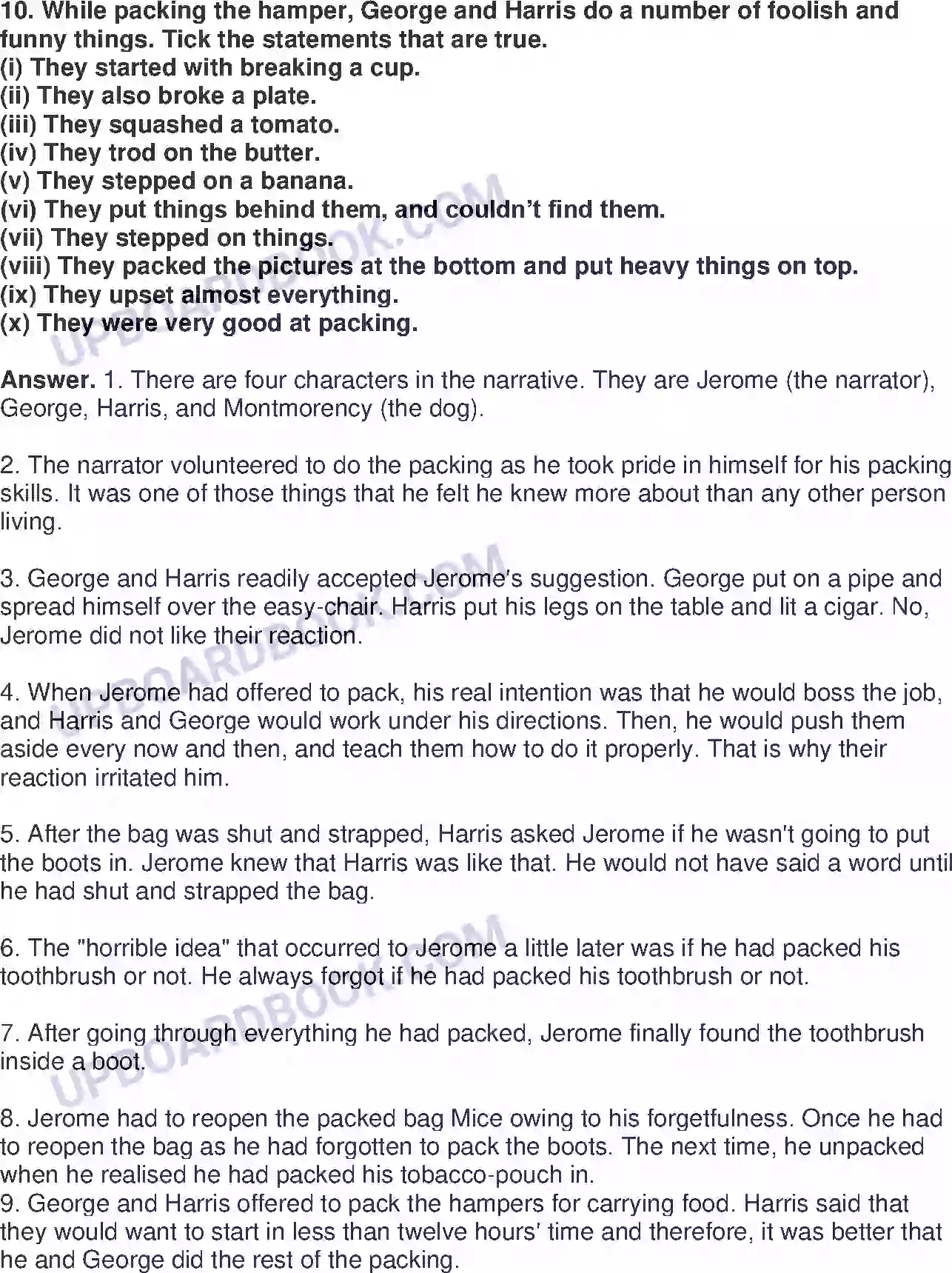
10. While packing the hamper, George and Harris do a number of foolish and funny things. Tick the statements that are true.
- They started with breaking a cup.
- They also broke a plate.
- They squashed a tomato.
- They trod on the butter.
- They stepped on a banana.
- They put things behind them, and couldn’t find them.
- They stepped on things.
- They packed the pictures at the bottom and put heavy things on top.
- They upset almost everything.
- They were very good at packing.
Answer. The true statements are: (i), (iii), (iv), (vi), (vii), and (ix).
QIl. What does Jerome say was Montmorency’s ambition in life? What do you think of Montmorency and why?
Answer. Jerome says Montmorency's ambition was to be a nuisance—to get in the way, be scolded, and have things thrown at him. He felt his day was successful if he could irritate people. I think Montmorency is a mischievous but typical pet dog who adds to the chaos simply by following his playful instincts, which makes the situation funnier.
QIll. Discuss in groups and answer the following questions in two or three paragraphs (100 —150 words)
1. Of the three, Jerome, George and Harris, who do you think is the best or worst packer? Support your answer with details from the text.
Answer. None of the three friends is a good packer, but Jerome is slightly better than George and Harris. Jerome at least had a method, though he was forgetful—he forgot the boots, his toothbrush, and packed his tobacco pouch by mistake. However, when George and Harris took over, they created absolute chaos. They broke a cup, squashed a tomato, trod on the butter, lost items behind them, and stepped on things. They packed irrationally, placing heavy items on top of light ones. Their packing session was far more disastrous and disorganized than Jerome's, making them the worst packers.
2. How did Montmorency ‘contribute’ to the packing?
Answer. Montmorency 'contributed' by turning the packing process into a comedy of errors. He sat on items that needed to be packed. He had a habit of poking his cold nose into their hands. He put his leg into the jam, messed with the teaspoons, and pretended the lemons were rats. In this pretend game, he charged into the hamper and 'killed' three lemons before Harris could stop him. His natural mischief and interruptions significantly delayed and complicated the packing.
3. Do you find this story funny? What are the humorous elements in it? (Pick out at least three, think about what happens, as well as how it is described.)
Answer. Yes, the story is extremely funny. The humour arises from the exaggerated incompetence of the characters. First, Jerome's overconfidence followed by his repeated unpacking for trivial items like a toothbrush is hilarious. Second, the description of George and Harris's packing is comic—they tread on butter, squash soft items, and create a mess, with Jerome sarcastically commenting on their "skill". Third, Montmorency's antics, like his pretend rat-hunt with the lemons and getting hit with a frying pan, add a layer of slapstick comedy. The way Jerome describes these events with witty remarks makes the narrative very humorous.
Thinking About Language
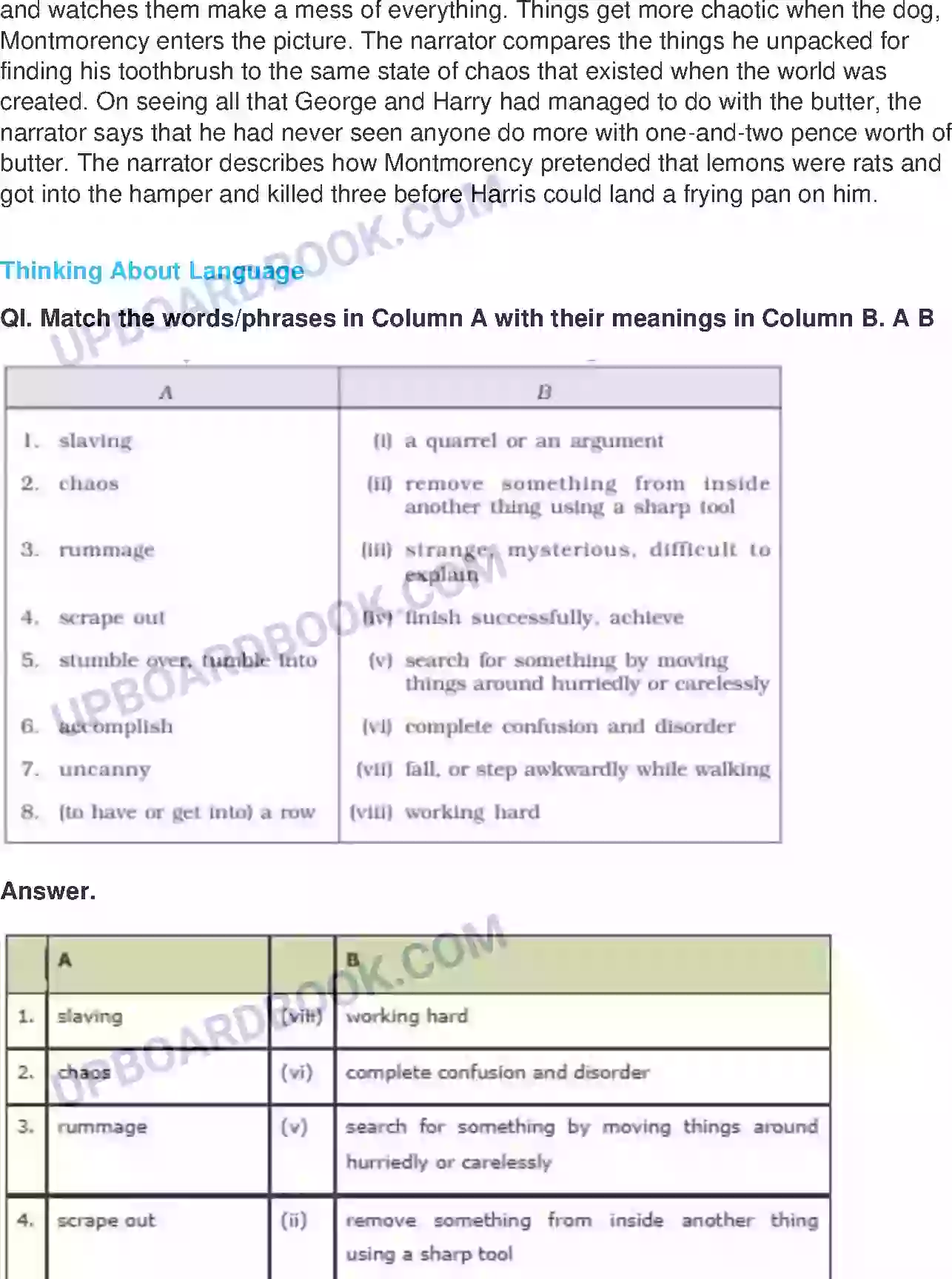
QI. Match the words/phrases in Column A with their meanings in Column B.
| Column A | Column B |
|---|---|
| 1. slaving | (viii) working hard |
| 2. chaos | (vi) complete confusion and disorder |
| 3. rummage | (v) search for something by moving things around hurriedly or carelessly |
| 4. scrape out | (ii) remove something from inside another thing using a sharp tool |
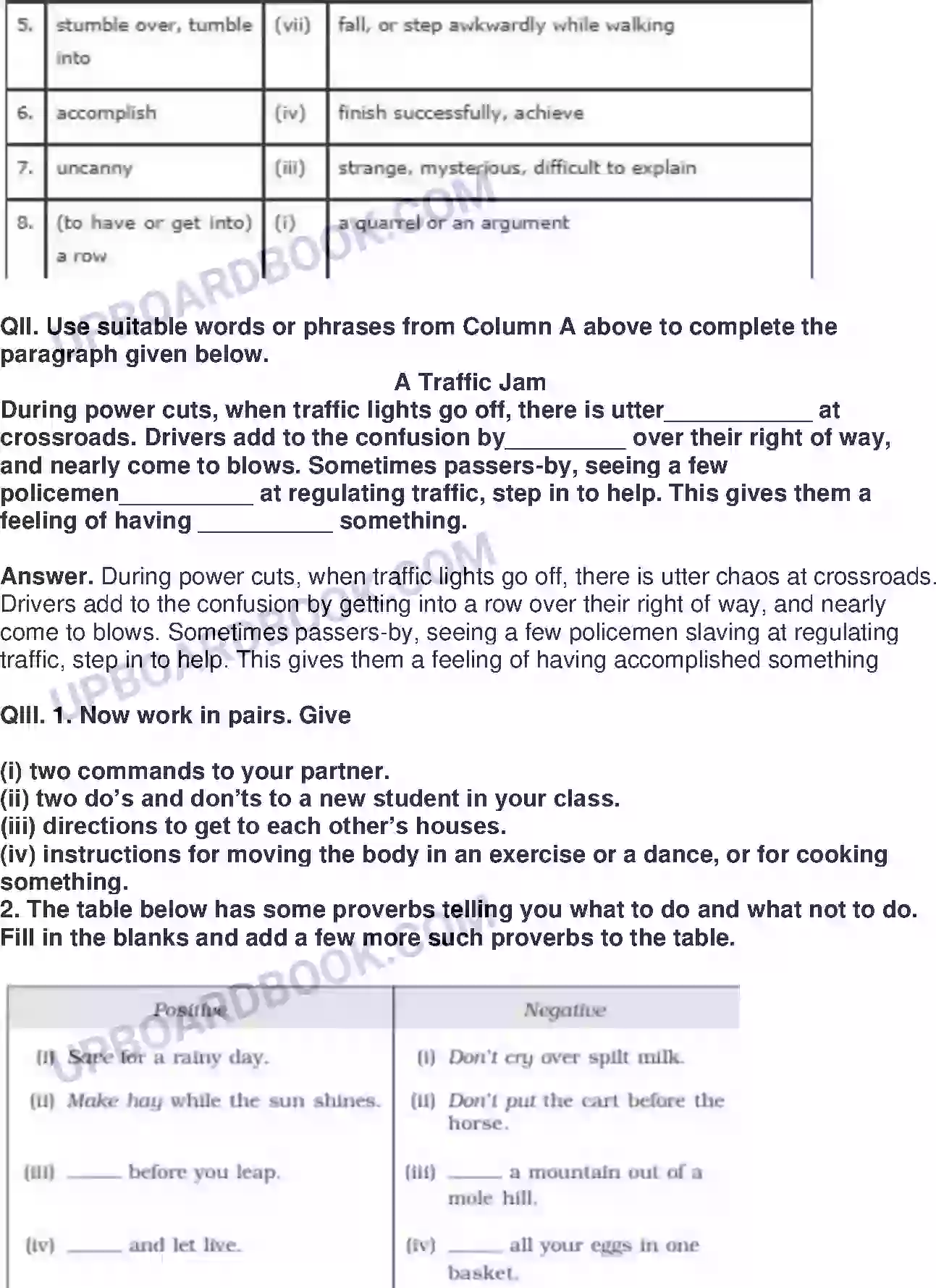
| 5. stumble over, tumble into | (vii) fall, or step awkwardly while walking |
| 6. accomplish | (iv) finish successfully, achieve |
| 7. uncanny | (iii) strange, mysterious, difficult to explain |
| 8. (to have or get into) a row | (i) a quarrel or an argument |
QIl. Use suitable words or phrases from Column A above to complete the paragraph given below.
A Traffic Jam During power cuts, when traffic lights go off, there is utter chaos at crossroads. Drivers add to the confusion by getting into a row over their right of way, and nearly come to blows. Sometimes passers-by, seeing a few policemen slaving at regulating traffic, step in to help. This gives them a feeling of having accomplished something.
QIll. 1. Now work in pairs. Give
- two commands to your partner.
- two do’s and don’ts to a new student in your class.
- directions to get to each other’s houses.
- instructions for moving the body in an exercise or a dance, or for cooking something.
Answer. (This is an activity to be done in pairs. Students should create their own responses.)
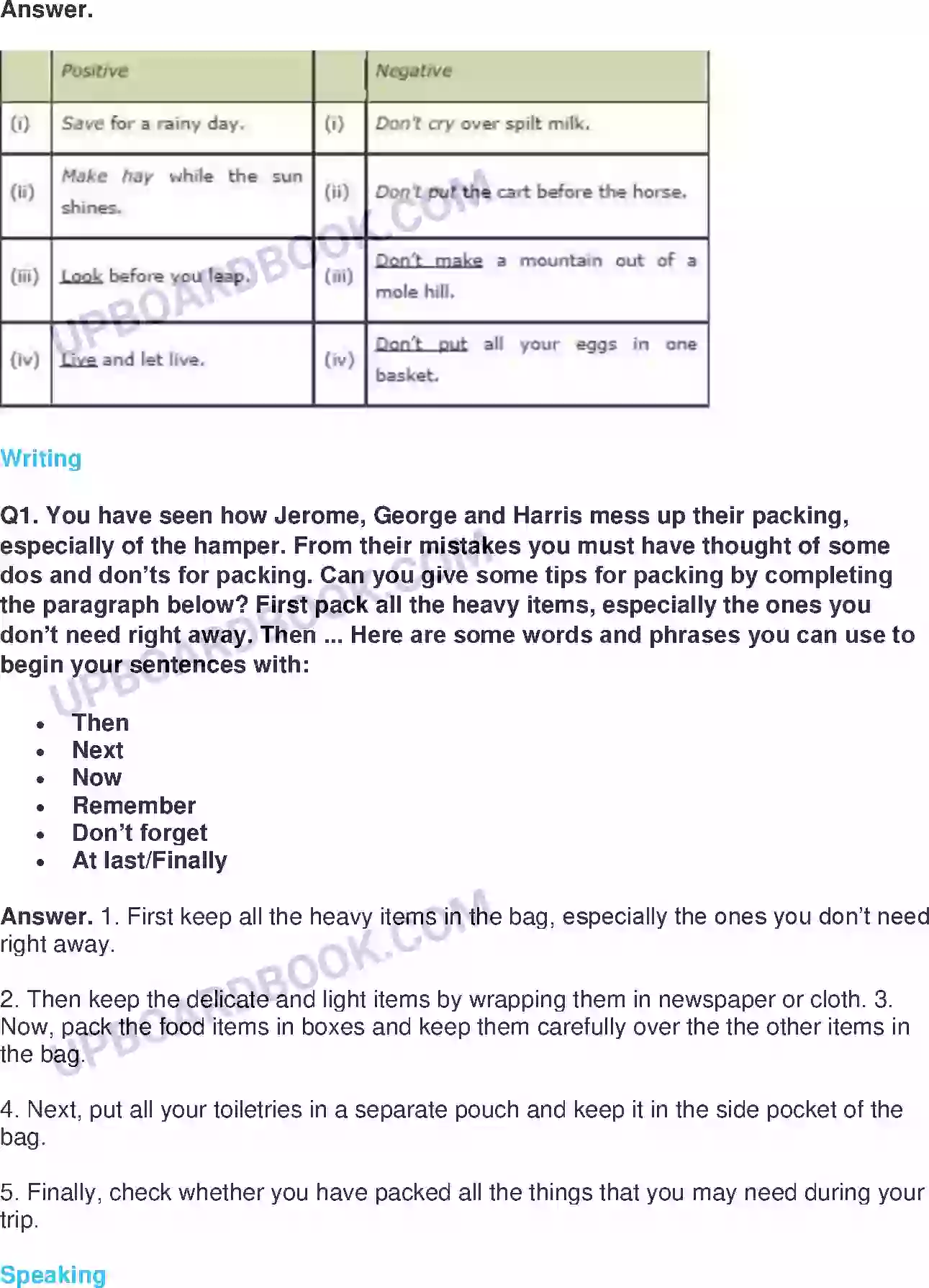
2. The table below has some proverbs telling you what to do and what not to do. Fill in the blanks and add a few more such proverbs to the table.
| Positive | Negative |
|---|---|
| (i) Save for a rainy day. | (i) Don’t cry over spilt milk. |
| (ii) Make hay while the sun shines. | (ii) Don’t put the cart before the horse. |
| (iii) Look before you leap. | (iii) Don’t make a mountain out of a mole hill. |
| (iv) Live and let live. | (iv) Don’t put all your eggs in one basket. |
| (v) Strike while the iron is hot. | (v) Don’t bite the hand that feeds you. |
| (vi) Honesty is the best policy. | (vi) Don’t judge a book by its cover. |
Writing
Q1. You have seen how Jerome, George and Harris mess up their packing, especially of the hamper. From their mistakes you must have thought of some dos and don’ts for packing. Can you give some tips for packing by completing the paragraph below?
First pack all the heavy items, especially the ones you don’t need right away. Then ...
Here are some words and phrases you can use to begin your sentences with: Then, Next, Now, Remember, Don’t forget, At last/Finally
Answer.
Then, place medium-weight items like clothes, neatly folded or rolled, on top of the heavy ones.
Next, pack fragile items, wrapping them securely in bubble wrap or soft clothing, and place them in the center of the bag for protection.
Now, pack essential items you'll need first, like a change of clothes or medicines, in a separate, easily accessible pouch.
Remember to pack toiletries in a leak-proof bag to avoid spills.
Don’t forget to check all pockets and compartments for important documents like tickets and IDs.
Finally, secure the bag properly, double-check your packing list, and ensure the bag is not overstuffed.
Speaking
Q1. Look at this sentence. “I told George and Harris that they had better leave the whole matter entirely to me.” The words had better are used
- in an advice or suggestion: You had better take your umbrella; it looks like rain.
- in an order: You had better complete your homework before you go out to play.
- as a threat: You had better leave or I’ll have you arrested for trespass!
When we speak, we say you’d/I’d/he’d better, instead of you had better, etc.
Work in pairs to give each other advice, orders or suggestions, or even to threaten each other. Imagine situations like the following: Your partner...
- hasn’t returned a book to the library.
- has forgotten to bring lunch.
- hasn’t got enough change for bus fare.
- has found out a secret about you.
- has misplaced your English textbook.
Answer. (Sample responses)
1. Advice: You’d better return that library book today to avoid a fine.
Threat: You’d better return my book, or I'll tell the librarian you lost it.
2. Order: You’d better remember your lunch tomorrow; borrowing every day isn't fair.
Suggestion: You’d better set a reminder so you don't forget your lunch again.
3. Advice: You’d better always keep some spare change for the bus.
Threat: You’d better find bus fare, or you'll have to walk home.
4. Order: You’d better keep that secret to yourself.
Threat: You’d better not tell anyone my secret, or I'll share yours.
5. Order: You’d better find my English textbook before our next class.
Suggestion: You’d better help me look for it; we can check the lost and found.
Get UP Board class 9 English 7. Packing Solution in Hindi Medium
UP Board class 9 English 7. Packing Solution is available at our platform https://upboardbook.com in hindi medium for free of cost. Content provided on our website is free of cost and in PDF format which is easily available for download. Getting the UP Board Solutions for class 9 will help student to achieve good learning experience so that they can study effectively. UP board holds examination of more than 3 million students every year and majority of the question of exams are from their UP Board Solutions. That’s why it is important to study using the textSolution issued by UP Board.
Importance of UP Board class 9 English 7. Packing Text Solutions
It is essential to know the importance of UP Board class 9 English 7. Packing textSolution issued by UP Board because students completely rely on these Solutions for their study and syllabus offered by UP Board is so balanced that each student should be aware about the importance of it. Below is the list of Importance of UP Board class 9 English 7. Packing :
- These TextSolutions are very clear and accurate which helps student to understand concept with ease.
- It is also to mention that these text Solutions are prepared by the content experts of subject, thus these Solutions helps student in clearing their doubts and understand the core concept easily.
- It is considered to be the best study material for competitive exam preparation.
Features of UP Board class 9 textSolutions
There are various features of UP Board class 9 TextSolutions, some of them are mentioned below so that you student can understand the value and usability of the contend and understand why Uttarpradesh board has prescribed these Solutions.
- Best feature of these textSolutions is free availability of content in PDF format
- Second feature that content generated and written is clear and easy to read.
- There are various illustration and images are shown in the Solution so that student can easily understand the concept and should be more appealing to the student.
- Each chapter is explained thoroughly
