 UPBoardBook
UP Board class 11 English (1. The Portrait of lady) solution PDF
UP Board class 11 English 1. The Portrait of lady is a Hindi Medium Solution which is prescribed by Uttar Pradesh Board for their students. These Solutions is completely prepared considering the latest syllabus and it covers every single topis, so that every student get organised and conceptual learning of the concepts. class 11 Students of UP Board who have selected hindi medium as their study medium they can use these Hindi medium textSolutions to prepare themselves for exam and learn the concept with ease.
UP Board class 11 English 1. The Portrait of lady Hindi Medium Solutions - PDF
Click Here to
Chapter 1: The Portrait of a Lady
by Khushwant Singh
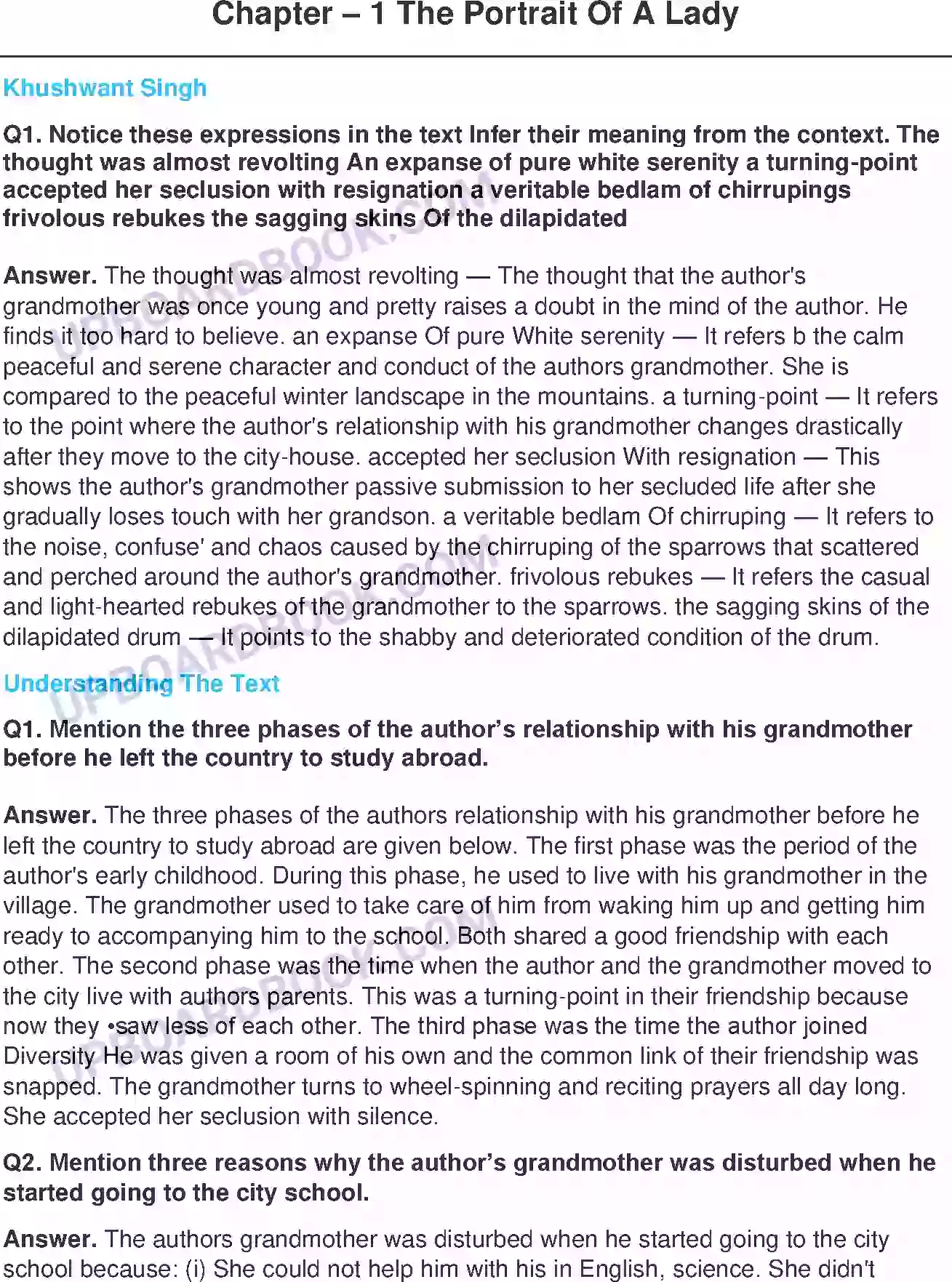
Understanding the Expressions
The thought was almost revolting — The idea that his grandmother was once young and pretty was shocking and difficult for the author to believe.
An expanse of pure white serenity — This describes the grandmother's calm, peaceful, and serene nature, comparing her to a tranquil winter landscape.
A turning-point — This marks the moment their relationship changed significantly after moving to the city.
Accepted her seclusion with resignation — She peacefully submitted to her lonely life as she grew distant from her grandson.
A veritable bedlam of chirrupings — Refers to the noisy, chaotic sound made by the sparrows around her.
Frivolous rebukes — The grandmother's light-hearted and playful scoldings to the sparrows.
The sagging skins of the dilapidated drum — Points to the worn-out and shabby state of the drum.
UP Board Textbook Questions & Answers
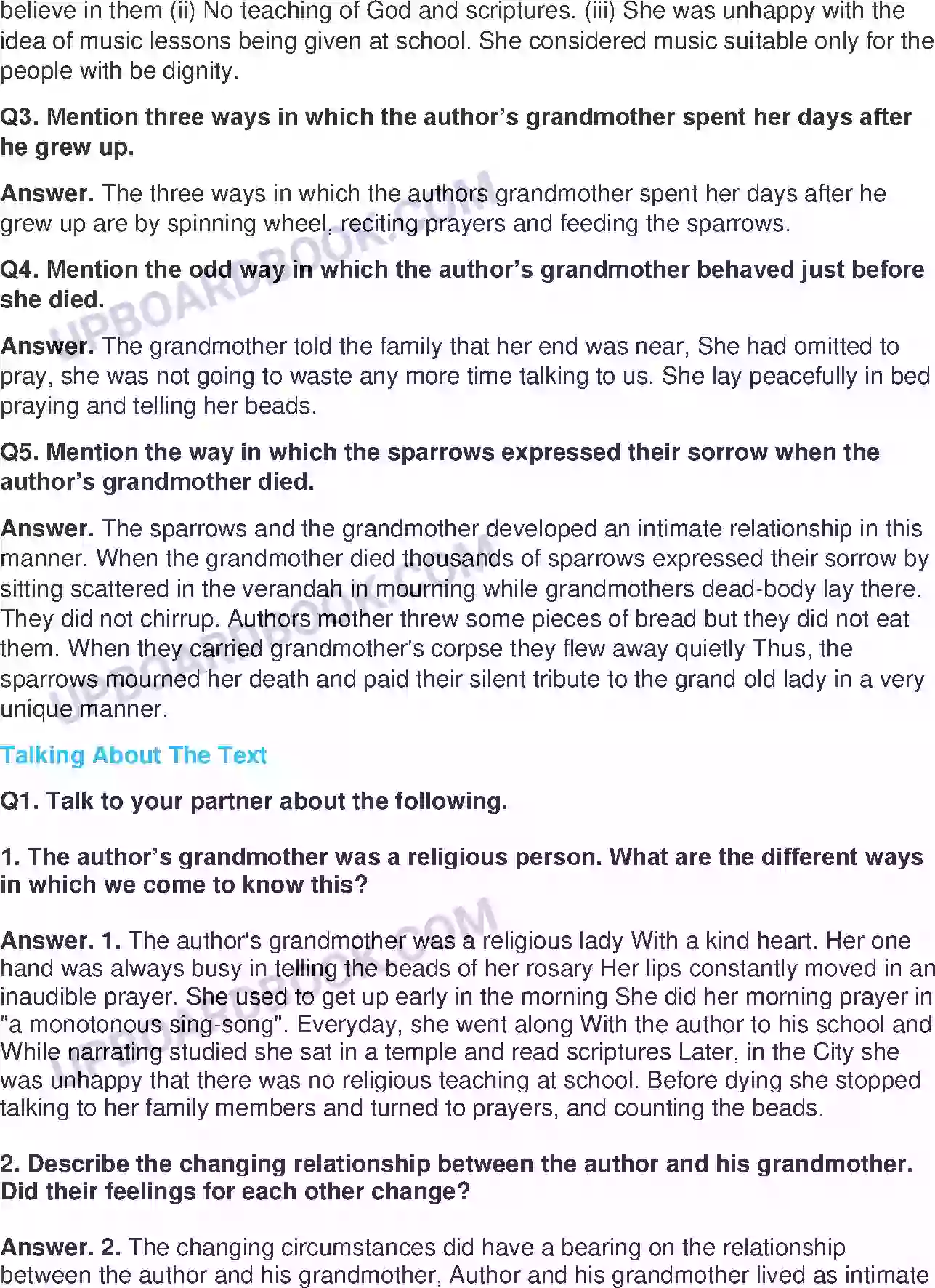
Q1. Mention the three phases of the author’s relationship with his grandmother before he left the country to study abroad.
Answer: The three phases were:
1. Childhood in the Village: They shared a close bond. She woke him, got him ready, walked him to school, and was his constant companion.
2. Life in the City: This was the turning point. They saw less of each other. She could no longer accompany him to his English school or help with his studies.
3. University Days: When he got his own room at university, their last common link was broken. She withdrew into a life of spinning, prayers, and feeding sparrows, accepting her solitude quietly.
Q2. Mention three reasons why the author’s grandmother was disturbed when he started going to the city school.
Answer: The grandmother was disturbed because:
(i) She could not help him with his new subjects like English and Science, which she did not believe in.
(ii) There was no teaching about God or scriptures in the school curriculum.
(iii) She was unhappy about the music lessons, considering music suitable only for people with low dignity.
Q3. Mention three ways in which the author’s grandmother spent her days after he grew up.
Answer: After the author grew up, his grandmother spent her days:
1. Spinning on her charkha (wheel).
2. Reciting prayers and telling the beads of her rosary.
3. Feeding the sparrows in the courtyard.
Q4. Mention the odd way in which the author’s grandmother behaved just before she died.
Answer: The day before her death, she declared that her end was near. She stopped talking to the family, saying she would not waste her last hours in conversation. She lay peacefully in bed, praying and telling her beads until her last breath.
Q5. Mention the way in which the sparrows expressed their sorrow when the author’s grandmother died.
Answer: Thousands of sparrows sat silently and scattered in the verandah where her body lay. They did not chirp. Even when bread crumbs were offered, they refused to eat. They flew away quietly when her body was taken for cremation, expressing their grief through a profound, silent tribute.
Talking About The Text
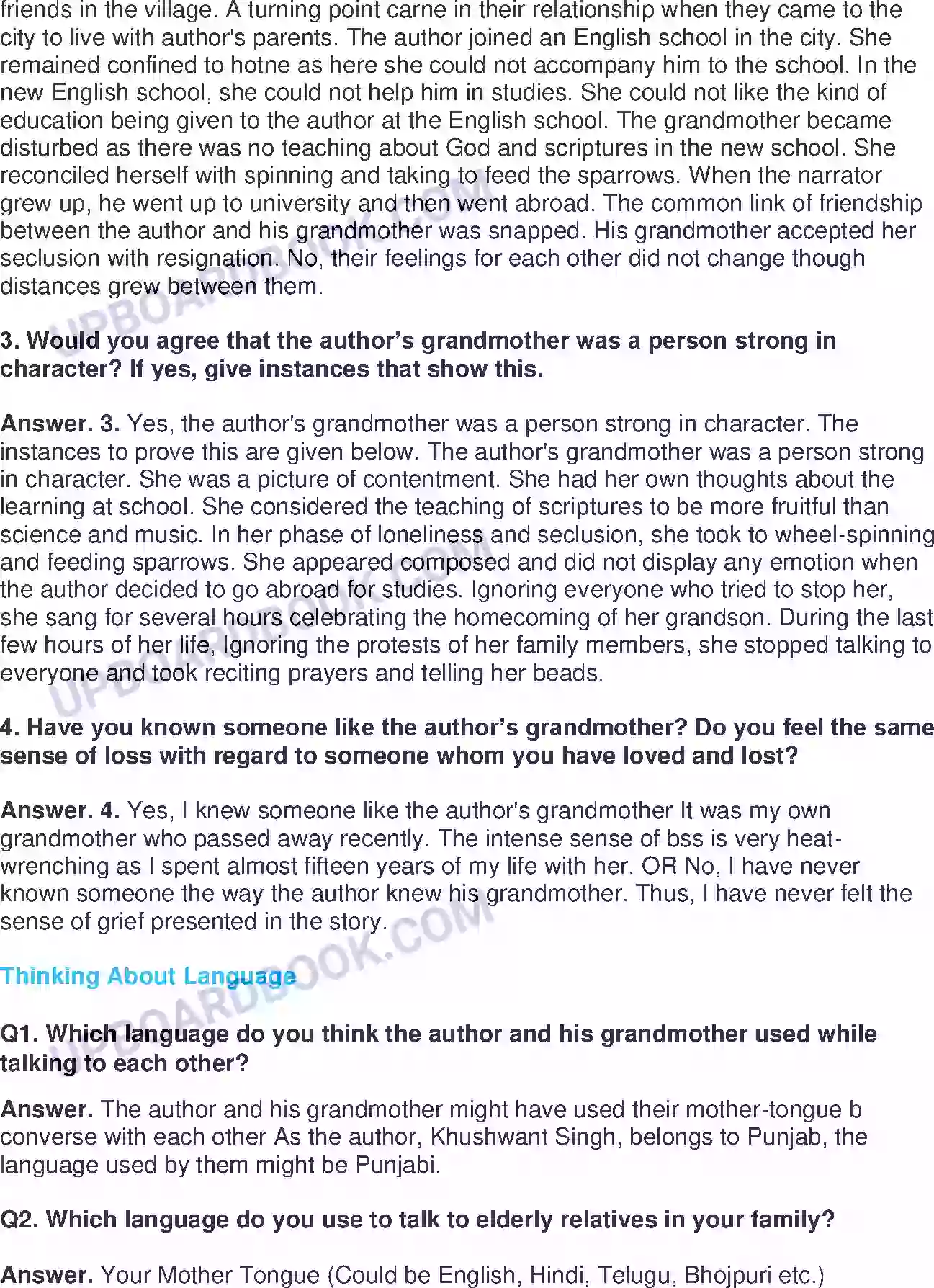
1. The author’s grandmother was a religious person. What are the different ways in which we come to know this?
Answer: We know she was deeply religious through her actions: her fingers were always busy telling the beads of her rosary; her lips constantly moved in silent prayer; she said her morning prayers in a sing-song; in the village, she spent her time at the temple reading scriptures; she was upset about the lack of religious teaching at the city school; and in her final hours, she devoted herself entirely to prayer.
2. Describe the changing relationship between the author and his grandmother. Did their feelings for each other change?
Answer: Their relationship evolved with changing circumstances. In the village, they were intimate friends. The move to the city created distance as their daily routines separated. This gap widened when he went to university and abroad. While the physical distance grew and their shared activities ceased, their underlying love and respect for each other remained unchanged.
3. Would you agree that the author’s grandmother was a person strong in character? If yes, give instances that show this.
Answer: Yes, she was remarkably strong in character. Instances include: having firm opinions about school education; adapting to solitude with dignity through spinning and feeding birds; not showing emotion when her grandson left for abroad; singing joyfully for hours upon his return despite her age; and choosing to pray in silence in her final moments, ignoring family protests.
4. Have you known someone like the author’s grandmother? Do you feel the same sense of loss with regard to someone whom you have loved and lost?
Answer: (This is a personal response. A sample is provided.) Yes, I knew my own grandmother who was very similar. The sense of loss after her passing is profound and heart-wrenching, as she was a pillar of love and wisdom in my life for many years.
Thinking About Language
Q1. Which language do you think the author and his grandmother used while talking to each other?
Answer: They most likely conversed in their mother tongue, Punjabi.
Q2. Which language do you use to talk to elderly relatives in your family?
Answer: I use [Your Mother Tongue, e.g., Hindi, Tamil, Bengali, etc.] to talk to my elderly relatives.
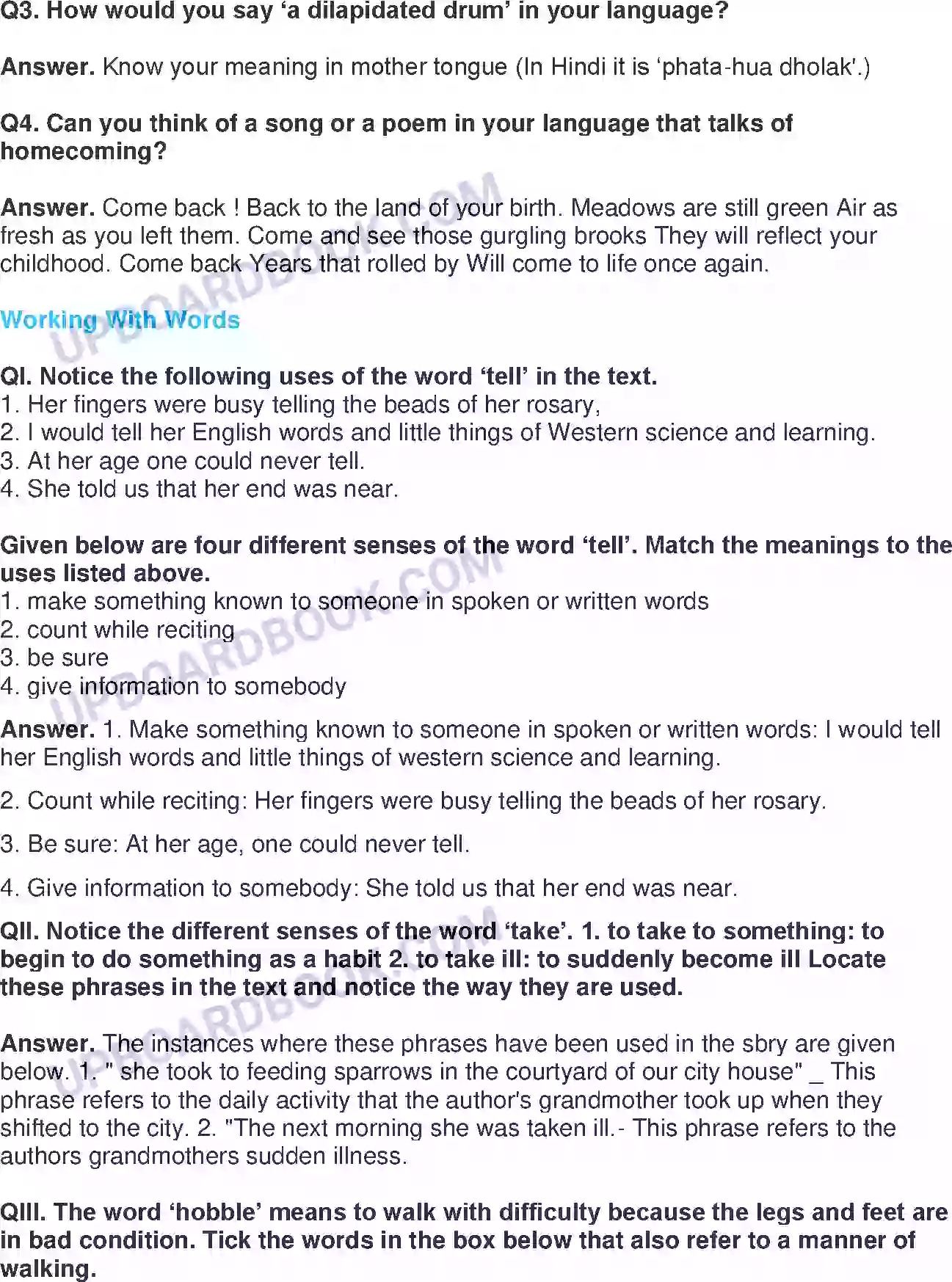
Q3. How would you say ‘a dilapidated drum’ in your language?
Answer: In my language, it is called [e.g., in Hindi: ‘phata-hua dholak’].
Q4. Can you think of a song or a poem in your language that talks of homecoming?
Answer: (A sample poetic response is provided)
Come back!
To the land of your birth.
The meadows are still green,
The air as fresh as you left it.
Come and see those gurgling brooks,
They still reflect your childhood.
Come back,
And the years that rolled by
Will come to life once again.
Working With Words
Ql. Match the uses of the word ‘tell’ with their meanings.
1. Her fingers were busy telling the beads of her rosary. – (b) count while reciting
2. I would tell her English words... – (a) make something known
3. At her age one could never tell. – (c) be sure
4. She told us that her end was near. – (d) give information
Qll. Locate the phrases with ‘take’ in the text.
Answer:
1. "...she took to feeding sparrows..." – This means she began feeding sparrows as a regular habit.
2. "The next morning she was taken ill." – This means she suddenly became ill.
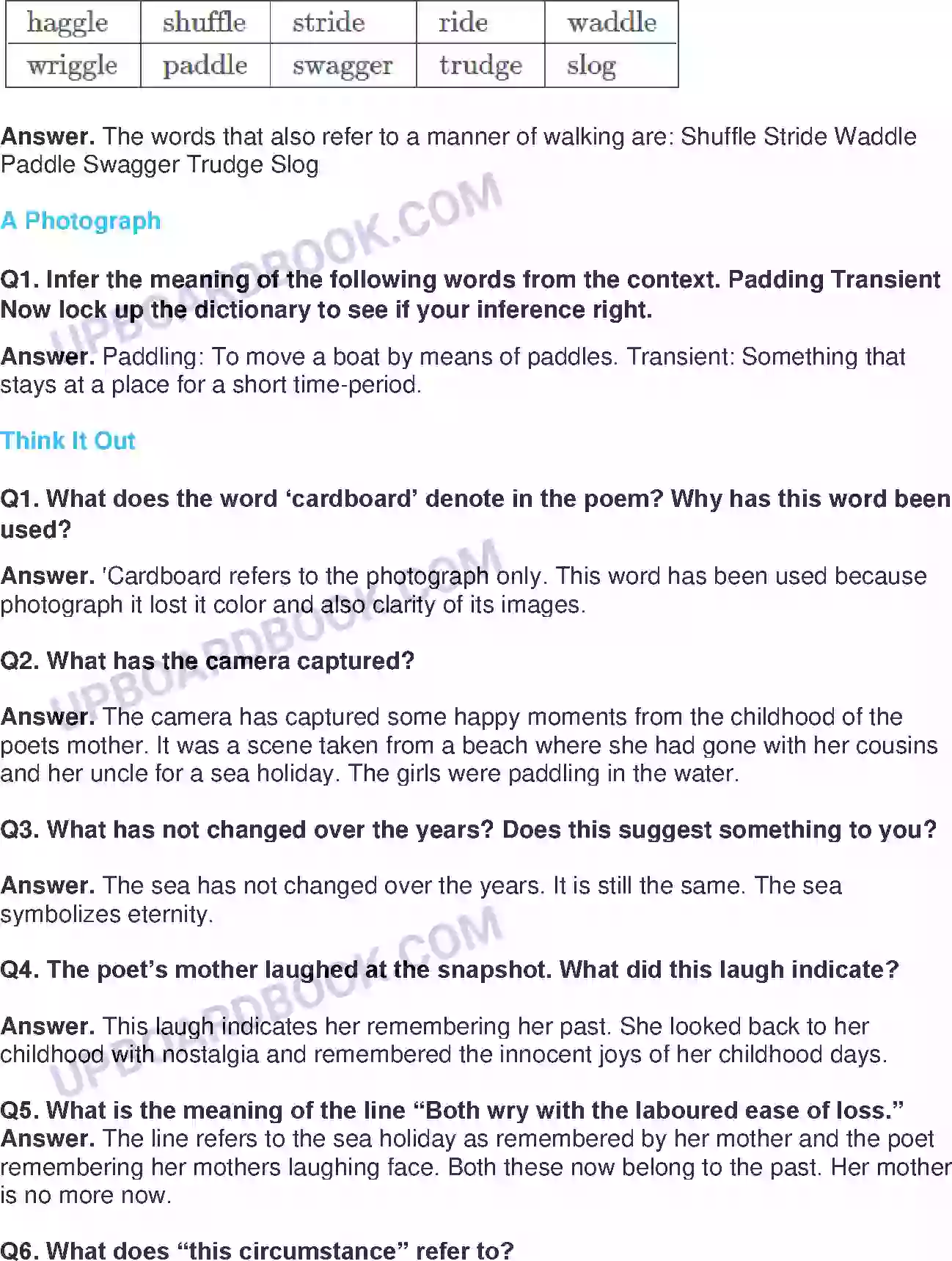
Qlll. Tick the words that refer to a manner of walking.
Answer: The words are: shuffle, stride, waddle, paddle, swagger, trudge, slog.
A Photograph (Poem Reference)
Q1. What does the word ‘cardboard’ denote in the poem? Why has this word been used?
Answer: ‘Cardboard’ refers to the old photograph mounted on a stiff card. It highlights the photograph's aged, faded, and fragile quality, emphasizing the passage of time.
Q2. What has the camera captured?
Answer: The camera captured a happy moment from the poet’s mother’s childhood—a scene at the beach where she, as a young girl, was paddling in the water with her two cousins.
Q3. What has not changed over the years? Does this suggest something to you?
Answer: The sea has remained unchanged over the years. This constancy contrasts with human life, which is transient. The sea symbolizes eternity and permanence.
Q4. The poet’s mother laughed at the snapshot. What did this laugh indicate?
Answer: Her laugh indicated nostalgic joy as she remembered her carefree and happy childhood days, recalling the innocence and fun of that seaside holiday.
Q5. What is the meaning of the line “Both wry with the laboured ease of loss.”
Answer: Both the mother’s memory of the past holiday and the poet’s memory of her mother’s laughter are now tinged with the pain of loss. The phrase "laboured ease" suggests the difficult acceptance of this loss, which has become a familiar, yet heavy, feeling.
Q6. What does “this circumstance” refer to?
Answer: ‘This circumstance’ refers to the poet’s present situation of grief and silence after her mother’s death. She is looking at the photograph and painfully realizing that her mother has been dead for about the same number of years as the age she was in the photo.
Q7. The three stanzas depict three different phases. What are they?
Answer:
Stanza 1: The mother’s childhood – a happy beach scene from the past.
Stanza 2: The mother’s adulthood – reminiscing about her childhood while looking at the photograph.
Stanza 3: The poet’s present – mourning her deceased mother, feeling the deep silence of her loss.
Get UP Board class 11 English 1. The Portrait of lady Solution in Hindi Medium
UP Board class 11 English 1. The Portrait of lady Solution is available at our platform https://upboardbook.com in hindi medium for free of cost. Content provided on our website is free of cost and in PDF format which is easily available for download. Getting the UP Board Solutions for class 11 will help student to achieve good learning experience so that they can study effectively. UP board holds examination of more than 3 million students every year and majority of the question of exams are from their UP Board Solutions. That’s why it is important to study using the textSolution issued by UP Board.
Importance of UP Board class 11 English 1. The Portrait of lady Text Solutions
It is essential to know the importance of UP Board class 11 English 1. The Portrait of lady textSolution issued by UP Board because students completely rely on these Solutions for their study and syllabus offered by UP Board is so balanced that each student should be aware about the importance of it. Below is the list of Importance of UP Board class 11 English 1. The Portrait of lady :
- These TextSolutions are very clear and accurate which helps student to understand concept with ease.
- It is also to mention that these text Solutions are prepared by the content experts of subject, thus these Solutions helps student in clearing their doubts and understand the core concept easily.
- It is considered to be the best study material for competitive exam preparation.
Features of UP Board class 11 textSolutions
There are various features of UP Board class 11 TextSolutions, some of them are mentioned below so that you student can understand the value and usability of the contend and understand why Uttarpradesh board has prescribed these Solutions.
- Best feature of these textSolutions is free availability of content in PDF format
- Second feature that content generated and written is clear and easy to read.
- There are various illustration and images are shown in the Solution so that student can easily understand the concept and should be more appealing to the student.
- Each chapter is explained thoroughly
