UP Board class 11 English 7. Glory At Twilight - (Short Stories) is a Hindi Medium Solution which is prescribed by Uttar Pradesh Board for their students. These Solutions is completely prepared considering the latest syllabus and it covers every single topis, so that every student get organised and conceptual learning of the concepts. class 11 Students of UP Board who have selected hindi medium as their study medium they can use these Hindi medium textSolutions to prepare themselves for exam and learn the concept with ease.
A Short Story from UP Board Woven Words English for Class 11
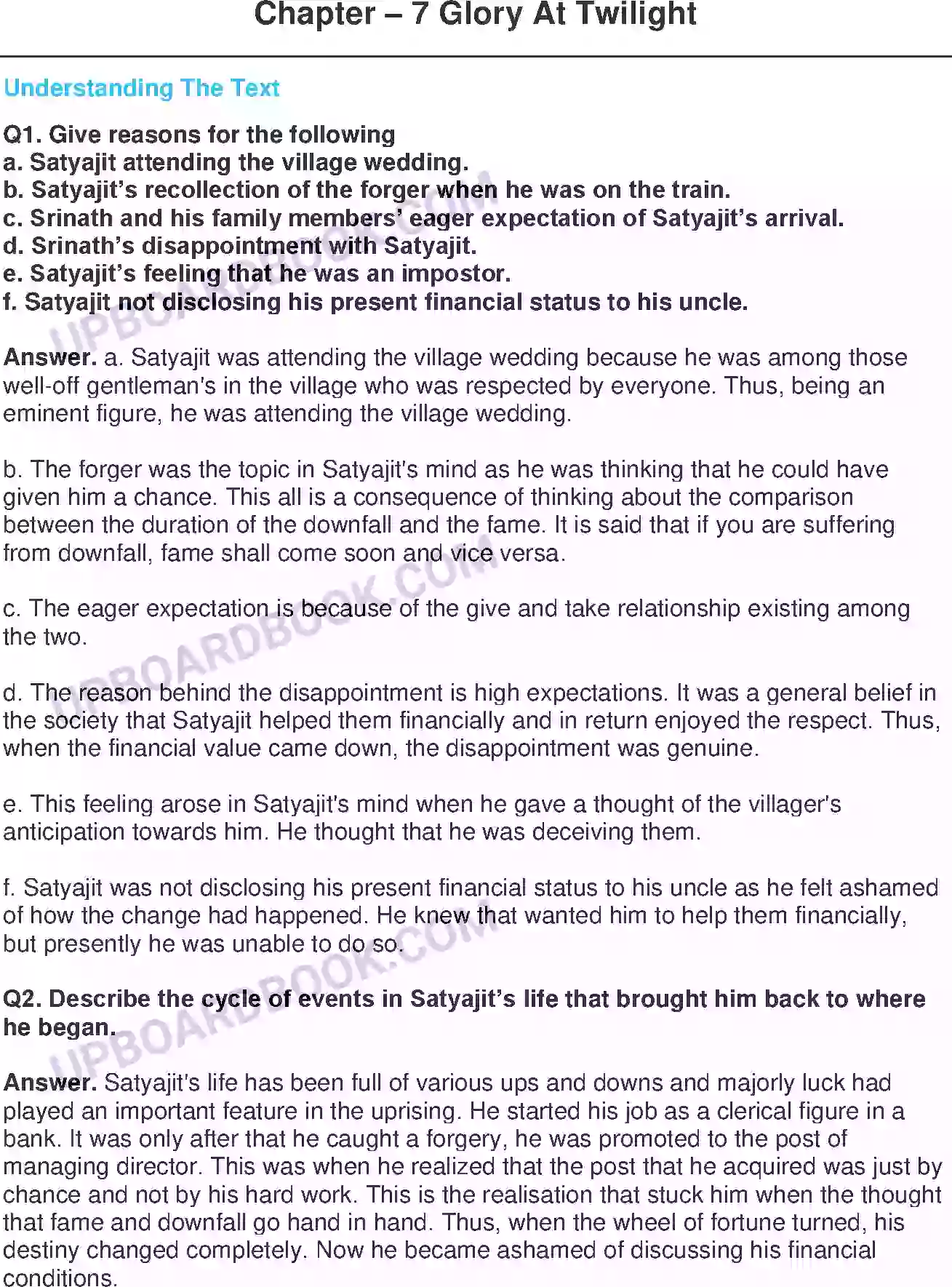
a. Satyajit attending the village wedding.
Satyajit attended the village wedding because he was considered one of the village's most respected and well-off gentlemen. His presence at such events was expected due to his high social standing.
b. Satyajit’s recollection of the forger when he was on the train.
On the train, Satyajit remembered the forger because his mind was occupied with thoughts about the nature of fame and downfall. He pondered how quickly fortunes can change, and this led him to think about the incident that originally catapulted him to success.
c. Srinath and his family members’ eager expectation of Satyajit’s arrival.
Srinath and his family eagerly awaited Satyajit because of a long-standing, unspoken agreement. Satyajit had always helped them financially in the past, and in return, they showed him great respect and honour. They expected his visit to bring them further assistance.
d. Srinath’s disappointment with Satyajit.
Srinath was disappointed because his high expectations were not met. The entire village believed Satyajit was their wealthy benefactor. When Satyajit arrived without the anticipated financial help, Srinath's disappointment was a natural reaction to this broken expectation.
e. Satyajit’s feeling that he was an impostor.
This feeling arose when Satyajit reflected on the villagers' hopeful anticipation. He knew he could no longer fulfill the role of the generous patron, yet he was still receiving their reverence. This mismatch between perception and reality made him feel like a fraud.
f. Satyajit not disclosing his present financial status to his uncle.
Satyajit felt deep shame about his sudden financial downfall. He knew his uncle expected help, and he was unable to provide it. To avoid this humiliation and the pity it might invite, he chose to hide the truth.
Satyajit's life was a rollercoaster largely driven by luck. He started as a lowly bank clerk. His big break came when he accidentally caught a forger, which led to a rapid promotion to Managing Director. He soon realized this lofty position was gained by chance, not merit. He learned that fame and downfall are closely linked. When his luck eventually ran out, the "wheel of fortune" turned, stripping him of his wealth and status. He found himself back in a state of financial struggle, too ashamed to even discuss his situation, thus completing a full circle back to his humble beginnings.
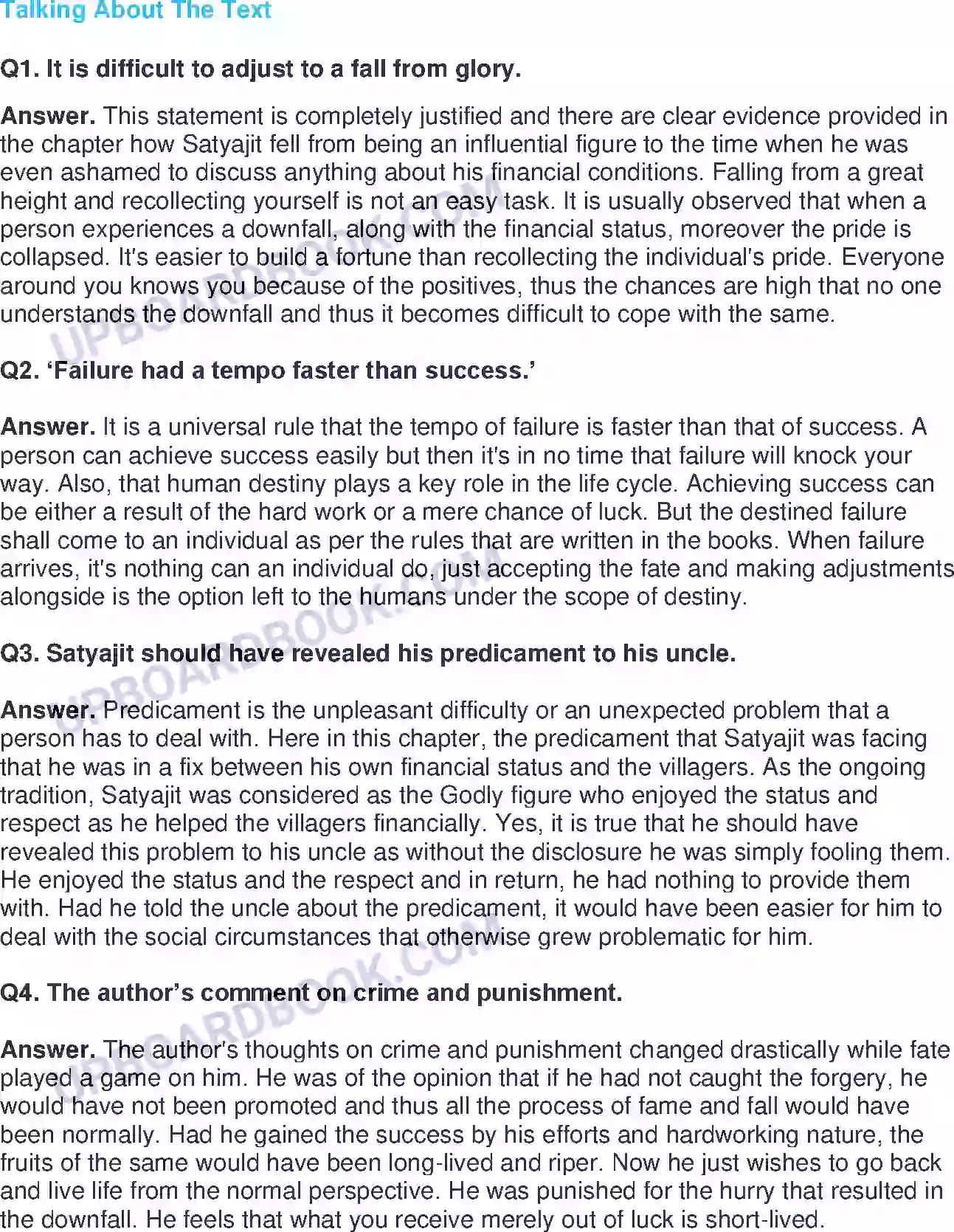
This statement is profoundly true, as shown by Satyajit's struggle. Falling from a position of high respect and wealth is not just a financial loss; it is a crushing blow to one's pride and identity. The world knows you for your success, and when that vanishes, you face not only internal shame but also the potential misunderstanding or judgment of others. Rebuilding self-worth after such a public fall is often much harder than building the initial fortune.
This line highlights a universal truth: success is often built slowly through hard work or a lucky break, but failure can strike swiftly and without warning. Satyajit's rise was sudden (catching the forger), but his fall was equally rapid. The story suggests that achievements based merely on luck are fragile. When destiny turns, failure arrives with overwhelming speed, leaving little time to prepare, and one is forced to accept fate and make difficult adjustments.
A predicament is a difficult, unpleasant situation. Satyajit's was the conflict between his impoverished reality and the villagers' rich expectations of him. Yes, he should have been honest with his uncle. By staying silent, he perpetuated a deception, enjoying respect under false pretenses. Honesty, though difficult, would have freed him from the burden of pretense and allowed his family to understand his true situation, potentially leading to genuine support rather than misplaced expectation.
The author presents an ironic view through Satyajit's experience. Catching the criminal (the forger) was the "crime" against his ordinary destiny, for which he was "punished" with unexpected fame and wealth. However, this reward felt unearned. The real punishment was the subsequent, swift downfall. The story comments that gains acquired hastily through luck, rather than diligent effort, are fleeting. In a twist, the "punishment" for his good deed was a painful lesson in the temporary nature of fortune.
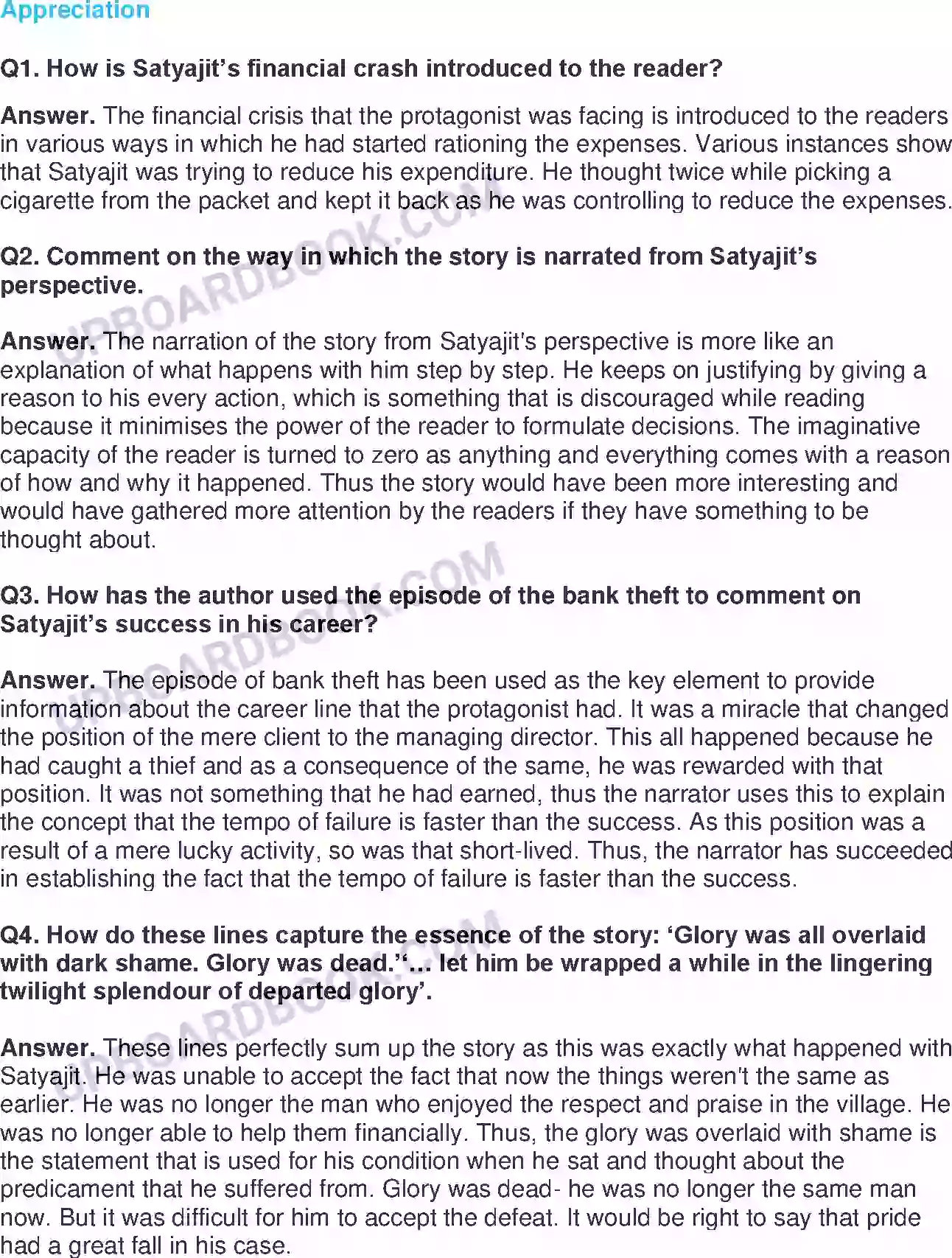
The author subtly introduces Satyajit's financial crisis through small, telling actions instead of stating it outright. For instance, we see him carefully rationing his cigarettes, hesitating before taking one from the packet. These minor details of cutting daily expenses effectively show he is grappling with severe financial constraints, allowing the reader to infer the magnitude of his crash.
Narrating the story from Satyajit's first-person perspective gives us direct access to his thoughts, justifications, and inner turmoil. We experience his shame, regret, and sense of fraudulence intimately. However, this style can also limit the narrative, as every event is filtered through his reasoning, leaving little room for the reader's own interpretation of other characters or events.
The bank theft episode is the pivotal event that defines Satyajit's career. It shows that his spectacular rise to Managing Director was not a result of skill or hard work, but a mere accident of luck. The author uses this to argue that success built on such a fragile foundation is unsustainable. It directly supports the theme that such easily-won glory leads to an equally swift failure, emphasizing the fickleness of fate.
These lines perfectly capture the story's core conflict. Satyajit's past glory is now buried under the shame of his present failure; the "glory was dead." Yet, he is unable to let go completely. The "lingering twilight splendour" is the faint, fading glow of his former respect that he still clings to. The lines encapsulate his painful state of being stuck between a glorious past he can't reclaim and a shameful present he can't accept.
UP Board class 11 English 7. Glory At Twilight - (Short Stories) Solution is available at our platform https://upboardSolution.com in hindi medium for free of cost. Content provided on our website is free of cost and in PDF format which is easily available for download. Getting the UP Board Solutions for class 11 will help student to achieve good learning experience so that they can study effectively. UP board holds examination of more than 3 million students every year and majority of the question of exams are from their UP Board Solutions. That’s why it is important to study using the textSolution issued by UP Board.
It is essential to know the importance of UP Board class 11 English 7. Glory At Twilight - (Short Stories) textSolution issued by UP Board because students completely rely on these Solutions for their study and syllabus offered by UP Board is so balanced that each student should be aware about the importance of it. Below is the list of Importance of UP Board class 11 English 7. Glory At Twilight - (Short Stories) :
There are various features of UP Board class 11 TextSolutions, some of them are mentioned below so that you student can understand the value and usability of the contend and understand why Uttarpradesh board has prescribed these Solutions.