 UPBoardBook
UP Board class 11 English (18. Felling Of The Banyan Tree - (Poetry)) solution PDF
UP Board class 11 English 18. Felling Of The Banyan Tree - (Poetry) is a Hindi Medium Solution which is prescribed by Uttar Pradesh Board for their students. These Solutions is completely prepared considering the latest syllabus and it covers every single topis, so that every student get organised and conceptual learning of the concepts. class 11 Students of UP Board who have selected hindi medium as their study medium they can use these Hindi medium textSolutions to prepare themselves for exam and learn the concept with ease.
UP Board class 11 English 18. Felling Of The Banyan Tree - (Poetry) Hindi Medium Solutions - PDF
Click Here to
UP Board Solutions for Class 11 English
Woven Words Poetry - Chapter 10
Felling Of The Banyan Tree
by Dilip Chitre
Understanding The Poem
Here are detailed solutions to help you grasp the poem's deeper meaning.
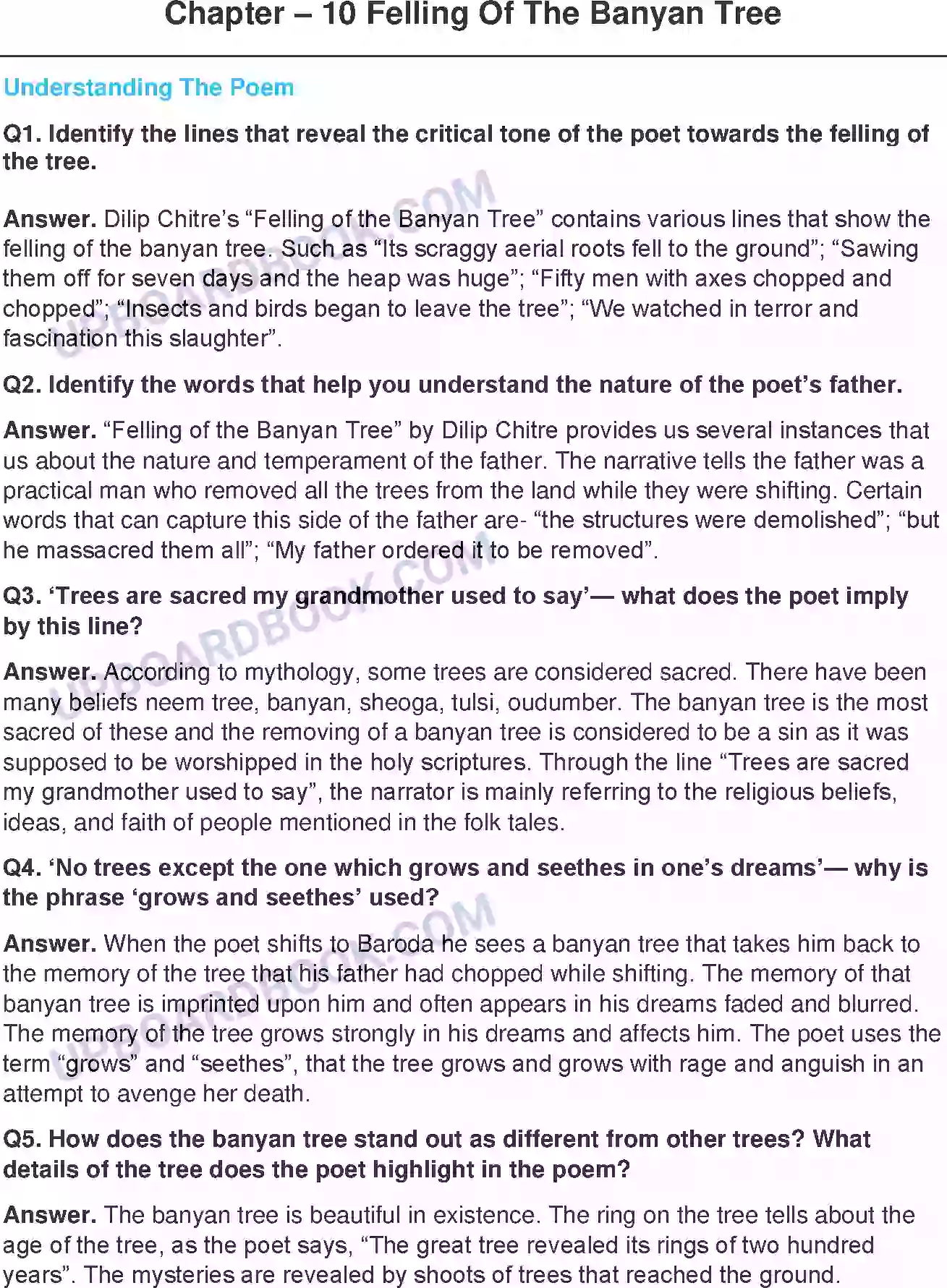
Q1. Identify the lines that reveal the critical tone of the poet towards the felling of the tree.
Answer: The poet, Dilip Chitre, uses several powerful lines to express his disapproval and sorrow over the tree's destruction. These lines reveal his critical tone:
- "Its scraggy aerial roots fell to the ground"
- "Sawing them off for seven days and the heap was huge"
- "Fifty men with axes chopped and chopped"
- "Insects and birds began to leave the tree"
- "We watched in terror and fascination this slaughter" – This line, comparing the act to a 'slaughter', is especially critical.
Q2. Identify the words that help you understand the nature of the poet’s father.
Answer: The father is portrayed as a decisive, practical, and ruthless man who prioritizes utility over sentiment or tradition. Key words and phrases that define his nature are:
- "My father ordered it to be removed" – Shows his authoritative command.
- "He massacred them all" – A harsh word comparing the act to a violent killing.
- "The structures were demolished" – Reflects his mindset of clearing everything without nostalgia.
Q3. ‘Trees are sacred my grandmother used to say’— what does the poet imply by this line?
Answer: By recalling his grandmother's words, the poet highlights the deep-rooted cultural and spiritual connection between nature and human life in Indian tradition. The line implies:
- A respect for nature inherited from older generations.
- The belief that trees, especially the banyan, are not just plants but abodes of life and divinity.
- A sharp contrast between the grandmother's sacred view and the father's practical view, symbolizing the clash between tradition and modernity.
Q4. ‘No trees except the one which grows and seethes in one’s dreams’— why is the phrase ‘grows and seethes’ used?
Answer: The phrase "grows and seethes" is used to convey the powerful and lasting psychological impact of the tree's destruction.
- Grows: The memory of the tree doesn't fade; instead, it becomes larger and more vivid in the poet's subconscious mind (dreams).
- Seethes: This word adds a tone of anger, restlessness, and simmering pain. The tree, in memory, is alive with a furious energy, as if protesting its unjust end.
Q5. How does the banyan tree stand out as different from other trees? What details of the tree does the poet highlight in the poem?
Answer: The banyan tree is majestic, ancient, and almost mythical compared to other trees. The poet highlights:
- Immense Age & Size: "The great tree revealed its rings of two hundred years" and it occupied the space of "fifty feet".
- Unique Structure: Its "scraggy aerial roots" that reached the ground, making it a complex ecosystem.
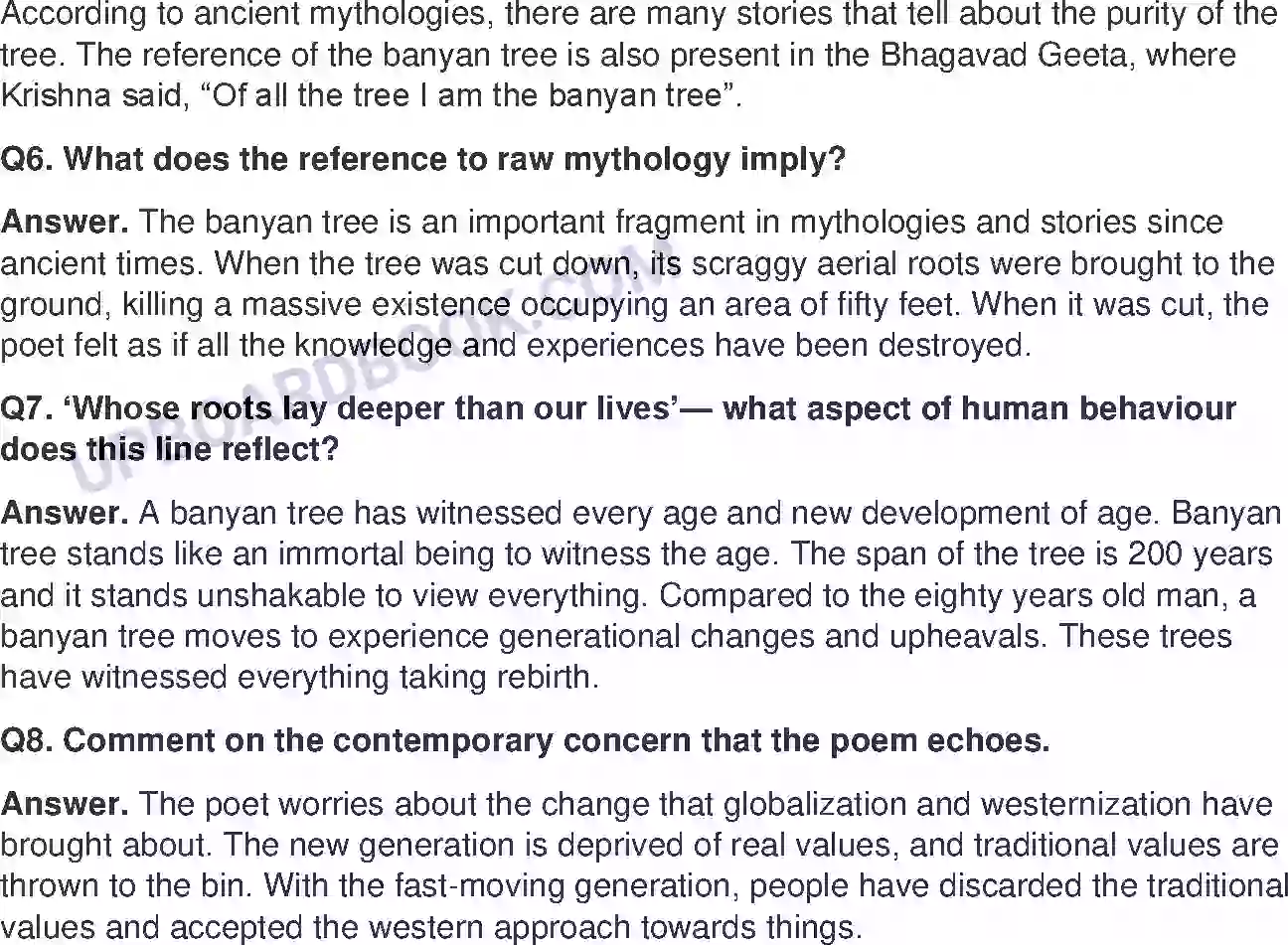
- Sacred & Mythological Status: It is not just a tree but a symbol of life and knowledge, as referenced in scriptures like the Bhagavad Gita where Krishna says, "Of all trees I am the banyan tree."
Q6. What does the reference to raw mythology imply?
Answer: The reference to "raw mythology" implies that the felling of the banyan tree was not just the cutting of wood; it was the violent destruction of a living piece of ancient lore and cultural heritage. It suggests:
- The tree was connected to primal stories, beliefs, and collective memory.
- Its destruction felt like an attack on ancient wisdom and the natural order itself.
- The act was brutal ('raw') and stripped away the protective, sacred layer of mythology that once preserved such natural wonders.
Q7. ‘Whose roots lay deeper than our lives’— what aspect of human behaviour does this line reflect?
Answer: This line reflects the human tendency to be short-sighted and arrogant. It highlights:
- Human Transience vs. Nature's Permanence: A single human life is brief compared to the centuries-old life of a banyan tree.
- Lack of Perspective: Humans often act based on immediate needs (like clearing land) without considering the deeper historical, ecological, and spiritual roots they are destroying.
- It criticizes the behavior of prioritizing temporary human convenience over enduring natural legacy.
Q8. Comment on the contemporary concern that the poem echoes.
Answer: The poem powerfully echoes the contemporary concern of environmental degradation and loss of cultural roots in the name of progress.
- Deforestation & Ecological Loss: The detailed slaughter of the tree mirrors the real-world clearing of forests, leading to loss of habitat and biodiversity.
- Clash of Values: The father (modernity, development) vs. the grandmother (tradition, reverence for nature) represents the ongoing conflict in societies rapidly embracing urbanization.
- Psychological Disconnect: The poem warns that severing our connection with nature leads to a deep, haunting sense of loss ("the tree that grows and seethes in one's dreams").
Key Takeaway: This poem is not just about a tree; it's about memory, tradition, and the irreversible cost of uprooting our connection to the natural world.
Get UP Board class 11 English 18. Felling Of The Banyan Tree - (Poetry) Solution in Hindi Medium
UP Board class 11 English 18. Felling Of The Banyan Tree - (Poetry) Solution is available at our platform https://upboardbook.com in hindi medium for free of cost. Content provided on our website is free of cost and in PDF format which is easily available for download. Getting the UP Board Solutions for class 11 will help student to achieve good learning experience so that they can study effectively. UP board holds examination of more than 3 million students every year and majority of the question of exams are from their UP Board Solutions. That’s why it is important to study using the textSolution issued by UP Board.
Importance of UP Board class 11 English 18. Felling Of The Banyan Tree - (Poetry) Text Solutions
It is essential to know the importance of UP Board class 11 English 18. Felling Of The Banyan Tree - (Poetry) textSolution issued by UP Board because students completely rely on these Solutions for their study and syllabus offered by UP Board is so balanced that each student should be aware about the importance of it. Below is the list of Importance of UP Board class 11 English 18. Felling Of The Banyan Tree - (Poetry) :
- These TextSolutions are very clear and accurate which helps student to understand concept with ease.
- It is also to mention that these text Solutions are prepared by the content experts of subject, thus these Solutions helps student in clearing their doubts and understand the core concept easily.
- It is considered to be the best study material for competitive exam preparation.
Features of UP Board class 11 textSolutions
There are various features of UP Board class 11 TextSolutions, some of them are mentioned below so that you student can understand the value and usability of the contend and understand why Uttarpradesh board has prescribed these Solutions.
- Best feature of these textSolutions is free availability of content in PDF format
- Second feature that content generated and written is clear and easy to read.
- There are various illustration and images are shown in the Solution so that student can easily understand the concept and should be more appealing to the student.
- Each chapter is explained thoroughly
