 UPBoardBook
UP Board class 11 English (19. Ode To Nightingale - (Poetry)) solution PDF
UP Board class 11 English 19. Ode To Nightingale - (Poetry) is a Hindi Medium Solution which is prescribed by Uttar Pradesh Board for their students. These Solutions is completely prepared considering the latest syllabus and it covers every single topis, so that every student get organised and conceptual learning of the concepts. class 11 Students of UP Board who have selected hindi medium as their study medium they can use these Hindi medium textSolutions to prepare themselves for exam and learn the concept with ease.
UP Board class 11 English 19. Ode To Nightingale - (Poetry) Hindi Medium Solutions - PDF
Click Here to
UP Board Solutions for Class 11 English
Woven Words - Poetry
Chapter 19: Ode To a Nightingale
Understanding The Poem
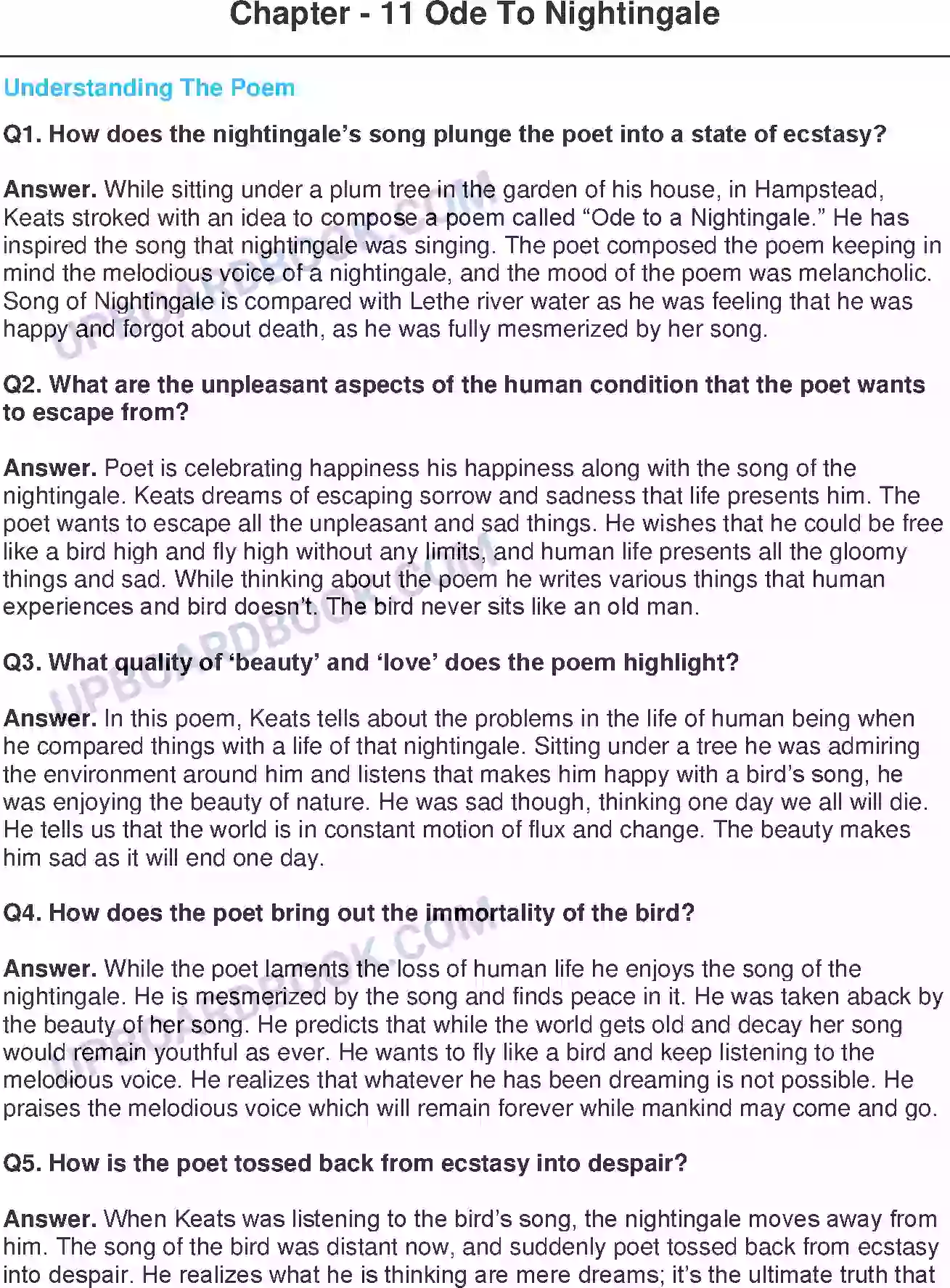
Q1. How does the nightingale’s song plunge the poet into a state of ecstasy?
Answer: While sitting in his garden in Hampstead, Keats was deeply inspired to write this ode after hearing a nightingale's song. The bird's melodious and joyful singing filled him with a profound sense of happiness and transported him to a dreamlike state. He compares the effect of the song to the waters of the mythical river Lethe, which made souls forget their past. Similarly, the nightingale's music made the poet momentarily forget his sorrows and the reality of death, completely captivating his mind and soul.
Q2. What are the unpleasant aspects of the human condition that the poet wants to escape from?
Answer: The poet wishes to escape from the many sorrows and hardships inherent in human life. He contrasts the free, joyful existence of the nightingale with human suffering—the fatigue of old age, sickness ("the fever, and the fret"), the inevitability of death, and the general melancholy that shadows human existence. He dreams of leaving behind this world of "weariness, fever, and fret" where youth grows pale and dies.
Q3. What quality of ‘beauty’ and ‘love’ does the poem highlight?
Answer: The poem highlights the transient and fleeting nature of beauty and love in the human world. While Keats is surrounded by natural beauty and is in love with the nightingale's song, this very experience makes him sad. He realizes that human beauty fades, love is often brief, and joy is momentary. The world is in a constant state of change and decay, making the experience of beauty bittersweet because it is destined to end.
Q4. How does the poet bring out the immortality of the bird?
Answer: The poet contrasts mortal human life with the immortal song of the nightingale. He reflects that this same enchanting song has been heard throughout history—by emperors and clowns, in biblical times, and in fairy tales. While generations of humans live and die, the nightingale's song remains eternally young, fresh, and unchanged. The bird (through its song) becomes a symbol of enduring art and beauty that transcends time.
Q5. How is the poet tossed back from ecstasy into despair?
Answer: The poet's magical trance is broken when the nightingale flies away and its song begins to fade. The word "forlorn," like a tolling bell, abruptly brings him back to his solitary self. He realizes that his visionary escape was just a product of his imagination—a "fancy" that cannot cheat reality. He is tossed back into the harsh world of his own consciousness, re-awakening to the inescapable truth of human mortality and sorrow.
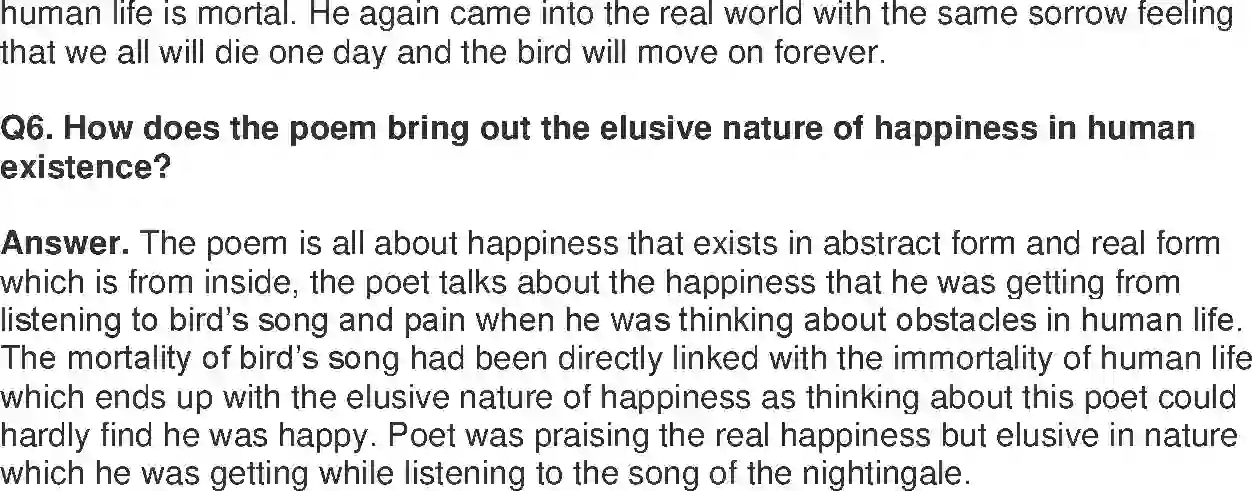
Q6. How does the poem bring out the elusive nature of happiness in human existence?
Answer: The poem masterfully portrays happiness as something elusive and difficult to hold onto. The poet experiences intense joy through the nightingale's song, but this happiness is immediately shadowed by thoughts of human suffering and death. He cannot sustain the ecstatic state; it vanishes as quickly as the bird's song fades into the distance. This shows that in human life, pure and lasting happiness is often intangible and fleeting, easily disrupted by the realities of our mortal condition.
These solutions provide a clear and detailed understanding of Keats' 'Ode to a Nightingale' to help you prepare effectively for your UP Board examinations.
Get UP Board class 11 English 19. Ode To Nightingale - (Poetry) Solution in Hindi Medium
UP Board class 11 English 19. Ode To Nightingale - (Poetry) Solution is available at our platform https://upboardbook.com in hindi medium for free of cost. Content provided on our website is free of cost and in PDF format which is easily available for download. Getting the UP Board Solutions for class 11 will help student to achieve good learning experience so that they can study effectively. UP board holds examination of more than 3 million students every year and majority of the question of exams are from their UP Board Solutions. That’s why it is important to study using the textSolution issued by UP Board.
Importance of UP Board class 11 English 19. Ode To Nightingale - (Poetry) Text Solutions
It is essential to know the importance of UP Board class 11 English 19. Ode To Nightingale - (Poetry) textSolution issued by UP Board because students completely rely on these Solutions for their study and syllabus offered by UP Board is so balanced that each student should be aware about the importance of it. Below is the list of Importance of UP Board class 11 English 19. Ode To Nightingale - (Poetry) :
- These TextSolutions are very clear and accurate which helps student to understand concept with ease.
- It is also to mention that these text Solutions are prepared by the content experts of subject, thus these Solutions helps student in clearing their doubts and understand the core concept easily.
- It is considered to be the best study material for competitive exam preparation.
Features of UP Board class 11 textSolutions
There are various features of UP Board class 11 TextSolutions, some of them are mentioned below so that you student can understand the value and usability of the contend and understand why Uttarpradesh board has prescribed these Solutions.
- Best feature of these textSolutions is free availability of content in PDF format
- Second feature that content generated and written is clear and easy to read.
- There are various illustration and images are shown in the Solution so that student can easily understand the concept and should be more appealing to the student.
- Each chapter is explained thoroughly
