UP Board class 11 English 2. A Pair Of Mustachios - (Short Stories) is a Hindi Medium Solution which is prescribed by Uttar Pradesh Board for their students. These Solutions is completely prepared considering the latest syllabus and it covers every single topis, so that every student get organised and conceptual learning of the concepts. class 11 Students of UP Board who have selected hindi medium as their study medium they can use these Hindi medium textSolutions to prepare themselves for exam and learn the concept with ease.
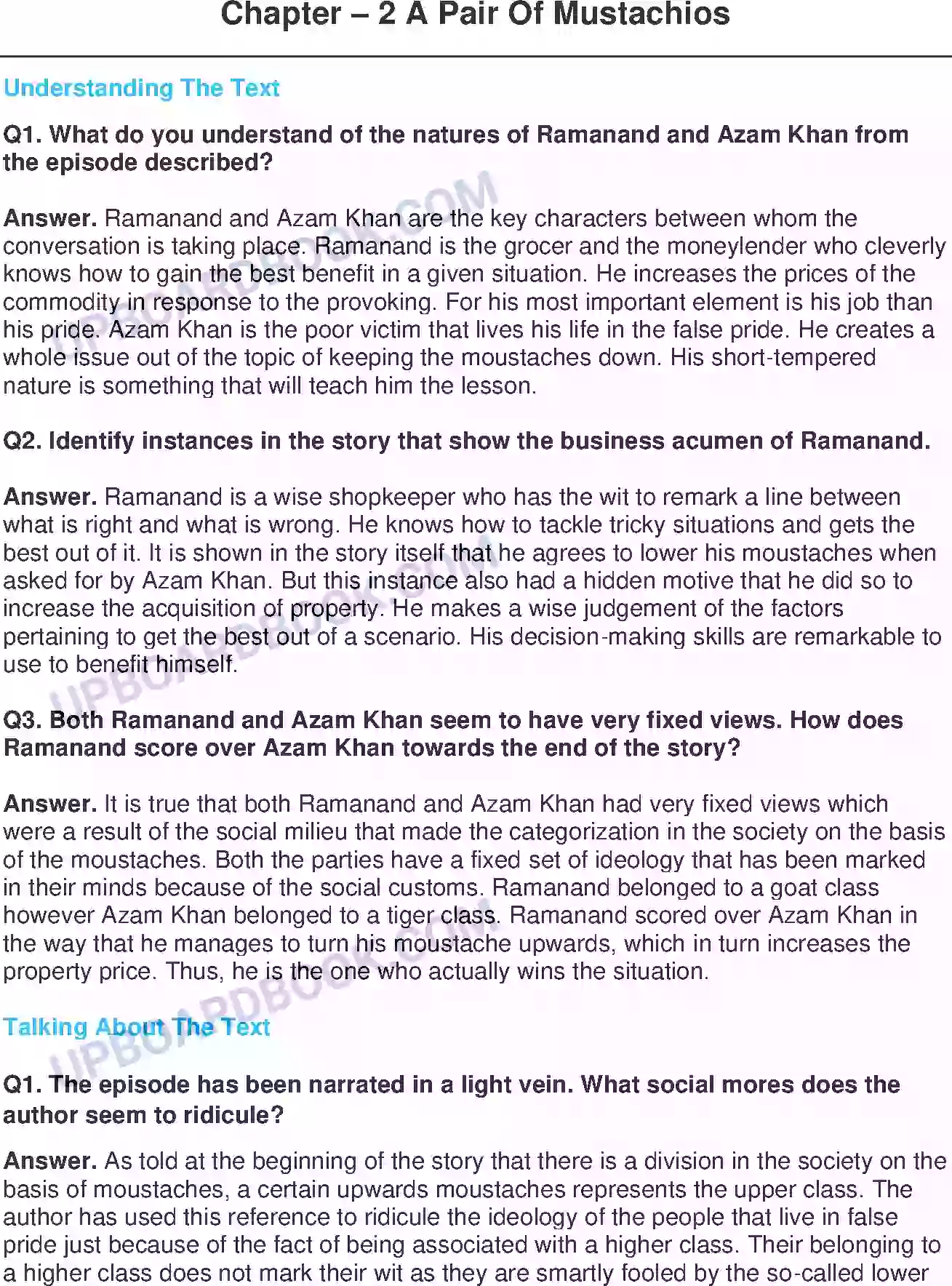
Answer: Ramanand and Azam Khan are the two central characters in this story. Ramanand is a grocer and moneylender. He is a practical and clever businessman who knows how to turn any situation to his advantage. For him, profit and material gain are more important than false prestige. In contrast, Azam Khan is a poor landlord who clings to the hollow pride of his ancestry. He is short-tempered, arrogant, and easily provoked, especially on matters of tradition like the style of his moustache. His nature ultimately leads to his downfall.
Answer: Ramanand displays sharp business acumen throughout the story. The key instance is when Azam Khan demands that Ramanand lower his moustache (a symbol of a lower class). Instead of refusing and starting a fight, Ramanand cleverly agrees but immediately doubles the price of everything he sells to Azam Khan. He understands that Azam Khan's pride will force him to pay the inflated prices just to feel superior. This shows Ramanand's ability to assess a person's weakness and use it for financial gain without direct confrontation.
Answer: Both characters are indeed rigid in their views based on social hierarchy. However, Ramanand scores over Azam Khan through his flexibility and cunning intelligence. While Azam Khan is blindly trapped by his "Tiger class" pride, Ramanand, from the "Goat class," pretends to bend the rule. He temporarily lowers his moustache but uses this act as a tool to exploit Azam Khan financially. In the end, Ramanand wins materially (by extracting more money) and morally (by exposing the foolishness of Azam's pride), while Azam Khan is left poorer and defeated.
Answer: Through this humorous story, the author ridicules several outdated social customs:
1. Blind Pride in Social Class: The author mocks the absurdity of linking a person's worth and status to superficial symbols like the style of a moustache.
2. Hollow Ancestral Pride: Azam Khan represents those who live in past glory and false prestige despite their current impoverished state.
3. The Illusion of Superiority: The story shows how the so-called "upper class" (Tiger) can be easily outwitted by the pragmatic "lower class" (Goat), proving that true intelligence is not bound by social labels.
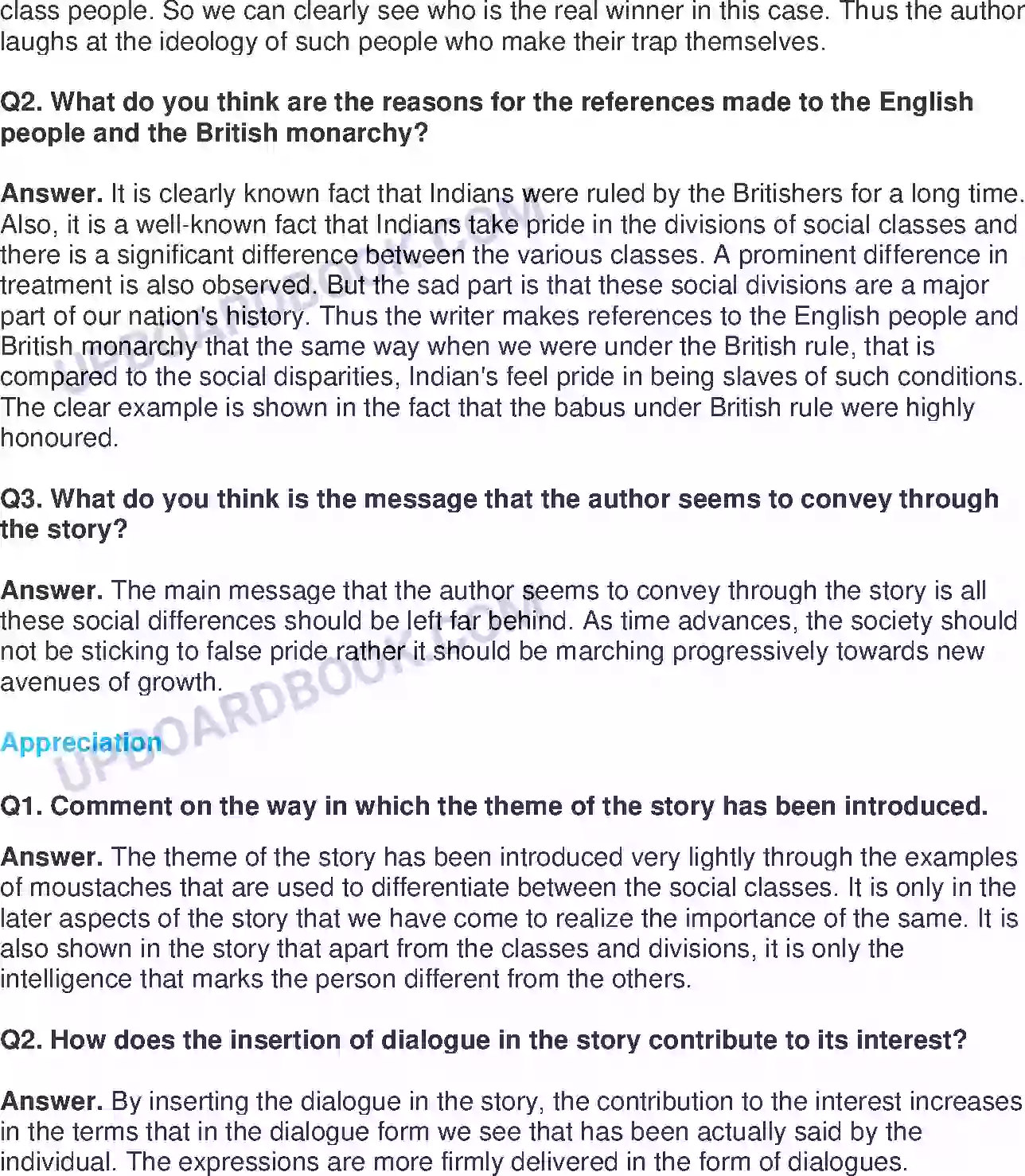
Answer: The references to the English and the British monarchy serve as a powerful satire. The author draws a parallel between the Indian obsession with social hierarchy and the colonial mindset. Just as Indians were subservient to the British, many Indians within their own society enslave themselves to rigid caste and class rules. The mention of "Babus" being honoured under British rule highlights how people often take pride in being part of a dominating system, whether foreign or domestic, instead of valuing genuine self-respect and equality.
Answer: The central message of the story is a critique of irrational social hierarchies and false pride. The author urges society to move beyond outdated customs and symbols that create meaningless divisions. He emphasizes that practical wisdom, adaptability, and intelligence (represented by Ramanand) are more valuable than clinging to hollow traditions (represented by Azam Khan). The story advocates for a progressive society where a person's worth is judged by their character and actions, not by their birth or superficial markers.
Answer: The theme is introduced in a deceptively simple and humorous manner. The story begins by casually explaining the different "classes" of moustaches in Indian society—Tiger, Lion, Goat, and Mouse—as if it were a common fact. This light-hearted setup makes the reader curious and engaged. It is only as the plot between Azam Khan and Ramanand unfolds that the deeper theme emerges: how these absurd symbols are used to exert power, maintain pride, and ultimately exploit others. The gradual revelation makes the social commentary more effective and thought-provoking.
Answer: The dialogue is crucial in making the story lively and impactful. It serves multiple purposes:
1. Reveals Character: Azam Khan's arrogant and commanding tone ("Lower your moustaches!") instantly reveals his pride and temper. Ramanand's calm, calculated replies ("As you please, Khan Sahib") show his cunning nature.
2. Creates Tension & Humor: The direct exchange of words creates immediate conflict and dramatic tension. The irony in their conversation, where politeness masks a power struggle, is the main source of the story's humour.
3. Enhances Realism: Dialogue makes the situation feel real and immediate, allowing readers to witness the confrontation firsthand rather than just being told about it. It brings the characters to life and makes their clash of ideologies more engaging.
UP Board class 11 English 2. A Pair Of Mustachios - (Short Stories) Solution is available at our platform https://upboardSolution.com in hindi medium for free of cost. Content provided on our website is free of cost and in PDF format which is easily available for download. Getting the UP Board Solutions for class 11 will help student to achieve good learning experience so that they can study effectively. UP board holds examination of more than 3 million students every year and majority of the question of exams are from their UP Board Solutions. That’s why it is important to study using the textSolution issued by UP Board.
It is essential to know the importance of UP Board class 11 English 2. A Pair Of Mustachios - (Short Stories) textSolution issued by UP Board because students completely rely on these Solutions for their study and syllabus offered by UP Board is so balanced that each student should be aware about the importance of it. Below is the list of Importance of UP Board class 11 English 2. A Pair Of Mustachios - (Short Stories) :
There are various features of UP Board class 11 TextSolutions, some of them are mentioned below so that you student can understand the value and usability of the contend and understand why Uttarpradesh board has prescribed these Solutions.