 UPBoardBook
UP Board class 11 English (4. Landscape of the Soul) solution PDF
UP Board class 11 English 4. Landscape of the Soul is a Hindi Medium Solution which is prescribed by Uttar Pradesh Board for their students. These Solutions is completely prepared considering the latest syllabus and it covers every single topis, so that every student get organised and conceptual learning of the concepts. class 11 Students of UP Board who have selected hindi medium as their study medium they can use these Hindi medium textSolutions to prepare themselves for exam and learn the concept with ease.
UP Board class 11 English 4. Landscape of the Soul Hindi Medium Solutions - PDF
Click Here to
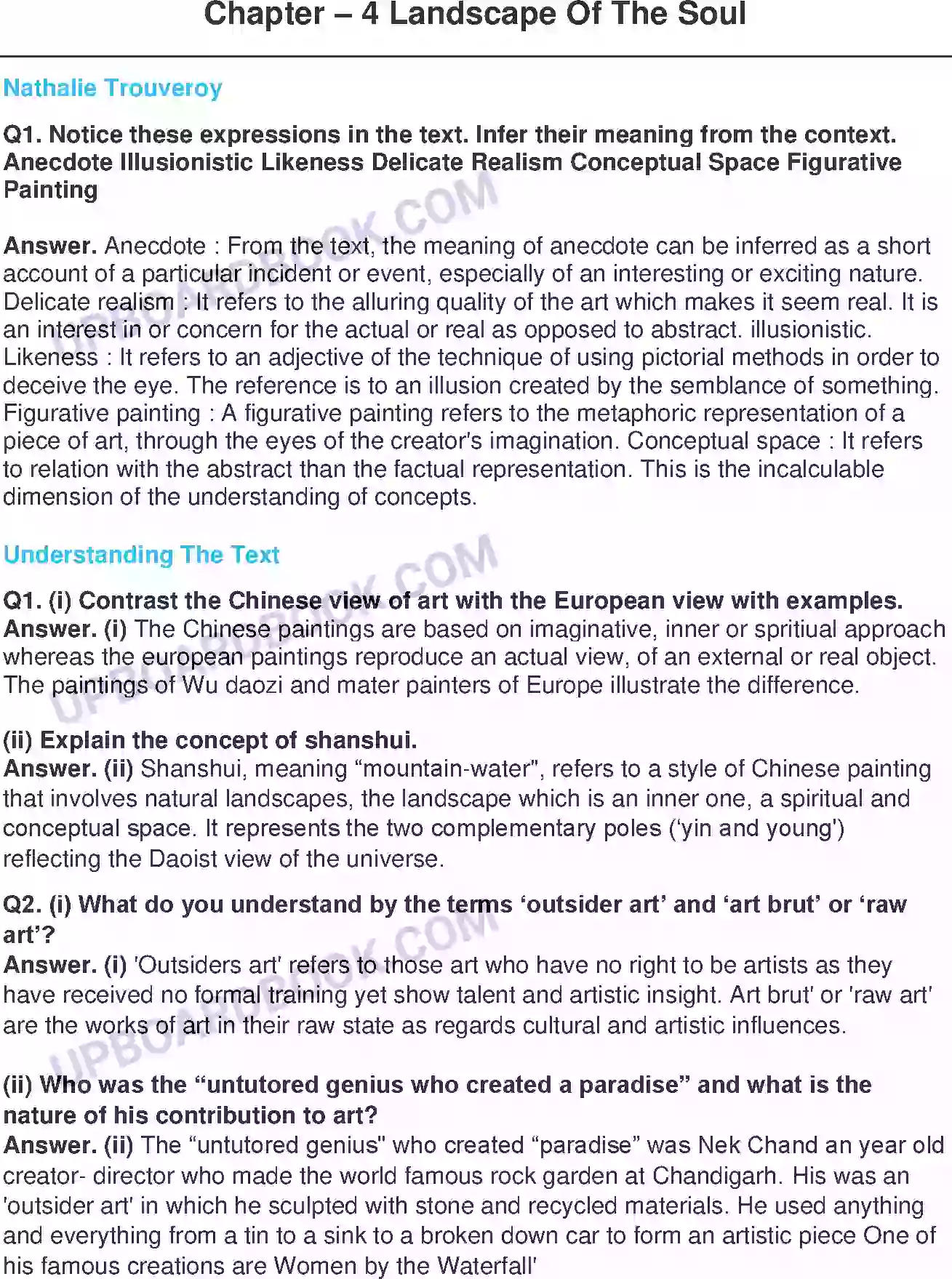

Chapter 4: Landscape of the Soul
by Nathalie Trouveroy
Understanding the Text
Q1. (i) Contrast the Chinese view of art with the European view with examples.
Answer: The Chinese and European views of art are fundamentally different. Chinese art, like the legendary painting by Wu Daozi, is not about reproducing an exact visual reality. It is imaginative, spiritual, and inner-directed. The artist creates a landscape meant to be entered mentally, a path for the soul to wander. In contrast, European art, such as the paintings by masters of the Renaissance, aims for delicate realism and an illusionistic likeness. The European painter wants you to see a specific scene from a fixed viewpoint, exactly as they saw it, creating a window into a real, external world.
(ii) Explain the concept of shanshui.
Answer: Shanshui, literally meaning "mountain-water", is the heart of Chinese landscape painting. It is not just a picture of nature but represents a spiritual and conceptual space. The mountain (Yang) stands for stability, reaching upwards towards heaven, while the water (Yin) represents flow, movement, and the earth below. Together, they embody the complementary poles of the Daoist universe. The empty space in these paintings is vital—it is the Middle Void where their interaction takes place, the breath of the landscape that makes it alive and full of energy.
Q2. (i) What do you understand by the terms ‘outsider art’ and ‘art brut’ or ‘raw art’?
Answer: 'Outsider Art' refers to art created by individuals who are self-taught and have not received any formal training in art. They often work outside the mainstream art world. 'Art Brut' or 'Raw Art' is a closely related term coined by French artist Jean Dubuffet. It describes works that are in their raw, pure state, completely uninfluenced by artistic culture or traditions. This art is impulsive, highly personal, and driven by a pure, untutored creative impulse.
(ii) Who was the “untutored genius who created a paradise” and what is the nature of his contribution to art?
Answer: The "untutored genius" was Nek Chand, a former road inspector who created the famous Rock Garden in Chandigarh. His contribution is a prime example of outsider art. With no formal training, he sculpted a magical world using stones, recycled materials, and urban waste—everything from broken tiles and bottles to discarded sinks and bicycle parts. His work, like the beautiful sculpture 'Women by the Waterfall', transformed everyday junk into artistic marvels, proving that profound artistic vision can exist completely outside the conventional art establishment.
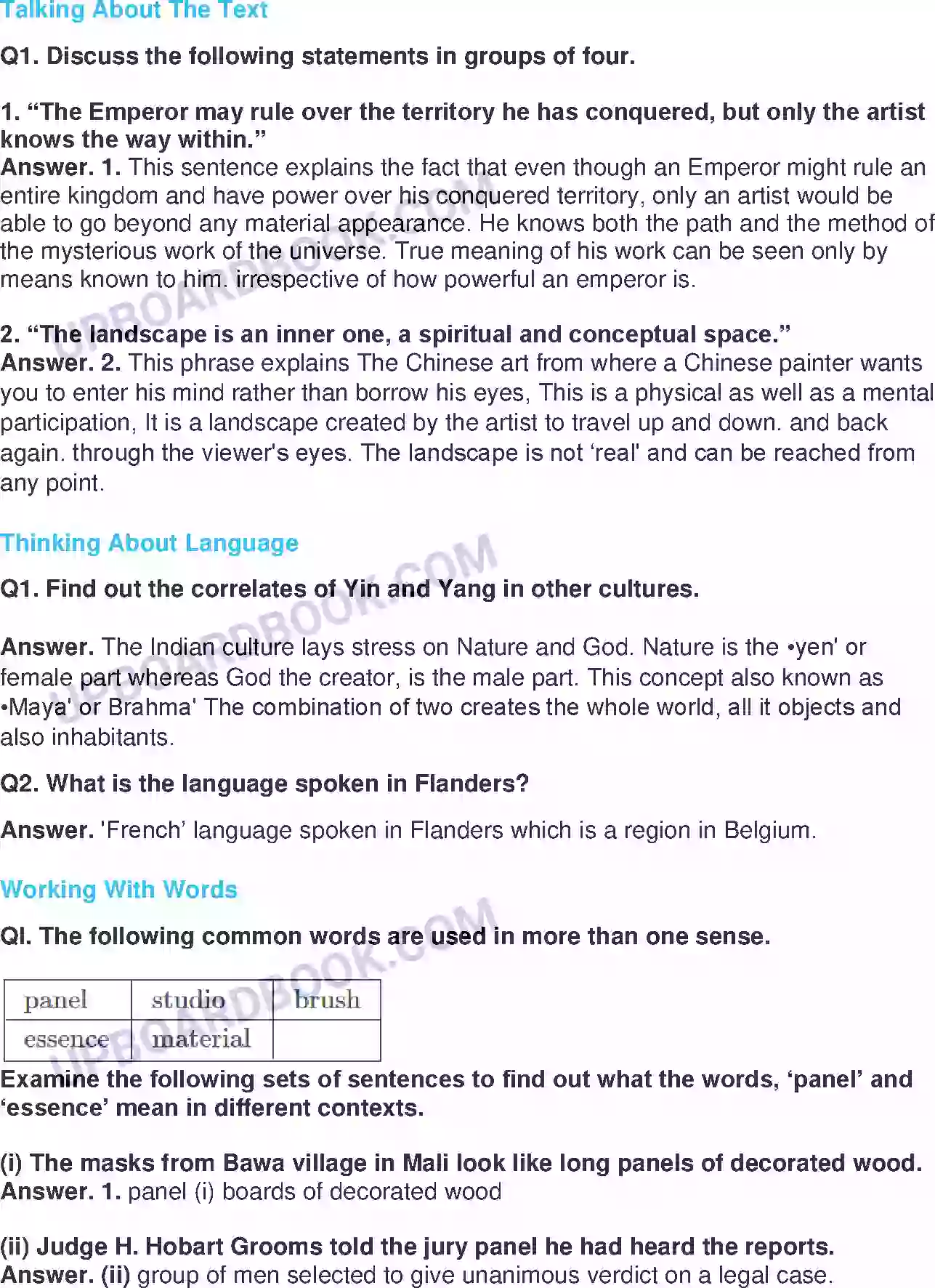
Talking About The Text
Discuss the following statements in groups of four.
1. “The Emperor may rule over the territory he has conquered, but only the artist knows the way within.”
Answer: This statement highlights the different kinds of power held by a ruler and an artist. An emperor has political power over physical land and people. However, the artist possesses a deeper, spiritual knowledge. The artist understands the inner essence, the soul, and the hidden pathways of creation. Like Wu Daozi, who could enter the cave in his painting and disappear, the artist knows the secret "way within" a work of art—a path of meaning and experience that remains inaccessible even to the most powerful emperor.
2. “The landscape is an inner one, a spiritual and conceptual space.”
Answer: This phrase perfectly captures the essence of classical Chinese landscape painting. The landscape is not a copy of an actual mountain or river. Instead, it is a mental and spiritual construct created by the artist. It is a "conceptual space" designed for the viewer to travel through with their imagination. The viewer is invited to participate physically and mentally, to wander up the mountain paths and along the rivers in their mind. This landscape has no single viewpoint; it can be entered and experienced from any point, making it a personal, inner journey for each observer.
Thinking About Language
Q1. Find out the correlates of Yin and Yang in other cultures.
Answer: The concept of complementary opposing forces exists in many cultures. In Indian philosophy, this is seen in the union of Purusha (the eternal masculine principle, consciousness) and Prakriti (the eternal feminine principle, nature/matter). Their interaction is responsible for the creation of the universe. Similarly, the idea of Brahma (the creator) and Maya (the illusory world) reflects a relationship between the fundamental reality and the perceived, ever-changing world.
Q2. What is the language spoken in Flanders?
Answer: Flanders is a region in Belgium. The primary language spoken there is Dutch (specifically the Belgian variant known as Flemish).
Working With Words
QI. The following common words are used in more than one sense. Examine the following sets of sentences to find out what the words, ‘panel’ and ‘essence’ mean in different contexts.
1. Panel
- (i) The masks... look like long panels of decorated wood. [Meaning: flat, usually rectangular pieces of a material]
- (ii) The judge told the jury panel... [Meaning: a selected group of people for a specific purpose (e.g., jury)]
- (iii) The panel is laying the groundwork for a treaty. [Meaning: a group of experts]
- (iv) The glass panels of the window were broken. [Meaning: sheets of glass in a window/door]
- (v) ...workshops and panel discussions... [Meaning: a discussion by a group of people]
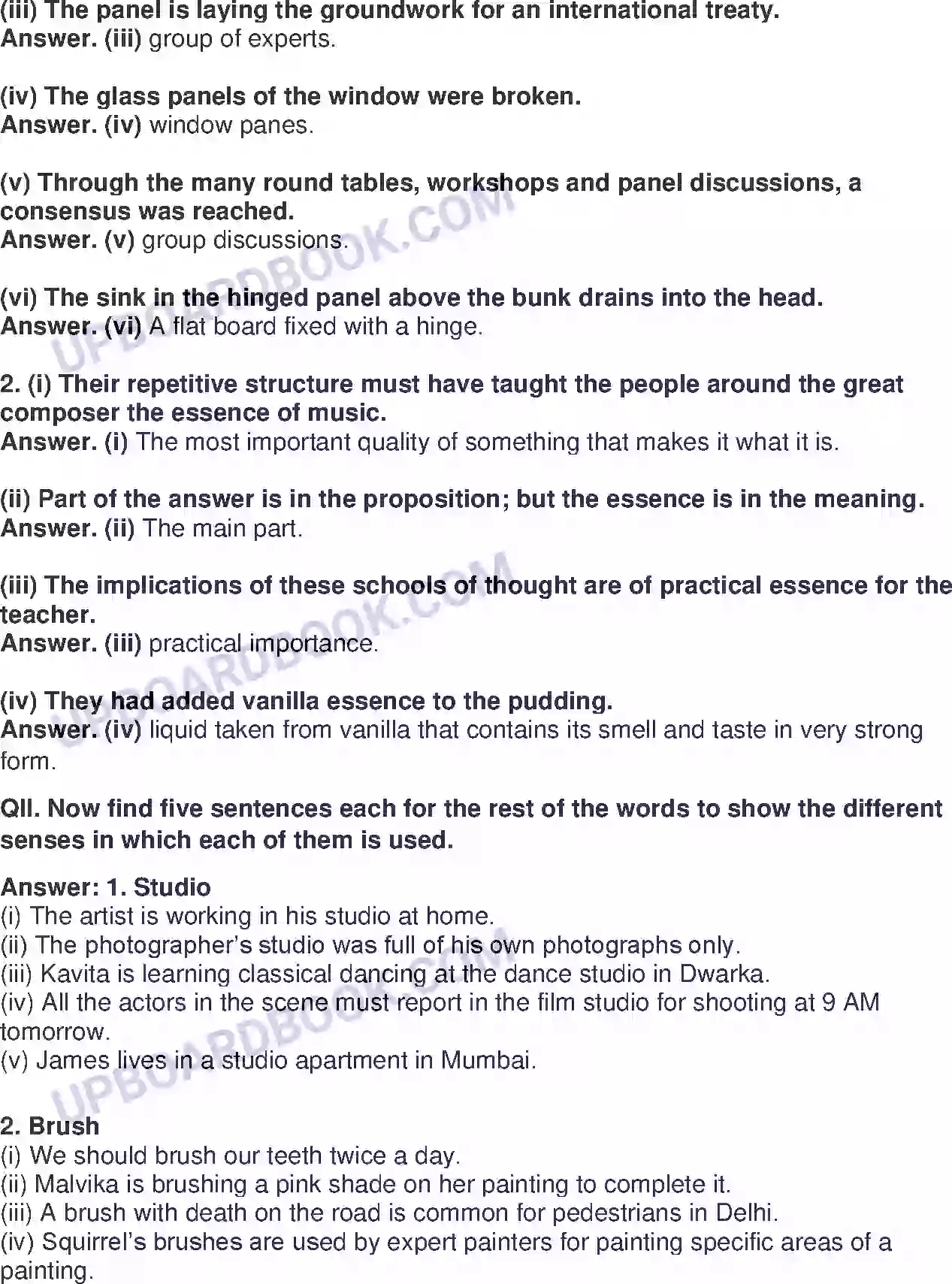
- (vi) The sink in the hinged panel... [Meaning: a distinct section of a surface, often with a hinge]
2. Essence
- (i) ...taught... the essence of music. [Meaning: the intrinsic, fundamental quality]
- (ii) ...the essence is in the meaning. [Meaning: the most important part]
- (iii) ...are of practical essence for the teacher. [Meaning: importance]
- (iv) They had added vanilla essence... [Meaning: a concentrated liquid flavoring]
These UP Board solutions are designed to help you grasp the core concepts of the chapter clearly and effectively.
Get UP Board class 11 English 4. Landscape of the Soul Solution in Hindi Medium
UP Board class 11 English 4. Landscape of the Soul Solution is available at our platform https://upboardbook.com in hindi medium for free of cost. Content provided on our website is free of cost and in PDF format which is easily available for download. Getting the UP Board Solutions for class 11 will help student to achieve good learning experience so that they can study effectively. UP board holds examination of more than 3 million students every year and majority of the question of exams are from their UP Board Solutions. That’s why it is important to study using the textSolution issued by UP Board.
Importance of UP Board class 11 English 4. Landscape of the Soul Text Solutions
It is essential to know the importance of UP Board class 11 English 4. Landscape of the Soul textSolution issued by UP Board because students completely rely on these Solutions for their study and syllabus offered by UP Board is so balanced that each student should be aware about the importance of it. Below is the list of Importance of UP Board class 11 English 4. Landscape of the Soul :
- These TextSolutions are very clear and accurate which helps student to understand concept with ease.
- It is also to mention that these text Solutions are prepared by the content experts of subject, thus these Solutions helps student in clearing their doubts and understand the core concept easily.
- It is considered to be the best study material for competitive exam preparation.
Features of UP Board class 11 textSolutions
There are various features of UP Board class 11 TextSolutions, some of them are mentioned below so that you student can understand the value and usability of the contend and understand why Uttarpradesh board has prescribed these Solutions.
- Best feature of these textSolutions is free availability of content in PDF format
- Second feature that content generated and written is clear and easy to read.
- There are various illustration and images are shown in the Solution so that student can easily understand the concept and should be more appealing to the student.
- Each chapter is explained thoroughly
