 UPBoardBook
UP Board class 11 English (24. Tribal Verse - (Essays)) solution PDF
UP Board class 11 English 24. Tribal Verse - (Essays) is a Hindi Medium Solution which is prescribed by Uttar Pradesh Board for their students. These Solutions is completely prepared considering the latest syllabus and it covers every single topis, so that every student get organised and conceptual learning of the concepts. class 11 Students of UP Board who have selected hindi medium as their study medium they can use these Hindi medium textSolutions to prepare themselves for exam and learn the concept with ease.
UP Board class 11 English 24. Tribal Verse - (Essays) Hindi Medium Solutions - PDF
Click Here to
UP Board Solutions for Class 11 English
Woven Words - Chapter 4: Tribal Verse
Understanding The Text
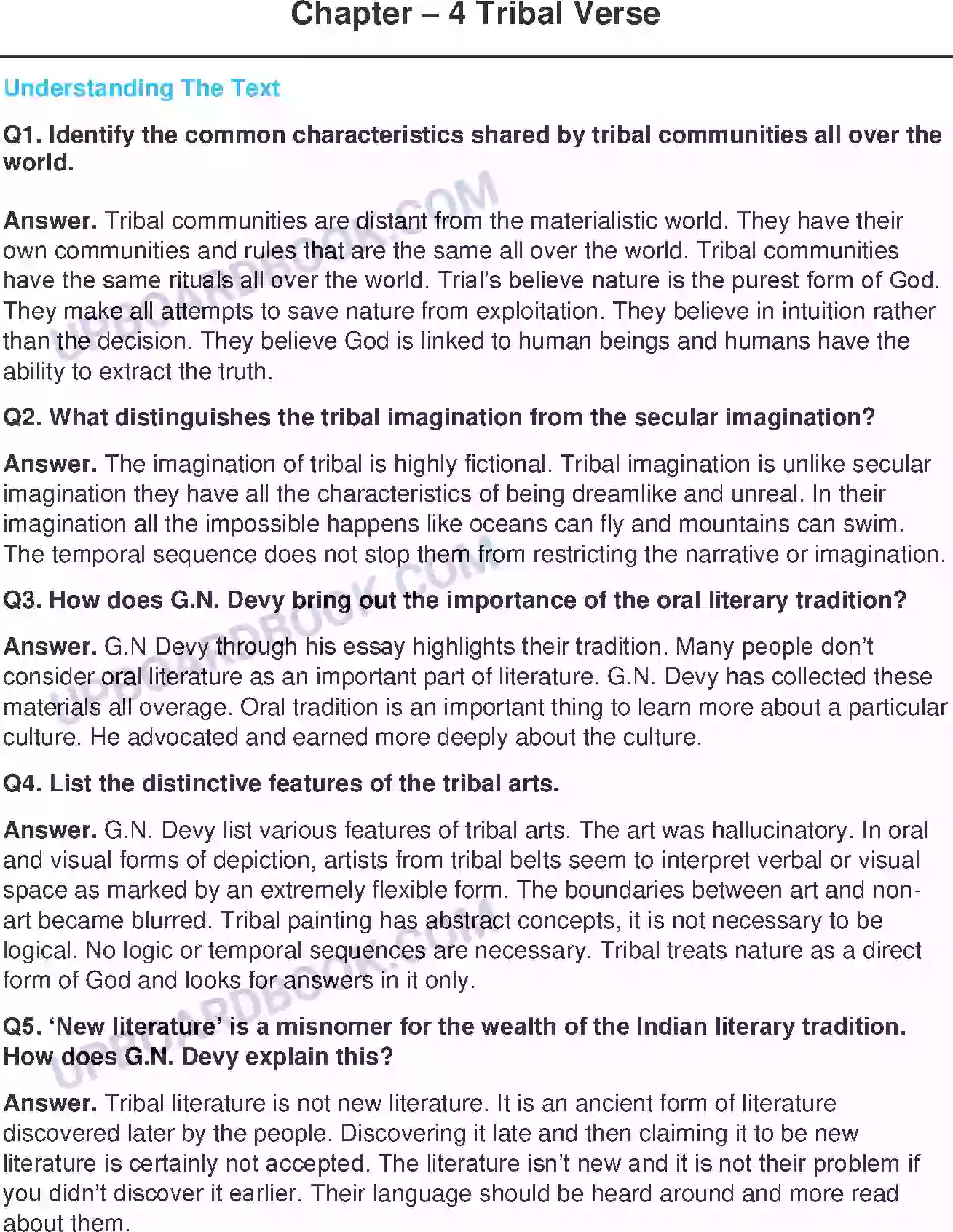
Q1. Identify the common characteristics shared by tribal communities all over the world.
Answer: Tribal communities across the globe share several common traits. They often live in harmony with nature, viewing it as a sacred and pure entity to be protected from exploitation. Their social structures are based on close-knit communities with their own distinct rules and rituals. They tend to rely more on intuition and spiritual connection rather than purely rational decision-making, believing that truth and divinity are directly accessible to human beings.
Q2. What distinguishes the tribal imagination from the secular imagination?
Answer: Tribal imagination is marked by its dreamlike, magical, and non-linear quality. Unlike secular imagination, which is often bound by logic and realistic sequences, tribal imagination freely transcends these boundaries. In their narratives, impossible events are commonplace—oceans can fly, and mountains can swim. Time and sequence are flexible, allowing for a more fluid and unrestricted form of storytelling.
Q3. How does G.N. Devy bring out the importance of the oral literary tradition?
Answer: G.N. Devy, through his extensive work and this essay, champions the significance of the oral literary tradition. He argues that oral literature is a vital and rich part of our cultural heritage, often overlooked by those who equate literature only with written texts. By collecting and studying these oral materials, Devy demonstrates that they are essential for a deep and authentic understanding of a culture's history, values, and worldview.
Q4. List the distinctive features of the tribal arts.
Answer: According to G.N. Devy, tribal arts possess several unique features:
- They are often hallucinatory and dreamlike in nature.
- They show extreme flexibility in interpreting verbal and visual space.
- The line between art and non-art is often blurred.
- Tribal paintings and stories embrace abstract concepts and are not confined by logic or chronological order.
- Nature is revered as a direct manifestation of the divine, and answers are sought within it.
Q5. ‘New literature’ is a misnomer for the wealth of the Indian literary tradition. How does G.N. Devy explain this?
Answer: G.N. Devy explains that calling tribal literature "new" is incorrect because it is actually an ancient tradition that has existed for centuries. Its late discovery and recognition by mainstream literary circles does not make it new. The problem lies not with the literature itself but with our delayed awareness of it. He emphasizes the need to acknowledge, read, and give voice to these long-standing tribal languages and narratives.
Appreciation
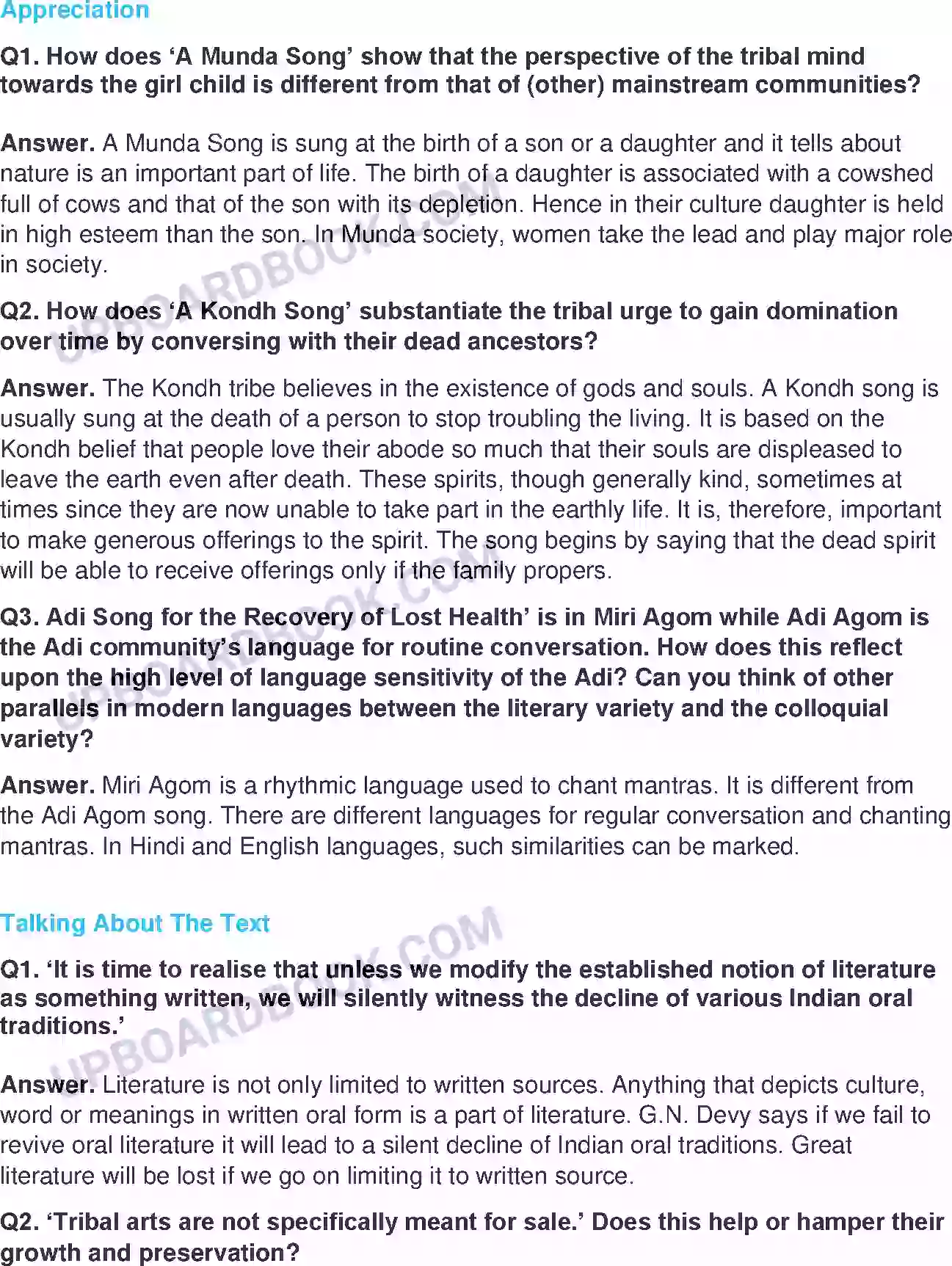
Q1. How does ‘A Munda Song’ show that the perspective of the tribal mind towards the girl child is different from that of (other) mainstream communities?
Answer: 'A Munda Song,' sung at the birth of any child, reveals a perspective that values the girl child highly. The birth of a daughter is associated with a cowshed full of cows (symbolizing prosperity and wealth), while the birth of a son is linked to its depletion. This indicates that in Munda society, daughters are held in high esteem and are seen as bringers of abundance. Women often take leading roles, reflecting a more gender-balanced social structure.
Q2. How does ‘A Kondh Song’ substantiate the tribal urge to gain domination over time by conversing with their dead ancestors?
Answer: The 'Kondh Song,' sung during funerals, reflects the belief that the souls of the deceased remain connected to their earthly abode. The song is a conversation meant to appease the spirit, urging it to accept its new state and stop troubling the living. By making generous offerings and singing these songs, the living community seeks to maintain harmony with the ancestral world, thereby exerting a form of control over the passage of time and the relationship between life and death.
Q3. ‘Adi Song for the Recovery of Lost Health’ is in Miri Agom while Adi Agom is the Adi community’s language for routine conversation. How does this reflect upon the high level of language sensitivity of the Adi?
Answer: This distinction shows a sophisticated linguistic sensitivity within the Adi community. They use Miri Agom, a special rhythmic and ritualistic language, for sacred purposes like healing chants, while using Adi Agom for everyday communication. This parallels modern languages where a formal, literary variety (like Sanskritized Hindi or Classical Arabic) exists alongside a colloquial, everyday spoken variety.
Talking About The Text
Q1. ‘It is time to realise that unless we modify the established notion of literature as something written, we will silently witness the decline of various Indian oral traditions.’
Answer: This statement stresses the urgent need to expand our definition of literature beyond just written texts. If we continue to ignore or undervalue oral traditions—stories, songs, chants passed down through generations—we risk losing an immense and irreplaceable part of India's cultural and literary wealth. Preserving these oral forms is crucial for a complete understanding of our heritage.
Q2. ‘Tribal arts are not specifically meant for sale.’ Does this help or hamper their growth and preservation?
Answer: This aspect has a dual effect. On one hand, not being commercialized keeps tribal arts authentic, deeply connected to community rituals, and free from market-driven distortions. On the other hand, the lack of economic incentive and wider patronage can lead to neglect, making it harder for these art forms to survive in the modern world. Conscious effort and support are needed to preserve them.
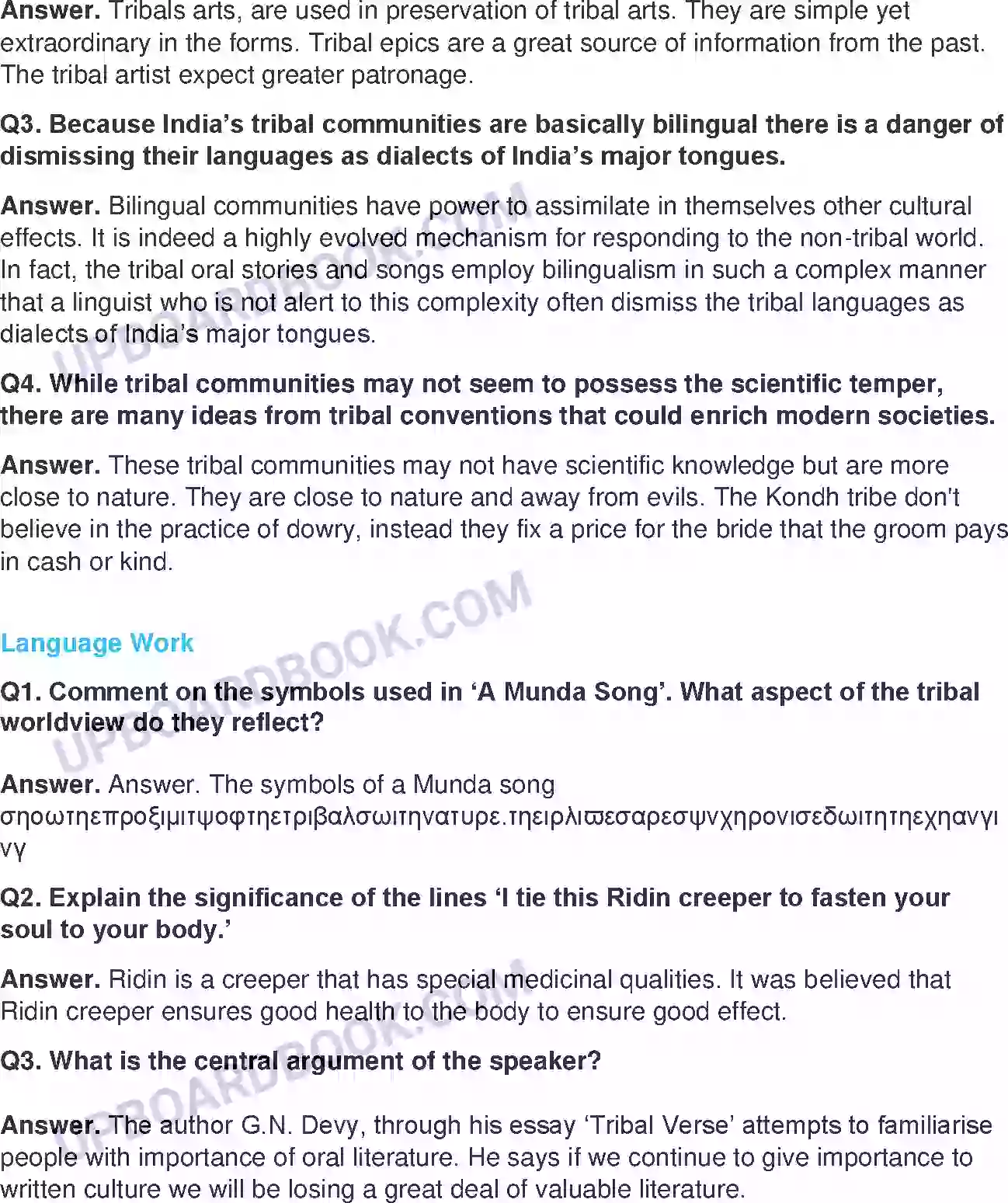
Q3. Because India’s tribal communities are basically bilingual there is a danger of dismissing their languages as dialects of India’s major tongues.
Answer: The bilingual nature of tribal communities is a sophisticated adaptation, not a sign of deficiency. They often use a major language for external interaction while retaining their native tongue for internal culture. However, this complexity can lead linguists to mistakenly label rich, independent tribal languages as mere "dialects" of languages like Hindi or Odia, thereby undermining their unique grammatical structures and literary value.
Q4. While tribal communities may not seem to possess the scientific temper, there are many ideas from tribal conventions that could enrich modern societies.
Answer: Absolutely. Tribal conventions offer valuable lessons for modern society. Their deep ecological wisdom promotes sustainable living in harmony with nature. Social practices, like the Kondh community's tradition of bride price (where the groom pays a price to the bride's family) as opposed to dowry, challenge patriarchal norms. Their community-centric living emphasizes collective well-being over individualism.
Language Work
Q1. Comment on the symbols used in ‘A Munda Song’. What aspect of the tribal worldview do they reflect?
Answer: The provided text seems to contain corrupted symbols. Typically, Munda songs use symbols from nature—like cows, rivers, forests, and crops. These symbols reflect a worldview deeply intertwined with the natural environment. They represent life, prosperity, fertility, and the cyclical nature of existence, showing how the tribe sees human life as an integral part of the ecological web.
Q2. Explain the significance of the lines ‘I tie this Ridin creeper to fasten your soul to your body.’
Answer: This line from a healing chant highlights the tribal belief in a direct connection between physical health and spiritual well-being. The Ridin creeper, believed to have medicinal properties, is used not just as a physical remedy but as a symbolic ritual to bind the wandering soul firmly to the ailing body, ensuring complete recovery. It blends the practical with the spiritual.
Q3. What is the central argument of the speaker?
Answer: The central argument of G.N. Devy in "Tribal Verse" is that India's oral and tribal literary traditions are immensely valuable and must be recognized as legitimate literature. He warns that an exclusive focus on written texts will lead to the irreversible loss of this vast cultural treasure. He advocates for the study, preservation, and integration of these traditions into the mainstream understanding of Indian literature.
Get UP Board class 11 English 24. Tribal Verse - (Essays) Solution in Hindi Medium
UP Board class 11 English 24. Tribal Verse - (Essays) Solution is available at our platform https://upboardbook.com in hindi medium for free of cost. Content provided on our website is free of cost and in PDF format which is easily available for download. Getting the UP Board Solutions for class 11 will help student to achieve good learning experience so that they can study effectively. UP board holds examination of more than 3 million students every year and majority of the question of exams are from their UP Board Solutions. That’s why it is important to study using the textSolution issued by UP Board.
Importance of UP Board class 11 English 24. Tribal Verse - (Essays) Text Solutions
It is essential to know the importance of UP Board class 11 English 24. Tribal Verse - (Essays) textSolution issued by UP Board because students completely rely on these Solutions for their study and syllabus offered by UP Board is so balanced that each student should be aware about the importance of it. Below is the list of Importance of UP Board class 11 English 24. Tribal Verse - (Essays) :
- These TextSolutions are very clear and accurate which helps student to understand concept with ease.
- It is also to mention that these text Solutions are prepared by the content experts of subject, thus these Solutions helps student in clearing their doubts and understand the core concept easily.
- It is considered to be the best study material for competitive exam preparation.
Features of UP Board class 11 textSolutions
There are various features of UP Board class 11 TextSolutions, some of them are mentioned below so that you student can understand the value and usability of the contend and understand why Uttarpradesh board has prescribed these Solutions.
- Best feature of these textSolutions is free availability of content in PDF format
- Second feature that content generated and written is clear and easy to read.
- There are various illustration and images are shown in the Solution so that student can easily understand the concept and should be more appealing to the student.
- Each chapter is explained thoroughly
