 UPBoardBook
UP Board class 11 English (2. We're Not Afraid to Die...if We Can All Be Together) solution PDF
UP Board class 11 English 2. We're Not Afraid to Die...if We Can All Be Together is a Hindi Medium Solution which is prescribed by Uttar Pradesh Board for their students. These Solutions is completely prepared considering the latest syllabus and it covers every single topis, so that every student get organised and conceptual learning of the concepts. class 11 Students of UP Board who have selected hindi medium as their study medium they can use these Hindi medium textSolutions to prepare themselves for exam and learn the concept with ease.
UP Board class 11 English 2. We're Not Afraid to Die...if We Can All Be Together Hindi Medium Solutions - PDF
Click Here to

UP Board Solutions for Class 11 English Hornbill
Chapter 2: We're Not Afraid to Die... if We Can All Be Together
Understanding The Text
Q1. List the steps taken by the captain
(i) to protect the ship when rough weather began.
Answer: To protect the ship from the rough weather, the captain took several steps. First, he slowed the ship down by dropping the storm jib. Then, he lashed a heavy mooring rope in a loop across the stern to add strength. Finally, he double-checked all the lashings and made sure everything was secure. The crew also went through a thorough life-raft drill to be prepared for any emergency.
(ii) to check the flooding of the water in the ship.
Answer: To stop the ship from flooding, the captain acted quickly. He put waterproof hatch covers across the gaping holes, which helped divert the incoming water to the sides. When the two hand pumps got blocked and the electric pump short-circuited, he didn't give up. He found another electric pump, connected it to an outlet pipe, and managed to get it started to pump the water out.
Q2. Describe the mental condition of the voyagers on 4 and 5 January.
Answer: On January 4, after 36 hours of continuous pumping, the voyagers felt a brief sense of relief. They were exhausted but managed to have their first meal in almost two days. However, this relief was very short-lived. By January 5, the weather deteriorated again, bringing a dangerous and terrifying situation. The fear of death was very real, and everyone was under immense mental stress and anxiety.
Q3. Describe the shifts in the narration of the events as indicated in the three sections of the text. Give a subtitle to each section.
Answer: The narrative of the story shifts in tone and focus across three distinct sections:
The First Section (Subtitle: The Dream Voyage Begins): This section starts on a hopeful and cheerful note. The narrator and his family are fulfilling their dream of a round-the-world voyage, inspired by Captain James Cook. They have prepared well and are in high spirits, even celebrating Christmas at sea despite some bad weather.
The Second Section (Subtitle: The Fury of the Waves): The tone shifts dramatically to one of intensity and danger. A monstrous wave hits the boat, throwing the narrator overboard and causing severe damage. The narrative focuses on the crew's desperate struggle for survival, battling injuries and a flooding ship. The children's courage shines through the adults' growing despair.
The Third Section (Subtitle: Triumph of Hope and Seamanship): This section is about resilience and ultimate victory. Motivated by the children's optimism, the narrator uses all his skills to navigate towards safety. Their perseverance pays off when they finally spot Île Amsterdam. The story ends on an emotional note, with the children declaring the narrator "the best daddy" and "the best captain."
Talking About The Text
Discuss the following questions with your partner.
1. What difference did you notice between the reaction of the adults and the children when faced with danger?
Answer: The reactions of the adults and children were strikingly different. The adults, burdened by responsibility and understanding the full gravity of the situation, began to lose hope and prepared for the worst. In contrast, the children displayed incredible maturity, courage, and optimism. Jonathan's words, "we're not afraid of dying if we can all be together," provided immense moral strength. Sue showed selfless love by making a card and hiding her serious injuries to avoid worrying her parents during the crisis.
2. How does the story suggest that optimism helps to endure “the direst stress”?
Answer: The story is a powerful testament to how optimism can help overcome even the most extreme stress. When the narrator was losing hope, it was the children's positive outlook that revived his spirit. Jonathan's fearless statement and Sue's heartfelt card infused the narrator with new determination. This optimism fueled his relentless efforts to calculate their position and navigate accurately, which ultimately led them to safety. Their positive attitude was as crucial as their physical struggle.
3. What lessons do we learn from such hazardous experiences when we are face-to-face with death?
Answer: Such life-threatening experiences teach us profound lessons:
• The importance of courage, perseverance, and never giving up hope.
• The power of unity, teamwork, and staying calm under pressure.
• The value of common sense, continuous effort, and careful planning in a crisis.
• How facing adversity can reveal our inner strength and the strength we draw from our loved ones.
4. Why do you think people undertake such adventurous expeditions in spite of the risks involved?
Answer: People undertake such risky adventures driven by a deep passion for exploration and a desire to challenge their limits. The thrill of experiencing nature's raw beauty and power, the quest for unique achievements, and the spirit of adventure often outweigh the known risks. For them, it is about pursuing a dream, testing human endurance, and feeling a profound connection with the natural world.
Thinking About Language
Q1. We have come across words like ‘gale’ and ‘storm’ in the account. Here are two more words for ‘storm’: typhoon, cyclone. How many words does your language have for ‘storm’?
Answer: In Hindi, a storm can be referred to as 'आंधी (aandhi)', 'तूफान (toofan)', or 'अंधड़ (andhad)'.
Q2. Here are the terms for different kinds of vessels: yacht, boat, canoe, ship, steamer, schooner. Think of similar terms in your language.
Answer: In Hindi, different words for boats or vessels include 'नाव (naav)', 'नौका (nauka)', 'जहाज़ (jahaaz)', and 'किश्ती (kishti)'.
Q3. ‘Catamaran’ is a kind of a boat. Do you know which Indian language this word is derived from? Check the dictionary.
Answer: The word 'Catamaran' is derived from the Tamil word 'कट्टुमरम् (Kattumaram)'.
Q4. Have you heard any boatmen’s songs? What kind of emotions do these songs usually express?
Answer: Yes, boatmen's songs (like 'Bhatiyali' in Bengali folklore) often express deep emotions such as longing for loved ones, nostalgia for home, and a profound love for the river or sea. They can also reflect themes of separation, nature's beauty, and the hardships of a life on the water.
Working With Words
Q1. The following words used in the text as ship terminology are also commonly used in another sense. In what contexts would you use the other meaning?
Knot: (i) A unit of speed in navigation. (ii) A fastening made by tying a rope (e.g., tie a knot). (iii) A small group of people (e.g., a knot of spectators).
Stern: (i) The rear part of a ship. (ii) Severe or strict in manner (e.g., a stern teacher).
Boom: (i) A horizontal pole on a sailboat. (ii) A period of economic growth (e.g., business boom). (iii) A deep, loud sound.
Hatch: (i) An opening in a ship's deck. (ii) To produce young from an egg. (iii) To devise a plan (e.g., hatch a scheme).
Anchor: (i) A heavy device used to moor a ship. (ii) A reliable support (e.g., She was the anchor of the family). (iii) A person who hosts a TV program.
Q2. The following three compound words end in -ship. What does each of them mean?
Airship: A powered, steerable aircraft that is lighter than air.
Flagship: The most important ship in a fleet, carrying the commander. It also means the best or most important product of a company.
Lightship: A ship that acts as a lighthouse, anchored at a dangerous point to warn other vessels with its bright light.
Q3. The following are the meanings listed in the dictionary against the phrase «take on». In which meaning is it used in the third paragraph of the account?
Answer: In the third paragraph, the line "...we took on two crewmen to help us tackle the roughest seas..." uses the meaning: to employ or engage somebody.
Things To Do
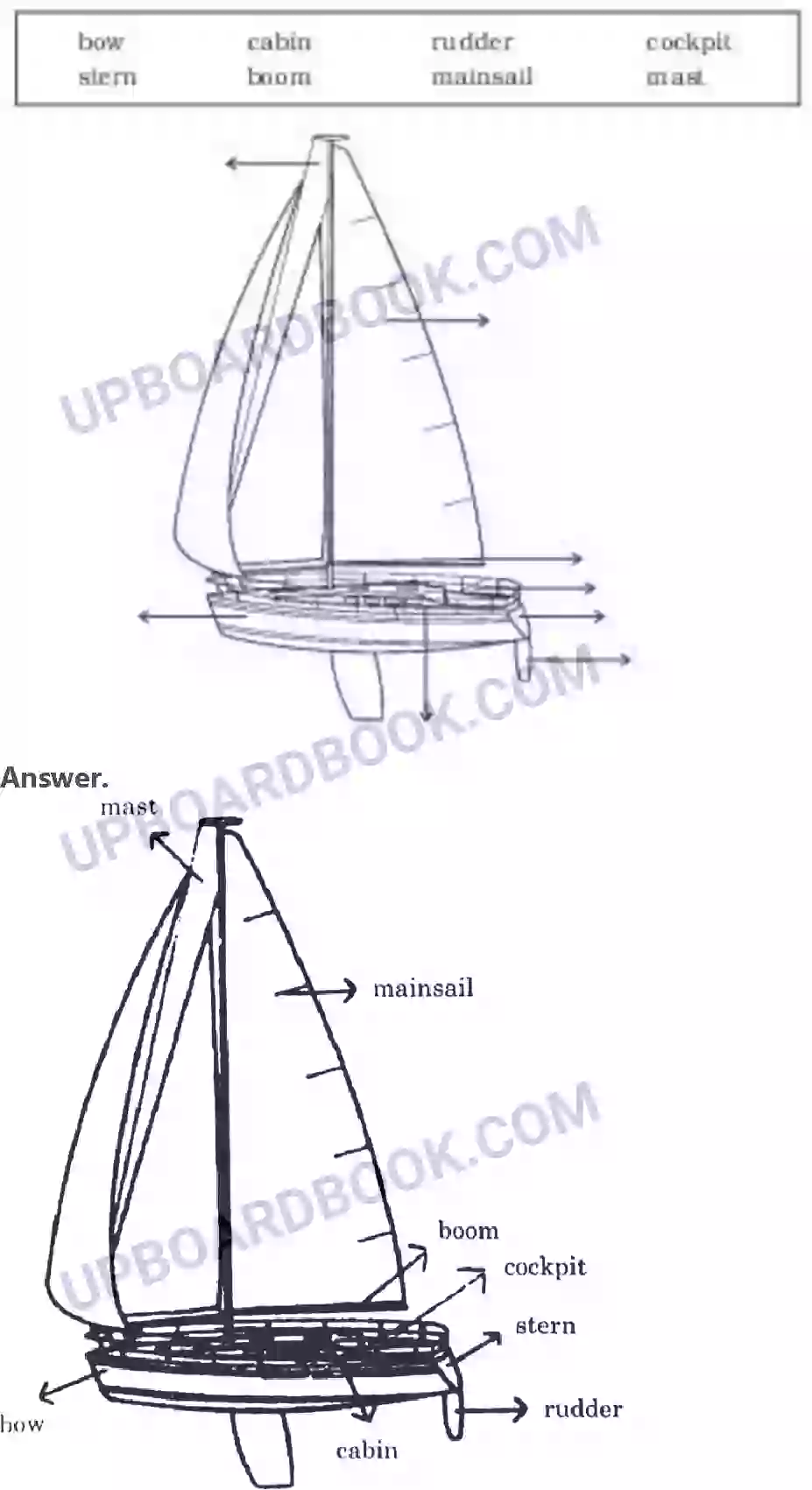
Q1. Given on the next page is a picture of a yacht. Label the parts of the yacht using the terms given in the box.
Answer: (Students are advised to label a diagram of a yacht with the following parts:)
Bow, Cabin, Rudder, Stern, Boom, Mainsail, Cockpit, Mast
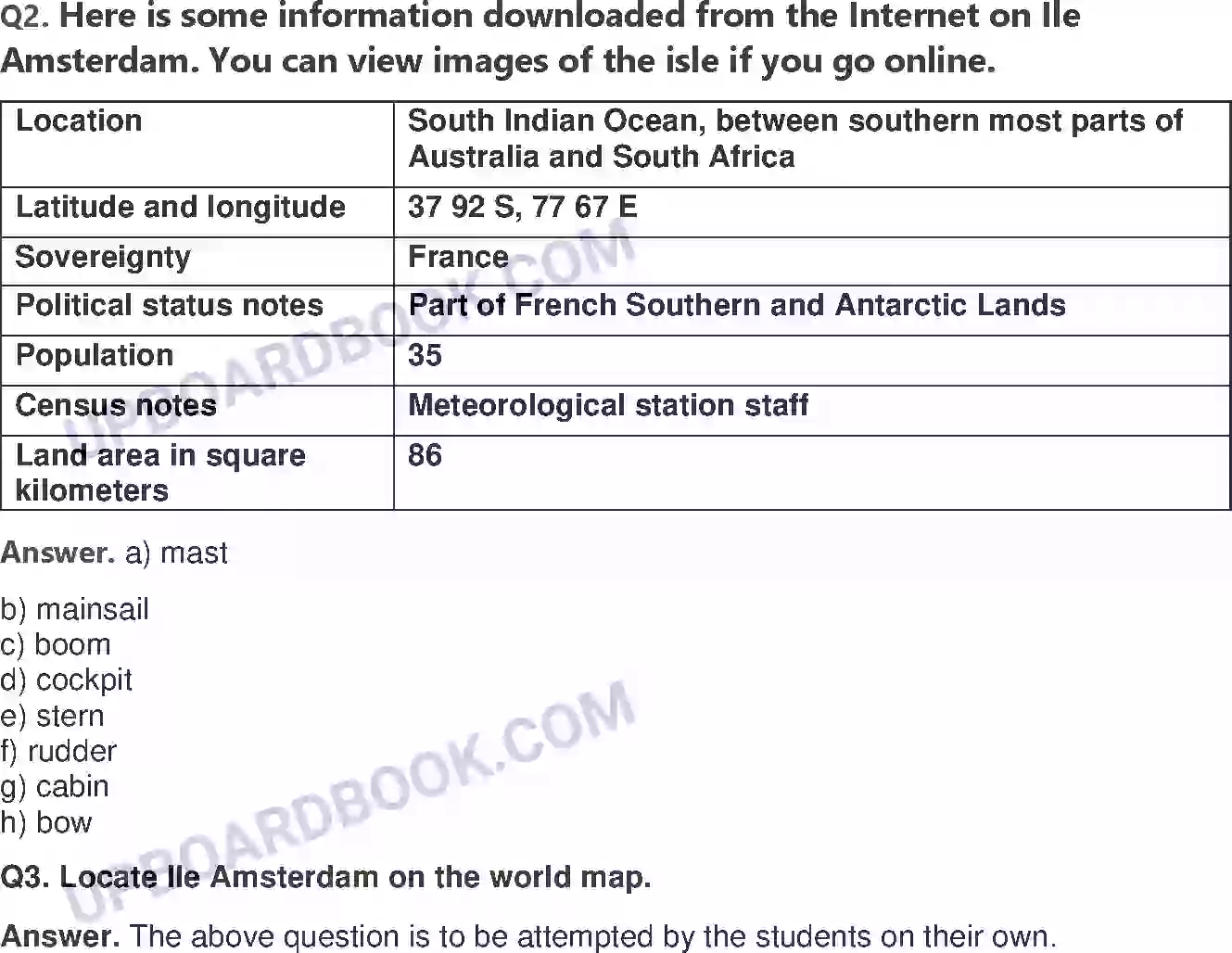
Q2. Here is some information downloaded from the Internet on Ile Amsterdam.
| Feature | Details |
|---|---|
| Location | South Indian Ocean, between southernmost parts of Australia and South Africa |
| Latitude and Longitude | 37°52' S, 77°34' E |
| Sovereignty | France |
| Political Status | Part of French Southern and Antarctic Lands |
| Population | About 30 (Non-permanent, meteorological station staff) |
| Land Area | Approximately 55 square kilometers |
Q3. Locate Ile Amsterdam on the world map.
Answer: Students are advised to locate Île Amsterdam on a world map using its coordinates (37°52' S, 77°34' E) in the South Indian Ocean.
Get UP Board class 11 English 2. We're Not Afraid to Die...if We Can All Be Together Solution in Hindi Medium
UP Board class 11 English 2. We're Not Afraid to Die...if We Can All Be Together Solution is available at our platform https://upboardbook.com in hindi medium for free of cost. Content provided on our website is free of cost and in PDF format which is easily available for download. Getting the UP Board Solutions for class 11 will help student to achieve good learning experience so that they can study effectively. UP board holds examination of more than 3 million students every year and majority of the question of exams are from their UP Board Solutions. That’s why it is important to study using the textSolution issued by UP Board.
Importance of UP Board class 11 English 2. We're Not Afraid to Die...if We Can All Be Together Text Solutions
It is essential to know the importance of UP Board class 11 English 2. We're Not Afraid to Die...if We Can All Be Together textSolution issued by UP Board because students completely rely on these Solutions for their study and syllabus offered by UP Board is so balanced that each student should be aware about the importance of it. Below is the list of Importance of UP Board class 11 English 2. We're Not Afraid to Die...if We Can All Be Together :
- These TextSolutions are very clear and accurate which helps student to understand concept with ease.
- It is also to mention that these text Solutions are prepared by the content experts of subject, thus these Solutions helps student in clearing their doubts and understand the core concept easily.
- It is considered to be the best study material for competitive exam preparation.
Features of UP Board class 11 textSolutions
There are various features of UP Board class 11 TextSolutions, some of them are mentioned below so that you student can understand the value and usability of the contend and understand why Uttarpradesh board has prescribed these Solutions.
- Best feature of these textSolutions is free availability of content in PDF format
- Second feature that content generated and written is clear and easy to read.
- There are various illustration and images are shown in the Solution so that student can easily understand the concept and should be more appealing to the student.
- Each chapter is explained thoroughly
