 UPBoardBook
UP Board class 11 English (6. The Third And Final Continent - (Short Stories)) solution PDF
UP Board class 11 English 6. The Third And Final Continent - (Short Stories) is a Hindi Medium Solution which is prescribed by Uttar Pradesh Board for their students. These Solutions is completely prepared considering the latest syllabus and it covers every single topis, so that every student get organised and conceptual learning of the concepts. class 11 Students of UP Board who have selected hindi medium as their study medium they can use these Hindi medium textSolutions to prepare themselves for exam and learn the concept with ease.
UP Board class 11 English 6. The Third And Final Continent - (Short Stories) Hindi Medium Solutions - PDF
Click Here to
UP Board Solutions for Class 11 English
Woven Words - Short Stories
Chapter 6: The Third And Final Continent
Understanding The Text
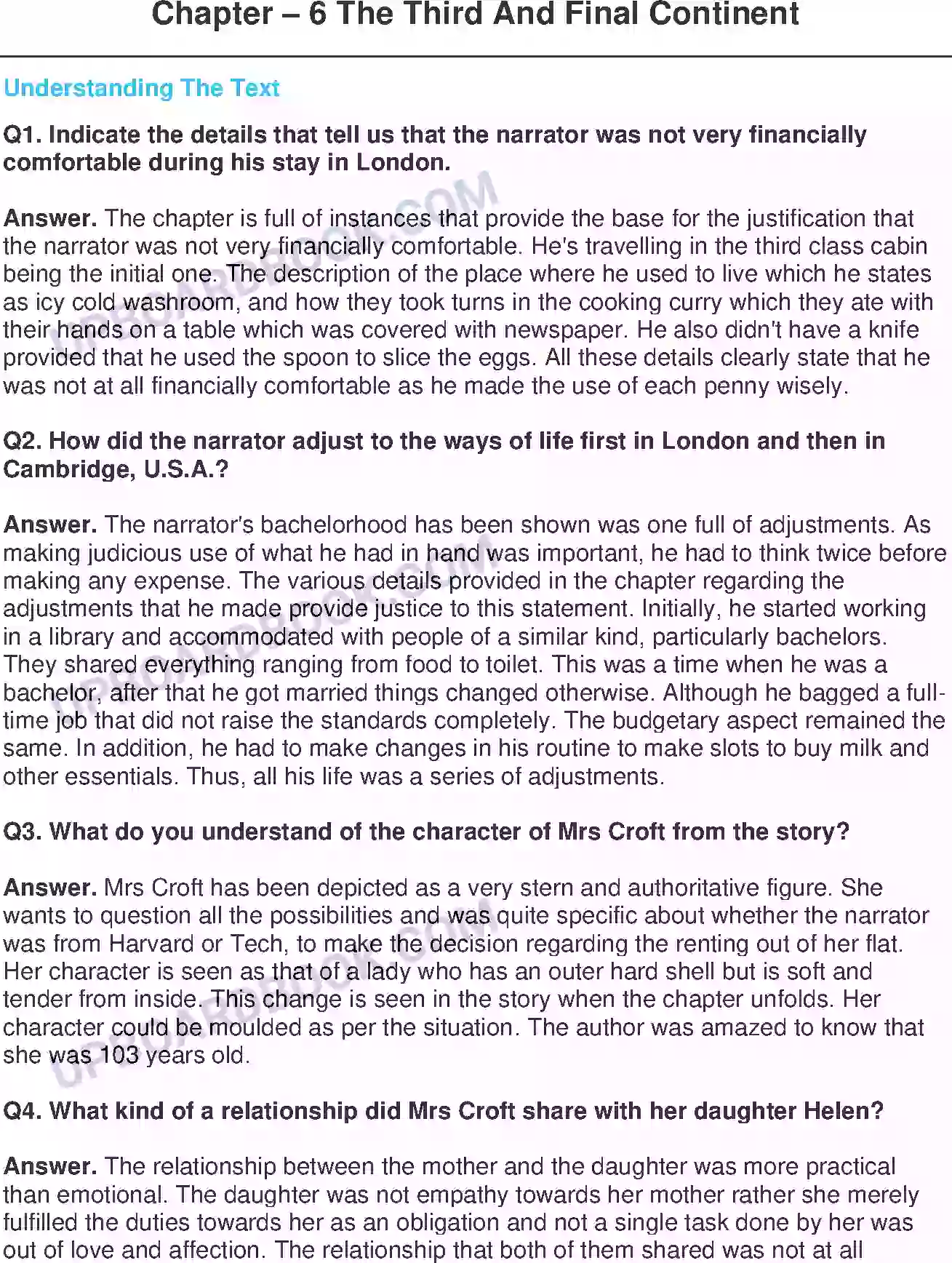
Q1. Indicate the details that tell us that the narrator was not very financially comfortable during his stay in London.
Answer: The story provides several clues about the narrator's financial struggles in London. He traveled in a third-class cabin on the ship. His living conditions were basic and shared; he describes an icy cold washroom and a routine where he and his roommates took turns cooking curry. They ate with their hands on a table covered with newspaper. A telling detail is his lack of a proper knife, forcing him to slice boiled eggs with a spoon. All these instances show he had to be very careful with his money.
Q2. How did the narrator adjust to the ways of life first in London and then in Cambridge, U.S.A.?
Answer: The narrator's life was a continuous process of adjustment. In London, as a bachelor, he worked in a library and lived frugally with other bachelors, sharing food and facilities to save money. Even after moving to Cambridge, USA, and getting a full-time job, his financial situation did not improve dramatically. He had to carefully budget and adjust his daily routine to manage chores like buying groceries. His entire journey involved adapting to new environments with limited resources.
Q3. What do you understand of the character of Mrs Croft from the story?
Answer: Mrs. Croft is initially portrayed as a stern, no-nonsense, and authoritative woman. She is very particular about her tenant, insisting on knowing if he is from "Harvard or Tech." However, beneath this tough exterior lies a person of warmth and resilience. The narrator is astonished to learn she is 103 years old. Her character softens as the story progresses, revealing a unique and endearing personality shaped by a long life and traditional values.
Q4. What kind of a relationship did Mrs Croft share with her daughter Helen?
Answer: The relationship between Mrs. Croft and her daughter Helen appears more dutiful than affectionate. Helen fulfills her responsibilities, like checking on her mother, but it seems driven by obligation rather than deep emotional connection. There is a noticeable lack of warmth and empathy in their interactions, highlighting a contrast to the close-knit family bonds often found in other cultures.
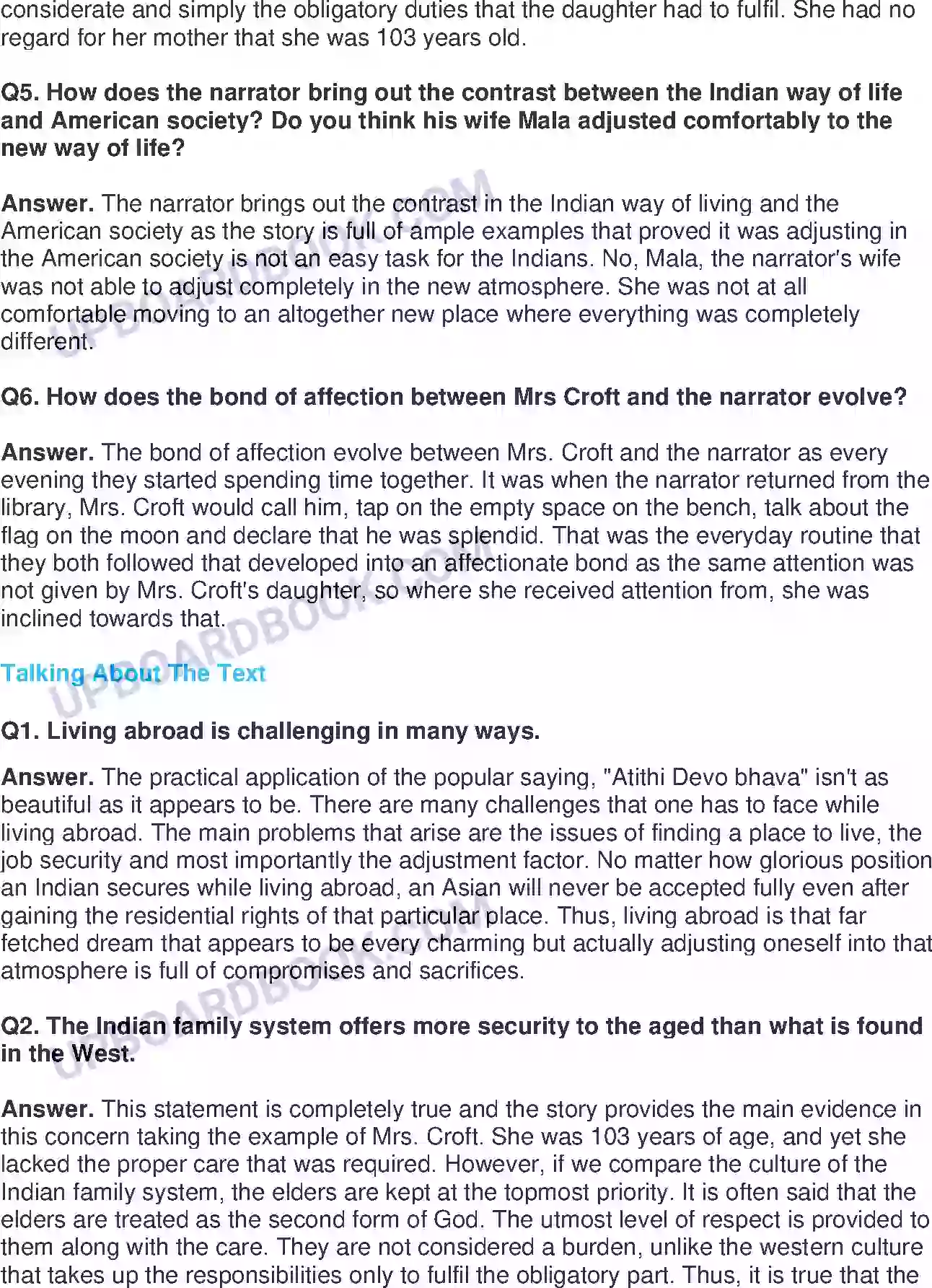
Q5. How does the narrator bring out the contrast between the Indian way of life and American society? Do you think his wife Mala adjusted comfortably to the new way of life?
Answer: The narrator highlights the contrast through his own experiences of frugality, adjustment, and cultural displacement. The story suggests that adapting to American society is challenging for Indians due to different social norms and a lack of familiar support systems. No, Mala did not adjust comfortably initially. Moving to a completely new environment with different customs was a significant and difficult change for her.
Q6. How does the bond of affection between Mrs Croft and the narrator evolve?
Answer: The bond grows through simple, consistent rituals. Every evening, upon the narrator's return, Mrs. Croft would call him to sit beside her on the bench. Their daily conversation about the American flag on the moon, ending with her declaration "Splendid!" and his required echo, became a cherished routine. This regular, respectful attention, which she did not receive from her own daughter, fostered a deep, affectionate connection between the two strangers.
Talking About The Text
Q1. Living abroad is challenging in many ways.
Answer: The story vividly illustrates that living abroad is a challenging dream. Beyond the initial hurdles of finding housing and job security, the deeper challenge lies in cultural adjustment and a sense of belonging. An individual often faces loneliness, has to make significant compromises, and may never feel fully accepted despite gaining legal residency. It involves a continuous process of sacrifice and adaptation to a foreign way of life.
Q2. The Indian family system offers more security to the aged than what is found in the West.
Answer: This statement finds strong support in the story through Mrs. Croft's situation. At 103, she lives alone and receives care that seems more obligatory than loving from her daughter. In contrast, the Indian family system traditionally places elders in a position of respect and honor, considering them the guiding force of the family. They are cared for within the family unit and are rarely left to live independently in old age, offering them greater emotional and physical security.
Q3. The eccentricities of the old are often endearing.
Answer: The story shows that the peculiar habits or "eccentricities" of the elderly can be charming. Mrs. Croft's rigid daily ritual of discussing the moon landing and insisting on the word "Splendid!" is a perfect example. While seemingly odd, these habits often stem from a lifetime of experiences and can evoke affection, much like the innocent and predictable nature of a child. They add uniqueness and warmth to their personality.
Appreciation
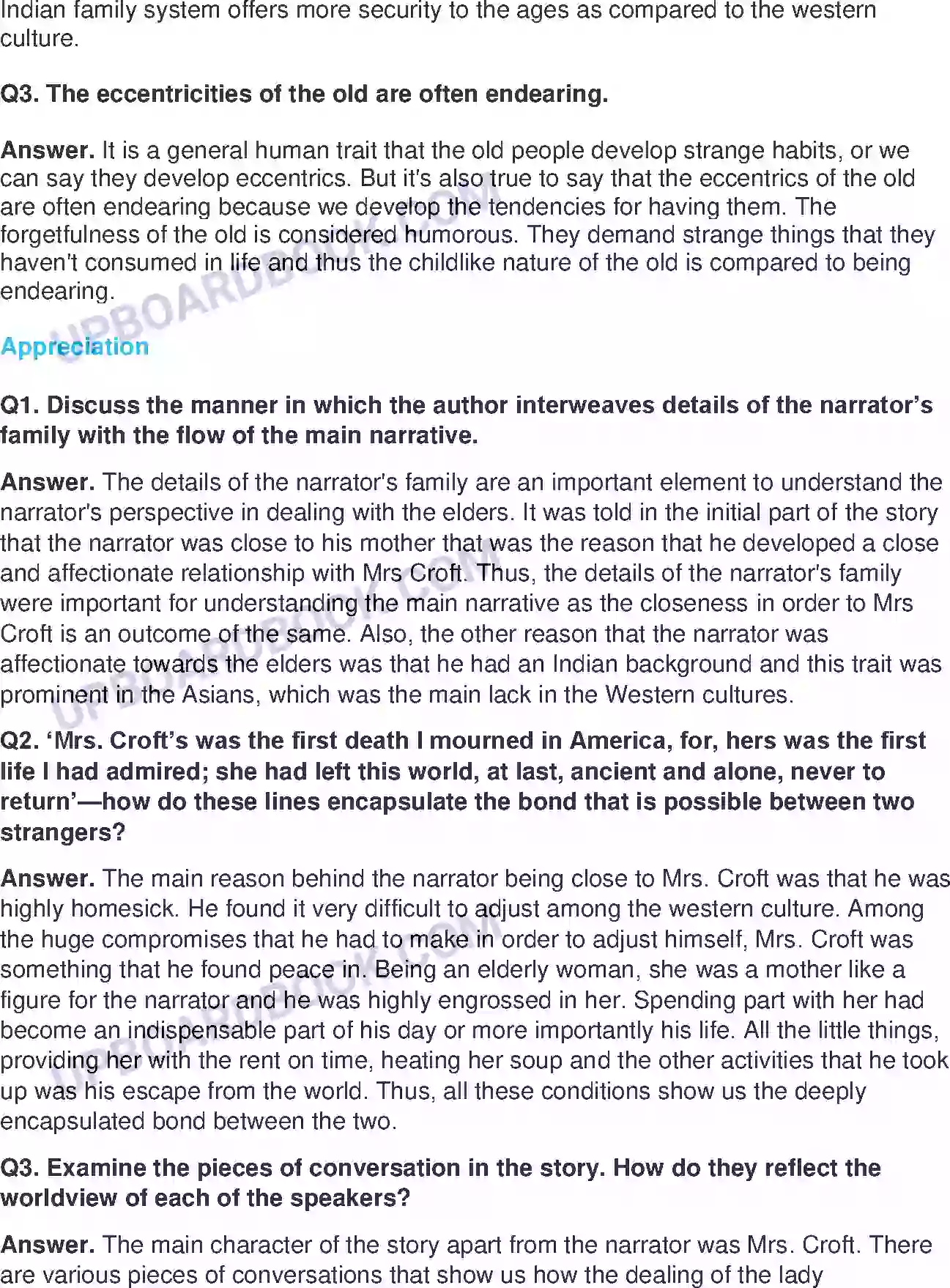
Q1. Discuss the manner in which the author interweaves details of the narrator’s family with the flow of the main narrative.
Answer: The author subtly weaves in the narrator's background to explain his actions. The narrator's closeness to his own mother in India is hinted at, which explains his natural respect and patience towards Mrs. Croft. His Indian upbringing, which emphasizes reverence for elders, directly contrasts with the Western individualism he encounters and fuels his empathetic bond with the lonely old woman. This background is crucial to understanding why he forms such a deep connection with her.
Q2. ‘Mrs. Croft’s was the first death I mourned in America, for, hers was the first life I had admired; she had left this world, at last, ancient and alone, never to return’—how do these lines encapsulate the bond that is possible between two strangers?
Answer: These powerful lines show that profound bonds are built on shared humanity, not just blood relations. In a new country where he felt like an outsider, Mrs. Croft became the narrator's first genuine human connection. Their daily interactions, though simple, were filled with mutual respect and consistency. Her death mattered to him because she was the first person whose spirit and resilience he truly admired in America. This highlights how deep affection can blossom between strangers through kindness, routine, and shared moments.
Q3. Examine the pieces of conversation in the story. How do they reflect the worldview of each of the speakers?
Answer: The dialogues reveal character perspectives clearly. Mrs. Croft's initial questions ("A Harvard man?") show her old-world values and judgment based on prestige. Her repeated "Splendid!" reflects her pride in a historic American achievement. The narrator's respectful and patient replies ("Yes, Madam") reveal his adaptable, polite nature and his cultural upbringing. Helen's brief, practical exchanges ("I come once a week to bring Mother groceries") show a transactional, duty-bound worldview, lacking emotional depth.
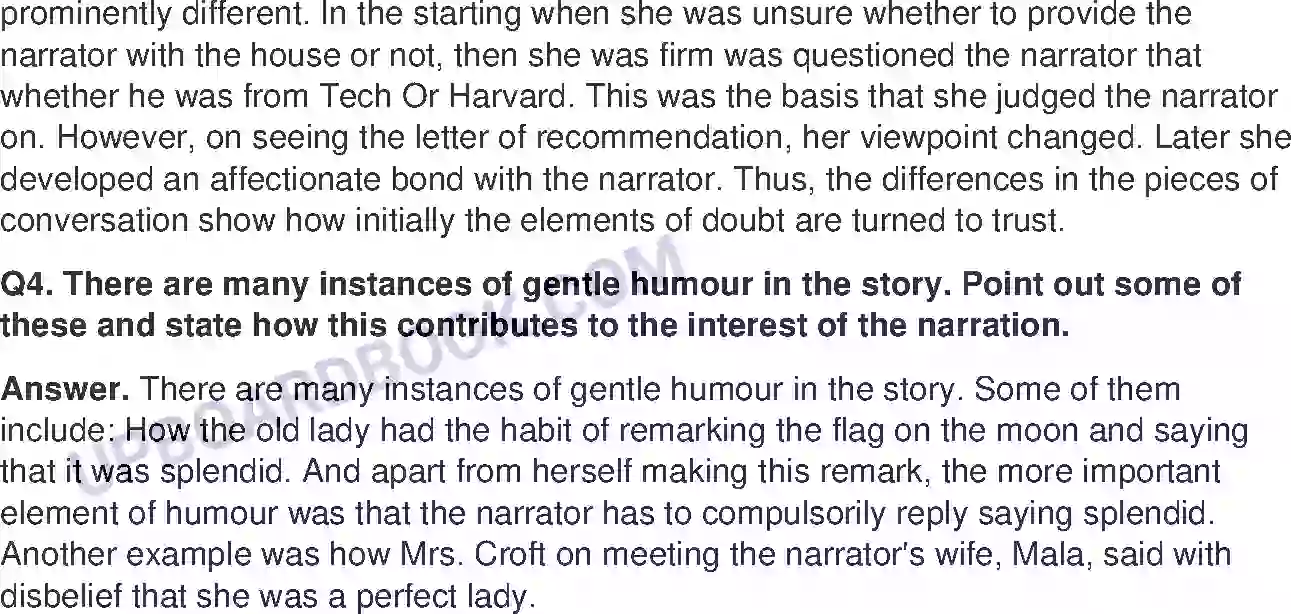
Q4. There are many instances of gentle humour in the story. Point out some of these and state how this contributes to the interest of the narration.
Answer: Gentle humor adds warmth and relatability to the story. Key instances include:
1. The rigid daily "Splendid!" ritual, which becomes a humorous yet touching game between them.
2. Mrs. Croft's shocked reaction upon seeing Mala in a sari: "She is a perfect lady!"
3. The narrator's description of using a spoon to slice eggs in London.
This humor prevents the story from becoming overly sentimental about struggle and loneliness. It makes the characters more endearing and their relationship more authentic, keeping the reader engaged with a light, human touch amidst the larger themes of displacement and connection.
Get UP Board class 11 English 6. The Third And Final Continent - (Short Stories) Solution in Hindi Medium
UP Board class 11 English 6. The Third And Final Continent - (Short Stories) Solution is available at our platform https://upboardbook.com in hindi medium for free of cost. Content provided on our website is free of cost and in PDF format which is easily available for download. Getting the UP Board Solutions for class 11 will help student to achieve good learning experience so that they can study effectively. UP board holds examination of more than 3 million students every year and majority of the question of exams are from their UP Board Solutions. That’s why it is important to study using the textSolution issued by UP Board.
Importance of UP Board class 11 English 6. The Third And Final Continent - (Short Stories) Text Solutions
It is essential to know the importance of UP Board class 11 English 6. The Third And Final Continent - (Short Stories) textSolution issued by UP Board because students completely rely on these Solutions for their study and syllabus offered by UP Board is so balanced that each student should be aware about the importance of it. Below is the list of Importance of UP Board class 11 English 6. The Third And Final Continent - (Short Stories) :
- These TextSolutions are very clear and accurate which helps student to understand concept with ease.
- It is also to mention that these text Solutions are prepared by the content experts of subject, thus these Solutions helps student in clearing their doubts and understand the core concept easily.
- It is considered to be the best study material for competitive exam preparation.
Features of UP Board class 11 textSolutions
There are various features of UP Board class 11 TextSolutions, some of them are mentioned below so that you student can understand the value and usability of the contend and understand why Uttarpradesh board has prescribed these Solutions.
- Best feature of these textSolutions is free availability of content in PDF format
- Second feature that content generated and written is clear and easy to read.
- There are various illustration and images are shown in the Solution so that student can easily understand the concept and should be more appealing to the student.
- Each chapter is explained thoroughly
