 UPBoardBook
UP Board class 11 English (26. The Story - (Essays)) solution PDF
UP Board class 11 English 26. The Story - (Essays) is a Hindi Medium Solution which is prescribed by Uttar Pradesh Board for their students. These Solutions is completely prepared considering the latest syllabus and it covers every single topis, so that every student get organised and conceptual learning of the concepts. class 11 Students of UP Board who have selected hindi medium as their study medium they can use these Hindi medium textSolutions to prepare themselves for exam and learn the concept with ease.
UP Board class 11 English 26. The Story - (Essays) Hindi Medium Solutions - PDF
Click Here to
UP Board Solutions for Class 11 English
Woven Words - Chapter 6: The Story (Essays)
Understanding The Text
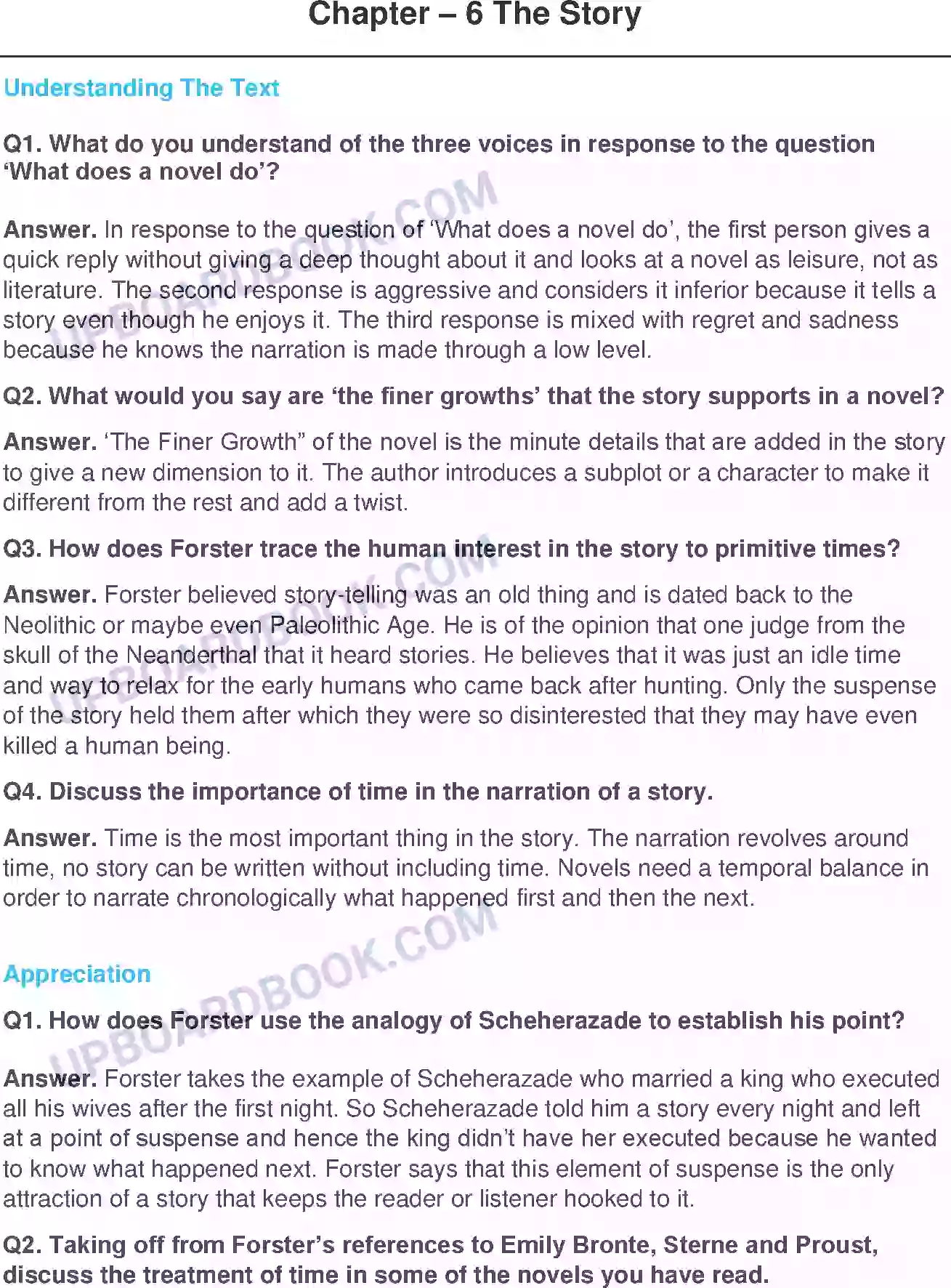
Q1. What do you understand of the three voices in response to the question ‘What does a novel do’?
Answer: The three voices represent different attitudes towards novels. The first voice gives a casual, unthinking reply, viewing a novel merely as a source of leisure, not serious literature. The second voice is dismissive and aggressive, considering novels inferior because they "just tell stories," even though the person secretly enjoys them. The third voice is tinged with regret and sadness, acknowledging the power of storytelling but feeling it operates on a lower intellectual plane.
Q2. What would you say are ‘the finer growths’ that the story supports in a novel?
Answer: 'The finer growths' refer to the intricate details, subplots, and character developments that grow from the basic story. These elements add depth, texture, and new dimensions to the narrative. They are what transform a simple sequence of events into a rich, layered literary work that offers more than just plot.
Q3. How does Forster trace the human interest in the story to primitive times?
Answer: Forster suggests that storytelling is a primal human instinct, dating back to the Neolithic or Paleolithic ages. He humorously speculates that even a Neanderthal skull might have listened to stories. He imagines early humans, resting after a hunt, being captivated by tales. The suspense of "what happens next" was the sole hook; once it was gone, their interest could vanish completely.
Q4. Discuss the importance of time in the narration of a story.
Answer: Time is the fundamental framework of a story. Narration is impossible without the concept of time, as it dictates the sequence of events—what happens first, next, and last. A novel requires a temporal structure to create a logical and engaging chronology, allowing the plot to unfold and characters to develop.
Appreciation
Q1. How does Forster use the analogy of Scheherazade to establish his point?
Answer: Forster uses the story of Scheherazade from Arabian Nights to highlight the primal power of suspense in storytelling. Scheherazade, sentenced to death, tells the king a story each night but stops at a cliffhanger. The king spares her life each day to hear the conclusion. This analogy perfectly illustrates Forster's point that the basic human craving to know "what happens next" is the core engine that drives a story forward.
Q2. Taking off from Forster’s references to Emily Bronte, Sterne and Proust, discuss the treatment of time in some of the novels you have read.
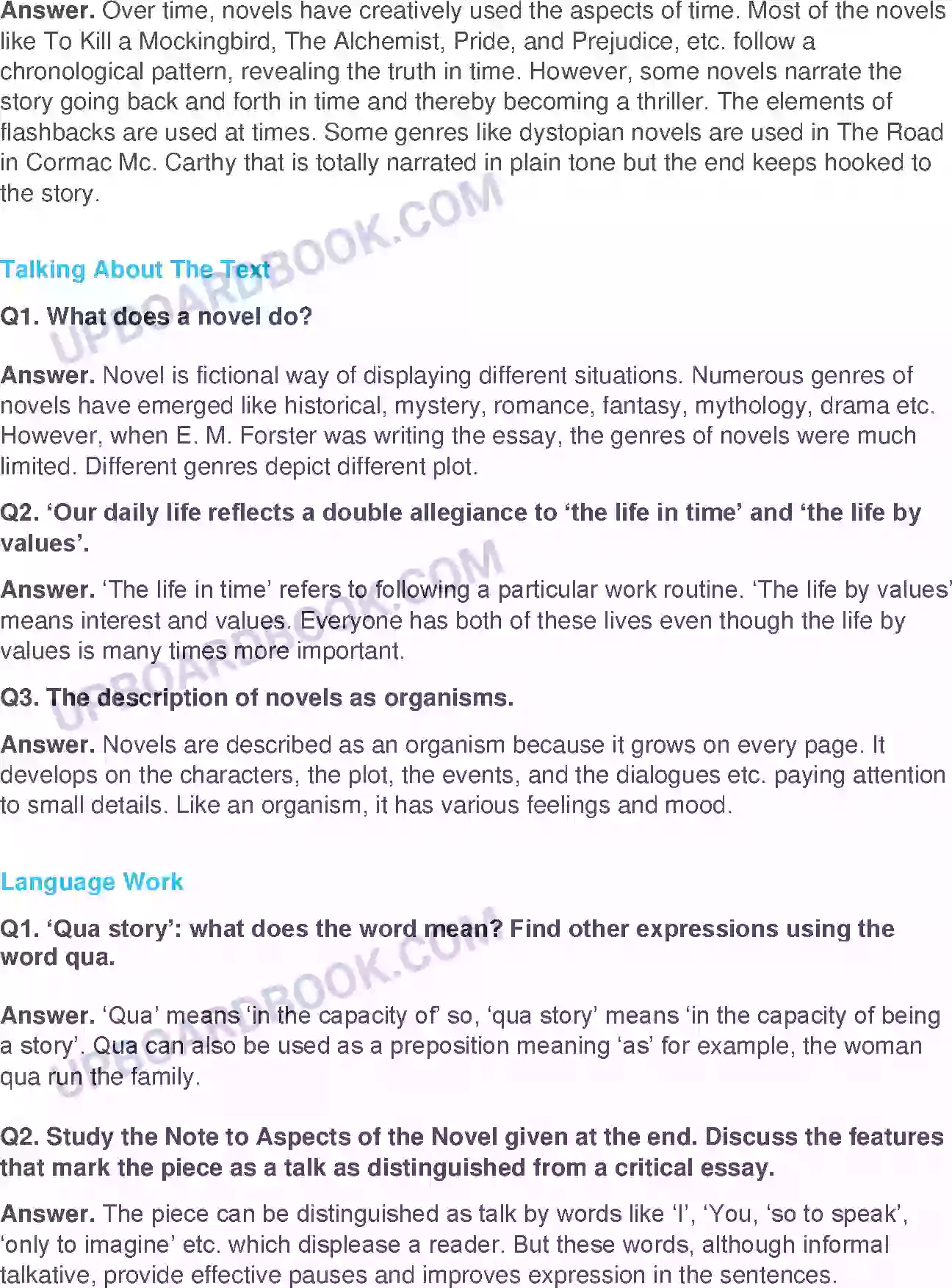
Answer: Novels treat time in diverse and creative ways. Many classic novels like Pride and Prejudice or To Kill a Mockingbird follow a linear, chronological timeline. Others, like many thrillers and mysteries, use flashbacks and non-linear narratives to build suspense and reveal secrets gradually. Some, like Cormac McCarthy's The Road, use a stark, present-tense narrative to create an immediate, timeless sense of dread, while the plot itself moves forward.
Talking About The Text
Q1. What does a novel do?
Answer: A novel is a long work of fiction that portrays human experience through characters, plot, and setting. It entertains, informs, and provokes thought. While in Forster's time genres were more limited, today novels span historical fiction, mystery, romance, science fiction, and more, each using its plot to explore different facets of life and society.
Q2. ‘Our daily life reflects a double allegiance to ‘the life in time’ and ‘the life by values’.
Answer: This statement means we live two parallel lives. 'The life in time' is our practical, chronological existence—our daily routines, schedules, and deadlines. 'The life by values' is our inner life of emotions, memories, principles, and meaningful experiences. While we navigate time, we are often guided and defined by our values.
Q3. The description of novels as organisms.
Answer: Describing a novel as an organism means it is a living, growing entity. It starts with a seed (an idea) and develops organically—characters evolve, plots twist, themes deepen, and details accumulate page by page. Like an organism, a novel has a structure, a pulse (pace), and can express a full range of human "moods" and emotions.
Language Work
Q1. ‘Qua story’: what does the word mean? Find other expressions using the word qua.
Answer: The word 'qua' is a preposition meaning 'in the capacity of' or 'as being'. So, 'qua story' means 'in its capacity as a story' or 'considered purely as a story'.
Other examples: The manager, qua manager, must make the final decision. We must consider this artifact qua historical evidence.
Q2. Study the Note to Aspects of the Novel given at the end. Discuss the features that mark the piece as a talk as distinguished from a critical essay.
Answer: The piece is clearly a transcribed lecture, not a formal essay. This is evident from its conversational tone, use of first-person ("I") and second-person ("you") pronouns, and informal phrases like "so to speak" or "only to imagine." These elements create a sense of direct address to an audience, with pauses and asides that make the content more engaging and accessible than a rigid, academic essay.
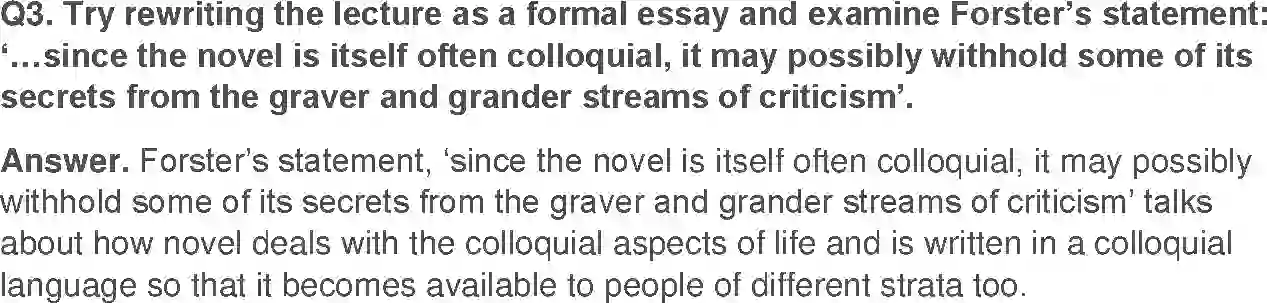
Q3. Try rewriting the lecture as a formal essay and examine Forster’s statement: ‘,..since the novel is itself often colloquial, it may possibly withhold some of its secrets from the graver and grander streams of criticism’.
Answer: Forster's statement suggests that novels, by their very nature, are deeply connected to everyday, colloquial life and language. Therefore, overly solemn, formal, or theoretical ("graver and grander") styles of literary criticism might fail to fully grasp the novel's essence. The novel's truths are often embedded in its casual dialogue, familiar settings, and common experiences, which require a more flexible and empathetic critical approach to uncover.
Get UP Board class 11 English 26. The Story - (Essays) Solution in Hindi Medium
UP Board class 11 English 26. The Story - (Essays) Solution is available at our platform https://upboardbook.com in hindi medium for free of cost. Content provided on our website is free of cost and in PDF format which is easily available for download. Getting the UP Board Solutions for class 11 will help student to achieve good learning experience so that they can study effectively. UP board holds examination of more than 3 million students every year and majority of the question of exams are from their UP Board Solutions. That’s why it is important to study using the textSolution issued by UP Board.
Importance of UP Board class 11 English 26. The Story - (Essays) Text Solutions
It is essential to know the importance of UP Board class 11 English 26. The Story - (Essays) textSolution issued by UP Board because students completely rely on these Solutions for their study and syllabus offered by UP Board is so balanced that each student should be aware about the importance of it. Below is the list of Importance of UP Board class 11 English 26. The Story - (Essays) :
- These TextSolutions are very clear and accurate which helps student to understand concept with ease.
- It is also to mention that these text Solutions are prepared by the content experts of subject, thus these Solutions helps student in clearing their doubts and understand the core concept easily.
- It is considered to be the best study material for competitive exam preparation.
Features of UP Board class 11 textSolutions
There are various features of UP Board class 11 TextSolutions, some of them are mentioned below so that you student can understand the value and usability of the contend and understand why Uttarpradesh board has prescribed these Solutions.
- Best feature of these textSolutions is free availability of content in PDF format
- Second feature that content generated and written is clear and easy to read.
- There are various illustration and images are shown in the Solution so that student can easily understand the concept and should be more appealing to the student.
- Each chapter is explained thoroughly
