 UPBoardBook
UP Board class 11 English (7. The Adventure) solution PDF
UP Board class 11 English 7. The Adventure is a Hindi Medium Solution which is prescribed by Uttar Pradesh Board for their students. These Solutions is completely prepared considering the latest syllabus and it covers every single topis, so that every student get organised and conceptual learning of the concepts. class 11 Students of UP Board who have selected hindi medium as their study medium they can use these Hindi medium textSolutions to prepare themselves for exam and learn the concept with ease.
UP Board class 11 English 7. The Adventure Hindi Medium Solutions - PDF
Click Here to

UP Board Solutions for Class 11 English Hornbill
Chapter 7: The Adventure
by Jayant Narlikar
Word Meanings from Context
Here are some important expressions from the chapter. Understand their meanings from how they are used in the story.
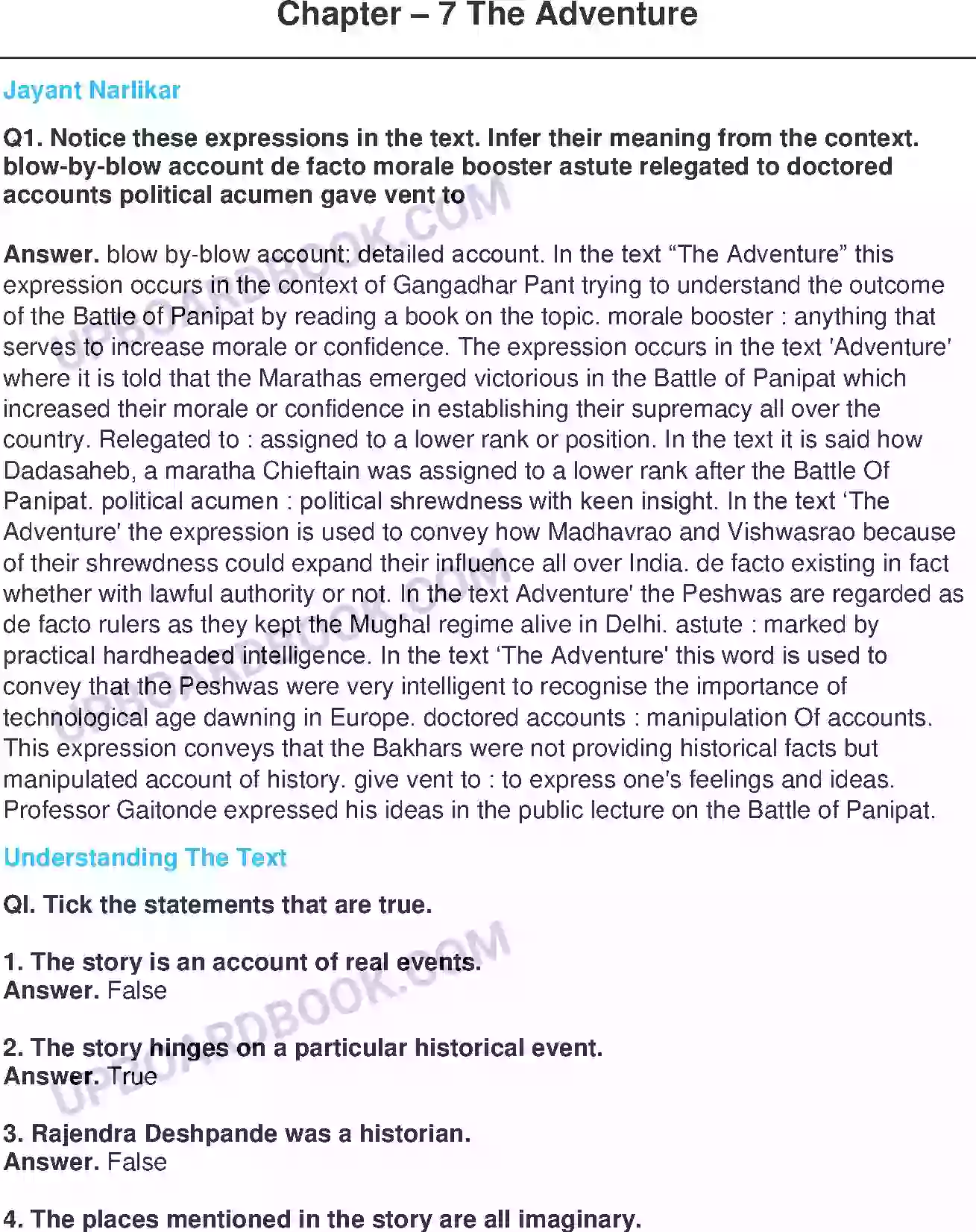
- blow-by-blow account: A very detailed, step-by-step description of an event.
- morale booster: Something that increases confidence and enthusiasm.
- relegated to: Assigned to a lower or less important position.
- political acumen: Sharp judgment and shrewdness in political matters.
- de facto: Existing in fact, even if not officially recognized by law.
- astute: Very clever, sharp, and practical in understanding situations.
- doctored accounts: False or manipulated records of events.
- gave vent to: Expressed a strong feeling freely.
Understanding The Text
Q1. Tick the statements that are true.
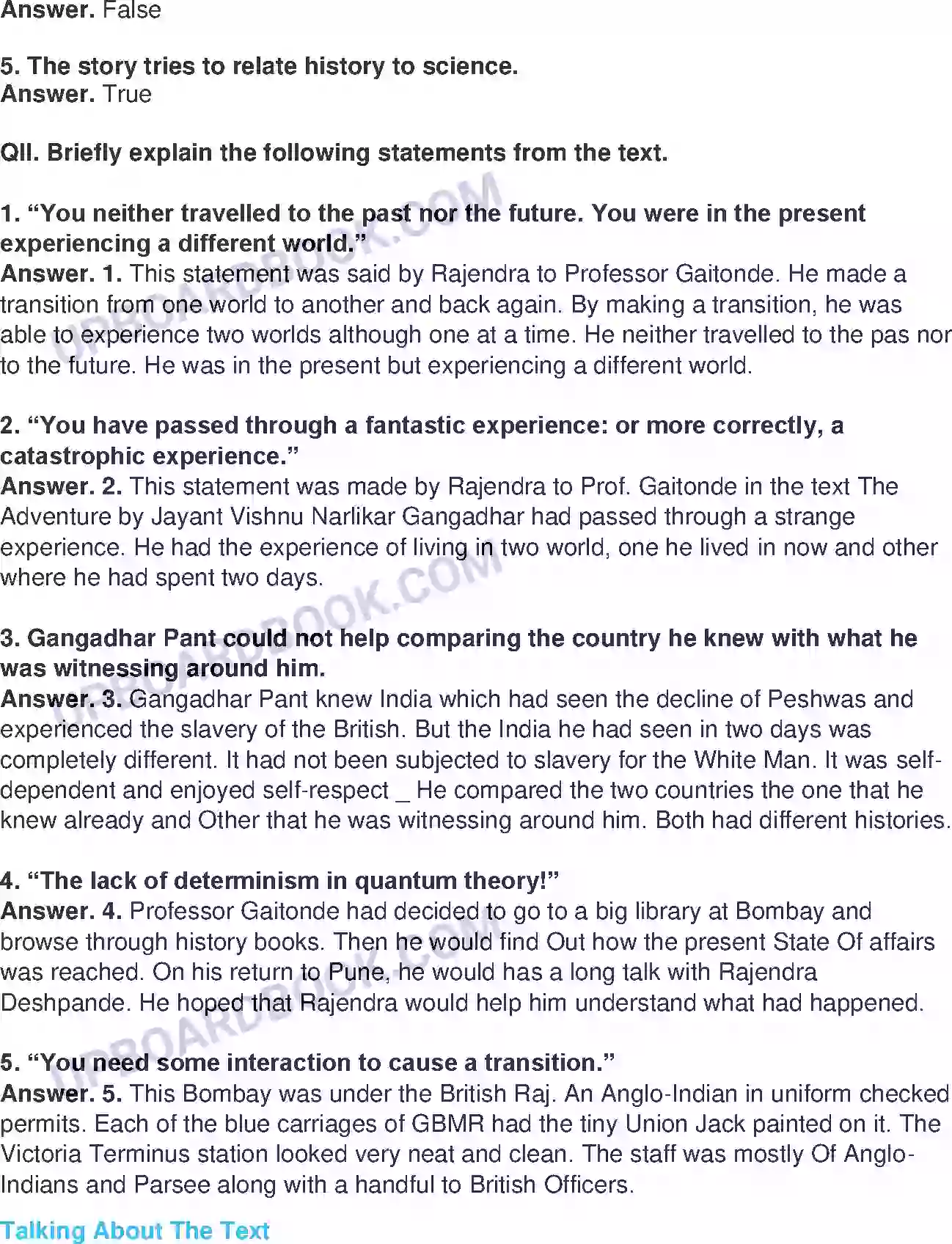
- The story is an account of real events. (False) - It is a work of fiction exploring an alternate reality.
- The story hinges on a particular historical event. (True) - The Battle of Panipat is the central historical event.
- Rajendra Deshpande was a historian. (False) - He was a scientist who helped explain the phenomenon.
- The places mentioned in the story are all imaginary. (False) - Places like Pune, Bombay, and the Victoria Terminus are real.
- The story tries to relate history to science. (True) - It uses scientific theories to explain historical possibilities.
Q2. Briefly explain the following statements from the text.
1. “You neither travelled to the past nor the future. You were in the present experiencing a different world.”
This was said by Rajendra to Professor Gaitonde. He explained that the Professor did not time-travel. Instead, due to a catastrophic phenomenon, his consciousness shifted to a different present—a parallel reality where history had taken another course. He experienced this alternate world while still being in the "present" moment.
2. “You have passed through a fantastic experience: or more correctly, a catastrophic experience.”
Rajendra described the Professor's journey as "catastrophic," referring to the "Catastrophe Theory" in science. Just as a single push can make a ball settle into a different valley, a critical moment (his collision) shifted the Professor's experience from one reality to another, making him witness a world where the Marathas won at Panipat.
3. Gangadhar Pant could not help comparing the country he knew with what he was witnessing around him.
Professor Gaitonde knew an India that had been under British rule. In the alternate reality, he witnessed a self-reliant, proud India that was never colonized because the Marathas had won at Panipat. The stark contrast between the enslaved India he knew and the independent India he saw forced him to constantly compare the two.
4. “The lack of determinism in quantum theory!”
Rajendra used this principle from physics to explain the Professor's experience. In quantum physics, particles don't have a single definite state; they exist in multiple potential states. Similarly, history might not have a single predetermined course. The Battle of Panipat could have had multiple potential outcomes, and the Professor experienced one of them.
5. “You need some interaction to cause a transition.”
This refers to the scientific idea that a system needs a trigger or interaction to move from one state to another. For Professor Gaitonde, the violent interaction—the collision with the truck—acted as the trigger that caused his transition from one reality to the parallel one.
Talking About The Text
Q1. Discuss the following statements in groups.
(i) A single event may change the course of the history of a nation.
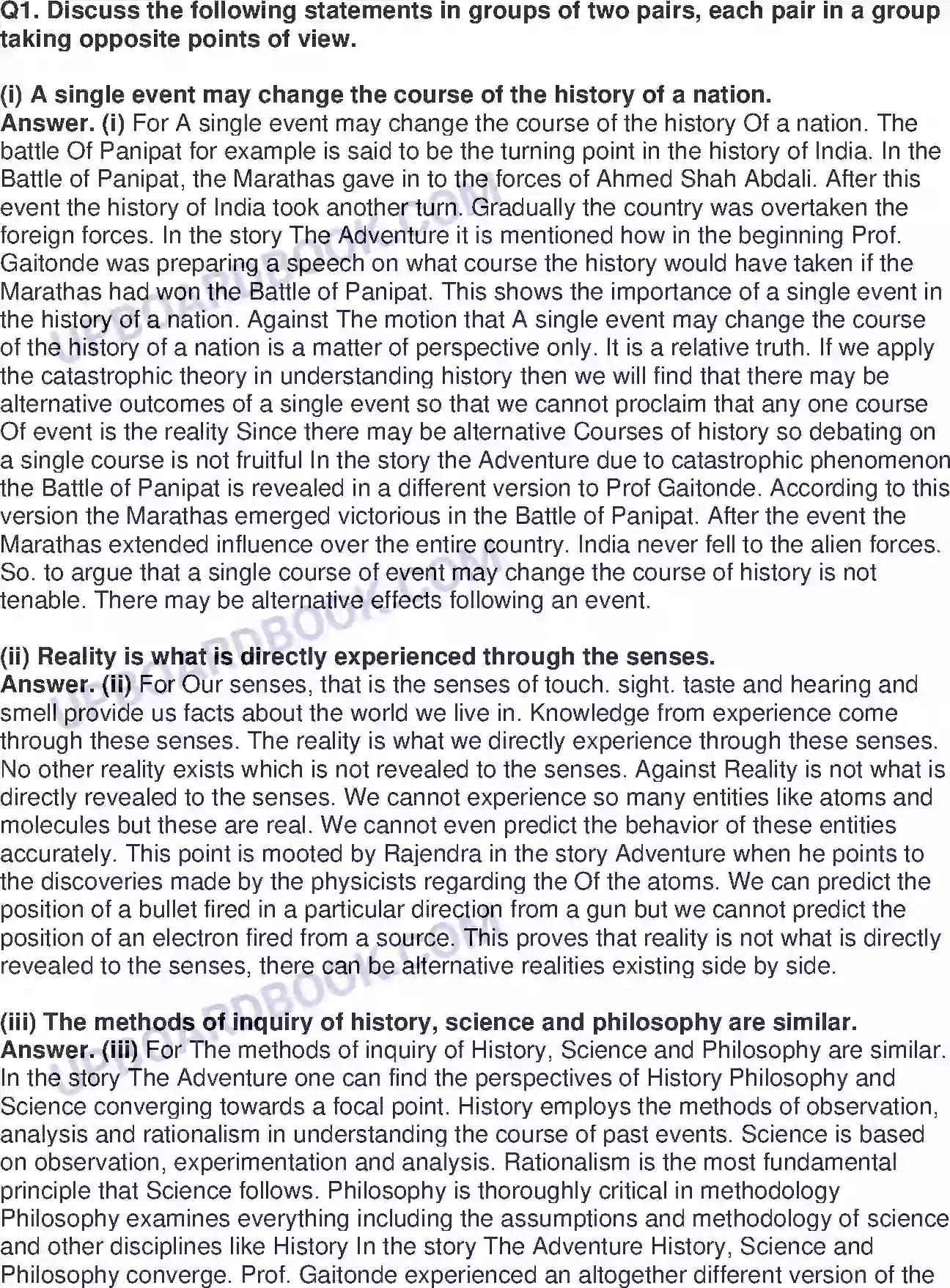
For the view: Yes, pivotal events like battles, decisions, or discoveries can dramatically alter a nation's path. The story itself imagines how a Maratha victory at Panipat could have prevented British colonization, showing how one battle's result changed everything.
Against the view: History is shaped by long-term social, economic, and cultural forces, not just single events. An event is often just the climax of deeper processes. The story also suggests there may be multiple potential histories, not just one changed course.
(ii) Reality is what is directly experienced through the senses.
For the view: Our primary knowledge of the world comes from sight, sound, touch, taste, and smell. What we directly perceive forms our undeniable, shared reality.
Against the view: Reality is more complex. Science reveals entities like atoms that we cannot sense directly. The story challenges this idea by presenting an alternate reality that felt just as real to Professor Gaitonde, suggesting reality might be multi-layered.
(iii) The methods of inquiry of history, science and philosophy are similar.
For the view: All three disciplines rely on observation, logic, reasoning, and analysis to seek truth. They question assumptions and build theories based on evidence, as seen when Rajendra uses a scientific theory to explain a historical "what-if" scenario.
Against the view: Their core methods differ. History interprets past evidence, science conducts repeatable experiments, and philosophy uses abstract reasoning and skepticism. They ask different kinds of questions and validate answers in distinct ways.
Q2. Answer the following questions.
(i) Compare this adventure with the one in ‘We’re Not Afraid to Die…’
Both stories involve overcoming great challenges, but the nature of the adventure is different. In ‘We’re Not Afraid to Die…’, the adventure is physical and real—a family battling a stormy sea for survival. In ‘The Adventure’, the challenge is intellectual and psychological—Professor Gaitonde grappling with a shifted reality and the mind-bending implications for history and science.
(ii) Why did Professor Gaitonde decide never to preside over meetings again?
In the alternate reality, during a public lecture, Professor Gaitonde saw an empty presidential chair. Assuming the chair was for him, he sat on it and began speaking, breaking the convention of that world where such lectures had no chairperson. The angry crowd threw objects at him, creating a humiliating and frightening experience. This trauma made him vow never to preside over a meeting again.
Thinking About Language
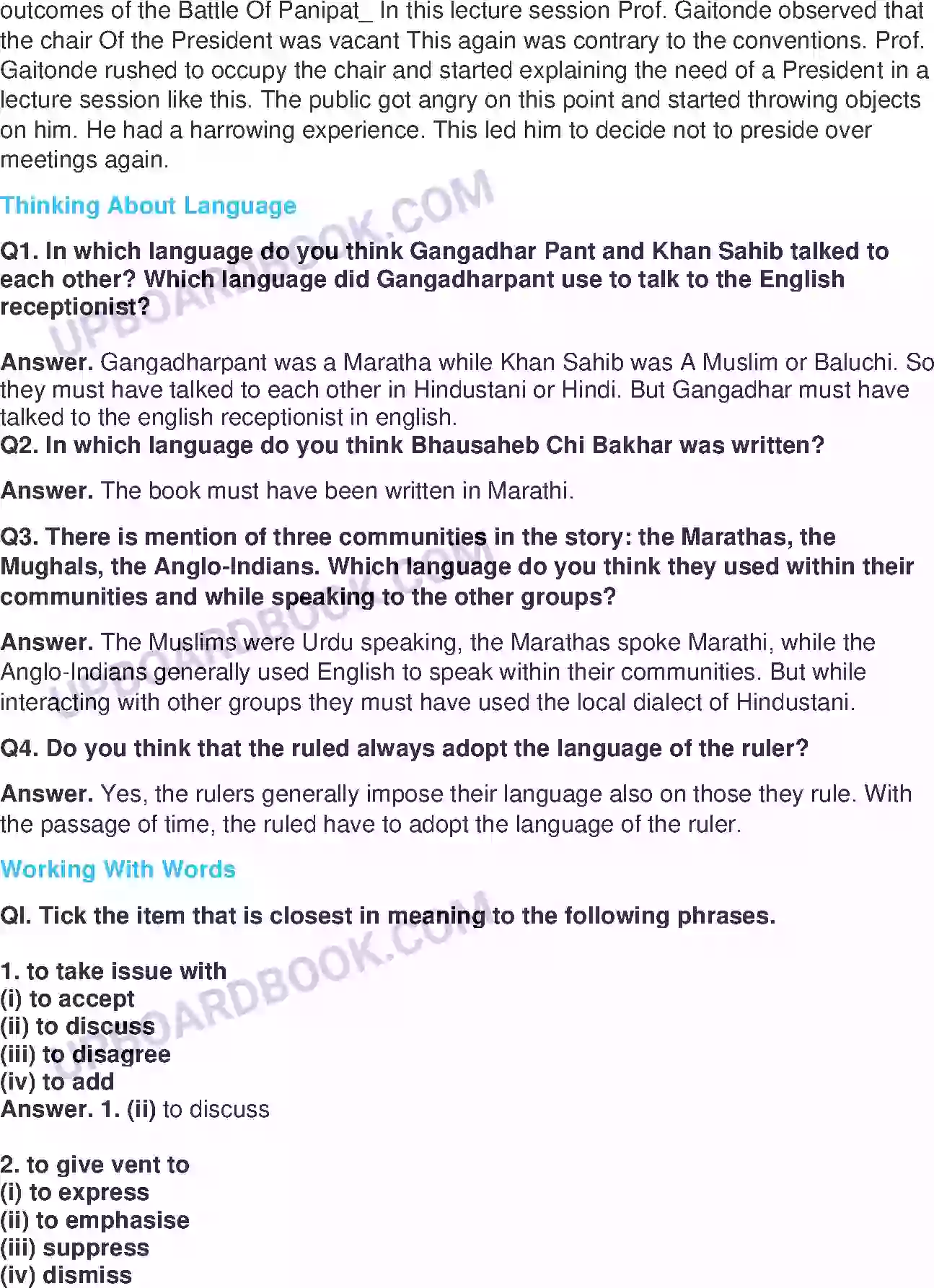
- Gangadhar Pant and Khan Sahib most likely conversed in Hindustani (Hindi-Urdu), the common lingua franca. Gangadhar with the English receptionist would have used English.
- Bhausaheb Chi Bakhar, being a Maratha historical text, was written in Marathi.
- Within their communities: Marathas spoke Marathi, Mughals spoke Persian (court) and Urdu, Anglo-Indians spoke English. To communicate with each other, they likely used a form of Hindustani or the local dialect.
- Often, the ruled do adopt the ruler's language for official work, education, and social advancement, but local languages continue to thrive in daily life and culture.
Working With Words
Q1. Tick the closest meaning.
- to take issue with – (iii) to disagree
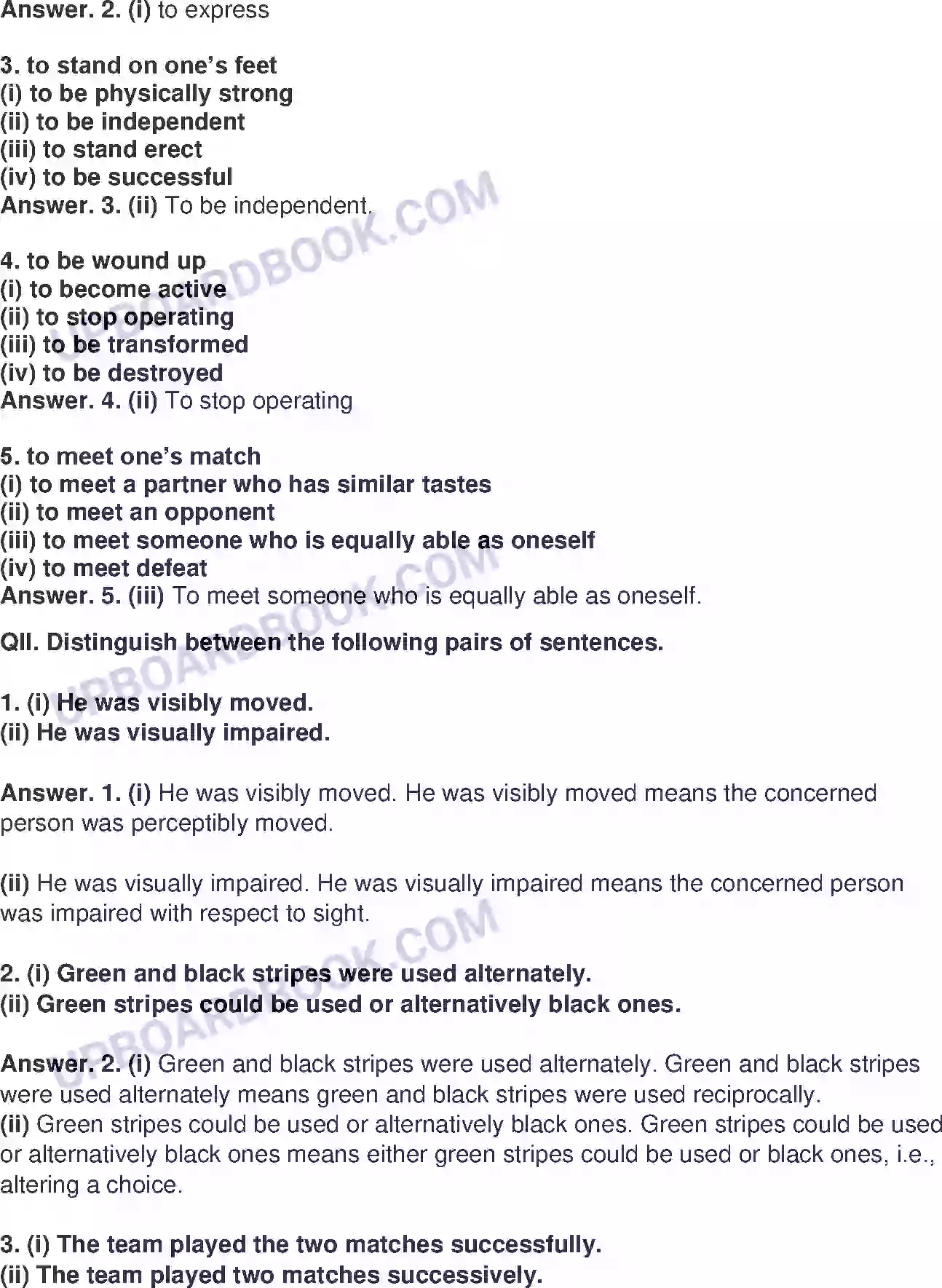
- to give vent to – (i) to express
- to stand on one’s feet – (ii) to be independent
- to be wound up – (ii) to stop operating
- to meet one’s match – (iii) to meet someone who is equally able as oneself
Q2. Distinguish between the pairs of sentences.
- (i) He was visibly moved. – His emotions were clearly seen/noticeable.
(ii) He was visually impaired. – He had a disability related to sight. - (i) Green and black stripes were used alternately. – First a green stripe, then a black, then green, and so on in a repeating order.
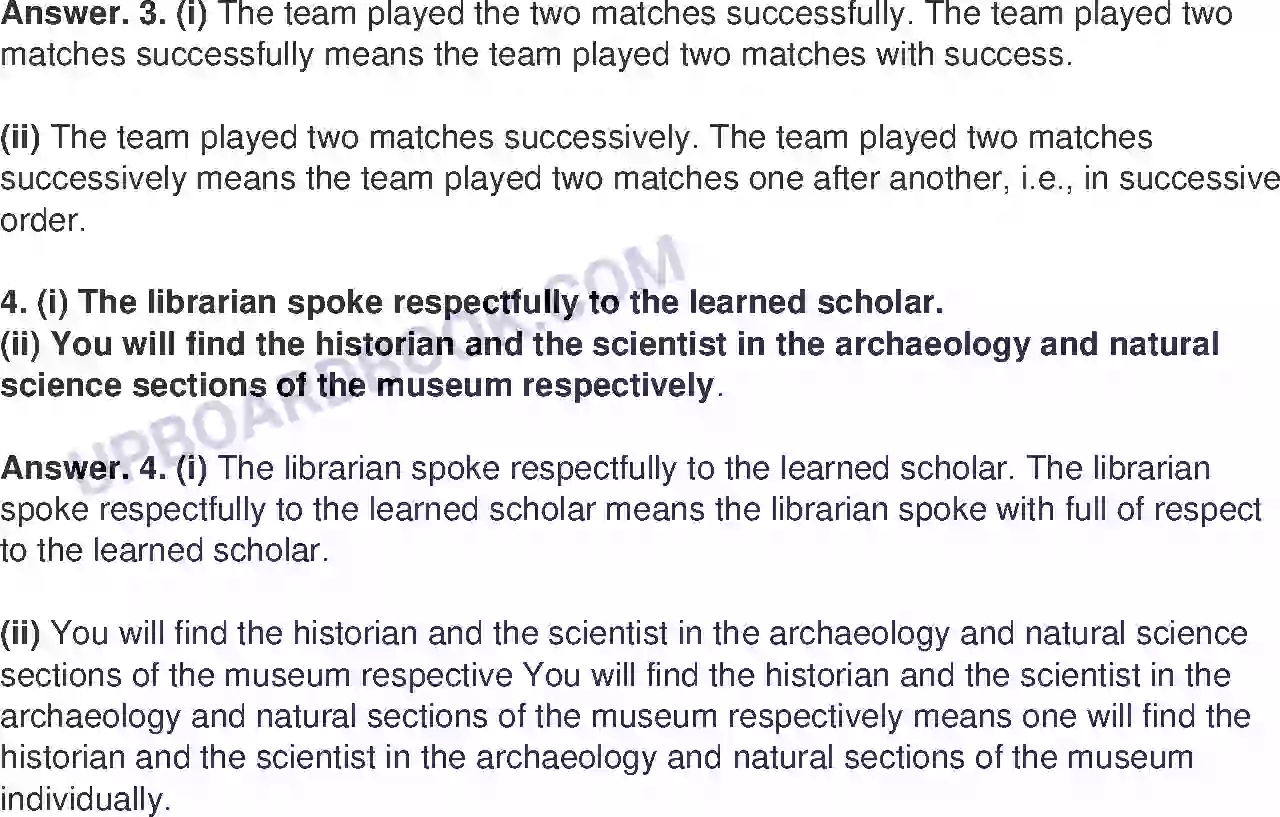
(ii) Green stripes could be used or alternatively black ones. – You have a choice: use either green stripes or, as another option, black stripes. - (i) The team played the two matches successfully. – The team won (or performed well in) both matches.
(ii) The team played two matches successively. – The team played two matches one after the other, in a row. - (i) The librarian spoke respectfully to the learned scholar. – The librarian showed respect in her manner of speaking.
(ii) You will find the historian and the scientist in the archaeology and natural science sections of the museum respectively. – The historian is in the archaeology section, and the scientist is in the natural science section (in that same order).
Get UP Board class 11 English 7. The Adventure Solution in Hindi Medium
UP Board class 11 English 7. The Adventure Solution is available at our platform https://upboardbook.com in hindi medium for free of cost. Content provided on our website is free of cost and in PDF format which is easily available for download. Getting the UP Board Solutions for class 11 will help student to achieve good learning experience so that they can study effectively. UP board holds examination of more than 3 million students every year and majority of the question of exams are from their UP Board Solutions. That’s why it is important to study using the textSolution issued by UP Board.
Importance of UP Board class 11 English 7. The Adventure Text Solutions
It is essential to know the importance of UP Board class 11 English 7. The Adventure textSolution issued by UP Board because students completely rely on these Solutions for their study and syllabus offered by UP Board is so balanced that each student should be aware about the importance of it. Below is the list of Importance of UP Board class 11 English 7. The Adventure :
- These TextSolutions are very clear and accurate which helps student to understand concept with ease.
- It is also to mention that these text Solutions are prepared by the content experts of subject, thus these Solutions helps student in clearing their doubts and understand the core concept easily.
- It is considered to be the best study material for competitive exam preparation.
Features of UP Board class 11 textSolutions
There are various features of UP Board class 11 TextSolutions, some of them are mentioned below so that you student can understand the value and usability of the contend and understand why Uttarpradesh board has prescribed these Solutions.
- Best feature of these textSolutions is free availability of content in PDF format
- Second feature that content generated and written is clear and easy to read.
- There are various illustration and images are shown in the Solution so that student can easily understand the concept and should be more appealing to the student.
- Each chapter is explained thoroughly
