 UPBoardBook
UP Board class 11 English (3. Discovering Tut The Saga Continues) solution PDF
UP Board class 11 English 3. Discovering Tut The Saga Continues is a Hindi Medium Solution which is prescribed by Uttar Pradesh Board for their students. These Solutions is completely prepared considering the latest syllabus and it covers every single topis, so that every student get organised and conceptual learning of the concepts. class 11 Students of UP Board who have selected hindi medium as their study medium they can use these Hindi medium textSolutions to prepare themselves for exam and learn the concept with ease.
UP Board class 11 English 3. Discovering Tut The Saga Continues Hindi Medium Solutions - PDF
Click Here to

Chapter 3: Discovering Tut - The Saga Continues
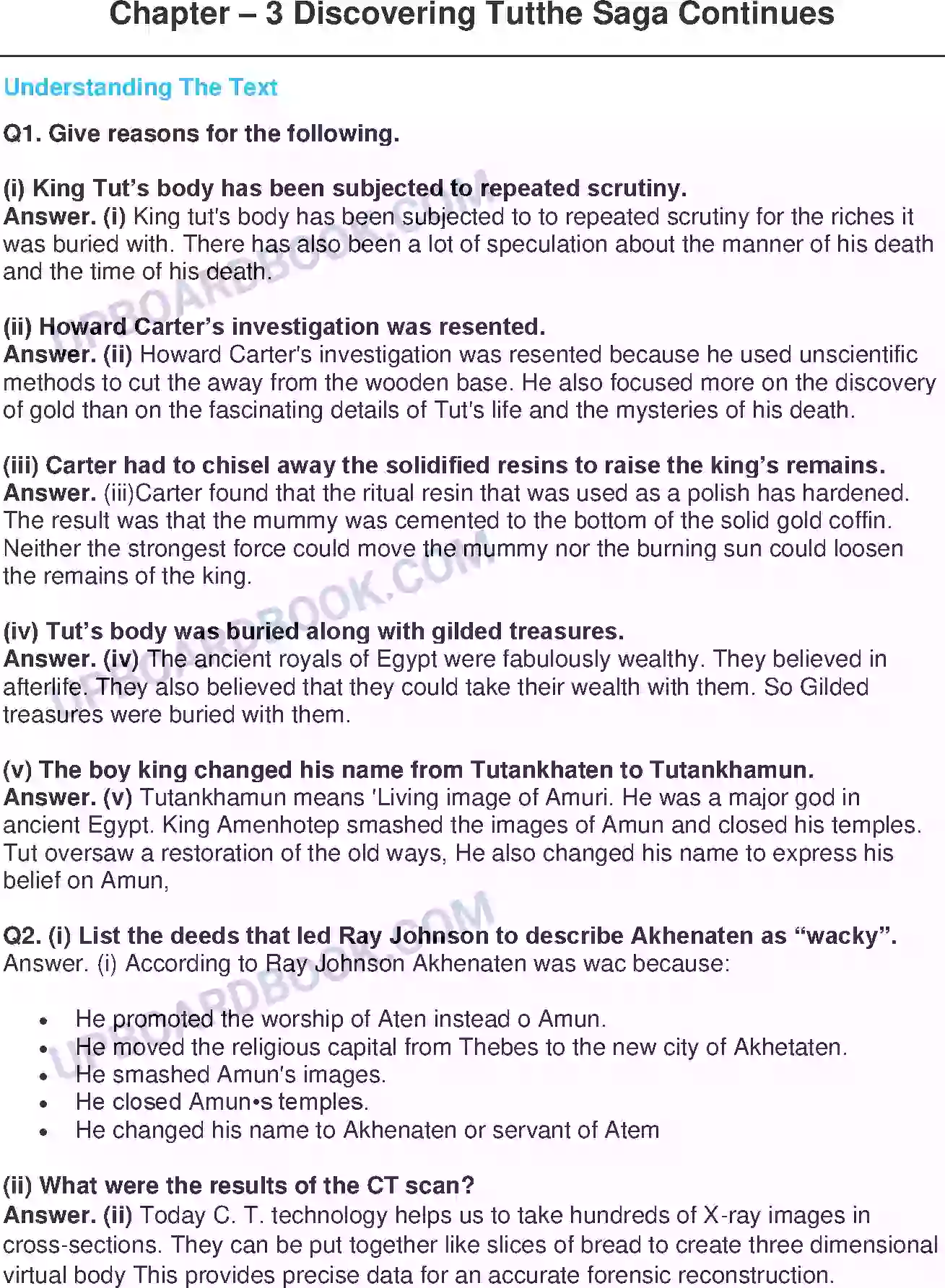
Understanding The Text
Q1. Give reasons for the following.
(i) King Tut’s body has been subjected to repeated scrutiny.
Answer: King Tut's mummy has been examined repeatedly for two main reasons. First, the incredible wealth of gold and artifacts he was buried with has always fascinated archaeologists and historians. Second, there has been ongoing mystery and speculation about the cause and the timing of his untimely death, prompting scientists to use newer technologies to find answers.
(ii) Howard Carter’s investigation was resented.
Answer: Howard Carter's methods were criticized because he used unscientific and forceful means to separate the mummy from its coffin, damaging it in the process. He was also resented for being more focused on collecting the golden treasures than on preserving historical evidence or respectfully studying the king's life and death.
(iii) Carter had to chisel away the solidified resins to raise the king’s remains.
Answer: Carter faced a problem because the ritual resins used in the mummification process had hardened over centuries, acting like a powerful glue. This had cemented the mummy firmly to the bottom of the solid gold coffin. Even the scorching desert sun could not loosen it, forcing Carter to chisel the remains free.
(iv) Tut’s body was buried along with gilded treasures.
Answer: The ancient Egyptian royals believed in an afterlife where they could continue their royal existence. They thought they could take their worldly riches with them. Therefore, to ensure a luxurious afterlife, King Tut was buried with a magnificent collection of gilded treasures, jewelry, and everyday objects made of gold.
(v) The boy king changed his name from Tutankhaten to Tutankhamun.
Answer: Tutankhamun means 'Living image of Amun'. His father, Akhenaten, had rejected the god Amun and promoted the worship of Aten. When Tut became pharaoh, he restored the old religious order. Changing his name to Tutankhamun was a powerful symbolic act to declare his faith in Amun and undo his father's reforms.
Q2.
(i) List the deeds that led Ray Johnson to describe Akhenaten as “wacky”.
Answer: Ray Johnson considered Pharaoh Akhenaten "wacky" for his radical and sudden religious reforms, which included:
- Promoting the worship of the sun-disk, Aten, as the sole god, rejecting the traditional pantheon.
- Smashing the statues of the major god, Amun, and closing his temples.
- Moving the entire religious capital from Thebes to a new city, Akhetaten.
- Changing his own name from Amenhotep IV to Akhenaten ("Servant of Aten").
(ii) What were the results of the CT scan?
Answer: The CT scan of Tut's mummy provided a detailed three-dimensional virtual image of his body. It helped reveal new forensic details, such as the condition of his bones and possible injuries. The scan offered crucial data that could help determine the cause of his death and provided a digital record without disturbing the physical remains further.
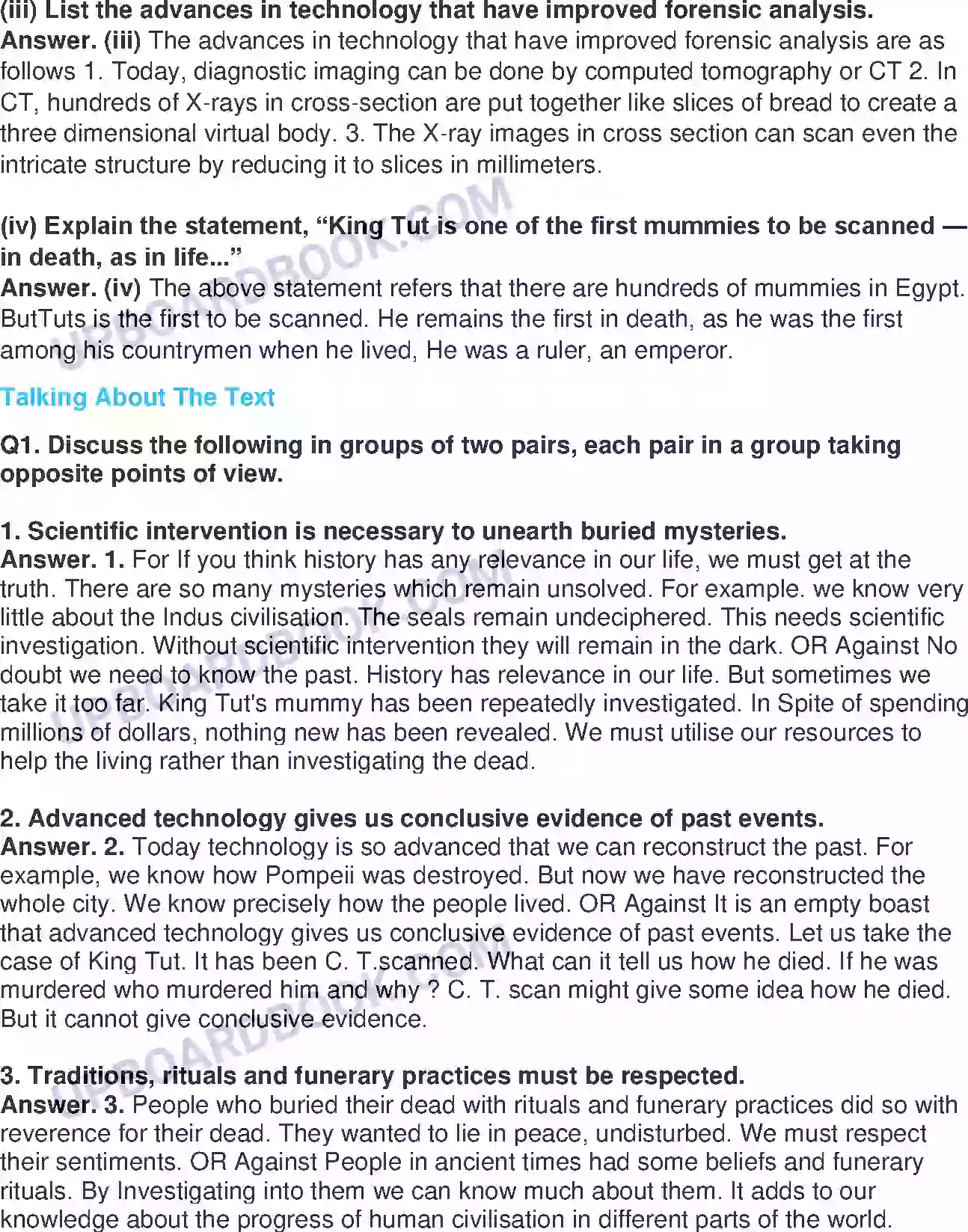
(iii) List the advances in technology that have improved forensic analysis.
Answer: Major technological advances that have revolutionized forensic analysis include:
- Computed Tomography (CT) Scans: They create detailed 3D images by combining hundreds of X-ray cross-sections.
- DNA Analysis: Allows scientists to study genetic material, establish familial relationships, and identify diseases.
- Radiocarbon Dating: Helps accurately determine the age of organic remains.
- Advanced digital imaging and virtual autopsies provide precise data without invasive procedures.
(iv) Explain the statement, “King Tut is one of the first mummies to be scanned — in death, as in life...”
Answer: This statement highlights a unique parallel. In life, Tutankhamun was a pharaoh, first among his people. In death, among the thousands of Egyptian mummies, his was among the very first to be examined using a CT scanner. Thus, he maintained a position of being "first" or pioneering, both in his royal life and in the modern scientific exploration of the past.
Talking About The Text
Discuss the following in groups (taking opposite points of view).
1. Scientific intervention is necessary to unearth buried mysteries.
Argument For: Scientific methods are essential to move beyond myths and uncover factual history. Technologies like CT scans and DNA analysis can solve ancient mysteries (like Tut's death) without damaging artifacts. This knowledge completes our understanding of human civilization and its evolution.
Argument Against: Excessive scientific probing of burial sites can be disrespectful to ancient cultures and their beliefs about the afterlife. Resources spent on investigating the past might be better used to solve present-day problems like poverty and disease. Sometimes, some mysteries should be left undisturbed.
2. Advanced technology gives us conclusive evidence of past events.
Argument For: Advanced technology provides strong, evidence-based conclusions. For example, CT scans showed a leg injury in Tut's mummy, supporting the theory of an accident. Carbon dating can pinpoint the age of objects with great accuracy, giving us a reliable timeline of history.
Argument Against: Technology often provides clues, not final answers. A CT scan can show a broken bone but cannot definitively prove it caused death or whether it was an accident or murder. Technology must be combined with historical context and can sometimes be open to interpretation.
3. Traditions, rituals and funerary practices must be respected.
Argument For: These practices are sacred expressions of a culture's beliefs about life, death, and the beyond. Disturbing graves for study violates the spiritual intent of a peaceful afterlife. We must honor the dignity of the dead and the sentiments of the ancient people.
Argument Against: Studying these rituals is key to understanding the culture itself. By examining burial sites scientifically, we learn about ancient social hierarchies, medical knowledge, art, and daily life. This respectful study preserves their memory more accurately than legend alone.
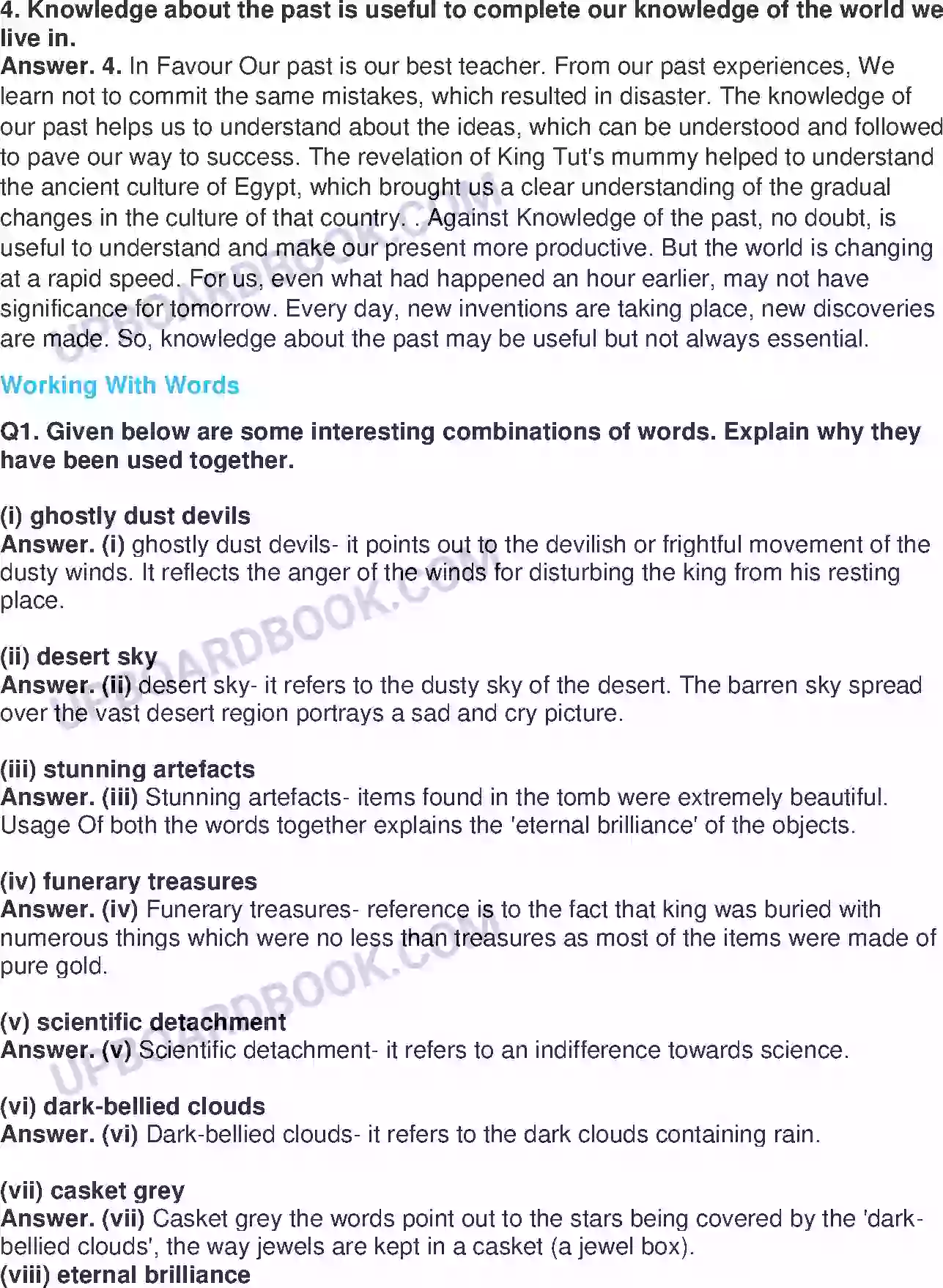
4. Knowledge about the past is useful to complete our knowledge of the world we live in.
Argument For: The past is the foundation of the present. Understanding history helps us avoid past mistakes, appreciate cultural diversity, and understand the origins of current social and political systems. It completes the story of humanity.
Argument Against: While interesting, not all past knowledge is essential for modern life. The world is changing rapidly, and focusing too much on the past can distract from solving urgent contemporary challenges like climate change or technological ethics. We should focus more on building the future.
Working With Words
Q1. Explain the interesting combinations of words.
(i) ghostly dust devils - Describes the eerie, swirling columns of dust in the desert, creating a haunting and unsettling atmosphere.
(ii) desert sky - Refers to the vast, empty, and often dusty sky that stretches over the desert landscape.
(iii) stunning artefacts - Highlights the breathtaking beauty and exquisite craftsmanship of the objects found in Tut's tomb.
(iv) funerary treasures - Refers to the valuable objects (treasures) that were specifically buried with the dead for use in the afterlife.
(v) scientific detachment - Describes the objective, emotionless, and purely factual approach required in scientific investigation.
(vi) dark-bellied clouds - A vivid image of rain clouds that are full and dark underneath, promising a storm.
(vii) casket grey - Suggests a dull, metallic grey colour, like the colour of a metal jewel box (casket), used to describe the sky covered with dark clouds.
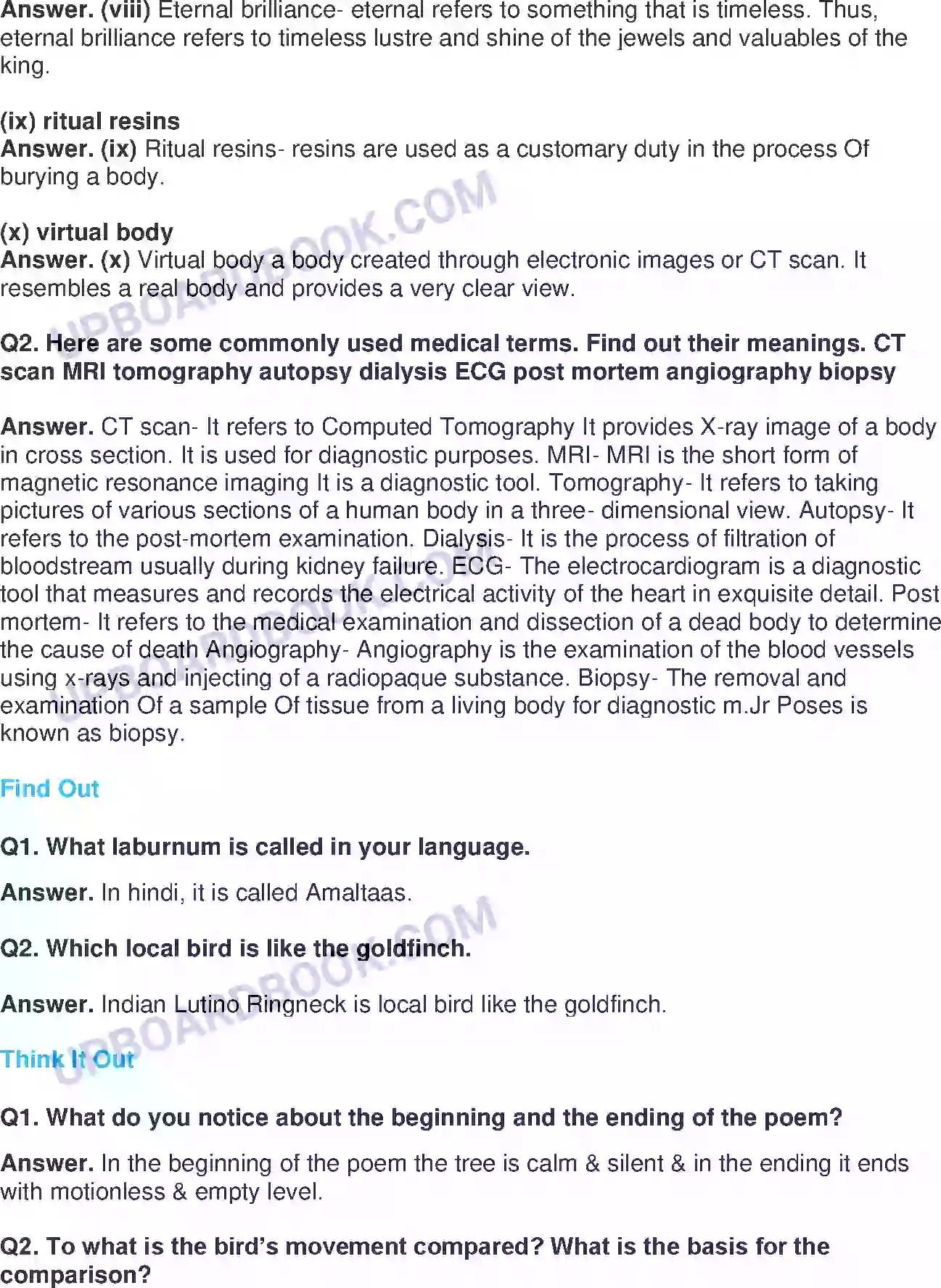
(viii) eternal brilliance - Emphasizes the timeless, undiminished shine and beauty of the gold and jewels, even after 3000 years.
(ix) ritual resins - The sticky substances used as part of the traditional (ritual) mummification process to preserve the body.
(x) virtual body - A detailed three-dimensional computer model of a body created from CT scan data, which can be studied without touching the actual mummy.
Q2. Meanings of medical terms.
- CT scan: Computed Tomography; uses X-rays to create detailed cross-sectional images of the body.
- MRI: Magnetic Resonance Imaging; uses magnetic fields and radio waves to create detailed images of organs and tissues.
- Tomography: Imaging by sections or slicing, using any kind of penetrating wave.
- Autopsy: A surgical procedure performed after death to examine the body and determine the cause of death (also called post-mortem).
- Dialysis: A treatment that filters and purifies the blood using a machine, often for kidney failure.
- ECG: Electrocardiogram; records the electrical activity of the heart.
- Post mortem: Another term for autopsy; examination after death.
- Angiography: Imaging technique to visualize the inside of blood vessels.
- Biopsy: Removal of a small sample of tissue for examination to diagnose disease.
These UP Board Solutions are designed to help you understand the chapter thoroughly. Always try to formulate answers in your own words.
Get UP Board class 11 English 3. Discovering Tut The Saga Continues Solution in Hindi Medium
UP Board class 11 English 3. Discovering Tut The Saga Continues Solution is available at our platform https://upboardbook.com in hindi medium for free of cost. Content provided on our website is free of cost and in PDF format which is easily available for download. Getting the UP Board Solutions for class 11 will help student to achieve good learning experience so that they can study effectively. UP board holds examination of more than 3 million students every year and majority of the question of exams are from their UP Board Solutions. That’s why it is important to study using the textSolution issued by UP Board.
Importance of UP Board class 11 English 3. Discovering Tut The Saga Continues Text Solutions
It is essential to know the importance of UP Board class 11 English 3. Discovering Tut The Saga Continues textSolution issued by UP Board because students completely rely on these Solutions for their study and syllabus offered by UP Board is so balanced that each student should be aware about the importance of it. Below is the list of Importance of UP Board class 11 English 3. Discovering Tut The Saga Continues :
- These TextSolutions are very clear and accurate which helps student to understand concept with ease.
- It is also to mention that these text Solutions are prepared by the content experts of subject, thus these Solutions helps student in clearing their doubts and understand the core concept easily.
- It is considered to be the best study material for competitive exam preparation.
Features of UP Board class 11 textSolutions
There are various features of UP Board class 11 TextSolutions, some of them are mentioned below so that you student can understand the value and usability of the contend and understand why Uttarpradesh board has prescribed these Solutions.
- Best feature of these textSolutions is free availability of content in PDF format
- Second feature that content generated and written is clear and easy to read.
- There are various illustration and images are shown in the Solution so that student can easily understand the concept and should be more appealing to the student.
- Each chapter is explained thoroughly
