 UPBoardBook
UP Board class 11 English (23. Patterns Of Creativity - (Essays)) solution PDF
UP Board class 11 English 23. Patterns Of Creativity - (Essays) is a Hindi Medium Solution which is prescribed by Uttar Pradesh Board for their students. These Solutions is completely prepared considering the latest syllabus and it covers every single topis, so that every student get organised and conceptual learning of the concepts. class 11 Students of UP Board who have selected hindi medium as their study medium they can use these Hindi medium textSolutions to prepare themselves for exam and learn the concept with ease.
UP Board class 11 English 23. Patterns Of Creativity - (Essays) Hindi Medium Solutions - PDF
Click Here to
UP Board Solutions for Class 11 English
Woven Words Essay - Chapter 3: Patterns of Creativity
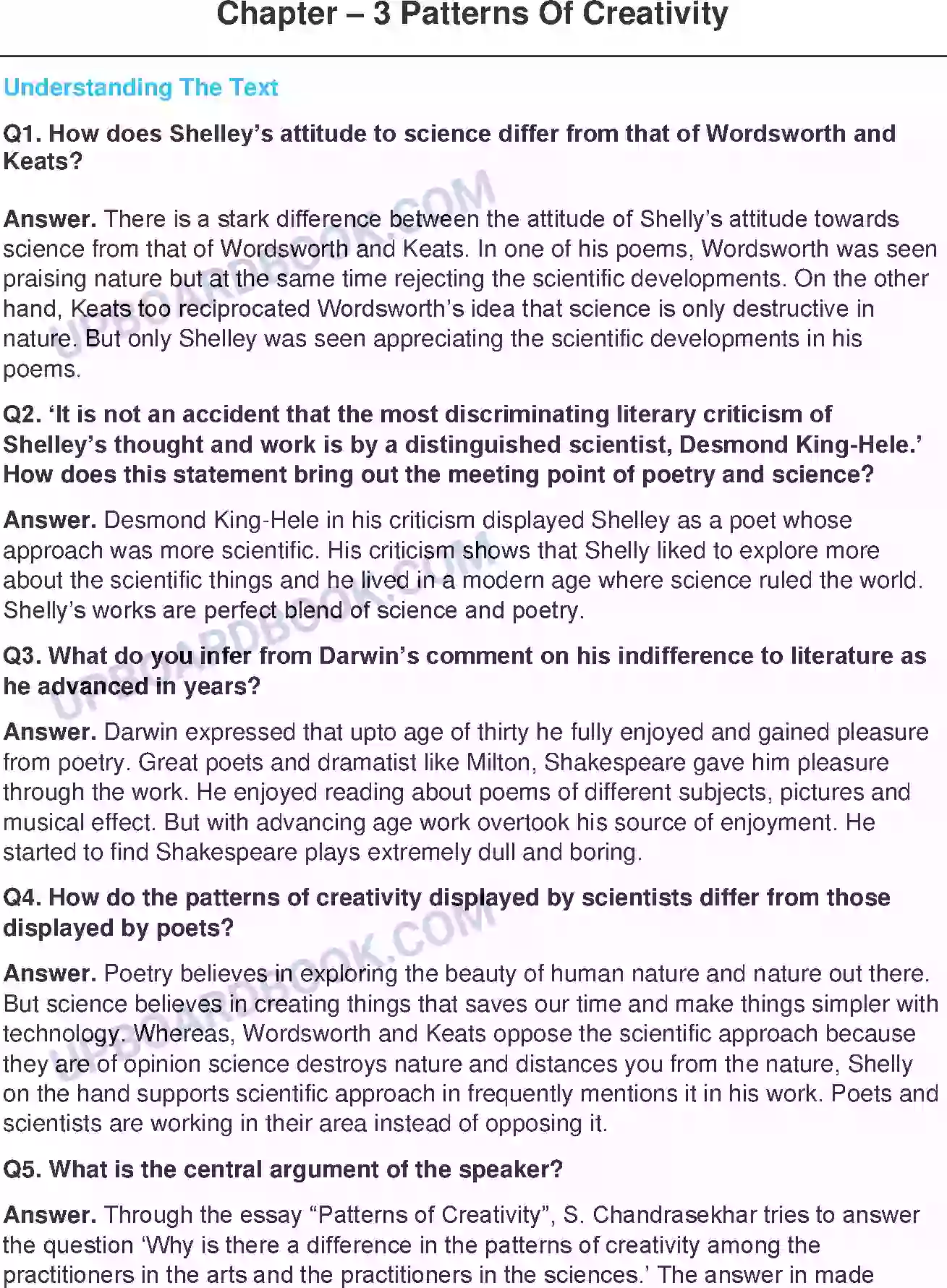
Q1. How does Shelley’s attitude to science differ from that of Wordsworth and Keats?
Answer: There is a clear difference in how these poets viewed science. Wordsworth and Keats often saw science as a force that distanced humanity from nature and was potentially destructive to its beauty. Shelley, however, had a more modern and welcoming attitude. He appreciated scientific progress and often incorporated scientific ideas and imagery into his poetry, seeing it as a way to understand the universe.
Q2. ‘It is not an accident that the most discriminating literary criticism of Shelley’s thought and work is by a distinguished scientist, Desmond King-Hele.’ How does this statement bring out the meeting point of poetry and science?
Answer: This statement highlights that Shelley's poetry had a scientific spirit of exploration within it. A scientist like King-Hele could recognize and appreciate this quality because Shelley's work wasn't just emotional; it was also analytical and curious about the natural world. This shows that at their best, both poetry and science seek to explore and explain reality, just through different methods.
Q3. What do you infer from Darwin’s comment on his indifference to literature as he advanced in years?
Answer: Charles Darwin's comment reveals how intense specialization can affect one's tastes. In his youth, he found great pleasure in poetry, music, and art. However, as he grew older and became completely absorbed in his scientific work, his mind lost the ability to relax and enjoy the arts. He even found Shakespeare "intolerably dull." This suggests that the rigorous, focused pattern of scientific thinking can sometimes crowd out the sensibility needed to appreciate artistic beauty.
Q4. How do the patterns of creativity displayed by scientists differ from those displayed by poets?
Answer: While both require immense creativity, their patterns differ:
Poets: Often draw inspiration from emotions, personal experience, and the beauty of nature and human life. Their creativity seeks to express, evoke feelings, and capture timeless moments.
Scientists: Their creativity is directed towards solving problems, discovering laws, and inventing technologies. It is a structured creativity that builds upon existing knowledge to create something new that is logical and verifiable.
Q5. What is the central argument of the speaker?
Answer: The central argument of S. Chandrasekhar in this essay is to explore why creative people in the arts and sciences often have such different approaches and attitudes towards each other's fields. He uses the contrasting views of poets (like Wordsworth, Keats, and Shelley) on science, and scientists (like Darwin) on poetry, to show this divide. He concludes by posing a profound question from Shelley's "A Defence of Poetry": why hasn't a scientist of equal genius written a similar "A Defence of Science"?
--- Appreciation ---
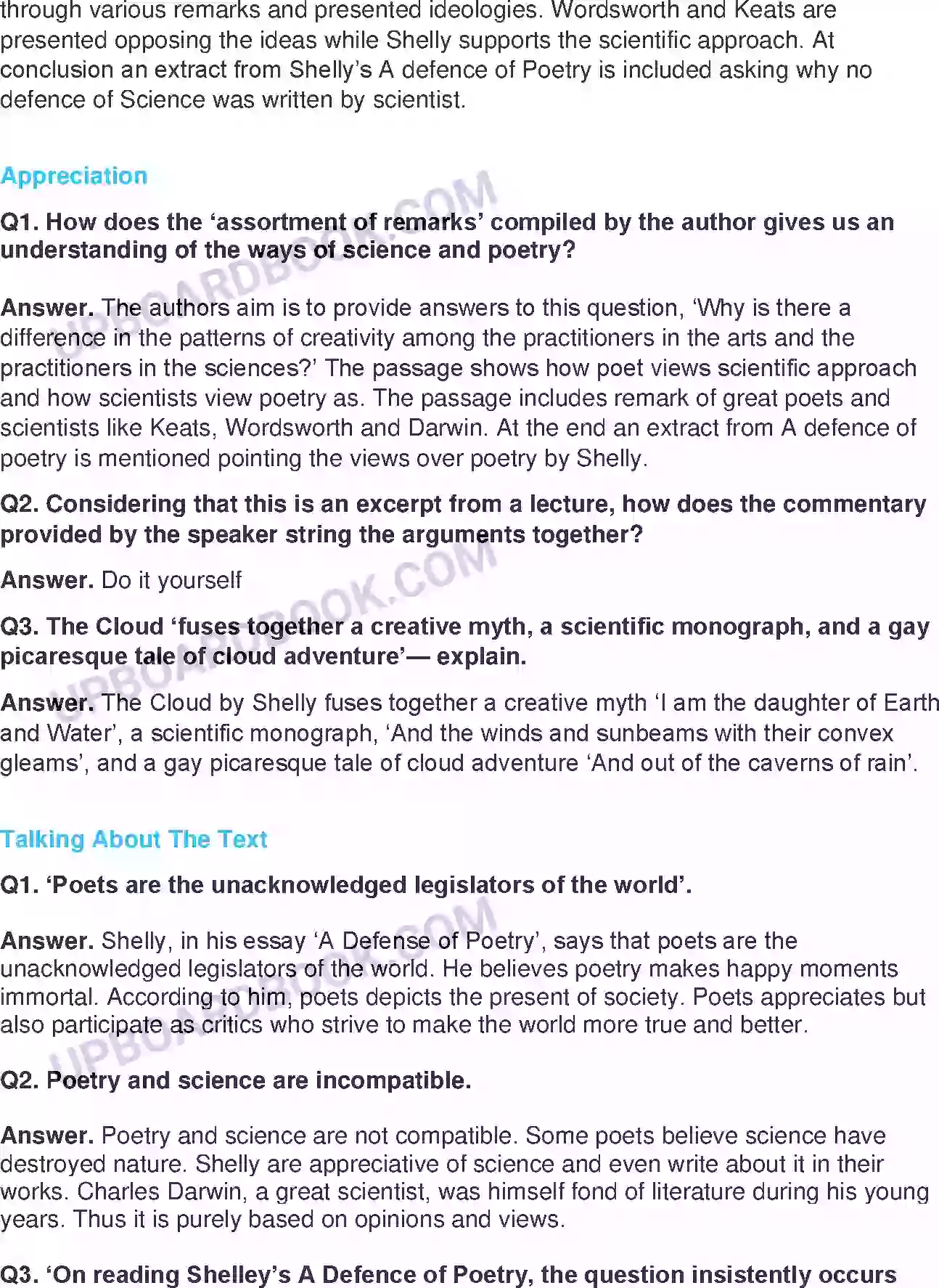
Q1. How does the ‘assortment of remarks’ compiled by the author give us an understanding of the ways of science and poetry?
Answer: The collection of quotes from famous poets and scientists acts like a dialogue between two different worlds. By presenting Wordsworth and Keats criticizing science, Shelley praising it, and Darwin lamenting his lost love for poetry, the author lets us see the inherent biases and patterns of thought in each discipline. This method helps us understand that the "way" of a poet (subjective, emotional) is naturally different from the "way" of a scientist (objective, analytical).
Q2. Considering that this is an excerpt from a lecture, how does the commentary provided by the speaker string the arguments together?
Answer: (This question is for self-reflection. Consider how the author connects one quote to the next, provides background, and poses questions to guide the listener from one idea to the next, building his central argument step-by-step.)
Q3. The Cloud ‘fuses together a creative myth, a scientific monograph, and a gay picaresque tale of cloud adventure’— explain.
Answer: Shelley's poem "The Cloud" is a unique blend:
Creative Myth: The cloud speaks as a mythical, immortal being ("I am the daughter of Earth and Water").
Scientific Monograph: It accurately describes the scientific processes of the water cycle - evaporation, condensation, precipitation ("I bring fresh showers for the thirsting flowers").
Picaresque Tale: The poem is a light-hearted, adventurous story of the cloud's journey across the sky, interacting with sun, moon, and stars.
--- Talking About The Text ---
Q1. ‘Poets are the unacknowledged legislators of the world’.
Answer: Shelley's famous line means that poets, through their work, shape the moral, social, and imaginative laws by which society lives. They don't pass official laws, but they influence culture, inspire change, challenge injustices, and define the ideals we strive for. They legislate the world of human spirit and conscience.
Q2. Poetry and science are incompatible.
Answer: This is a matter of perspective. While their methods differ—one intuitive, the other analytical—they are not fundamentally incompatible. Both aim to uncover truth and understand our existence. Figures like Shelley and Leonardo da Vinci, who combined artistic and scientific genius, prove that the two can enrich each other. The perceived conflict often arises from a narrow view of either field.
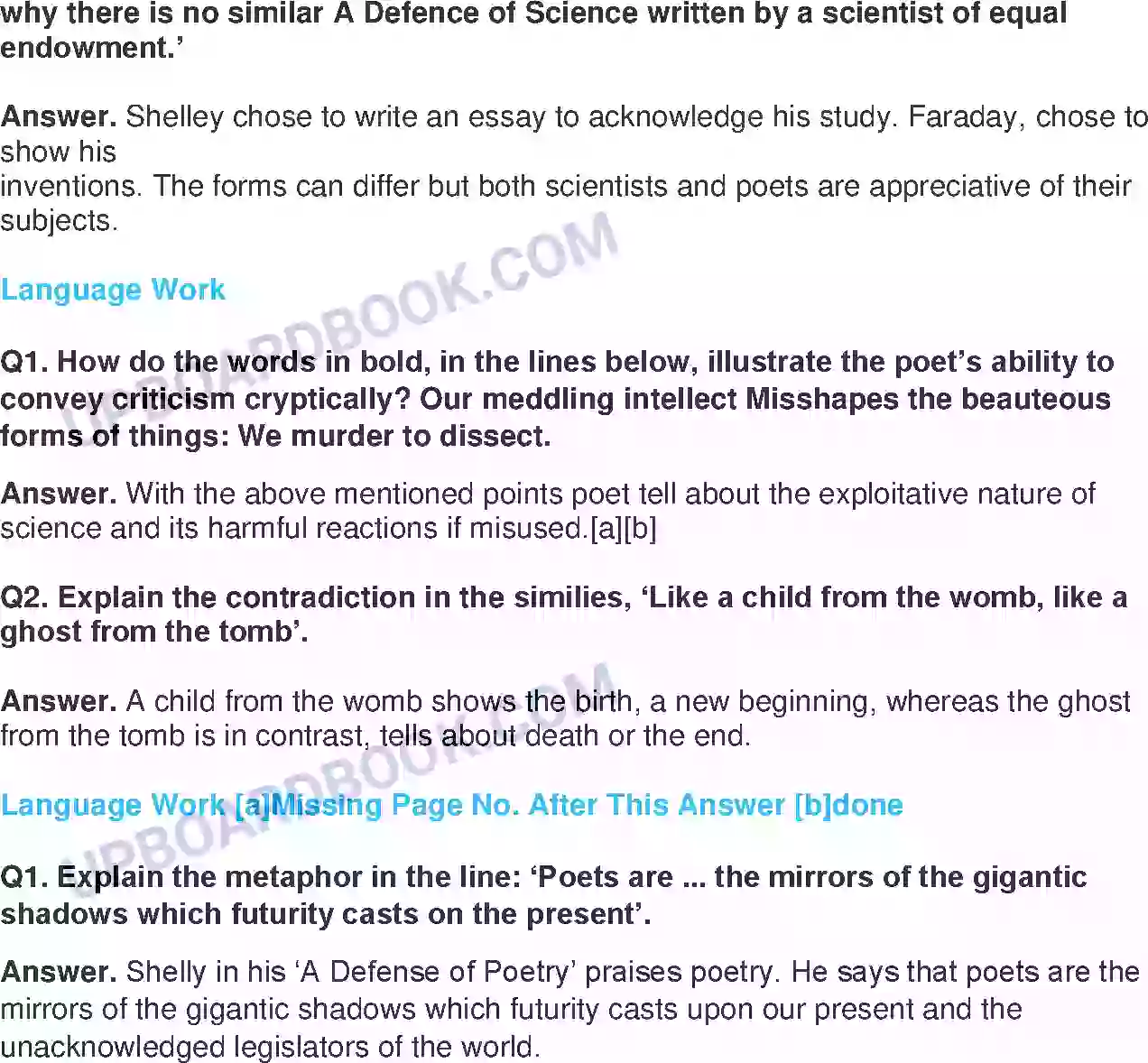
Q3. ‘On reading Shelley’s A Defence of Poetry, the question insistently occurs why there is no similar A Defence of Science written by a scientist of equal endowment.’
Answer: This concluding question is the essay's key insight. It suggests that scientists, like Faraday, often "defend" science through their inventions and discoveries rather than through philosophical essays. Their creativity is demonstrated in action and tangible results. Poets, whose work is the expression itself, feel the need to defend their art in words. It highlights a fundamental difference in how the two disciplines manifest their value to the world.
--- Language Work ---
Q1. How do the words in bold illustrate the poet’s ability to convey criticism cryptically?
"Our meddling intellect Misshapes the beauteous forms of things: We murder to dissect."
Answer: The powerful verbs "misshapes" and "murder" cryptically convey a strong criticism of purely analytical science. "Misshapes" suggests that intellectual analysis distorts the true, holistic beauty of nature. "Murder to dissect" is even sharper—it implies that the scientific act of breaking something down to understand it destroys its living essence. The poet packs a deep philosophical critique into just a few vivid words.
Q2. Explain the contradiction in the similes, ‘Like a child from the womb, like a ghost from the tomb’.
Answer: This is a juxtaposition of opposites to describe the cloud's cyclic rebirth. "A child from the womb" symbolizes birth, life, and a joyful beginning. "A ghost from the tomb" symbolizes death, the end, and something eerie. By using both, Shelley captures the cloud's perpetual cycle of dying (evaporating/dispersing) and being reborn (condensing) in a dramatic and memorable way.
Q3. Explain the metaphor: ‘Poets are ... the mirrors of the gigantic shadows which futurity casts on the present’.
Answer: In this metaphor, poets are described as "mirrors." The "gigantic shadows" are the vast, looming ideas, possibilities, and consequences of the future. Poets have the unique ability to catch and reflect these shadows—the hints of what is to come—onto the present. They don't just write about the current moment; they interpret the present in light of the future, offering prophecy, warning, and vision.
Get UP Board class 11 English 23. Patterns Of Creativity - (Essays) Solution in Hindi Medium
UP Board class 11 English 23. Patterns Of Creativity - (Essays) Solution is available at our platform https://upboardbook.com in hindi medium for free of cost. Content provided on our website is free of cost and in PDF format which is easily available for download. Getting the UP Board Solutions for class 11 will help student to achieve good learning experience so that they can study effectively. UP board holds examination of more than 3 million students every year and majority of the question of exams are from their UP Board Solutions. That’s why it is important to study using the textSolution issued by UP Board.
Importance of UP Board class 11 English 23. Patterns Of Creativity - (Essays) Text Solutions
It is essential to know the importance of UP Board class 11 English 23. Patterns Of Creativity - (Essays) textSolution issued by UP Board because students completely rely on these Solutions for their study and syllabus offered by UP Board is so balanced that each student should be aware about the importance of it. Below is the list of Importance of UP Board class 11 English 23. Patterns Of Creativity - (Essays) :
- These TextSolutions are very clear and accurate which helps student to understand concept with ease.
- It is also to mention that these text Solutions are prepared by the content experts of subject, thus these Solutions helps student in clearing their doubts and understand the core concept easily.
- It is considered to be the best study material for competitive exam preparation.
Features of UP Board class 11 textSolutions
There are various features of UP Board class 11 TextSolutions, some of them are mentioned below so that you student can understand the value and usability of the contend and understand why Uttarpradesh board has prescribed these Solutions.
- Best feature of these textSolutions is free availability of content in PDF format
- Second feature that content generated and written is clear and easy to read.
- There are various illustration and images are shown in the Solution so that student can easily understand the concept and should be more appealing to the student.
- Each chapter is explained thoroughly
